Cell Division and Cell Cycle: Meiosis - kapak
Bilim#cell division#meiosis#sexual reproduction#gametes

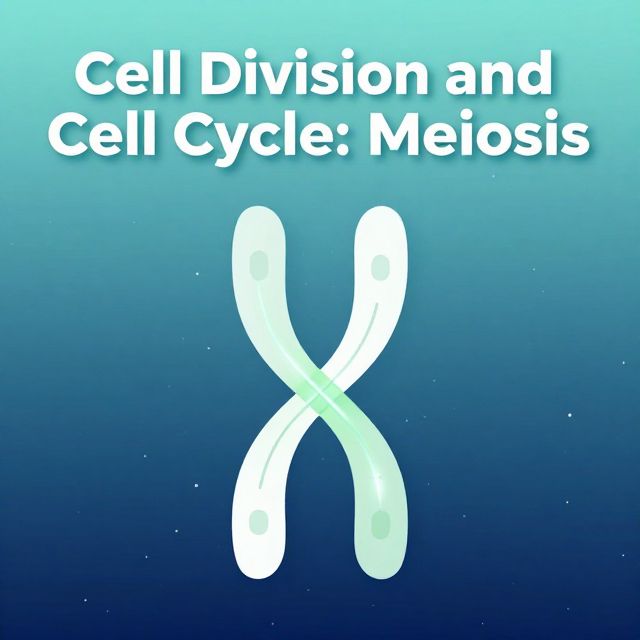
Cell Division and Cell Cycle: Meiosis

An academic summary of cell division, focusing on sexual reproduction, the necessity of meiosis, its stages, and unique features like synapsis, homologous recombination, and reduction division.

sevv_s0March 28, 2026 ~23 dk toplam
01

Sesli Özet

6 dakika

Konuyu otobüste, koşarken, yolda dinleyerek öğren.

Sesli Özet

Cell Division and Cell Cycle: Meiosis

0:006:20
02

Flash Kartlar

25 kart

Karta tıklayarak çevir. ← → ile gez, ⎵ ile çevir.

1 / 25
Tüm kartları metin olarak gör
  1. 1. What are the primary purposes of cell division in living organisms?

    Cell division is essential for several biological processes. It enables growth and development of an organism from a single cell, facilitates the repair and regeneration of tissues, and is fundamental for reproduction, especially in the formation of specialized reproductive cells.

  2. 2. What are gametes and how do they differ from somatic cells in terms of genetic material?

    Gametes are specialized reproductive cells (like sperm and oocytes) that contain half the genetic material of somatic cells. Somatic cells are diploid, meaning they have two sets of chromosomes, while gametes are haploid, possessing only a single set of chromosomes.

  3. 3. What is the crucial role of meiosis in the context of sexual reproduction?

    Meiosis is the specialized cell division process that produces haploid gametes from diploid germ-line cells. Its crucial role is to reduce the chromosome number by half, ensuring that when two gametes fuse during fertilization, the resulting offspring maintains a consistent and correct chromosome number across generations.

  4. 4. Define "haploid" and "diploid" in relation to chromosome sets.

    A haploid cell contains a single set of chromosomes (n), typically found in gametes. A diploid cell contains two sets of chromosomes (2n), one set inherited from each parent, characteristic of somatic cells in most sexually reproducing organisms.

  5. 5. How does sexual reproduction contribute to the formation of a new organism?

    Sexual reproduction involves the fusion of two haploid gametes (one from each parent) during a process called fertilization (syngamy). This fusion forms a single diploid cell called a zygote, which then undergoes repeated mitotic divisions to develop into a multicellular adult organism.

  6. 6. What is "heterogamy" in the context of gametes?

    Heterogamy refers to the condition where gametes from opposite sexes are morphologically distinct. For example, in animals, sperm and oocytes have different sizes and structures, and in plants, microspores and macrospores also show distinct forms.

  7. 7. Why is meiosis referred to as a "reduction division"?

    Meiosis is called a reduction division because it reduces the number of chromosomes in the daughter cells by half compared to the parent cell. This is critical for sexual reproduction, as it ensures that the fusion of two gametes during fertilization restores the diploid chromosome number without doubling it each generation.

  8. 8. What is the relationship between meiosis and fertilization in the cycle of sexual reproduction?

    Meiosis and fertilization are two interdependent processes that collectively define the cycle of sexual reproduction. Meiosis produces haploid gametes, and fertilization is the fusion of these haploid gametes to form a diploid zygote, thus maintaining the species' characteristic chromosome number across generations.

  9. 9. How does meiosis differ from mitosis in its overall purpose?

    While both are forms of cell division, mitosis produces two genetically identical diploid daughter cells for growth and repair. Meiosis, however, produces four genetically diverse haploid daughter cells (gametes) for sexual reproduction, reducing the chromosome number and introducing genetic variation.

  10. 10. What cell cycle phases must a cell complete before entering meiosis?

    Before a cell enters meiosis, it must successfully complete the G1, S, and G2 phases of the cell cycle. This ensures that the cell has grown sufficiently, and most importantly, that its DNA has been accurately replicated during the S phase, so each chromosome consists of two sister chromatids.

  11. 11. Name the two successive nuclear divisions that characterize meiosis.

    Meiosis proceeds through two successive nuclear divisions: Meiosis I and Meiosis II. Each of these major divisions is further subdivided into prophase, metaphase, anaphase, and telophase, similar to mitosis, but with distinct events.

  12. 12. Why is Prophase I considered an extended and critically important stage in meiosis?

    Prophase I is crucial because it is during this extended stage that homologous chromosomes condense, precisely pair up (synapsis), and undergo homologous recombination (crossing over). These events are vital for genetic diversity and the accurate segregation of chromosomes later in meiosis.

  13. 13. List the five sub-periods of Prophase I.

    The five sub-periods of Prophase I are leptotene, zygotene, pachytene, diplotene, and diakinesis. Each sub-stage involves specific chromosomal behaviors, such as condensation, pairing, crossing over, and separation of homologous chromosomes.

  14. 14. Describe the first unique feature of meiosis: Synapsis.

    Synapsis is the precise pairing and alignment of homologous chromosomes along their entire length, occurring early during Prophase I. This forms intricate complexes and is absolutely crucial for the subsequent genetic exchange between non-sister chromatids.

  15. 15. Explain the second unique feature of meiosis: Homologous Recombination (Crossing Over).

    Homologous recombination, or crossing over, is the exchange of genetic material between non-sister chromatids of homologous chromosomes while they are physically joined during synapsis. This process generates new combinations of alleles on chromosomes, significantly increasing genetic diversity in offspring.

  16. 16. What is a chiasma and what does its presence indicate?

    A chiasma (plural: chiasmata) is an X-shaped structure that can often be observed under a light microscope. It represents the physical manifestation of a crossover event, providing visual evidence that genetic material has been exchanged between homologous chromosomes.

  17. 17. What is the third unique feature of meiosis that distinguishes it from mitosis?

    The third unique feature is reduction division, specifically the fact that chromosomes do not undergo replication between Meiosis I and Meiosis II. This ensures that at the conclusion of meiosis, each resulting cell contains only half the original complement of chromosomes, leading to haploid gametes.

  18. 18. How do homologous chromosomes align at the metaphase plate during Metaphase I?

    During Metaphase I, homologous pairs of sister chromatids align side-by-side along the metaphase plate. A crucial aspect is that one pair of sister chromatids is linked to one spindle pole, while its homologous pair is linked to the opposite pole, and their arrangement is random.

  19. 19. What significant event occurs during Anaphase I of meiosis?

    During Anaphase I, homologous chromosomes separate and move to opposite poles of the cell. Importantly, the sister chromatids within each chromosome remain attached at their centromeres, meaning each pole receives a haploid set of chromosomes, each still composed of two chromatids.

  20. 20. What is the ploidy and chromatid state of cells at the end of Meiosis I?

    At the end of Meiosis I, the cells are considered haploid in terms of chromosome number (n), because homologous chromosomes have separated. However, each chromosome still consists of two recombinant sister chromatids, so the DNA content is effectively still 2C (where C is the DNA content of a haploid cell with one chromatid).

  21. 21. How does Meiosis II compare to mitosis?

    Meiosis II proceeds in a manner analogous to mitosis. It involves the separation of sister chromatids, similar to how sister chromatids separate in mitosis. However, the cells entering Meiosis II are haploid, unlike the diploid cells entering mitosis.

  22. 22. Describe the alignment of chromosomes during Metaphase II.

    During Metaphase II, individual chromosomes, each still composed of two sister chromatids, align at the metaphase plate. This alignment is similar to Metaphase in mitosis, but it occurs in two haploid cells rather than one diploid cell.

  23. 23. What is the key event that occurs during Anaphase II?

    In Anaphase II, the sister chromatids finally separate from each other and move to opposite poles of the cell. This separation effectively halves the DNA content per chromosome, leading to individual chromatids now being considered full chromosomes.

  24. 24. What is the final outcome of meiosis in terms of cell number, ploidy, and chromatid state?

    The final outcome of meiosis is the production of four haploid (n) daughter cells. Each of these cells contains one chromatid per chromosome, and they are genetically distinct from each other and from the parent cell, ready to function as gametes.

  25. 25. How does the random arrangement of homologous pairs at Metaphase I contribute to genetic variation?

    The random arrangement of homologous pairs at the metaphase plate during Metaphase I means that the maternal and paternal chromosomes can orient independently. This independent assortment leads to many different combinations of chromosomes in the resulting gametes, significantly increasing genetic diversity in offspring.

03

Bilgini Test Et

15 soru

Çoktan seçmeli sorularla öğrendiklerini ölç. Cevap + açıklama.

Soru 1 / 15Skor: 0

What is the primary purpose of meiosis in sexually reproducing organisms?

04

Detaylı Özet

7 dk okuma

Tüm konuyu derinlemesine, başlık başlık.

📚 Cell Division and Cell Cycle - II: Meiosis

Source Information: This study material has been compiled from a lecture's audio transcript and accompanying PDF/PowerPoint slides provided by Prof. Dr. Elif Aylin Özüdoğru, Spring 2026, İstanbul.


💡 Introduction to Meiosis and Sexual Reproduction

All living organisms undergo cell division for fundamental processes such as growth, development, tissue regeneration, and reproduction. Sexual reproduction, a prevalent method among eukaryotic organisms, relies on a specialized form of cell division called meiosis. Meiosis is crucial for producing gametes (sex cells) with half the genetic material of somatic cells, thereby ensuring the maintenance of a consistent chromosome number across generations and contributing significantly to genetic diversity.

🧬 Sexual Reproduction and Chromosome Number Maintenance

Sexual reproduction involves the fusion of specialized reproductive cells called gametes.

  • Diploid Cells (2n) 📚: Somatic cells in adult individuals contain two sets of chromosomes, one from each parent. (Greek: diploos, "double" + eidos, "form").
  • Haploid Cells (n) 📚: Gametes contain only one set of chromosomes. (Greek: haploos, "single" + ploion, "vessel").

Parents produce haploid gametes, which then fuse during fertilization (syngamy) to form a diploid zygote. This single diploid cell undergoes repeated mitotic divisions to develop into a complete adult organism.

Historically, it was understood that without a mechanism to reduce the chromosome number during gamete formation, each successive fertilization would double the chromosome count, leading to an unsustainable increase (e.g., 2n → 4n → 8n → 16n). Meiosis serves as this essential reduction division, producing cells with half the normal chromosome number. This ensures that the chromosome number remains constant from one generation to the next. Meiosis and fertilization together constitute the cycle of sexual reproduction.

Types of Gametes 🚻

  • Isogamous organisms: Produce gametes that are morphologically similar.
  • Heterogamous organisms: Produce gametes that are morphologically different.
    • Sperm cells: Typically small and mobile.
    • Oocytes (ova): Usually large, nonmobile, and store significant amounts of nutrients.
    • Microspores (Pollen): In plants.
    • Macrospores (Ovules): In plants.

Germ-line Cells vs. Somatic Cells ✅

  • Somatic cells: Diploid cells that undergo mitosis to form genetically identical diploid daughter cells.
  • Germ-line cells: Diploid cells set aside early in development that will eventually undergo meiosis to produce haploid gametes.

🔬 The Process of Meiosis

Meiosis is the specialized cell division that produces haploid gametes from diploid cells during gametogenesis. While it shares some similarities with mitosis (e.g., similar stages, organization strategies), meiosis has a more complex task: it must separate both sister chromatids and homologous chromosomes.

Meiosis begins after a cell has completed the G1, S, and G2 phases of the cell cycle, ensuring DNA replication has occurred. It involves two successive nuclear divisions:

  1. Meiosis I (Reductional Division)
  2. Meiosis II (Equational Division)

Each division is subdivided into Prophase, Metaphase, Anaphase, and Telophase.

🌟 Unique Features of Meiosis

Meiosis is distinguished from mitosis by three critical features:

  1. Synapsis 🤝

    • Occurs early in Prophase I.
    • Following chromosome replication, homologous chromosomes precisely pair along their entire length.
    • This process forms intricate complexes, crucial for subsequent genetic exchange.
  2. Homologous Recombination (Crossing Over) 🧬

    • The second unique feature, occurring during synapsis in Prophase I.
    • Genetic exchange happens between non-sister chromatids of homologous chromosomes while they are physically joined.
    • These crossover events lead to the formation of new, "remixed" chromosomes with unique combinations of alleles, significantly increasing genetic diversity.
    • In humans, an average of two or three crossover events occur per chromosome pair.
    • Evidence of crossing over can be observed under a light microscope as an X-shaped structure called a chiasma (plural: chiasmata), indicating where two chromatids (one from each homologue) have exchanged parts.
  3. Reduction Division 📉

    • A key distinction: chromosomes do not replicate between Meiosis I and Meiosis II.
    • This ensures that at the end of meiosis, each resulting cell contains only half the original complement of chromosomes.

📊 Detailed Stages of Meiosis I (Reductional Division)

Meiosis I is the first division, where homologous chromosomes separate, reducing the chromosome number by half.

Prophase I: The Longest and Most Complex Stage ⏳

Prophase I is further subdivided into five periods, characterized by distinct chromosome behaviors:

  • 1️⃣ Leptotene: Chromosomes begin to condense and become visible.
  • 2️⃣ Zygotene: Homologous chromosomes begin to pair up (synapsis) along their length, forming a synaptonemal complex. This precise pairing is essential for crossing over.
  • 3️⃣ Pachytene: Synapsis is complete. The paired homologous chromosomes are now called bivalents (or tetrads, as they consist of four chromatids). Crossing over (homologous recombination) occurs during this stage. Visually, a bivalent appears as a recognition process involving a total of 4 chromatids.
  • 4️⃣ Diplotene: Homologous chromosomes begin to separate, but remain attached at the points where crossing over occurred (chiasmata). These chiasmata are visible as X-shaped structures, representing the physical exchange of chromosome pieces.
  • 5️⃣ Diakinesis: Chromosomes re-condense further, the nuclear envelope breaks down, and the meiotic spindle begins to form. The bivalents are now ready for metaphase.

Metaphase I: Alignment of Homologous Pairs ↔️

  • Visual Description: Bivalents (homologous pairs of sister chromatids) align along the metaphase plate. Each homologous pair is oriented such that one chromosome faces one pole and its homologue faces the opposite pole.
  • Key Point: The arrangement of these homologous pairs at the metaphase plate is random with respect to their parental origin. This independent assortment further contributes to genetic variation. A pair of sister chromatids is linked to one pole, and the homologous pair is linked to the opposite pole.

Anaphase I: Separation of Homologous Chromosomes ➡️⬅️

  • Visual Description: Homologous chromosomes separate and move to opposite poles of the cell.
  • Key Point: Crucially, the sister chromatids within each chromosome remain attached at their centromeres. This means that each pole receives a haploid set of chromosomes, but each chromosome still consists of two sister chromatids.

Telophase I & Cytokinesis: Two Haploid Cells ✌️

  • The chromosomes arrive at the poles, and the nuclear envelope may reform.
  • Cytokinesis usually follows, dividing the cytoplasm to form two daughter cells.
  • Result: Each daughter cell is now haploid (n) in terms of chromosome number, but each chromosome still consists of two recombinant sister chromatids. The genetic content is still 2n in terms of DNA amount, but the chromosome number has been reduced.

📊 Detailed Stages of Meiosis II (Equational Division)

Meiosis II is similar to mitosis and separates the sister chromatids. It begins after Telophase I, without an intervening S phase (no DNA replication).

Prophase II: Preparation for Second Division 🔄

  • Chromosomes (each still composed of two chromatids) condense again, and the nuclear envelope breaks down (if it reformed in Telophase I).
  • The spindle apparatus forms.

Metaphase II: Alignment of Sister Chromatids ↕️

  • Visual Description: Individual chromosomes, each composed of two sister chromatids, align along the metaphase plate.
  • Key Point: The kinetochores of sister chromatids attach to microtubules from opposite poles.

Anaphase II: Separation of Sister Chromatids 🏃‍♀️🏃‍♂️

  • Visual Description: Sister chromatids finally separate and move to opposite poles of the cell, now considered individual chromosomes.
  • Key Point: The centromere divides, allowing the sister chromatids to move apart.

Telophase II & Cytokinesis: Four Haploid Gametes ✨

  • Visual Description: Chromosomes arrive at the poles, nuclear envelopes reform around the sets of chromosomes, and the chromosomes decondense.
  • Cytokinesis divides the cytoplasm.
  • Result: Four genetically distinct haploid (n) daughter cells are produced. Each cell contains one chromatid per chromosome, ready to function as a gamete.

🧬 Separation of Alleles During Meiosis

Meiosis ensures the segregation of alleles, which are different forms of a gene located at a specific gene locus on a chromosome.

  • Genotype: Describes the combination of alleles an individual possesses (e.g., Homozygous dominant (AA), Heterozygous (Bb), Homozygous recessive (cc)).

Example 1: Segregation of a Single Gene (Yy - Yellow Seeds) 🟡

Consider a heterozygous plant (Yy) for seed color (Y = yellow, y = green).

  1. Prophase I: Homologous chromosomes (one carrying Y, the other y) pair up.
  2. Metaphase I: The homologous pair aligns at the metaphase plate.
  3. Anaphase I: Homologous chromosomes separate. One secondary meiocyte receives the chromosome with allele Y, the other receives the chromosome with allele y. Each chromosome still has two sister chromatids.
  4. Meiosis II: Sister chromatids separate.
  5. Result: Four haploid gametes are produced: two carrying the Y allele and two carrying the y allele. This demonstrates Mendel's Law of Segregation, where alleles for a gene separate during gamete formation.

Example 2: Independent Assortment of Two Genes (YyRr) 🟢🟠

Consider a heterozygous diploid cell (YyRr) for two different genes (e.g., Y/y for seed color, R/r for seed shape).

  • Visual Description: During Metaphase I, the homologous pairs for the Y/y gene and the R/r gene align independently at the metaphase plate. There are two equally probable orientations:
    • Orientation 1: Y and R chromosomes go to one pole, y and r chromosomes go to the other.
    • Orientation 2: Y and r chromosomes go to one pole, y and R chromosomes go to the other.
  • Result: After Meiosis I and II, this independent assortment leads to four types of gametes in roughly equal proportions: YR, Yr, yR, and yr. This illustrates Mendel's Law of Independent Assortment, where alleles for different genes assort independently of one another during gamete formation.

Meiosis is a fundamental biological process vital for sexual reproduction, ensuring both the stability of chromosome number across generations and the generation of genetic diversity within a species.
Kendi çalışma materyalini oluştur

PDF, YouTube videosu veya herhangi bir konuyu dakikalar içinde podcast, özet, flash kart ve quiz'e dönüştür. 1.000.000+ kullanıcı tercih ediyor.

Sıradaki Konular

Tümünü keşfet
Understanding Cellular Division: The Cell Cycle, Mitosis, and Meiosis

Understanding Cellular Division: The Cell Cycle, Mitosis, and Meiosis

This podcast explores the intricate world of cellular division, detailing the cell cycle's phases and control, the process of mitosis for somatic cell reproduction, and meiosis for genetic diversity in gamete formation.

5 dk Özet 25 15
Introduction to Basic Genetics

Introduction to Basic Genetics

Explore the fundamental principles of genetics, from cell theory and the nature of genetic material to heredity, cell division, and the diverse branches of genetic study.

Özet 25 15
The Reproductive System: Cell Division and Reproduction

The Reproductive System: Cell Division and Reproduction

Explore the fundamental processes of cell division and the diverse strategies of reproduction, including asexual and sexual methods, gametogenesis, fertilization, and the human reproductive systems.

Özet 25 15 Görsel
The Cell Cycle Control System Explained

The Cell Cycle Control System Explained

Explore the intricate mechanisms governing cell division, from key proteins like cyclins and Cdks to the checkpoints ensuring proper replication and mitosis.

Özet 25 15
Cell Division and Cell Cycle Overview

Cell Division and Cell Cycle Overview

An academic summary detailing prokaryotic and eukaryotic cell division, including binary fission, the eukaryotic cell cycle phases, and the stages of mitosis and cytokinesis.

6 dk Özet 25 15
Gene and Genome: Fundamental Concepts

Gene and Genome: Fundamental Concepts

This audio summary provides an academic overview of genes and genomes, detailing their definitions, structural components, functional aspects, and organizational differences between prokaryotic and eukaryotic systems.

6 dk Özet 25 15
Understanding Reproduction: Sexual, Asexual, Plant, and Human Systems

Understanding Reproduction: Sexual, Asexual, Plant, and Human Systems

Explore the fundamental mechanisms of reproduction, from the genetic diversity of sexual reproduction to the efficiency of asexual methods, covering plant and human reproductive processes in detail.

12 dk Özet
Cytology: The Study of the Cell and Its Division

Cytology: The Study of the Cell and Its Division

Explore the fundamental principles of cytology, from bacterial binary fission to the intricate eukaryotic cell cycle, chromosome organization, and genetic mechanisms.

17 dk Özet 25 15