 Podit
Podit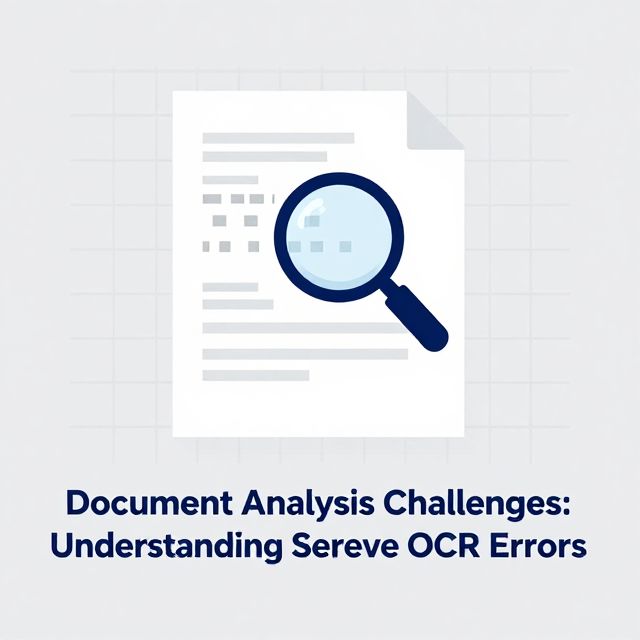
Document Analysis Challenges: Understanding Severe OCR Errors
Source Information: This study material is compiled from a lecture audio transcript discussing the challenges encountered with an unreadable document due to severe Optical Character Recognition (OCR) errors. The original document, intended for analysis, consisted solely of repetitive, unidentifiable 'ÿ' characters, rendering its content inaccessible.
📚 Introduction to Document Analysis Challenges
This study material addresses a critical issue in digital document processing: the impact of severe Optical Character Recognition (OCR) errors. When a document's content is corrupted to the point of being unreadable, it poses an insurmountable barrier to information extraction and automated content generation. This material will explore the nature and causes of such extreme OCR failures, exemplified by a document found to contain only 'ÿ' symbols, and discuss their profound implications for data integrity and automated systems.
1️⃣ Understanding Optical Character Recognition (OCR)
📚 Definition: Optical Character Recognition (OCR) is a technology designed to convert various types of documents—such as scanned paper documents, PDFs, or images—into editable and searchable digital data.
✅ How it Works:
- OCR engines analyze the visual patterns of characters within an image.
- These patterns are then matched against known letterforms and symbols.
- The goal is to transform static image-based text into dynamic, machine-readable text.
💡 Ideal Scenario: A well-scanned document with clear text typically yields highly accurate OCR results, enabling seamless data conversion.
2️⃣ The Nature and Causes of Severe OCR Errors
Severe OCR errors, like the pervasive 'ÿ' characters encountered in the problematic document, indicate a fundamental breakdown in the recognition process. The 'ÿ' character often serves as a placeholder in various encoding schemes, signifying an unprintable or unrecognized character that the system could not even approximate.
⚠️ Key Causes of Extreme OCR Failure:
-
Poor Image Quality: This is a primary culprit.
- Low scanning resolution.
- Blurry or out-of-focus images.
- Skewed or improperly aligned scans.
- Presence of shadows, smudges, or dirt on the document.
- Example: A document scanned quickly with a phone camera in poor lighting conditions might result in illegible text for an OCR engine.
-
Complex Document Layouts:
- Unusual or highly decorative fonts.
- Text printed on textured or patterned backgrounds.
- Overlapping text or graphics.
- Example: An old manuscript with ornate calligraphy or a magazine page with text printed over a busy image can confuse OCR software.
-
Absolute OCR Engine Failure or Corruption:
- An extreme level of data corruption in the source image itself.
- A highly unconventional or corrupted font that the OCR engine's character sets cannot match.
- A fundamental misconfiguration during the OCR process, leading to incorrect interpretation parameters.
- Example: If an OCR system is configured for Latin script but fed a document in an entirely different, unsupported script, it might output generic unrecognized characters.
-
The 'ÿ' Character Phenomenon:
- The uniform appearance of 'ÿ' characters suggests that the OCR engine failed to recognize any meaningful character.
- It indicates that the system couldn't even make an educated guess, resorting to a default "unrecognized" symbol.
- This is more severe than minor character substitutions (e.g., 'O' for '0').
3️⃣ Impact on Automated Content Generation and Information Extraction
The presence of severe OCR errors has profound implications, particularly for tasks that rely on clean, readable input data, such as automated content generation and information extraction.
✅ Consequences of Unreadable Input:
-
Inability to Discern Content:
- It becomes impossible to identify the subject matter or core message of the document.
- Arguments, data points, or key concepts cannot be extracted.
- The original purpose or intent of the document remains unknown.
- Example: If a legal document is corrupted, an AI cannot identify clauses, parties, or legal precedents.
-
Compromised Integrity of Content Generation:
- Automated systems are designed to be "strictly faithful" to the source content.
- When the source is unintelligible, generating content would require fabricating information, which violates ethical and functional guidelines.
- Example: An AI tasked with summarizing a research paper cannot do so if the paper's text is gibberish; any summary it produces would be entirely made up.
-
Dependency on Data Quality:
- This scenario highlights the absolute dependency of advanced AI and content generation systems on clean, readable input data.
- Even the most sophisticated algorithms cannot perform their intended function of synthesizing and presenting information accurately without interpretable source material.
- Example: A powerful language model trained on vast amounts of text is useless if the specific document it needs to process is unreadable. Its capabilities are fundamentally limited by the quality of the input it receives.
4️⃣ Conclusion: The Prerequisite of Readable Data
💡 Key Takeaway: The experience with severely corrupted documents underscores the critical importance of data quality as a fundamental prerequisite for any form of automated analysis or content creation.
- Foundation of Knowledge Extraction: While AI systems are designed to process, understand, and explain complex information, their ability to do so is entirely contingent upon receiving readable and meaningful input.
- Insurmountable Obstacle: When faced with a document composed entirely of unidentifiable characters due to severe OCR errors, the process of extracting knowledge, identifying themes, and constructing an educational narrative becomes an insurmountable obstacle.
- First Step in Analysis: The first and most crucial step in any successful document analysis project must always be ensuring the clarity and accuracy of the digital text. Without this foundational element, subsequent stages of interpretation, synthesis, and content generation cannot proceed effectively.
Understanding these challenges is vital for anyone involved in digital document management, data science, and AI-driven content solutions, emphasizing that technology's power is ultimately constrained by the quality of the data it processes.