 Podit
Podit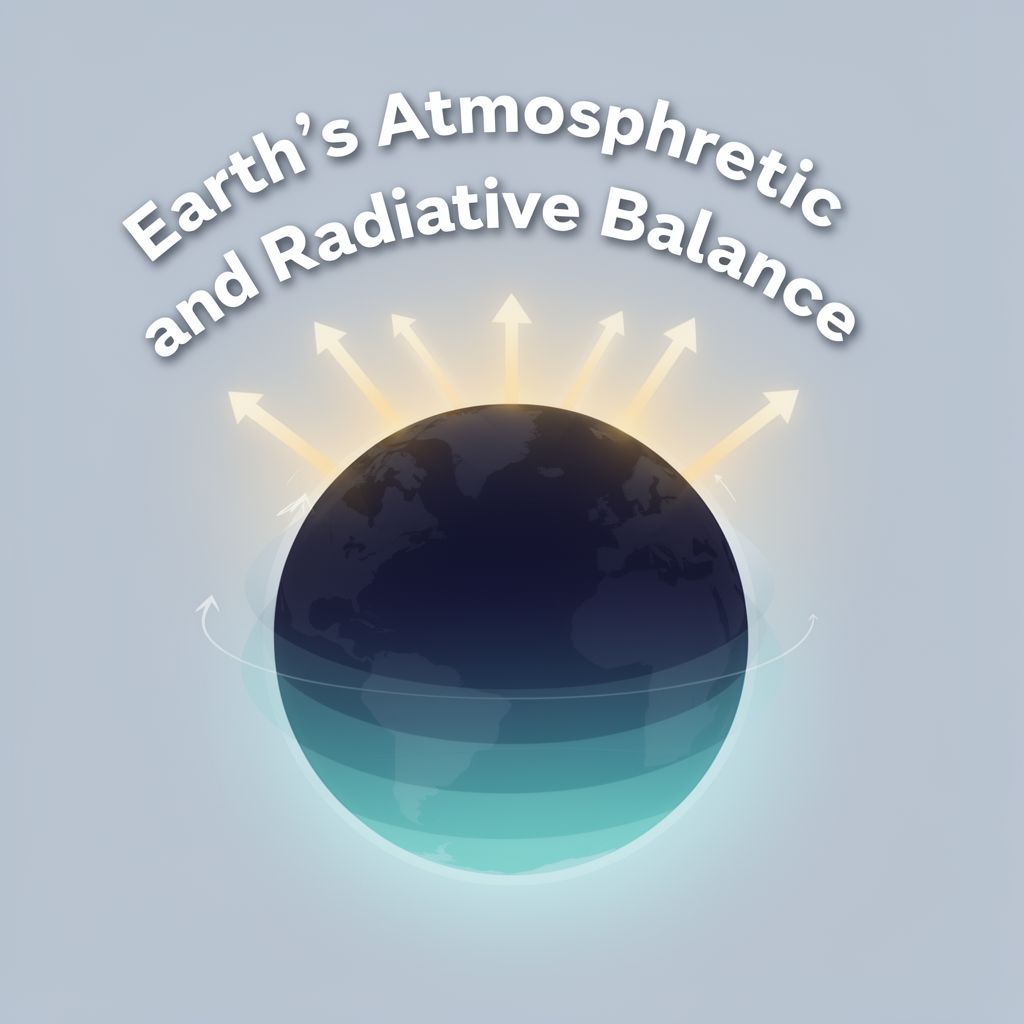
This study material has been compiled from various sources, including a lecture audio transcript and copy-pasted text which contained lecture slides and interactive poll questions.
📚 Earth's Atmospheric and Radiative Processes: A Study Guide
🌍 Introduction to Earth and Its Systems
This guide explores the fundamental characteristics of Earth, the evolution of its atmosphere and oceans, and the physical laws governing thermal radiation and planetary energy balance. Understanding these concepts is crucial for comprehending Earth's climate system.
✅ Key Earth Facts
- Age: Approximately 4.54 billion years 🕰️
- Radius: Approximately 6,400 kilometers
- Distance to Sun: Average of 150 million kilometers
- Light Travel Time from Sun: Approximately 8 minutes
🌬️ Formation and Evolution of Earth's Atmosphere and Oceans
The early Earth underwent significant transformations that shaped its current environment.
1️⃣ Early Atmosphere Formation
- Volcanic Outgassing: Major events leading to early Earth's formation included extensive volcanic eruptions.
- Composition: These eruptions produced Earth's first atmosphere, primarily consisting of water vapor (H₂O) and carbon dioxide (CO₂).
2️⃣ Ocean Formation
- Cooling Planet: As Earth cooled, the abundant water vapor in the atmosphere began to condense.
- Condensation & Rain: This condensation led to the formation of clouds and subsequent rainfall.
- Accumulation: Over vast periods, this rainwater accumulated, forming the Earth's oceans.
3️⃣ Oxygenation and Ozone Layer Development
- Photosynthesizing Bacteria: Around 3.5 billion years ago, a pivotal moment occurred with the emergence of photosynthesizing bacteria.
- Oxygen Release: These organisms began to release oxygen (O₂) into the atmosphere.
- Gradual Increase: Oxygen levels steadily increased over geological time.
- Ozone Layer Formation: Eventually, oxygen concentrations became sufficient for the development of the ozone (O₃) layer in the upper atmosphere, with significant amounts recorded around 2.3 billion years ago.
- Protective Role: The ozone layer is critical for absorbing harmful ultraviolet (UV) radiation, thereby protecting life on the surface and facilitating its diversification.
🔥 Principles of Thermal Radiation
Earth's energy balance is fundamentally governed by the principles of thermal radiation, also known as blackbody radiation. Electromagnetic waves (light) carry this energy.
📚 Key Laws of Thermal Radiation
-
Planck Function (Spectral Radiance)
- Definition: Quantifies the intensity of radiation emitted by a blackbody at a given temperature and wavelength. It describes the radiation power per unit area, per unit solid angle, per unit wavelength.
- Formula:
$B(\lambda, T) = \frac{2hc^2}{\lambda^5 (e^{\frac{hc}{k\lambda T}} - 1)}$
- $h$: Planck's constant ($6.626 \times 10^{-34}$ J s)
- $c$: Speed of light ($3 \times 10^8$ m/s)
- $k$: Boltzmann's constant ($1.381 \times 10^{-23}$ J/K)
- $\lambda$: Wavelength
- $T$: Absolute temperature
- Application: Can be inverted to measure temperature from observed intensity.
-
Wien's Displacement Law (Peak Emission Wavelength)
- Definition: States that hot materials emit electromagnetic radiation at shorter wavelengths than cooler objects. It relates the peak emission wavelength to the object's temperature.
- Formula: $\lambda_p = \frac{2898}{T} \text{ μm}$
- Examples:
- Sun: Surface temperature $\approx 5780$ K. $\lambda_p = \frac{2898}{5780} \approx 0.5$ μm (visible light).
- Earth: Average temperature $\approx 300$ K. $\lambda_p = \frac{2898}{300} \approx 9.7$ μm (infrared radiation).
-
Stefan-Boltzmann Law (Total Emitted Flux)
- Definition: Calculates the total flux (power per unit area) emitted by a blackbody across all wavelengths. It is proportional to the fourth power of its absolute temperature.
- Formula:
$F = \sigma T^4$
- $\sigma$: Stefan's constant ($5.67 \times 10^{-8}$ W m⁻² K⁻⁴)
- Examples:
- Sun: $F_{sun} \approx 63,284,072$ W/m²
- Earth: $F_{earth} \approx 390$ W/m²
-
Kirchhoff's Law (Absorptivity = Emissivity)
- Definition: For any material, its absorptivity ($a$) is equal to its emissivity ($\epsilon$).
- Absorptivity ($a$): Fraction of incident radiation absorbed. ($a=1$ for a perfect blackbody).
- Emissivity ($\epsilon$): Ratio of emitted intensity to that of a perfect blackbody.
- Formula: $a = \epsilon$
- Implication: If $a = \epsilon \neq 1$, then $F = \epsilon \times \sigma T^4 = a \times \sigma T^4$.
- Definition: For any material, its absorptivity ($a$) is equal to its emissivity ($\epsilon$).
📊 Planetary Radiation Balance and Effective Temperature
Earth's climate system is maintained by a delicate balance between incoming solar radiation and outgoing terrestrial radiation.
💡 Solar Constant ($F_s$)
- Definition: The flux of solar radiation incident on Earth, outside the atmosphere.
- Value: Approximately $1370$ W/m².
☁️ Albedo (A)
- Definition: The fraction of incident solar radiation that is reflected back into space.
- Earth's Average Albedo: Approximately $0.3$ (or 30%). This means 30% of incoming solar radiation is reflected.
⚖️ Radiative Equilibrium
For Earth's temperature to remain stable, the absorbed solar energy must equal the emitted terrestrial infrared radiation.
-
Solar Energy Incident on Earth (averaged over surface):
- Total incident solar energy: $F_s \times \pi R_e^2$ (where $R_e$ is Earth's radius)
- Averaged over Earth's surface area ($4\pi R_e^2$): $\frac{F_s \times \pi R_e^2}{4\pi R_e^2} = \frac{F_s}{4} = \frac{1370 \text{ W/m}^2}{4} = 342 \text{ W/m}^2$.
-
Solar Radiation Scattered Back to Space:
- Due to albedo: $\frac{F_s}{4} \times A = 342 \text{ W/m}^2 \times 0.3 = 102 \text{ W/m}^2$.
-
Solar Energy Absorbed by Climate System:
- $\frac{F_s}{4} \times (1 - A) = 342 \text{ W/m}^2 \times (1 - 0.3) = 240 \text{ W/m}^2$.
🌡️ Effective Radiating Temperature ($T_e$)
This is the temperature Earth would have if it were a perfect blackbody radiating directly to space, without an atmosphere.
- Balance Equation: Absorbed Solar Energy = Emitted Terrestrial IR $F_s \times \pi R_e^2 \times (1 - A) = \sigma T_e^4 \times 4\pi R_e^2$
- Solving for $T_e$: $T_e^4 = \frac{F_s \times (1 - A)}{4\sigma}$
- Calculation: $T_e^4 = \frac{1370 \text{ W/m}^2 \times (1 - 0.3)}{4 \times 5.67 \times 10^{-8} \text{ W m}^{-2} \text{ K}^{-4}}$ $T_e \approx 255 \text{ K}$
⚠️ Important Distinction: Effective vs. Surface Temperature
- Effective Radiating Temperature ($T_e$): 255 K
- Average Surface Temperature ($T_g$): Approximately 288 K
- Reason for Difference: Earth's average surface temperature is significantly higher than its effective radiating temperature due to the greenhouse effect of its atmosphere. Greenhouse gases trap outgoing infrared radiation, warming the surface.
📝 Summary of Key Climate Factoids
- Incident Solar Radiation (averaged over Earth's surface): 342 W/m²
- Solar Radiation Scattered Back to Space (Albedo): 102 W/m²
- Solar Input to Climate System (Absorbed): 240 W/m²
- IR Flux Emitted from Earth (in radiative equilibrium): 240 W/m²
- Effective Radiating Temperature ($T_e$): 255 K
- Average Surface Temperature ($T_g$): 288 K
🎯 Conclusion
Earth's journey from its early formation to its current state is a complex interplay of geological, biological, and physical processes. The evolution of its atmosphere, driven by volcanic outgassing and later by photosynthetic life, was fundamental in shaping a habitable planet. Simultaneously, the planet's temperature and energy budget are meticulously governed by universal laws of thermal radiation. The balance between incoming solar energy, Earth's albedo, and the emission of infrared radiation dictates the planet's effective radiating temperature. Understanding these interconnected physical and atmospheric processes is essential for comprehending Earth's climate and its ongoing changes.