Podit
Podit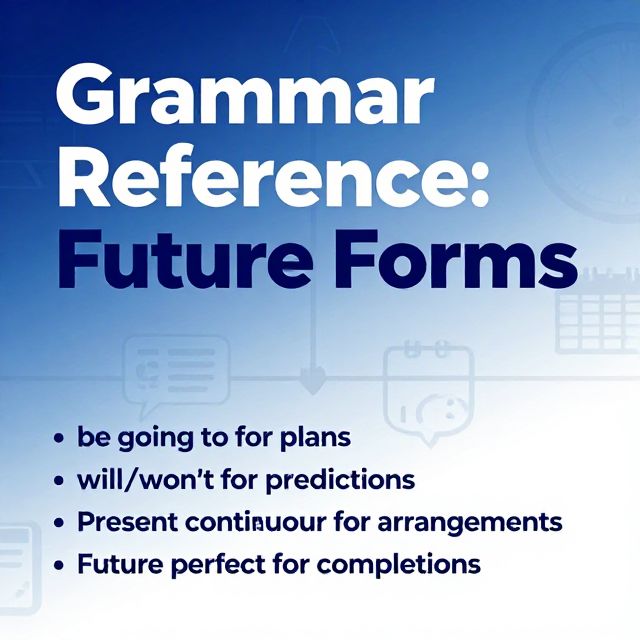
Flash Kartlar
25 kartKarta tıklayarak çevir. ← → ile gez, ⎵ ile çevir.
Tüm kartları metin olarak gör
1. When do we use 'be going to' to express future plans or intentions?
We use 'be going to' for plans and intentions that have already been decided. It indicates a pre-determined course of action or a decision made prior to the moment of speaking. For example, 'I've decided that next year I'm going to do more exercise.'
2. How is 'be going to' used for predictions?
'Be going to' is used for predictions when there is clear evidence in the present that something is about to happen. The current situation provides a strong indication of the future outcome. For instance, 'All the evidence suggests the situation is going to get worse.'
3. What is the primary use of 'will' and 'won't' for general predictions?
'Will' and 'won't' are primarily used for general predictions, especially when expressing beliefs, hopes, or expectations about the future. These predictions often involve verbs like 'think,' 'hope,' or 'expect,' indicating a less certain or more subjective outlook. An example is, 'I believe that one day we will live on Mars.'
4. Explain the use of 'will' for decisions made at the moment of speaking.
'Will' is used to express decisions that are made spontaneously, at the exact moment of speaking. These are not pre-planned intentions but rather immediate reactions or choices. For example, if someone says, 'It's cold,' a spontaneous decision would be, 'I'll close the window now.'
5. Provide an example of 'will' being used to state a future fact.
'Will' is used to state facts about the future that are certain and unchangeable. These are typically age, dates, or other undeniable future occurrences. A common example is, 'I'll be 17 next year,' which is a simple statement of a future age.
6. When is the present continuous tense used to talk about the future?
The present continuous is used for fixed future arrangements or confirmed plans. These are events that have been organized and scheduled, often involving other people or specific times and places. For instance, 'Experts from around the world are meeting next month' implies a pre-arranged event.
7. Describe a situation where the present simple tense refers to a future action.
The present simple tense is used for future actions that are part of a timetable, schedule, or fixed program. These events are usually impersonal and occur at a set time, like public transport schedules or event listings. An example is, 'My train leaves at 4 pm tomorrow.'
8. How is the present simple used with time expressions like 'when' or 'as soon as' for future events?
The present simple is used in clauses introduced by time expressions such as 'when,' 'as soon as,' or 'until' to refer to future actions. In these subordinate clauses, 'will' cannot be used. The main clause typically uses 'will' to express the future consequence. For example, 'When I go to university, I'll study chemistry.'
9. Describe the future continuous tense and provide an example.
The future continuous tense describes activities that will be in progress at a specific time in the future, indicating they are unfinished. It emphasizes the ongoing nature of an action at a future point. For example, 'At this time tomorrow, he'll be flying to the US.'
10. Explain the function of the future perfect simple tense and give an example.
The future perfect simple is used for actions that will be completed by a certain point in the future. It focuses on the completion of an action before a specified future deadline, often using the preposition 'by'. For instance, 'I will have gone to bed by midnight.'
11. What does the future perfect continuous tense highlight, and can you give an example?
The future perfect continuous tense focuses on the duration of an activity leading up to a particular moment in the future. It emphasizes how long an action will have been ongoing by a specific future point. For example, 'By 8 pm, I'll have been revising history for five hours.'
12. What do the phrases 'be on the point of' and 'be on the verge of' express?
The phrases 'be on the point of' and 'be on the verge of' are used to express that something is going to happen very soon. They convey a sense of immediacy and an impending action or event. For example, 'They are on the verge of inventing something really revolutionary.'
13. What is the general rule for tense changes in reported speech when the reporting verb is in the past tense?
When the reporting verb is in the past tense (e.g., 'said,' 'asked'), the tense of the verb in reported speech typically shifts one tense back. For instance, present simple becomes past simple, present continuous becomes past continuous, and so on.
14. Besides tense, what other grammatical elements change in reported speech?
In reported speech, pronouns and possessive adjectives also change to reflect the new speaker's perspective. For example, 'I' might become 'he' or 'she,' and 'my' might become 'his' or 'her,' depending on the context of the original statement and the reporter.
15. How do adverbs of place and time change in reported speech?
Adverbs of place and time often change in reported speech to reflect the shift in perspective. For example, 'here' typically becomes 'there,' and 'now' becomes 'then.' This adjustment ensures the reported statement makes sense from the new time and location.
16. Which modal verbs do not change in reported speech?
Modal verbs such as 'could,' 'would,' 'should,' and 'might' generally do not change in reported speech. These modals already express a degree of past or hypothetical meaning, so a further backshift is usually unnecessary.
17. What happens to the auxiliary verb 'do' in reported questions?
In reported questions, the auxiliary verb 'do' is not used. The question structure is converted into a statement structure, and 'do' is omitted, with the main verb taking the appropriate past tense form if a tense shift is required.
18. What two structural changes occur in reported questions regarding inversion and punctuation?
In reported questions, there is no inversion of the subject and verb (the word order becomes subject + verb, like a statement), and question marks are omitted. The sentence ends with a full stop, as it is no longer a direct question.
19. When do we use 'if' or 'whether' in reported questions?
We use 'if' or 'whether' in reported questions when there is no question word (e.g., who, what, where, why). These words introduce the reported question, turning it into a subordinate clause. For example, 'She asked me if I liked rap music.'
20. How are passive infinitives formed?
Passive infinitives are formed with 'to be' followed by the past participle of the main verb. This structure is used after certain verbs or adjectives that require an infinitive. For example, 'He wants to be given a chance.'
21. What is the structure for forming passive gerunds?
Passive gerunds are formed using 'being' followed by the past participle of the main verb. This structure is typically used after prepositions or verbs that are followed by a gerund. For example, 'She dislikes being told what to do.'
22. When a verb has two objects, which object is more commonly made the subject in a passive sentence?
When verbs have two objects (e.g., 'give,' 'tell'), it is more common to make the person (indirect object) the subject of the passive sentence. This often results in a more natural-sounding sentence. For example, 'I was given a surprise.'
23. Describe the structure and meaning of the causative form 'subject + have/get + object + past participle'.
This causative structure, 'subject + have/get + object + past participle,' is used to describe actions someone else does for us. It indicates that the subject arranges for a service to be performed by another person. For example, 'He had his computer fixed.'
24. Explain the causative structure 'subject + have + agent + infinitive without to'.
This causative structure is used when the subject arranges for an agent to perform an action, often implying a command or instruction. The agent is explicitly mentioned, and the verb following the agent is an infinitive without 'to'. For example, 'She had her assistant prepare the report.'
25. How does the causative structure 'subject + get + agent + infinitive with to' function?
The causative structure 'subject + get + agent + infinitive with to' is used to indicate that the subject persuades or convinces an agent to perform an action. It implies more effort or persuasion than 'have'. An example from the text is, 'He got his friend to fix his computer.'
Bilgini Test Et
15 soruÇoktan seçmeli sorularla öğrendiklerini ölç. Cevap + açıklama.
Which future form is used for plans and intentions that have already been decided?