English Language Essentials: Grammar, Vocabulary, and Culture - kapak
Eğitim#english grammar#vocabulary#idioms#language learning

English Language Essentials: Grammar, Vocabulary, and Culture

Explore key English grammar points, essential vocabulary, common idioms, and a detailed look at the cello's musical significance.

mustafacellistJanuary 9, 2026 ~17 dk toplam
01

Sesli Özet

8 dakika

Konuyu otobüste, koşarken, yolda dinleyerek öğren.

Sesli Özet

English Language Essentials: Grammar, Vocabulary, and Culture

0:007:44
02

Flash Kartlar

25 kart

Karta tıklayarak çevir. ← → ile gez, ⎵ ile çevir.

1 / 25
Tüm kartları metin olarak gör
  1. 1. What grammatical structure is used to express staying away from something?

    The structure 'avoid + verb -ing' is used to express the act of staying away from or preventing something.

  2. 2. What is the key difference between 'prevent' and 'stop'?

    'Prevent' often refers to stopping another person or an event from happening, while 'stop' is more general.

  3. 3. What verb form typically follows prepositions like 'in,' 'at,' 'from,' 'by,' and 'for'?

    Prepositions such as 'in,' 'at,' 'from,' 'by,' and 'for' are typically followed by a verb in its '-ing' form, also known as a gerund.

  4. 4. What does it mean to 'borrow' something?

    To 'borrow' means to take something from someone with the intention of returning it.

  5. 5. What does it mean to 'lend' something?

    To 'lend' means to give something to someone for a period, expecting it back.

  6. 6. What does the term 'matter' signify when referring to importance?

    The term 'matter' can mean 'to be important,' as seen in the phrase 'Black lives matter.'

  7. 7. What does 'don't mind' imply when used in relation to people?

    When we say 'don't mind' in relation to people, it implies that something is 'not important' to that person.

  8. 8. What does 'don't matter' refer to in a general sense?

    'Don't matter' refers to something being 'not important' in a general sense, often for inanimate objects or situations.

  9. 9. What is the appropriate agreeable response to the polite inquiry 'Do you mind, if I...'?

    The appropriate response to such a question, if you are agreeable, is 'Of course not.'

  10. 10. Who is referred to as 'Caucasian'?

    'Caucasian' refers to a person of white skin, typically of European descent.

  11. 11. What does the idiom 'English rose' describe?

    An 'English rose' is an idiomatic expression used to describe an attractive girl, often implying natural, delicate beauty.

  12. 12. What does the term 'pale' describe?

    'Pale' describes a light or weak color, often referring to skin that is lacking color.

  13. 13. What is the meaning of 'delicate'?

    'Delicate' means 'hassas,' indicating something that is easily broken, fragile, or requiring careful handling.

  14. 14. What is a 'melting pot' in a societal context?

    A 'melting pot' describes a place or society where people from different cultures blend, forming a new, unified culture.

  15. 15. What is a 'custom'?

    A 'custom' refers to a traditional and widely accepted way of behaving or doing something, a 'gelenek.'

  16. 16. What does 'formative' describe?

    'Formative' describes something that has a significant influence on a person's or thing's development, especially during a period of growth.

  17. 17. How do 'fraudulently' and 'fraudsters' relate to deceit?

    'Fraudulently' means acting deceitfully for personal gain, and 'fraudsters' are those who engage in such dishonest acts.

  18. 18. What does it mean to do something 'surreptitiously'?

    'Surreptitiously' means doing something secretly, without drawing attention, or 'gizlice, fark ettirmeden.'

  19. 19. What does the idiom 'dip a toe into something' mean?

    To 'dip a toe into something' means to try something new cautiously or tentatively.

  20. 20. Describe a 'risk averse' person.

    A 'risk averse' person dislikes taking risks or prefers to avoid uncertainty.

  21. 21. What is a 'cheapskate'?

    A 'cheapskate' is an informal term for a person who is unwilling to spend money, often considered stingy.

  22. 22. What does 'competence' refer to?

    'Competence' refers to the ability to do something successfully or efficiently, denoting 'liyakat.'

  23. 23. What does the idiom 'low-hanging fruit' describe?

    'Low-hanging fruit' describes a goal or task that is easily achievable, something that is 'easy for me.'

  24. 24. What is 'perseverance' synonymous with?

    'Perseverance' is the continued effort to do or achieve something despite difficulties, synonymous with 'determination' and 'persistence.'

  25. 25. What is the cello widely known for regarding its sound?

    The cello is widely known for its exceptionally deep, warm, and resonant tone, often compared to the human voice.

03

Detaylı Özet

4 dk okuma

Tüm konuyu derinlemesine, başlık başlık.

This study material has been compiled from a lecture audio transcript and additional copy-pasted notes, providing a comprehensive overview of English language concepts and a specific musical instrument.


📚 English Language Concepts: A Study Guide

🎯 Introduction

This guide offers an in-depth look at various English grammar points, essential vocabulary, common idioms, and an introduction to a specific musical instrument. The aim is to enhance understanding and linguistic proficiency by presenting information clearly and comprehensively.

1️⃣ Mastering Core English Grammar and Vocabulary

1.1 Grammar Rules & Structures

  • Avoid + verb -ing

    • Concept: Used to express staying away from or preventing something.
    • Example: "I avoid eating late at night."
  • Prevent vs. Stop 💡

    • Prevent: Often refers to stopping another person or an event from happening.
      • Example: "The security system prevents unauthorized access."
    • Stop: Can be used more broadly for halting an action or movement.
  • Prepositions followed by verb -ing (Gerund)

    • Rule: Prepositions like in, at, from, by, for are typically followed by a verb in its -ing form.
    • Examples:
      • "I am interested in learning new languages."
      • "He succeeded by working hard."

1.2 Verb Distinctions: Borrow vs. Lend

  • 📚 Borrow: To take something from someone with the intention of returning it. (Equivalent to "almak" in Turkish).

    • Example: "Do you mind if I borrow your car tonight?"
    • Example: "Ahmet borrowed my car keys to go to work."
  • 📚 Lend: To give something to someone for a period, expecting it back. (Equivalent to "vermek" in Turkish).

    • Example: "I lent my phone charger to my friend."
    • Past Tense: lent

1.3 Understanding Matter and Mind

  • 📚 Matter: To be important.

    • Example: "Black lives matter." (Meaning: Black lives are important.)
  • 📚 Don't mind (for people): Indicates that something is not important or not an issue for that person, often used in polite contexts.

    • Example: "I don't mind waiting here for you." (Meaning: Waiting is not a problem for me.)
  • 📚 Don't matter (for things/situations): Refers to something being not important in a general sense.

    • Example: "It doesn't matter if we're a few minutes late."
  • Polite Inquiry: Do you mind, if I...? 💬

    • Usage: A polite way to ask for permission.
    • Appropriate Response (if agreeable): "Of course not."
    • Example:
      • "Do you mind if I kiss your cheeks once?"
      • "Of course not." (Meaning: No, I don't mind; you can do it.)

2️⃣ Expanding Your Vocabulary: Idioms and Specific Terms

This section introduces a selection of terms and idiomatic expressions to enrich your English vocabulary.

  • 📚 Caucasian: Refers to a person of white skin, typically of European descent.
  • 📚 English rose: An idiomatic expression describing an attractive girl, often implying natural, delicate beauty.
  • 📚 Pale: Describes a light or weak color, often referring to skin that is lacking color.
  • 📚 Delicate: Easily broken, fragile, or requiring careful handling.
  • 📚 Melting pot: A place or society where people from different countries, cultures, or backgrounds blend to form a new, unified culture.
  • 📚 Custom: A traditional and widely accepted way of behaving or doing something.
  • 📚 Formative: Having a significant influence on a person's or thing's development, especially during a period of growth.
    • Example: "Formative feedback helps students improve."
  • 📚 Fraudulently: Acting in a deceitful or dishonest way, often for personal gain.
  • 📚 Fraudsters: Individuals who engage in fraudulent acts.
  • 📚 Surreptitiously: Doing something secretly, without drawing attention.
  • 📚 Dip a toe into (something) 👣: To try something new cautiously or tentatively.
  • 📚 Risk averse: A person who dislikes taking risks or prefers to avoid uncertainty.
  • 📚 Cheapskate: An informal term for a person who is unwilling to spend money; stingy.
  • 📚 Competence: The ability to do something successfully or efficiently.
  • 📚 Low-hanging fruit 🍎: A goal or task that is easily achievable.
  • 📚 Perseverance: The continued effort to do or achieve something despite difficulties; determination, persistence.
  • 📚 Outwork / Outperform: To work harder or achieve better results than others.
    • Example: "He outworked everyone on the team."
  • 📚 Bracing: Invigorating or strengthening; preparing oneself for something difficult.
    • Example: "Aren't you always bracing for the worst?"
  • 📚 Anticipation: The action of looking forward to something; expectation.
    • Example: "This second sentence creates anticipation."
  • 📚 Default: A preselected option or a failure to fulfill an obligation.

3️⃣ The Cello: A Deep Dive into a Resonant Instrument

The cello is a magnificent bowed string instrument with a prominent place in the violin family.

3.1 Key Characteristics ✅

  • Family: Part of the violin family.
  • Size: Larger than a viola but smaller than a double bass.
  • Playing Position: Typically played while seated, with the instrument resting on the floor and held between the player's knees.
  • Tone: Known for its exceptionally deep, warm, and resonant tone.
  • Expressive Sound: Its profound and rich sound quality is often compared to the human voice, particularly the male voice, due to its range and emotional depth. This allows it to convey a wide spectrum of emotions.

3.2 Historical Significance 📜

  • Baroque Period: The cello became a fundamental and indispensable part of Western classical music starting in the Baroque period.
  • Evolution: During this era, composers began to fully explore its capabilities, moving it beyond a mere bass line instrument to one capable of carrying melodic lines and intricate harmonies.
  • Modern Role: Its role has expanded significantly, making it a cornerstone of orchestras, chamber ensembles, and a beloved instrument for solo repertoire across various musical genres.

Understanding the cello's characteristics and historical journey provides a deeper appreciation for its contribution to the rich tapestry of classical music.
Kendi çalışma materyalini oluştur

PDF, YouTube videosu veya herhangi bir konuyu dakikalar içinde podcast, özet, flash kart ve quiz'e dönüştür. 1.000.000+ kullanıcı tercih ediyor.

Sıradaki Konular

Tümünü keşfet
An Overview of Essential English Phrasal Verbs

An Overview of Essential English Phrasal Verbs

This academic summary provides a structured overview of common English phrasal verbs, detailing their meanings and usage for enhanced linguistic comprehension.

4 dk 25 15
English Expressions: Degree, Frequency, and Regret

English Expressions: Degree, Frequency, and Regret

Explore English adverbs for degree and frequency, and structures for expressing past regret and hypothetical situations.

6 dk Özet 25
Navigating German Grammar: Essential Dictionary Abbreviations

Navigating German Grammar: Essential Dictionary Abbreviations

Learn to effectively use a German dictionary by understanding key grammatical abbreviations for cases, genders, verb types, and more.

6 dk Özet 25 15
Mastering Past Tenses: Simple Past and Present Perfect

Mastering Past Tenses: Simple Past and Present Perfect

Explore the nuances of English past tenses, including irregular verbs, and learn to discuss life events and experiences effectively.

25 15
Language in Use: Exploring a New Photography Hobby

Language in Use: Exploring a New Photography Hobby

This podcast analyzes a text about starting photography as a new hobby, focusing on the correct grammatical and lexical choices within the narrative to enhance understanding of English language usage.

Özet 25 15
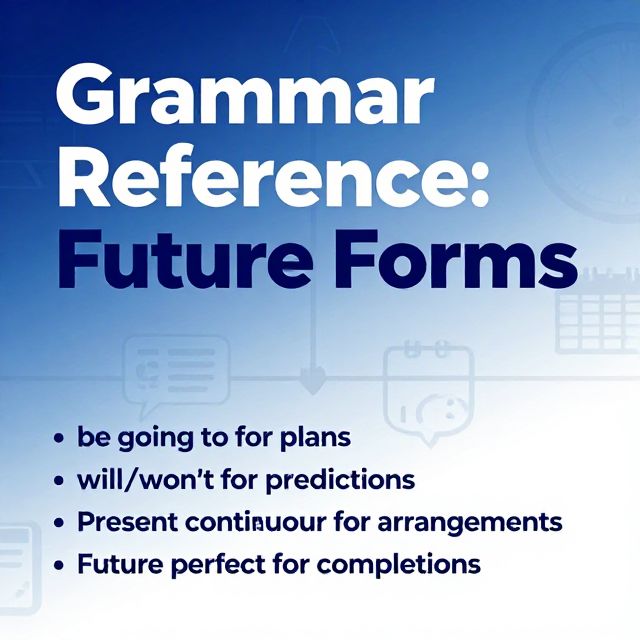
English Grammar Essentials: Future Forms, Reported Speech, and Passives

English Grammar Essentials: Future Forms, Reported Speech, and Passives

An educational overview of key English grammar concepts including future tenses, reported speech, passive structures, and causatives, designed for language learners.

25 15
First Language Acquisition: Concepts and Developmental Stages

First Language Acquisition: Concepts and Developmental Stages

This summary explores first language acquisition, differentiating it from learning. It details early developmental stages, including cooing, babbling, one-word, two-word, and telegraphic speech, alongside the development of morphological, syntactic, and semantic knowledge.

5 dk Özet 25 15
German Vocabulary and Phrases: Lessons 8-10

German Vocabulary and Phrases: Lessons 8-10

This summary covers key German vocabulary and phrases from Lessons 8, 9, and 10, focusing on daily activities, object descriptions, personal preferences, and various forms of communication.

7 dk Özet 25 15