Podit
Podit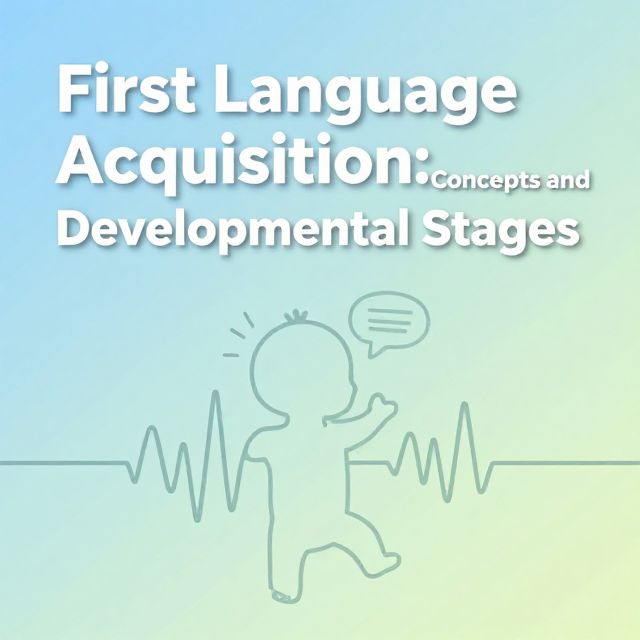
📚 First Language Acquisition: A Comprehensive Study Guide
Source Information: This study material has been compiled and organized from a lecture audio transcript and a provided text document on First Language Acquisition.
🎯 Introduction to First Language Acquisition
First Language Acquisition (FLA) is the fascinating and complex process by which individuals acquire their native language. It is a fundamental aspect of human development, occurring largely subconsciously and following a remarkably consistent schedule across all normal children. This guide will explore the core concepts of FLA, differentiate it from language learning, detail the sequential stages of child language development, and explain how children progressively develop their morphological, syntactic, and semantic knowledge.
1️⃣ Key Concepts: Acquisition vs. Learning
Understanding the distinction between language acquisition and language learning is crucial for comprehending how children master their native tongue.
📚 What is Acquisition?
✅ Definition: Acquisition is a subconscious process where individuals are often unaware of the process as it happens and when new knowledge is gained.
- Nature: It's similar to how children learn their native language.
- Focus: Requires meaningful interaction in the target language, with a primary focus on meaning rather than explicit grammar rules or form.
- Example: A child naturally picking up grammar rules by listening and speaking, without formal instruction.
📚 What is Learning?
✅ Definition: Learning a language is a conscious and deliberate process, typically experienced in formal educational settings.
- Nature: New knowledge is consciously represented in the mind.
- Focus: Often emphasizes grammatical form, rules, and explicit instruction.
- Example: Studying verb conjugations or vocabulary lists in a classroom setting.
💡 Key Differences:
- Consciousness: Acquisition is subconscious; learning is conscious and deliberate.
- Focus: Acquirers focus on meaning and context; learners often focus on form and rules.
- Mother Tongue vs. Second Language: Mother tongue is primarily acquired, while a second language is often primarily learned, though elements of acquisition can occur.
2️⃣ Stages of Early Language Development
All normal children develop language at roughly the same time, following a predictable sequence of stages.
👶 Early Vocalizations (0-11 Months)
- 1 Month: Infants can distinguish between similar sounds, such as [ba] and [pa].
- First 3 Months:
- Develop a range of crying styles for different needs.
- Produce big smiles in response to speaking faces.
- Start creating distinct vocalizations.
- Cooing (First Few Months):
- Earliest use of speech-like sounds.
- Production of vowel-like sounds, especially high vowels like [i] and [u].
- By 4 months, sounds similar to velar consonants [k] and [ɡ] emerge.
- By 5 months, children can discriminate between vowels ([i] and [a]) and syllables ([ba] and [ɡa]).
- Babbling (6-10 Months):
- Between 6 and 8 months, children sit up and produce various vowels and consonants.
- Combinations like "ba-ba-ba" and "ga-ga-ga" appear.
- Later Babbling (Around 9-10 Months): Recognizable intonation patterns emerge, and variations in combinations (e.g., "ba-ba-da-da") become common.
🗣️ First Words and Combinations (12 Months Onwards)
- The One-Word Stage (12-18 Months):
- Children utter single terms for everyday objects.
- Examples: "milk," "cookie," "cat," "cup," "spoon."
- The Two-Word Stage (Around 18-20 Months):
- Children begin to combine words into simple phrases.
- Examples: "baby chair," "mommy eat," "cat bad."
- Telegraphic Speech (Beyond 20 Months):
- Characterized by strings of words (lexical morphemes) forming rudimentary phrases or sentences.
- Often omits function words (articles, prepositions, auxiliary verbs).
- Examples: "this shoe all wet," "cat drink milk," "daddy go bye-bye."
3️⃣ The Acquisition Process: Developing Linguistic Knowledge
Beyond initial speech production, children systematically develop their understanding of morphology, syntax, and semantics. This process often involves "trying out constructions and testing whether they work or not."
📝 Developing Morphology
By two-and-a-half years old, children incorporate inflectional morphemes that indicate grammatical function.
- -ing Form: Used in progressive constructions.
- Examples: "cat sitting," "mommy reading book."
- Plural -s: Added to form plurals.
- Examples: "boys," "cats."
- ⚠️ Overgeneralization: Children often overgeneralize this rule to irregular nouns.
- Examples: "foots" (for feet), "mans" (for men).
- Past Tense -ed: Added to verbs.
- Examples: "walked," "played."
- ⚠️ Overgeneralization: Similarly, they overgeneralize to irregular verbs.
- Examples: "goed" (for went), "comed" (for came). 💡 These overgeneralizations are a natural part of development, showing the child's attempt to apply learned rules.
🏗️ Developing Syntax
Children's syntactic development is evident in how they form questions and negatives.
❓ Forming Questions
- Stage 1 (Early): Simple "Wh-" form at the beginning of an expression.
- Examples: "Where kitty?", "Where horse go?"
- Stage 2 (More Complex): More elaborate expressions, but auxiliary movement may not be present.
- Examples: "What book name?", "Why you smiling?"
- Stage 3 (Adult-like): Auxiliary movement becomes evident, aligning more closely with adult grammar, though not always consistently across all Wh-question types.
- Examples: "Can I have a piece?", "Did I caught it?", "Will you help me?", "How that opened?"
🚫 Forming Negatives
- Stage 1 (Simple): "No" or "Not" placed at the beginning of an utterance.
- Examples: "no fall," "no sit there."
- Stage 2 (Additional Forms): "Don't" and "can't" appear, increasingly used in front of the verb.
- Examples: "He no bite you," "I don’t want it."
- Stage 3 (Incorporation of Auxiliaries): Other auxiliary forms like "didn't" and "won't" are incorporated, and Stage 1 forms disappear.
- Examples: "I didn’t caught it," "He not taking it."
🧠 Developing Semantics
Semantic development involves how children acquire and refine word meanings.
- Overextension (Initial Phase): Children initially overextend the meaning of a word based on perceived similarities (shape, sound, size, movement, texture).
- Example: The word "ball" might be used for all round objects, including a lampshade, a doorknob, or the moon.
- Narrowing Down (Gradual Process): This overextension is gradually followed by a process of narrowing down the application of each term as the child learns more words and refines their understanding of specific meanings.
📈 Conclusion
First language acquisition is a complex, subconscious developmental process that unfolds systematically in children. It progresses from pre-linguistic vocalizations through distinct stages of one-word and two-word utterances, culminating in telegraphic speech. Concurrently, children develop sophisticated morphological rules, construct increasingly complex syntactic structures for questions and negatives, and refine their semantic understanding from broad overextensions to precise word meanings. This intricate process highlights the innate human capacity for language and its structured emergence.