Understanding Pragmatics in Language - kapak
Eğitim#pragmatics#linguistics#language#communication

Understanding Pragmatics in Language

Explore pragmatics: the study of meaning communicated by speakers and interpreted by listeners, considering context, speaker intention, and social distance.

cinepApril 7, 2026 ~16 dk toplam
01

Flash Kartlar

25 kart

Karta tıklayarak çevir. ← → ile gez, ⎵ ile çevir.

1 / 25
Tüm kartları metin olarak gör
  1. 1. What is the primary concern of pragmatics in language study?

    Pragmatics is fundamentally concerned with the study of meaning as it is communicated by a speaker or writer and subsequently interpreted by a listener or reader. It delves into the nuances of language that go beyond the literal words themselves. Essentially, it focuses on what people truly intend to convey through their utterances.

  2. 2. What does 'speaker meaning' refer to in pragmatics?

    Speaker meaning refers to the analysis of what people truly intend to convey through their utterances, rather than merely what the individual words and phrases might signify on their own. It focuses on the speaker's communicative intention. This means understanding the underlying message the speaker wants to get across.

  3. 3. Provide an example to illustrate speaker meaning beyond literal interpretation.

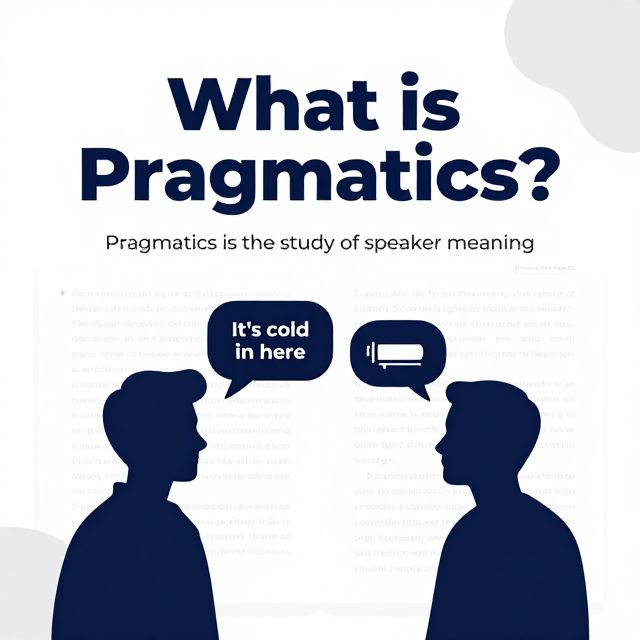
    Consider the statement, 'It’s cold in here.' Literally, it describes the temperature. However, pragmatically, the speaker might be implying, 'Please close the window,' or 'Turn on the heater,' or 'Can we move to a warmer place?' The intended meaning goes beyond the literal description of the temperature.

  4. 4. Explain the pragmatic interpretation of 'Can you pass the salt?'

    Literally, 'Can you pass the salt?' is a question about physical ability. Pragmatically, however, it is understood not as a query about capability but as a polite request for the listener to pass the salt. The speaker's intention is to make a request, not to inquire about the listener's physical capacity.

  5. 5. What does 'contextual meaning' involve in pragmatics?

    Contextual meaning involves interpreting what people mean within a particular context and understanding how that context profoundly influences what is said. The same words can have different meanings depending on the situation. Pragmatics studies how context shapes the interpretation of utterances.

  6. 6. How does the sentence 'She is ready' demonstrate contextual meaning?

    The meaning of 'She is ready' varies dramatically with context. If said before a trip, it means she's packed and prepared to depart. If uttered during an exam, it means she's ready to begin the test. The sentence itself remains the same, but its interpretation changes based on the specific situation, highlighting contextual meaning.

  7. 7. How does pragmatics study 'how more gets communicated than is explicitly said'?

    Pragmatics explores how listeners actively make inferences about what is spoken to interpret the speaker’s true intended meaning, even when it's not directly stated. This involves understanding implied messages that go beyond the literal words. The listener fills in the gaps based on shared knowledge and context.

  8. 8. Give an example of implied meaning from the text.

    The statement 'I have an exam tomorrow' literally means an exam is scheduled. However, the implied meaning could be 'I cannot go out,' 'I cannot stay long,' or 'I need to study.' The speaker doesn't explicitly state these, but the listener can infer them from the context and shared understanding.

  9. 9. What is the concept of 'relative distance' in pragmatics?

    Relative distance in pragmatics addresses what is said versus what is left unsaid, and how this is tied to the notion of closeness. This closeness can be physical, social, or conceptual, implying a shared experience. Speakers adjust 'how much needs to be said' based on their perceived distance from the listener.

  10. 10. How does social distance influence what is said versus unsaid?

    Social distance dictates the level of formality and explanation required in communication. In a distant relationship, like with a coworker you barely know, more explicit information and politeness are needed. In contrast, with a close friend, much can be left unsaid due to shared understanding and experience. Pragmatics studies how this distance shapes linguistic choices.

  11. 11. What is syntax, and what does it primarily study?

    Syntax, often known as grammar, refers to the knowledge we possess regarding the order of elements within a sentence. It is the study of relationships between linguistic forms and how these forms are arranged in sequence. Syntax determines which sequences are well-formed and grammatically correct in a language.

  12. 12. Provide an example of a syntactically correct but semantically odd sentence.

    Noam Chomsky's famous example is 'Colorless green ideas sleep furiously.' This sentence is syntactically correct, following the structure of adjective + adjective + noun + verb + adverb. However, it is semantically odd because ideas cannot be 'colorless and green' nor can they 'sleep,' making no real-world sense.

  13. 13. What is semantics, and what does it focus on?

    Semantics refers to the study of meaning itself. It examines the relationships between linguistic forms and entities in the world, essentially how words literally connect to things. Semantic analysis attempts to establish relationships between verbal descriptions and states of affairs, determining their accuracy or truth regardless of who produces them.

  14. 14. How does pragmatics differ from both syntax and semantics?

    Pragmatics, unlike syntax and semantics, is the study of the relationships between linguistic forms and the *users* of these forms. While syntax focuses on sentence structure and semantics on literal meaning, pragmatics focuses on what speakers mean, their assumptions, goals, and the actions they perform when they talk, considering the human element.

  15. 15. What is a significant challenge in pragmatic analysis?

    A significant challenge in pragmatic analysis is that human concepts like speaker intention, implied meaning, and contextual interpretation are extremely difficult to analyze consistently and objectively. Meaning is often communicated without clear linguistic evidence, relying heavily on inference and shared understanding, which are hard to quantify.

  16. 16. How does the Alex and Jamie dialogue illustrate the difficulty of analyzing implied meaning?

    In the dialogue, Alex and Jamie imply excitement and surprise about a game without explicitly stating 'The team won' or 'I’m excited.' Their meaning is understood through context and shared knowledge, not direct statements. This shows how meaning can be communicated without clear linguistic evidence, making objective analysis challenging.

  17. 17. Why is pragmatics considered a frustrating area of study despite its appeal?

    Pragmatics is appealing because it's about how people make sense of each other linguistically. However, it can be frustrating because it requires making sense of people and what they have in mind, which is inherently complex and subjective. The lack of explicit linguistic markers for much of pragmatic meaning adds to this difficulty.

  18. 18. What is the first source of regularity in human communication according to the text?

    The first source of regularity in human communication is that people are members of social groups and generally follow patterns of behavior expected within those groups. These social norms dictate appropriate linguistic responses and interactions. Within familiar groups, it's easier to be polite and say appropriate things.

  19. 19. How do social groups influence linguistic behavior?

    Social groups influence linguistic behavior by establishing expected patterns of communication. Within a familiar social group, individuals typically find it easy to be polite and say appropriate things because they understand the shared norms. In unfamiliar settings, people may be unsure what to say, highlighting the role of group norms.

  20. 20. Provide an example of how social norms dictate appropriate linguistic responses.

    In Saudi Arabia, responding to 'How are you?' with 'Praise to God' is a social norm. An outsider initially responding with 'Fine, thanks' might be perceived as such, even if not literally wrong. Learning to use the culturally appropriate expression demonstrates how social norms dictate expected linguistic responses in a given context.

  21. 21. What is the second source of regularity in human communication?

    The second source of regularity in human communication is that most people within a linguistic community share similar basic experiences of the world and possess a lot of non-linguistic knowledge. This shared understanding facilitates communication by allowing individuals to infer meaning without needing explicit details.

  22. 22. How does shared non-linguistic knowledge facilitate communication?

    Shared non-linguistic knowledge facilitates communication by allowing speakers and listeners to rely on common ground and experiences. This means they don't need to explicitly state every detail, as much can be understood through inference. It makes communication more efficient and less verbose.

  23. 23. Give an example of how shared world knowledge aids understanding.

    When two people in a city agree to 'meet at the usual spot around 5' at a popular café, they don't need to specify the café or what 'usual spot' means. Their shared non-linguistic experience of their local environment and routines allows them to understand each other efficiently without needing extra details.

  24. 24. What happens if one 'gets the pragmatics wrong'?

    If one 'gets the pragmatics wrong,' it might be perceived as offensive, inappropriate, or simply make the person seem like an outsider. While the linguistic forms used might not be inaccurate in a literal sense, failing to adhere to pragmatic norms can lead to misunderstandings or social awkwardness.

  25. 25. What is the fundamental difference between semantics and pragmatics regarding meaning?

    Semantics deals with the literal, objective meaning of words and sentences, focusing on the relationship between linguistic forms and entities in the world. Pragmatics, in contrast, focuses on the speaker's intended meaning and the interpretation of meaning within a specific context, considering the users of the language and their goals.

02

Bilgini Test Et

15 soru

Çoktan seçmeli sorularla öğrendiklerini ölç. Cevap + açıklama.

Soru 1 / 15Skor: 0

Which of the following best describes the primary focus of pragmatics according to the text?

03

Detaylı Özet

6 dk okuma

Tüm konuyu derinlemesine, başlık başlık.

📚 Understanding Pragmatics: Meaning Beyond Words

Sources: Copy-pasted text, Lecture Audio Transcript


🎯 Introduction to Pragmatics

Pragmatics is a fascinating field within linguistics that focuses on the study of meaning as it is communicated by a speaker (or writer) and interpreted by a listener (or reader). Unlike other areas of language study that might focus solely on words or sentence structure, pragmatics delves into the nuances of language that go beyond the literal, exploring how context, intention, and shared understanding shape communication. It's about analyzing what people mean by their utterances, rather than just what the words themselves signify.


🗣️ Core Principles of Pragmatics

Pragmatics can be understood through several key principles:

1. The Study of Speaker Meaning

✅ Pragmatics primarily investigates what speakers intend to convey through their words, rather than just the dictionary definition of those words.

  • Example 1: "It's cold in here."

    • Literal Meaning (Semantics): The temperature in the room is low.
    • Speaker Meaning (Pragmatics): Depending on the context, the speaker might actually intend to request: "Please close the window," "Turn on the heater," or "Can we move to a warmer place?"
    • 💡 The words describe temperature, but pragmatics uncovers the speaker's true communicative intent.
  • Example 2: "Can you pass the salt?"

    • Literal Meaning (Semantics): A question about the listener's physical ability to pass the salt.
    • Speaker Meaning (Pragmatics): This is a polite request for the listener to pass the salt.
    • 💡 Pragmatics recognizes this as a request, not an inquiry into physical capability.

2. The Study of Contextual Meaning

✅ Pragmatics examines how the meaning of an utterance is influenced by the specific situation or environment in which it is spoken.

  • Example: "She is ready."
    • Context 1 (Before a trip): This could mean she has finished packing and is prepared to leave.
    • Context 2 (During an exam): This could mean she is ready to start the test.
    • 💡 The same sentence can have entirely different meanings based on the surrounding context, and pragmatics helps us interpret these variations.

3. The Study of Implied Meaning (More is Communicated Than Said)

✅ Pragmatics explores how listeners make inferences to understand the speaker's intended meaning, even when it's not explicitly stated.

  • Example: "I have an exam tomorrow."
    • Literal Meaning: A simple statement about a scheduled exam.
    • Inferred Meaning (Pragmatics): The speaker might be implying they cannot go out, cannot stay long, or need to study.
    • 💡 The listener can infer these meanings without the speaker explicitly saying, "I can't go out." This highlights how much meaning is conveyed implicitly.

4. The Study of Relative Distance

✅ Pragmatics analyzes how the relationship between speakers (their closeness or distance) affects what is said and what is left unsaid. Shared experiences and assumptions reduce the need for explicit detail.

  • Example: Coworker you barely know.
    • Sentence: "Could you help me with this?"
    • What is said: A direct request for help.
    • What is unsaid: "I need to be polite and provide context, so you understand why I’m asking."
    • 💡 Social distance often requires more formality and explanation. Pragmatics studies how this "distance" shapes the level of explicitness in communication.

📊 Pragmatics vs. Syntax and Semantics

To fully grasp pragmatics, it's crucial to distinguish it from two other fundamental areas of linguistic analysis:

📚 Syntax

Syntax is often referred to as grammar. It is the study of:

  • The order of elements in a sentence.

  • The relationships between linguistic forms.

  • How linguistic forms are arranged in sequence to determine which sequences are grammatically well-formed.

  • Example 1: Possible English sentence: "The young student is writing an important exam today."

  • Example 2: Impossible/Ungrammatical sentence: "*Student young the writing is today exam important an."

  • Example 3: Grammatical but semantically strange sentence: "Colorless green ideas sleep furiously." (Noam Chomsky)

    • This sentence is syntactically correct (adjective + adjective + noun + verb + adverb).
    • However, it is semantically odd because ideas cannot be "colorless and green" or "sleep."
    • 💡 Syntax focuses purely on grammatical rules and sentence structure, irrespective of real-world meaning or speaker intent.

📚 Semantics

Semantics is the study of meaning itself. It focuses on:

  • The relationships between linguistic forms and entities in the world.
  • How words literally connect to things.
  • Establishing relationships between verbal descriptions and states of affairs in the world, determining if they are accurate or true, regardless of who produces the description.
  • 💡 Semantics deals with the literal, objective meaning of words and sentences.

📚 Pragmatics

In contrast to syntax and semantics, pragmatics is the study of the relationships between linguistic forms and the users of these forms. It focuses on:

  • What speakers mean.
  • What speakers assume.
  • Speakers' goals.
  • The actions (e.g., requests, questions) speakers perform when they talk.
  • 💡 Pragmatics looks at how people use language in real-world contexts, considering human factors.

⚠️ Challenges and Regularities in Pragmatic Analysis

While pragmatics offers deep insights, it also presents challenges:

Challenges of Objective Analysis

  • Difficulty: Human concepts like speaker intention, implied meaning, and contextual interpretation are hard to analyze consistently and objectively.
  • Lack of Explicit Evidence: Conversations often involve implied and inferred meanings without clear linguistic evidence.
    • Example: Alex and Jamie discussing a game.
      • Alex: "Did you watch the game last night?"
      • Jamie: "Yeah, that final goal was something else."
      • Alex: "Totally. I didn’t expect them to come back like that."
      • Jamie: "Same here. I almost thought it was over."
      • Alex: "Guess we’ll be rooting for them again next weekend."
      • 💡 Neither explicitly states "The team won" or "I'm excited." Their excitement and surprise are implied through shared context and inference.

Sources of Regularity

Despite the complexities, human communication exhibits regularity due to:

  1. Social Group Membership:

    • People follow general patterns of behavior expected within their social groups.
    • Familiar Groups: Easy to be polite and appropriate.
    • Unfamiliar Groups: Uncertainty about what to say.
    • Example: Responding to "How are you?" in Saudi Arabia.
      • A non-native speaker might say "Fine, thanks."
      • Native speakers often say "Praise to God."
      • 💡 The non-native's initial answer wasn't wrong literally, but pragmatically it conveyed being a social outsider. Learning the appropriate response demonstrates adapting to social norms.
  2. Shared Non-Linguistic Knowledge:

    • Most people within a linguistic community share similar basic experiences and a lot of common knowledge about the world.
    • Example: Meeting at a popular café.
      • Person A: "Let’s meet at the usual spot around 5."
      • Person B: "Perfect. I’ll grab a latte and save you a seat."
      • 💡 Neither needs to explain which café or what "the usual spot" means because they share common knowledge of their local environment and routines. This shared experience allows for efficient communication without excessive detail.

📝 Conclusion

Pragmatics is essential for understanding how humans truly communicate. It moves beyond the literal meaning of words to explore the dynamic interplay between speakers, listeners, context, and intention. While challenging to analyze objectively, the regularities in human behavior and shared knowledge provide a framework for interpreting the rich, implied meanings that characterize everyday language use.
Kendi çalışma materyalini oluştur

PDF, YouTube videosu veya herhangi bir konuyu dakikalar içinde podcast, özet, flash kart ve quiz'e dönüştür. 1.000.000+ kullanıcı tercih ediyor.

Sıradaki Konular

Tümünü keşfet
Pragmatics: Understanding Meaning Beyond Words

Pragmatics: Understanding Meaning Beyond Words

This summary explores pragmatics, the study of speaker meaning and context in communication. It covers concepts like deixis, reference, inference, presupposition, speech acts, and politeness.

6 dk Özet 25 15
First Language Acquisition: Concepts and Developmental Stages

First Language Acquisition: Concepts and Developmental Stages

This summary explores first language acquisition, differentiating it from learning. It details early developmental stages, including cooing, babbling, one-word, two-word, and telegraphic speech, alongside the development of morphological, syntactic, and semantic knowledge.

5 dk Özet 25 15
Pragmatics: Concepts, Types, Context, Speech Acts, and Cooperation

Pragmatics: Concepts, Types, Context, Speech Acts, and Cooperation

This audio summary explores the foundational concepts of pragmatics, pragmatic competence, various kinds of pragmatics, the role of context, speech act theory, and Grice's cooperative principle.

7 dk Özet 25 15
The Linguistic and Sociological Significance of "Hello"

The Linguistic and Sociological Significance of "Hello"

An academic exploration of the word "hello," examining its etymology, historical evolution, sociolinguistic functions, and contemporary usage in human communication.

6 dk Özet 25 15
Discourse Analysis: Interpreting Language Beyond Sentences

Discourse Analysis: Interpreting Language Beyond Sentences

This summary explores discourse analysis, examining how language users interpret meaning in texts and conversations, focusing on cohesion, coherence, the co-operative principle, and background knowledge.

5 dk Özet 25 15
Linguistic Processes: Word Formation and Discourse Analysis

Linguistic Processes: Word Formation and Discourse Analysis

This summary explores word formation processes, including borrowing, compounding, and blending, alongside an in-depth analysis of discourse, covering cohesion, coherence, conversational dynamics, and Grice's maxims.

6 dk Özet 25 15
Understanding Culture and Its Dynamics

Understanding Culture and Its Dynamics

Explore the definition of culture, its key components, and dynamic processes like assimilation, acculturation, culture shock, and cultural lag.

Özet 15
Discourse Analysis: Concepts and Applications

Discourse Analysis: Concepts and Applications

This audio summary provides an academic overview of discourse analysis, exploring key concepts such as cohesion, coherence, speech events, conversation analysis, turn-taking, and linguistic hedges.

6 dk Özet 25 15