 Podit
Podit
This study material is compiled from various sources, including a lecture audio transcript and copy-pasted text.
📚 Linguistic Processes: Word Formation and Discourse Analysis
This study guide explores fundamental linguistic processes, covering how new words are formed and how language is understood beyond individual sentences in the field of discourse analysis.
📝 Word Formation Processes
Word formation describes the mechanisms by which languages create new lexical items.
1. Borrowing (Loan-Translation / Calque)
📚 Definition: Borrowing involves taking words or phrases from one language and integrating them into another. A specific type of borrowing is loan-translation, also known as a calque, where the individual components of a foreign word or phrase are literally translated into the target language.
✅ Key Characteristics:
- Direct translation of morphemes or words.
- Retains the conceptual meaning of the original phrase.
- Can lead to new expressions in the borrowing language.
💡 Examples of Loan-Translations/Calques:
- From French: The English word "skyscraper" is a calque of the French term
gratte-ciel, which literally means "scrape-sky." - From Dutch: Similarly, the Dutch
wolkenkrabber("cloud scratcher") is a calque for "skyscraper." - From German: The German
Wolkenkratzer("cloud scraper") also calques "skyscraper." - From German: The English word "superman" is a loan-translation of the German
Übermensch. - From German: The term "loan-word" itself is believed to be a calque from the German
Lehnwort. - From Spanish: The English expression "moment of truth" is a calque from the Spanish phrase
el momento de la verdad. While originally referring to the final sword thrust in a bullfight, its English usage is broader. - From Spanish: Modern Spanish speakers sometimes use
perros calientes(literally "dogs hot") as a calque for "hot dogs."
💡 Borrowing with Sound Modification vs. Calque:
- The American concept of "boyfriend" was borrowed into Japanese as
boyifurendowith sound modification (phonetic adaptation). - In contrast, the same concept was calqued into Chinese as
nan pengyu, meaning "male friend" (a direct translation of the components).
2. Compounding
📚 Definition: Compounding is the process of joining two or more separate words to create a single new word. This is a highly productive word formation process in languages like English and German.
✅ Key Characteristics:
- Combines existing words.
- Can form nouns, adjectives, or verb phrases.
💡 Examples:
- Compound Nouns:
bookcase,doorknob,fingerprint,sunburn,textbook,wallpaper,wastebasket,waterbed. - Compound Adjectives:
good-looking,low-paid. - Adjective + Noun Compounds:
fast-food restaurant,full-time job. - In Hmong (Southeast Asia):
hwj("pot") +kais("spout") =hwjkais("kettle");paj("flower") +kws("corn") =pajkws("popcorn");hnab("bag") +rau("put") +ntawv("paper" or "book") =hnabraun-tawv("schoolbag").
3. Blending
📚 Definition: Blending combines parts of two words to form a new single term, typically taking the beginning of one word and joining it to the end of another.
✅ Key Characteristics:
- Combines fragments of words.
- Often results in a new word that is shorter than the combined original words.
💡 Example:
gasoholis a blend ofgasolineandalcohol, referring to a fuel made from both.
🗣️ Fundamentals of Discourse Analysis
Discourse analysis is the study of "language beyond the sentence," focusing on how language is used in texts and conversations to convey meaning.
1. Interpreting Discourse
✅ Core Idea: Language users interpret meaning not just from grammatical correctness but from context and intention.
- We can understand fragmentary messages (e.g., newspaper headlines like "Trains collide, two die") by inferring relationships (cause and effect).
- We can interpret notices (e.g., "No shoes, no service") by understanding implied conditions ("If you are wearing no shoes, you will receive no service").
- Even ungrammatical texts can be understood by attempting to discern the writer's intended message, relying on linguistic form and broader cognitive knowledge.
2. Cohesion
📚 Definition: Cohesion refers to the explicit linguistic ties and connections that exist within a text, linking sentences and ideas together.
✅ Types of Cohesive Ties:
- Reference: Using pronouns or demonstratives to refer back to previously mentioned entities (e.g., "My father once bought a Lincoln convertible. He did it...").
- Lexical Chains: Related words that share a common element of meaning (e.g., "bought," "saving," "penny," "worth a fortune," "sold," "pay" all relate to "money").
- Connectors: Words or phrases that explicitly mark relationships between clauses or sentences (e.g.,
However,therefore,because). - Verb Tenses: Consistent or contrasting verb tenses can create connections across sentences.
⚠️ Limitation: While cohesion helps structure messages and contributes to judgments of text quality, a highly cohesive text can still be difficult to interpret if it lacks overall meaning.
- Example of High Cohesion, Low Coherence: "My father bought a Lincoln convertible. The car driven by the police was red. That color doesn’t suit her. She consists of three letters. However, a letter isn’t as fast as a telephone call." (Despite connections like "Lincoln – the car," "red – that color," the text makes little sense).
3. Coherence
📚 Definition: Coherence is the cognitive process by which individuals "make sense" of what they read and hear. It is not inherent in the words or structures themselves but exists in the minds of the interpreters.
✅ Key Aspects:
- Sense-Making: People try to align language with their experience of the world.
- Gap-Filling: Interpreters actively fill in missing information and create meaningful connections not explicitly stated in the text.
- Universal Process: This process is involved in interpreting all discourse, not just "odd" texts.
💡 Example of Coherence in Conversation:
- HER: "That’s the telephone."
- HIM: "I’m in the bath."
- HER: "O.K."
- Despite no explicit cohesive ties, we understand: She requests him to answer the phone. He states a reason why he cannot. She undertakes to perform the action. This interpretation relies on shared knowledge of conversational actions.
💬 Conversational Dynamics
1. Speech Events
✅ Definition: Any activity in which language plays a significant role (e.g., debate, interview, discussion, casual conversation).
- Influencing Factors: The roles and relationships of speakers/hearers, topic, and setting all influence what is said and how it is said.
2. Conversation Analysis & Turn-Taking
✅ Core Principle: English conversation typically involves turn-taking, where one person speaks at a time, and silence between turns is generally avoided.
- Signaling Completion: Speakers indicate they are finished by asking a question, pausing at the end of a syntactic structure, or using intonation.
- Signaling Desire to Speak: Listeners can indicate they want to speak through short sounds, body shifts, or facial expressions.
- Turn-Keeping Strategies: Speakers can avoid normal completion points to "hold the floor" by:
- Avoiding pauses at sentence ends.
- Using connectors (
and,and then,so,but). - Placing pauses where the message is incomplete.
- Using hesitation markers (
er,em,uh,ah).
- Perceptions: Different turn-taking conventions can lead to perceptions of "rudeness" (cutting in) or "shyness" (waiting too long).
3. The Co-operative Principle (Paul Grice)
📚 Definition: An underlying assumption in most conversational exchanges is that participants are cooperating with each other to achieve mutual understanding.
- Statement: "Make your conversational contribution such as is required, at the stage at which it occurs, by the accepted purpose or direction of the talk exchange in which you are engaged."
✅ Gricean Maxims (Supporting the Co-operative Principle):
- Quantity Maxim: Make your contribution as informative as required, but no more or less.
- Quality Maxim: Do not say what you believe to be false or for which you lack adequate evidence.
- Relation Maxim: Be relevant.
- Manner Maxim: Be clear, brief, and orderly.
💡 Example: If asked "How do you like your sandwich?" and the reply is "Oh, a sandwich is a sandwich," the speaker is being co-operative. By stating something obvious and uninformative, they imply they have no strong opinion, suggesting the sandwich isn't worth discussing.
4. Hedges
📚 Definition: Expressions used to show concern about adhering to the maxims while maintaining cooperation. They indicate that a speaker is not entirely sure about the correctness or completeness of their statement.
💡 Examples:
- Quality Maxim Hedges (accuracy/evidence):
sort of,kind of(e.g., "His hair was kind of long"),As far as I know...,Now, correct me if I’m wrong, but...,I’m not absolutely sure, but.... - Indicating belief/possibility: "I think it’s possible that Jackson may be guilty" (vs. "Jackson is guilty").
5. Implicatures
📚 Definition: Additional conveyed meanings that are not explicitly stated but are inferred by the listener based on the co-operative principle and maxims.
💡 Example:
- CAROL: "Are you coming to the party tonight?"
- LARA: "I’ve got an exam tomorrow."
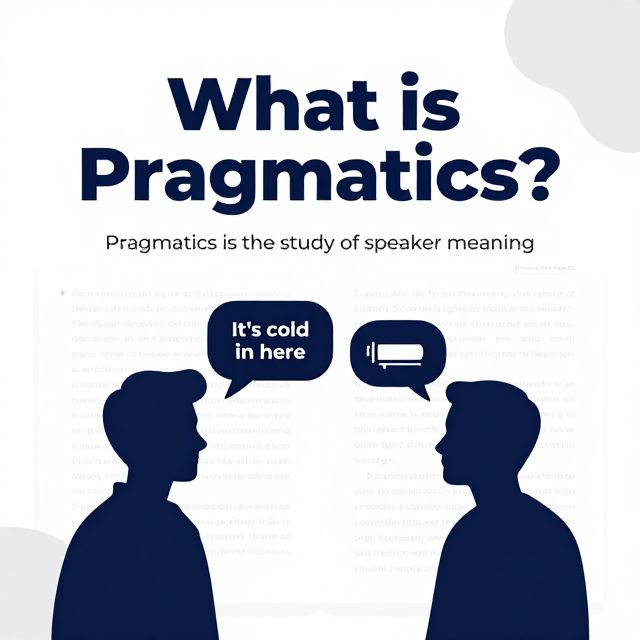
- Lara's statement is not a direct "Yes" or "No." However, Carol infers "No" or "Probably not" because she assumes Lara is being relevant (Relation maxim) and informative (Quantity maxim). Carol uses shared background knowledge (exams require studying, studying precludes partying) to derive the implicature.
🧠 Background Knowledge in Discourse Understanding
Our ability to interpret discourse heavily relies on background knowledge.
1. Schemas
📚 Definition: A schema (plural: schemata) is a general, conventional knowledge structure stored in memory, representing typical features of a concept or situation.
✅ Role: Schemas help us understand and predict information not explicitly stated. 💡 Examples:
- "Classroom schema": Our knowledge of what a classroom is typically like (desks, teacher, students, blackboard).
- "Supermarket schema": Expectations about food displayed on shelves, aisles, shopping carts, check-out counters.
2. Scripts
📚 Definition: A script is a dynamic schema, representing a series of conventional actions or events that typically occur in a particular situation.
✅ Role: Scripts allow us to infer a sequence of actions even if they are not explicitly mentioned. 💡 Examples:
- "Going to the dentist" script: Involves making an appointment, waiting, sitting in a chair, the dentist examining teeth, etc.
- "Eating in a restaurant" script: Involves entering, being seated, ordering, eating, paying, leaving.
- If a text says, "Suzy went into the nearest place, sat down and ordered an avocado sandwich... she left a good tip," we infer she opened a door, there were tables, she ate the sandwich, and paid for it, even though these actions aren't stated.
- Cough Syrup Instructions: "Fill measure cup to line and repeat every 2 to 3 hours." We understand we should drink the syrup, not rub it on our neck, because of our "taking medicine" script.
🎯 Conclusion
Understanding language involves more than just knowing grammar. It encompasses how words are formed through processes like borrowing, compounding, and blending. Crucially, it involves discourse analysis, which examines how we interpret meaning "beyond the sentence." This interpretation relies on both cohesion (explicit linguistic ties) and coherence (our cognitive ability to make sense of information using background knowledge). In conversations, the Co-operative Principle and its maxims guide our interactions, while hedges and implicatures reveal unspoken meanings. Ultimately, our schemas and scripts—our organized background knowledge—are vital for filling gaps and constructing comprehensive interpretations of the world through language.