 Podit
Podit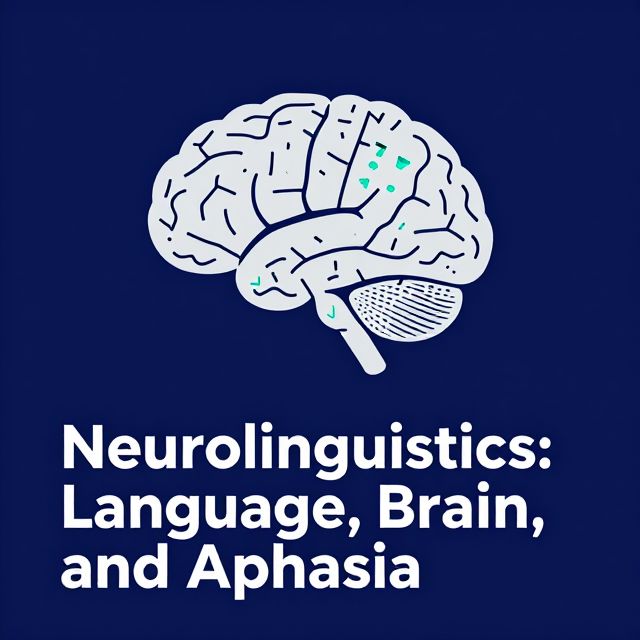
🧠 Language and the Brain: An Introduction to Neurolinguistics
Source Information: This study material is compiled from a copy-pasted text and a lecture audio transcript on the topic of "Language and the Brain."
📚 Overview of Neurolinguistics
Neurolinguistics is a fascinating interdisciplinary field dedicated to understanding the intricate relationship between the human brain and language. It scientifically investigates how the brain processes, comprehends, and generates language and communication. This field delves into both the structural and functional aspects of the brain, as well as the structure and function of language itself.
✅ Key Focus Areas:
- Brain Structure and Function: How different parts of the brain contribute to language.
- Language Structure and Function: How linguistic elements are represented and processed.
- Communication: The neural basis of human communication.
💡 Core Disciplines:
While closely related to psycholinguistics, neurolinguistics distinguishes itself by its primary focus on brain research. Its foundational disciplines include:
- Neurology: The study of the nervous system and its disorders.
- Linguistics: The scientific study of language.
- Psychology: The scientific study of the mind and behavior.
Modern neurolinguistic research often employs experiments, computer simulations, and neuroimaging studies. A particularly prominent area of study involves investigating language and communication impairments resulting from brain damage.
🌍 The Interdisciplinary Nature of Neurolinguistics
Neurolinguistics is profoundly interdisciplinary, drawing theories, methods, and findings from a vast array of academic fields. This rich integration provides diverse data, hypotheses, and research approaches, infusing the study with inspiration and vitality.
🤝 Contributing Fields:
- Humanities: Philosophy, Linguistics, Anthropology
- Medical Sciences: Neuroanatomy, Neurology, Neurophysiology, Psychiatry, Speech Pathology
- Natural Sciences: Neurobiology, Chemistry
- Social Sciences: Psychology, Cognitive Science
- Technology: Computer Science, Artificial Intelligence
🧠 Parts of the Brain and Their Functions
The brain, the central organ for language processing, is broadly divided into three main parts, which are further subdivided into specialized regions.
1️⃣ Major Brain Divisions:
- The Forebrain (Prosencephalon): The largest and most complex part of the brain.
- Includes the cerebrum, thalamus, hypothalamus, and pineal gland.
- The Midbrain (Mesencephalon): Located between the forebrain and hindbrain.
- Composed of a section of the brainstem, involved in motor movement, particularly movements of the eye, and in auditory and visual processing.
- The Hindbrain (Rhombencephalon): Located at the back of the brain.
- Made up of the remainder of the brainstem, the cerebellum, and the pons. It controls vital functions like breathing, heart rate, and balance.
2️⃣ The Cerebral Cortex: Hemispheres and Lobes
The cerebral cortex, the outermost layer of the cerebrum, is crucial for higher-order functions, including language. It consists of two cerebral hemispheres:
- Left Hemisphere: Typically dominant for language in most individuals.
- Right Hemisphere: Often dominant in left-handed individuals and plays a role in spatial and visual processing, as well as some aspects of language like intonation and context.
These two hemispheres function cooperatively, but one side is usually dominant for specific functions.
The cortex is further subdivided into four distinct lobes, each with specialized functions:
1. Frontal Lobe
- Location: Frontal part of the brain.
- Functions: Reasoning, physical ability, higher-order cognitive capacities (e.g., planning, decision-making), and expressive language.
- ⚠️ Damage Impact: Can affect sexual preferences, social relationships, and attention.
2. Parietal Lobe
- Location: Midsection of the brain.
- Functions: Processing tactile sensory information such as pressure, touch, and pain. Also involved in spatial awareness.
- ⚠️ Damage Impact: May result in difficulties with verbal memory, eye gaze control, and language focus.
3. Temporal Lobe
- Location: Cerebral hemisphere, below the frontal and parietal lobes.
- Functions: Visual and auditory memories, management of certain speech and hearing abilities, behavioral aspects, and language comprehension.
- ⚠️ Damage Impact: Can lead to difficulties with memory, speech perception, and overall language abilities.
4. Occipital Lobe
- Location: Rear of the skull in the cerebral hemisphere.
- Functions: Primarily controls vision.
- ⚠️ Damage Impact: Can result in visual difficulties such as failure to distinguish objects, inability to describe colors, and inability to recognize language (e.g., written words).
🗣️ Aphasia: Language Impairment
📚 Definition: Aphasia is a language impairment caused by disease or injury to the language-specific areas of the brain.
📉 General Symptoms:
Individuals with aphasia may experience difficulties in various aspects of language:
- Speaking: Finding appropriate words, forming sentences.
- Comprehension: Understanding spoken language.
- Reading: Recognizing and understanding written words.
- Writing: Composing words and sentences.
- Numbers: Employing numerical concepts.
📊 Types of Aphasia:
-
Broca's Aphasia (Non-fluent Aphasia)
- Damage Location: Generally in the anterior part of the left hemisphere (Broca's area).
- Characteristics: Impaired syntax, difficulty producing fluent speech. Speech may be reduced to single words in severe cases. Comprehension is relatively preserved.
-
Wernicke's Aphasia (Fluent Aphasia)
- Damage Location: Generally in the posterior part of the left hemisphere (Wernicke's area).
- Characteristics: Fluent but often nonsensical speech, using "foolish words and phrases." Individuals are usually unaware of their speech errors and may continue talking excessively. Significant difficulty with auditory comprehension.
-
Global Aphasia
- Damage Location: Frequently associated with a major lesion in the left hemisphere, affecting both Broca's and Wernicke's areas.
- Characteristics: Severe impairment in all language modalities (speaking, comprehension, reading, writing). The individual may be largely silent, communicating primarily through facial expressions and gestures.
-
Anomic Aphasia
- Severity: A less severe form of aphasia.
- Characteristics: Good comprehension and repetition abilities. The primary difficulty is word recognition and retrieval (anomia), leading to the use of generic fillers like "thing" when identifying intended words.
-
Transcortical Motor Aphasia (Non-fluent Aphasia)
- Similarity: Comparable to Broca's aphasia.
- Characteristics: Non-fluent speech, difficulty responding spontaneously to questions. However, individuals possess excellent repetition abilities and can easily repeat lengthy statements.
-
Transcortical Sensory Aphasia (Fluent Aphasia)
- Similarity: Comparable to Wernicke's aphasia.
- Characteristics: Fluent speech and normal repetition, but decreased auditory comprehension. Individuals may ask inquiries repeatedly rather than providing direct responses.
🔬 Neurological Investigation of Language Impairments
Neurologists investigate language abnormalities by comparing clinical data with linguistic analyses of abnormal language patterns. By examining the correlation between specific abnormal linguistic patterns and particular abnormal brain structures, they can deduce the type of brain abnormality responsible for a given language impairment. This approach helps neurologists understand how language is processed in the brain and how language impairment develops in patients who have sustained brain damage, leading to various forms of language loss.
📝 Conclusion
Neurolinguistics is a vital interdisciplinary field that bridges the gap between the complexities of the brain and the intricacies of language. By integrating insights from numerous scientific and humanistic disciplines, it explores how our brain processes and produces language. The brain's complex architecture, including its major divisions and specialized cortical lobes, underpins various linguistic and cognitive functions. Damage to these specific brain regions can result in diverse forms of aphasia, each characterized by distinct language impairments. Through ongoing clinical and linguistic investigations, neurologists continue to unravel the mechanisms of language processing and the etiology of language disorders, significantly advancing our understanding of human cognition.