The Developing Brain: Structure, Function, and Growth - kapak
Bilim#brain#neuroscience#neurogenesis#myelination

The Developing Brain: Structure, Function, and Growth

Explore the intricate structure of the brain, its cellular components, major regions, and the complex processes of brain development and physical growth from conception to adulthood.

itekinMarch 30, 2026 ~16 dk toplam
01

Flash Kartlar

25 kart

Karta tıklayarak çevir. ← → ile gez, ⎵ ile çevir.

1 / 25
Tüm kartları metin olarak gör
  1. 1. What are the three main components of a neuron and their primary functions?

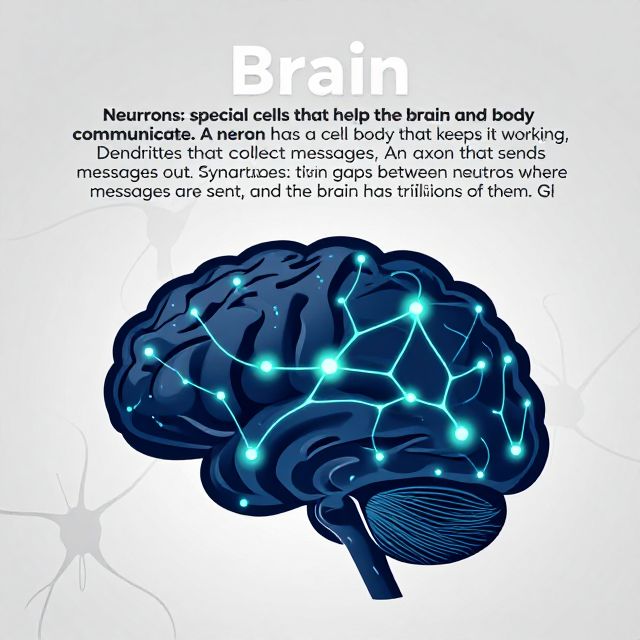
    A neuron consists of a cell body, which maintains the neuron's function; dendrites, which receive incoming messages from other neurons; and an axon, which transmits messages outward to other neurons. These components work together to facilitate communication within the nervous system.

  2. 2. Explain the role of synapses in neuronal communication.

    Synapses are the tiny gaps between neurons where communication occurs. When an electrical signal reaches the end of an axon, it triggers the release of neurotransmitters into the synapse, which then bind to receptors on the dendrites of the next neuron, transmitting the message. The brain contains trillions of these crucial connections.

  3. 3. What is the function of glial cells and the myelin sheath?

    Glial cells play a crucial supportive role in the brain by protecting neurons and accelerating message transmission. They achieve this acceleration by creating a myelin sheath, an insulating layer that wraps around axons. This sheath allows electrical signals to travel much faster along the neuron.

  4. 4. Which brain structure constitutes about eighty percent of the brain and what are some other major structures mentioned?

    The cerebral cortex constitutes about eighty percent of the brain's mass. Other major structures mentioned include the cerebellum and the brainstem. These structures, along with the cerebral cortex, form the larger organizational components of the brain.

  5. 5. Why is the brainstem considered vital, especially at birth?

    The brainstem is vital because it controls essential life-sustaining functions such as sleeping, breathing, blinking, and sucking. It is one of the most developed areas of the central nervous system at birth, ensuring that newborns can perform these critical functions immediately.

  6. 6. Describe the primary function of the occipital lobe.

    The occipital lobe is primarily responsible for processing visual information. It receives raw visual data from the eyes and interprets it, allowing us to perceive shapes, colors, and movements. Damage to this lobe can lead to various visual impairments.

  7. 7. What functions are associated with the temporal lobe?

    The temporal lobe is involved in processing hearing, language comprehension, and emotions. It plays a key role in interpreting sounds, understanding spoken words, and regulating emotional responses. This lobe is crucial for auditory perception and social interaction.

  8. 8. What is the role of the parietal lobe?

    The parietal lobe is involved in spatial processing and integrating sensory information from various parts of the body. It helps us understand where our body is in space, process touch, temperature, and pain, and combine different sensory inputs into a coherent perception of the world.

  9. 9. List the key functions of the frontal lobe.

    The frontal lobe is critical for higher-order cognitive functions. These include cognitive control, memory, planning, decision-making, and inhibition. It is essentially the brain's executive center, responsible for complex thought and goal-directed behavior.

  10. 10. What connects the two cerebral hemispheres, and what is the phenomenon of cerebral lateralization?

    The two cerebral hemispheres are connected by the corpus callosum, a thick band of nerve fibers. Cerebral lateralization is the phenomenon where each hemisphere is specialized for different processing modes, meaning certain functions are predominantly handled by one side of the brain.

  11. 11. Is the idea of being "left-brained" or "right-brained" accurate according to the text? Explain.

    No, the text states that it is a myth to suggest individuals are simply "left-brained" or "right-brained." While cerebral lateralization emerges early and hemispheres show specialization (e.g., right for faces, left for speech), this does not mean individuals exclusively use one side for all functions. Both hemispheres work together in complex ways.

  12. 12. Define neurogenesis and when it primarily occurs during development.

    Neurogenesis is the process of forming new neurons through cell division. It begins approximately six weeks after conception and is largely complete by the midway point of gestation. Most of the brain's neurons are formed before birth during this critical period.

  13. 13. Where does adult neurogenesis primarily occur, and what influences it?

    Adult neurogenesis primarily occurs in the hippocampus, a brain region crucial for memory and learning. This process is influenced by environmental factors, increasing under rewarding conditions and decreasing in threatening environments, highlighting the brain's adaptability.

  14. 14. How do neurons reach their designated areas in the developing cortex?

    After their formation, neurons migrate to their designated areas in the developing cortex. This migration is guided by glial cells, which act as scaffolding, providing a pathway for the neurons to follow to their correct locations.

  15. 15. What is arborization in the context of dendrite development?

    Arborization is a significant change in dendrites characterized by an enormous increase in their size and complexity. This process enhances their capacity to form connections with other neurons, greatly expanding the brain's communication network.

  16. 16. Explain myelination and its impact on message transmission.

    Myelination is the formation of an insulating myelin sheath around axons. This sheath dramatically increases the speed of message transmission along the neuron. It's a crucial process for efficient brain function, allowing for faster and more coordinated neural communication.

  17. 17. Describe the progression of myelination in different brain regions.

    Myelination starts prenatally, accelerates rapidly after birth, slows during toddlerhood, and continues into young adulthood. It progresses from deeper brain regions outward, with sensory areas maturing earlier than the frontal lobe executive function areas, reflecting the developmental sequence of brain functions.

  18. 18. What is the difference between white matter and gray matter in the brain?

    Myelinated axons appear as white matter due to the fatty myelin sheath. Unmyelinated neuronal cell bodies, along with dendrites and synapses, form gray matter. White matter facilitates rapid communication between different brain regions, while gray matter is involved in processing information.

  19. 19. What is synaptogenesis, and when does it primarily occur?

    Synaptogenesis is the process where each neuron forms synapses (connections) with thousands of other neurons, resulting in trillions of connections. This process begins prenatally and continues rapidly after birth, with timing varying across cortical areas, such as the sensorimotor cortex maturing earlier than the prefrontal cortex.

  20. 20. What is synaptic pruning, and what principle guides it?

    Synaptic pruning is a normal developmental process where approximately forty percent of synaptic connections are eliminated. It is guided by the 'use it or lose it' principle, meaning rarely active synapses disappear, optimizing brain efficiency. Atypical pruning patterns are observed in some developmental disorders.

  21. 21. Define brain plasticity and explain why children's brains are considered more plastic.

    Brain plasticity refers to the brain's capacity to be affected by experience, meaning its structure and function can change in response to environmental input. Children's brains are more plastic, offering better chances of recovery from damage compared to adults, due to their greater capacity for reorganization.

  22. 22. Differentiate between experience-expectant plasticity and experience-dependent plasticity.

    Experience-expectant plasticity refers to the brain's 'expectation' of species-typical experiences for proper development, like exposure to language. Experience-dependent plasticity involves unique individual experiences shaping neural connections throughout life, such as learning a musical instrument or living in an enriched environment.

  23. 23. Describe two key physical growth patterns observed in development.

    Two key growth patterns are the cephalocaudal pattern, which proceeds from head to toe (e.g., head control before leg control), and the proximodistal pattern, which proceeds from the middle of the organism out to the periphery (e.g., spinal cord before arm buds). These patterns illustrate the directional nature of physical development.

  24. 24. How do genetic and environmental factors influence variability in physical development?

    Both genetic and environmental factors influence physical development. Genes affect growth through hormones like growth hormone and thyroxine. Environmental influences are evident in secular trends, such as increased height and earlier menstruation in industrialized cultures over generations, showing the impact of nutrition and healthcare.

  25. 25. Explain the developmental principle of "sequence."

    The principle of sequence states that development follows a fundamental order. For example, one cell must exist before two, and muscles and bones must develop before nerves can coordinate movement. This principle highlights the sequential and hierarchical nature of biological development.

02

Bilgini Test Et

15 soru

Çoktan seçmeli sorularla öğrendiklerini ölç. Cevap + açıklama.

Soru 1 / 15Skor: 0

Which part of a neuron is responsible for collecting incoming messages from other neurons?

03

Detaylı Özet

6 dk okuma

Tüm konuyu derinlemesine, başlık başlık.

This study material is compiled from various sources, including copy-pasted text and a lecture audio transcript, to provide a comprehensive overview of brain structure, development, and physical growth.


🧠 Understanding the Brain and Development

This study guide explores the fundamental building blocks of the brain, its intricate developmental processes, and broader patterns of physical growth. It also highlights key principles that govern overall development.

1. The Brain's Fundamental Building Blocks and Regions

The brain is a complex organ responsible for communication between the body and the external world.

1.1. Cellular Components

  • Neurons 📚: Specialized cells that facilitate communication within the brain and between the brain and the body.
    • Cell Body: Maintains the neuron's function.
    • Dendrites: Collect incoming messages from other neurons.
    • Axon: Transmits messages outward to other neurons.
  • Synapses 📚: Tiny gaps between neurons where messages are transmitted. The human brain contains trillions of these connections.
  • Glial Cells 📚: Support cells that protect neurons and enhance message transmission speed by forming a myelin sheath around axons.

1.2. Major Brain Structures

The brain is organized into several key regions, each with specialized functions.

  • Cerebral Cortex: Constitutes approximately 80% of the brain's mass. It is responsible for higher-level cognitive functions.
    • Occipital Lobe: Primarily responsible for vision.
    • Temporal Lobe: Processes hearing, language, and emotions.
    • Parietal Lobe: Involved in spatial processing and integrating information from various sensory sources.
    • Frontal Lobe: Critical for cognitive control, memory, planning, decision-making, and inhibition.
  • Brain Stem: Controls vital functions essential for survival, such as sleeping, breathing, blinking, and sucking. It is one of the most developed areas of the Central Nervous System (CNS) at birth.
  • Cerebral Hemispheres: The brain is divided into two hemispheres, connected by the corpus callosum.
    • Cerebral Lateralization 📚: The specialization of each hemisphere for different modes of processing.
      • ✅ This specialization emerges early; for example, infants use their right hemispheres more for processing faces and their left for most aspects of speech (Adibpour et al., 2018; Dehaene-Lambertz, 2017).
      • ⚠️ Myth Busted: The idea that individuals are simply "left-brained" or "right-brained" is a simplification and largely a myth. Both hemispheres work together.

2. Brain Development: A Journey from Formation to Plasticity

Brain development is a dynamic and continuous process involving several key stages.

2.1. Early Stages of Neuronal Development

  • Neurogenesis 📚: The formation of new neurons through cell division.
    • 1️⃣ Begins approximately 6 weeks after conception and is largely complete by the midway point of gestation.
    • ✅ Most of the 100 billion neurons an adult possesses are formed before birth.
    • 💡 Neurogenesis continues throughout life, primarily in the hippocampus (crucial for memory and learning).
    • 📈 Environmental Influence: Adult neurogenesis increases under rewarding conditions and decreases in threatening environments.
  • Neuronal Migration: After formation, neurons travel to their specific destinations in the developing cortex, guided by glial cells acting as scaffolding.
  • Neuronal Differentiation: Once at their destination, neurons first grow an axon, then dendrites, and begin to develop specific structural and functional characteristics.
    • Arborization 📚: An enormous increase in the size and complexity of the dendritic tree, enhancing the dendrites' capacity to form connections.

2.2. Myelination and Synaptic Development

  • Myelination 📚: The formation of an insulating myelin sheath around axons, significantly increasing the speed of neural transmission.
    • 1️⃣ Starts prenatally.
    • 2️⃣ Occurs rapidly for the first few months after birth.
    • 3️⃣ Slows during toddlerhood.
    • 4️⃣ Continues into young adulthood.
    • 📊 Progression: Myelination begins deep in the brain and moves upward and outward. Sensory areas mature earlier than executive function areas in the frontal lobe.
    • White vs. Gray Matter: Myelinated parts of axons form white matter (subcortical, carries signals), while unmyelinated neuronal cell bodies form gray matter (cortical, processes information).
  • Synaptogenesis 📚: The rapid formation of synaptic connections between neurons, where each neuron forms synapses with thousands of others, resulting in trillions of connections.
    • ✅ Begins prenatally and proceeds rapidly before and after birth.
    • Timing Variation: The timing and rate of synapse production vary across cortical areas. Sensorimotor cortex completes synapse generation earlier than the prefrontal cortex, which matures into the mid-to-late twenties (responsible for planning, prioritizing, and decision-making).
  • Synaptic Pruning 📚: A normal developmental process where approximately 40% of synaptic connections are eliminated.
    • ✅ Guided by the "use it or lose it" principle: rarely active synapses are likely to disappear.
    • ⚠️ Atypical Patterns: Atypical pruning patterns are observed in developmental disorders, such as autism spectrum disorder (ASD), which can lead to larger brains and greater synaptic densities.

2.3. Brain Plasticity

  • Brain Plasticity 📚: The brain's capacity to be molded or changed by experience.
    • ✅ Children's brains are more plastic than adults', offering better chances of recovery from brain damage. For example, a child with early language area damage has a better chance of recovery than an adult with similar damage.
  • Two Kinds of Plasticity:
    • Experience-Expectant Plasticity 📚: The role of species-typical experiences in shaping brain development. The brain "expects" certain basic sensory inputs for proper wiring.
      • 💡 Example: Babies born with cataracts who do not have them removed early may have compromised visual system development, as the visual cortex reorganizes to process auditory information due to lack of visual input during a sensitive period.
      • ⚠️ Sensitive Periods: Periods during which the brain is particularly receptive to certain experiences. If the expected input is not received during this time, the neural organization may be irreversibly compromised.
    • Experience-Dependent Plasticity 📚: The role of unique individual experiences in shaping brain development throughout life.
      • 💡 Example 1: Rats raised in enriched environments develop more dendritic spines, more synapses, and thicker cortices compared to those in empty cages, and perform better in learning tasks (Sale et al., 2009).
      • 💡 Example 2: Musicians who play instruments like the trumpet show increased cortical cells devoted to controlling their lips after years of practice.

3. Physical Growth Patterns

Physical growth is a dynamic process characterized by uneven rates and patterns.

  • Body Fat & Growth Rate: Body fat is highest in infancy, gradually declining until 6-8 years. Growth is very rapid in the first two years and during early adolescence.
  • Uneven Growth Across the Body: The head region is disproportionately large in infants (e.g., 50% of body length at 2 months) compared to adulthood (10%).
    • 💡 "Cuteness" Hypothesis: This infant characteristic (large heads, high foreheads, large eyes) is hypothesized to boost parental motivation for care (Lorenz, 1971).
  • Two Growth Patterns:
    • 1️⃣ Cephalocaudal Pattern 📚: Development proceeds from head to toe. Infants gain control of head and neck muscles before their torso and legs (e.g., lifting head before sitting or walking).
    • 2️⃣ Proximodistal Pattern 📚: Development proceeds from the middle of the organism out to the periphery. The spinal cord develops before arm buds, and the heart and lungs develop before fingers.
  • Influences on Physical Development:
    • Genetic Factors: Primarily influence growth through hormones (e.g., growth hormone from the pituitary gland, thyroxine from the thyroid gland).
    • Environmental Factors: Evident in secular trends 📚, which are marked changes in physical development over generations.
      • 📈 Examples: Adults in industrialized cultures are several centimeters taller than their great-grandparents, and girls begin menstruating earlier.

4. Important Principles Underlying Development

Development is governed by several fundamental principles:

  1. Sequence is Fundamental ✅: Development follows a specific order (e.g., one cell before two, muscles/bones before nerve coordination).
  2. Timing is Crucial ✅: There are sensitive periods where exposure to certain factors (e.g., teratogens) can have severe effects, while exposure at other times may have little impact.
  3. Differentiation and Integration ✅: Development involves cells differentiating into specialized types and then integrating to form complex structures and functions.
  4. Development Proceeds Unevenly ✅: Various subsystems within an organism develop at their own rates (e.g., unevenness in physical development).
  5. Changes in Form and Interaction ✅: Development involves qualitative changes in both the organism's physical form and how it interacts with its environment.
  6. Development is Epigenetic 📚: Traits and characteristics emerge from the continuous interaction between genes and the environment, rather than being solely determined by genetics.
Kendi çalışma materyalini oluştur

PDF, YouTube videosu veya herhangi bir konuyu dakikalar içinde podcast, özet, flash kart ve quiz'e dönüştür. 1.000.000+ kullanıcı tercih ediyor.

Sıradaki Konular

Tümünü keşfet
The Nervous System: Structure, Tissue, and Communication

The Nervous System: Structure, Tissue, and Communication

An academic overview of the nervous system's anatomical and functional divisions, its cellular components, the role of myelination, and the electrical and chemical mechanisms of neuronal communication.

7 dk Özet 25 15
Nervous System: Structure, Function, and Signaling

Nervous System: Structure, Function, and Signaling

An academic overview of the nervous system's anatomical and functional divisions, cellular components, electrical signaling mechanisms, and inter-neuronal communication.

5 dk Özet 25 15
The Nervous and Endocrine Systems: Body's Control Centers

The Nervous and Endocrine Systems: Body's Control Centers

Explore the intricate workings of the nervous and endocrine systems, their structures, functions, and how they maintain the body's homeostasis.

Özet 25 15 Görsel
Anatomy of the Nervous System

Anatomy of the Nervous System

An academic overview of the nervous system, detailing the Central Nervous System (CNS) and Peripheral Nervous System (PNS), their components, functions, and associated disorders.

8 dk Özet 25 15
Human Brain Anatomy: Ventricles, Terminology, and Structures

Human Brain Anatomy: Ventricles, Terminology, and Structures

Explore the intricate anatomy of the human brain, covering the ventricular system, essential directional terms, embryonic development, and the major divisions and structures of the adult brain.

25 15
Cells & Signalling: The Brain's Language of Psychology

Cells & Signalling: The Brain's Language of Psychology

Unlock the secrets of how brain cells communicate to shape your thoughts, emotions, and behaviors. This podcast dives into neurons, neurotransmitters, and their profound impact on psychology.

10 dk Özet 25 15
The Neural Bases of Behaviour: An Introduction

The Neural Bases of Behaviour: An Introduction

An introductory guide to how the nervous system and brain support human behaviour, covering the CNS, PNS, and the role of neurons.

3 dk 22 10
Neurolinguistics: Language, Brain, and Aphasia

Neurolinguistics: Language, Brain, and Aphasia

This audio summary explores neurolinguistics, its interdisciplinary nature, the structure and functions of the brain's language areas, and various types of aphasia resulting from brain damage.

6 dk Özet 25 15