 Podit
Podit
This study material is compiled from a copy-pasted text and a lecture audio transcript.
📚 Discourse Analysis: Understanding Language Beyond the Sentence
🎯 Introduction to Discourse Analysis
Discourse analysis is the study of language beyond the sentence, focusing on how language is used in real-world texts and conversations. While traditional linguistics often examines the forms and structures of language in isolation, discourse analysis investigates how language users successfully interpret intended meanings, make sense of complex texts, understand implicit communication, and participate effectively in conversational activities. It delves into the practical application of language, including subtle cues like pauses, which can convey significant meaning, as humorously illustrated by comedian Jerry Seinfeld's observation on "favors."
✅ Key Focus: How language users interpret and convey meaning in context.
📖 Defining Discourse and Its Interpretation
What is Discourse?
The term "discourse" is typically defined as "language beyond the sentence." This means discourse analysis is concerned with studying language in complete texts and conversations, rather than just individual words or sentences.
💡 Insight: We are capable of more than just recognizing grammatically correct forms. We can interpret fragmented messages and infer relationships.
- Example 1: Newspaper headlines like "Trains collide, two die" are understood to mean the collision caused the deaths.
- Example 2: A sign "No shoes, no service" implies a conditional relationship: "If you are wearing no shoes, you will receive no service."
Interpreting Ungrammatical Discourse
Even when faced with texts containing errors, we actively try to make sense of them. Rather than simply rejecting an ungrammatical text, we attempt to arrive at a reasonable interpretation of the writer's intended message.
- Example: "My Town" Essay A student's essay, despite grammatical errors ("My natal was in a small town," "The distant between my town and Riyadh 7 miles exactly"), is generally understandable. This demonstrates our inherent drive to interpret and construct meaning, even when linguistic forms are imperfect.
🔗 Cohesion and Coherence: The Pillars of Textual Understanding
Cohesion: The Ties Within a Text
📚 Definition: Cohesion refers to the linguistic ties and connections that exist within a text, linking words and phrases to create a unified whole. These ties help maintain reference and establish relationships between ideas.
✅ Types of Cohesive Ties:
-
Reference: Using pronouns or repeated nouns to refer to the same entities (e.g., "father – he," "Lincoln – it").
-
Lexical Chains: Words sharing a common element of meaning (e.g., "bought – saving – penny – worth a fortune – sold – pay" all relate to "money").
-
Connectors: Words or phrases that mark relationships between sentences or clauses (e.g., "However," "and then," "so").
-
Verb Tense Consistency: Maintaining consistent verb tenses to connect events in time.
-
Example: "My father once bought a Lincoln convertible. He did it by saving every penny he could. That car would be worth a fortune nowadays. However, he sold it to help pay for my college education. Sometimes I think I’d rather have the convertible."
- Notice the connections: "father" -> "he"; "Lincoln convertible" -> "that car" -> "the convertible"; "bought," "saving," "penny," "worth a fortune," "sold," "pay" form a lexical chain related to money. "However" signals a contrast.
⚠️ Limitation of Cohesion: While crucial for well-written texts, cohesion alone is not sufficient for interpretation. A text can have many cohesive ties but still be nonsensical.
- Example: "My father bought a Lincoln convertible. The car driven by the police was red. That color doesn’t suit her. She consists of three letters. However, a letter isn’t as fast as a telephone call."
- This text has cohesive links ("Lincoln – the car," "red – that color," "her – she," "letters – a letter") but lacks overall meaning.
Coherence: Making Sense of the Whole
📚 Definition: Coherence is the concept of "everything fitting together well." Unlike cohesion, coherence does not reside in the words or structures themselves, but in the minds of the people who interpret the text. It's our ability to "make sense" of what we read and hear by aligning it with our experience of the world.
💡 Insight: We actively construct meaning by filling in gaps and creating meaningful connections that are not explicitly stated. This process is fundamental to understanding all discourse.
- Example: The "Telephone" Conversation
HER: That’s the telephone.
HIM: I’m in the bath.
HER: O.K.
- Despite a lack of explicit cohesive ties, we understand this conversation perfectly.
- 1️⃣ HER's implied request: "Please answer the telephone."
- 2️⃣ HIM's implied reason for refusal: "I cannot answer because I am bathing."
- 3️⃣ HER's implied action: "I will answer it myself."
- This interpretation relies on our background knowledge of how conversations work and typical actions associated with telephones and bathing.
🗣️ Conversation Analysis and The Co-operative Principle
Conversation as a Social Activity
English conversation is typically an activity where participants take turns speaking, usually one person at a time, with an avoidance of silence.
✅ Turn-Taking Mechanisms:
- Signaling Completion: Speakers indicate they are finished by asking a question, pausing at the end of a sentence, or completing a syntactic structure.
- Signaling Desire to Speak: Listeners can make short sounds, use body shifts, or facial expressions to indicate they want to take a turn.
💡 Turn-Taking Strategies: Different conversational styles exist.
-
"Rudeness" vs. "Shyness": Perceptions of rudeness (cutting in) or shyness (waiting too long) often stem from differing adherence to turn-taking conventions.
-
"Holding the Floor": Speakers can avoid normal completion points to keep talking by:
- Avoiding pauses at sentence ends.
- Using connectors like "and," "and then," "so," "but" to run sentences together.
- Placing pauses where the message is incomplete.
- Filling pauses with hesitation markers (e.g., "er," "em," "uh," "you know").
-
Example of Holding the Floor: "A: that’s their favorite restaurant because they … enjoy French food and when they were … in France they couldn’t believe it that … you know that they had … that they had had better meals back home"
- Pauses are strategically placed mid-sentence or filled, making it harder for others to interject.
The Co-operative Principle
Philosopher Paul Grice proposed that most conversational exchanges operate on an underlying assumption that participants are cooperating.
📚 Definition: "Make your conversational contribution such as is required, at the stage at which it occurs, by the accepted purpose or direction of the talk exchange in which you are engaged."
✅ Gricean Maxims (Supporting the Co-operative Principle):
- Quantity: Be as informative as required, but no more and no less.
- Quality: Do not say what you believe to be false or for which you lack adequate evidence.
- Relation: Be relevant.
- Manner: Be clear, brief, and orderly.
- Example: The "Sandwich" Reply
Woman 1: "How do you like the sandwich you are eating?"
Woman 2: "Oh, a sandwich is a sandwich."
- Interpretation: Logically, this states the obvious. However, assuming Woman 2 is being co-operative and adhering to the Quantity maxim, her lack of explicit evaluation implies she has no strong opinion. She is communicating that "the sandwich isn't worth talking about."
Hedges: Signaling Adherence to Maxims
📚 Definition: Hedges are words or phrases used to indicate that a speaker is concerned about following the maxims, suggesting that what they are saying might not be perfectly correct or complete.
- Examples:
- Quality Maxim Hedges: "As far as I know…," "Now, correct me if I’m wrong, but…," "I’m not absolutely sure, but…," "I think it’s possible that…"
- Accuracy Hedges: "His hair was kind of long," "The book cover is sort of yellow."
Implicatures: Conveying Unstated Meaning
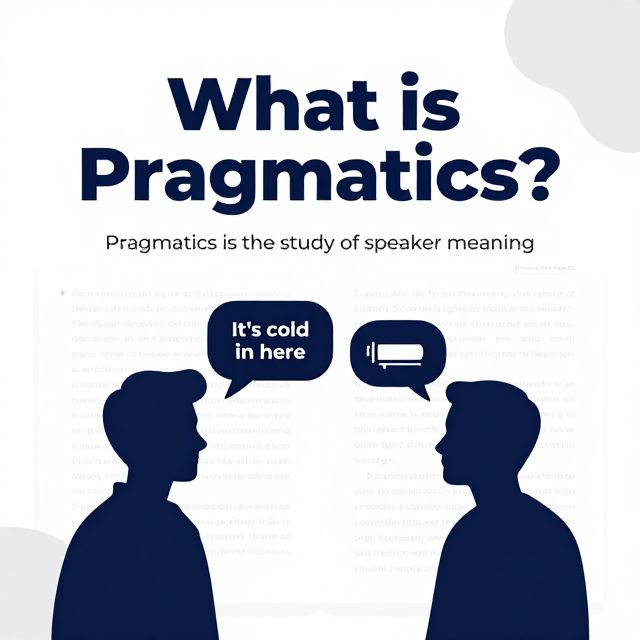
📚 Definition: An implicature is an additional conveyed meaning that is not explicitly said but is implied by the speaker and inferred by the listener, based on the co-operative principle and maxims.
💡 Vivid Example: The "Party/Exam" Scenario CAROL: Are you coming to the party tonight? LARA: I’ve got an exam tomorrow.
Let's break down how Carol arrives at the implicature "No" or "Probably not":
- Carol's Assumption: Carol assumes Lara is being co-operative and relevant (Relation maxim).
- Literal Meaning: Lara's statement is literally about an exam, not about attending the party.
- Shared Background Knowledge: Carol knows that having an exam tomorrow conventionally involves studying tonight, and studying tonight precludes partying tonight.
- Inference: Because Lara chose to state something relevant to her availability for the party, Carol infers that Lara's exam is the reason she cannot come.
- Conveyed Meaning (Implicature): Lara is implying, "No, I am not coming to the party tonight because I have an exam tomorrow and need to study."
This example vividly shows how we use maxims and shared background knowledge to grasp meanings that are not directly stated.
🧠 The Role of Background Knowledge: Schemas and Scripts
The interpretation of discourse heavily relies on the background knowledge shared by participants. This knowledge allows us to make inferences and understand meanings that are not explicitly stated.
Schemas: Conventional Knowledge Structures
📚 Definition: A schema (plural: schemata) is a general, conventional knowledge structure that exists in memory. It represents our organized knowledge about a particular concept or situation.
- Example: "John at School"
- "John was on his way to school last Friday. He was really worried about the math lesson."
- Initial Schema Activation: Most readers infer John is a schoolboy, walking or on a bus, based on their "school schema."
- "Last week he had been unable to control the class."
- Schema Revision: Readers now infer John is a teacher, unhappy, perhaps driving a car. The "schoolboy" schema is abandoned.
- "It was unfair of the math teacher to leave him in charge."
- Further Revision: John reverts to schoolboy status; the "teacher" schema is abandoned.
- "After all, it is not a normal part of a janitor’s duties."
- Final Revision: John is revealed to be a janitor.
- This example vividly demonstrates how our schemas are dynamic; we continuously build and revise interpretations based on new information and our expectations of what normally happens.
- "John was on his way to school last Friday. He was really worried about the math lesson."
Scripts: Dynamic Schemas for Actions
📚 Definition: A script is essentially a dynamic schema, representing a series of conventional actions that take place in a particular situation. It's our knowledge of typical event sequences.
- Example: "Eating in a Restaurant" Script
"Trying not to be out of the office for long, Suzy went into the nearest place, sat down and ordered an avocado sandwich. It was quite crowded, but the service was fast, so she left a good tip. Back in the office, things were not going well."
- Inferences from Script: Even though not stated, we infer Suzy opened a door, there were tables, she ate the sandwich, and then paid for it. Our "Eating in a Restaurant" script fills in these unmentioned actions.
💡 Vivid Example: The "Cough Syrup" Instructions "Fill measure cup to line and repeat every 2 to 3 hours."
- Interpretation: We don't literally keep filling the cup every 2-3 hours, nor do we rub it on our neck. Our "Taking Medicine" script tells us to drink the contents of the measure cup every 2-3 hours. This highlights how crucial scripts are for understanding even simple instructions, as they fill in vital, unstated actions.
Conclusion
Our understanding of language goes far beyond the literal meaning of words and sentences. Discourse analysis reveals that we actively construct meaning by leveraging linguistic connections (cohesion), making sense of information based on our world knowledge (coherence), adhering to unspoken rules of conversation (co-operative principle and maxims), and drawing on pre-existing mental frameworks (schemas and scripts). This complex interplay allows us to communicate effectively, interpret implicit messages, and navigate the intricacies of social interaction through language.