 Podit
Podit
This study material has been compiled from a lecture audio transcript and copy-pasted text provided by the user.
Pragmatics: Understanding Language in Context 📚
Introduction
This study material introduces the fundamental concepts of pragmatics, a crucial field in linguistics that explores how meaning is constructed and interpreted in real-world communication. We will delve into pragmatic competence, various kinds of pragmatics, the essential role of context, Speech Act Theory, and Grice's Cooperative Principle. Understanding these areas provides a comprehensive framework for analyzing the intricate nature of human communication.
1. Concepts of Pragmatics and Pragmatic Competence
1.1. What is Pragmatics? 💡
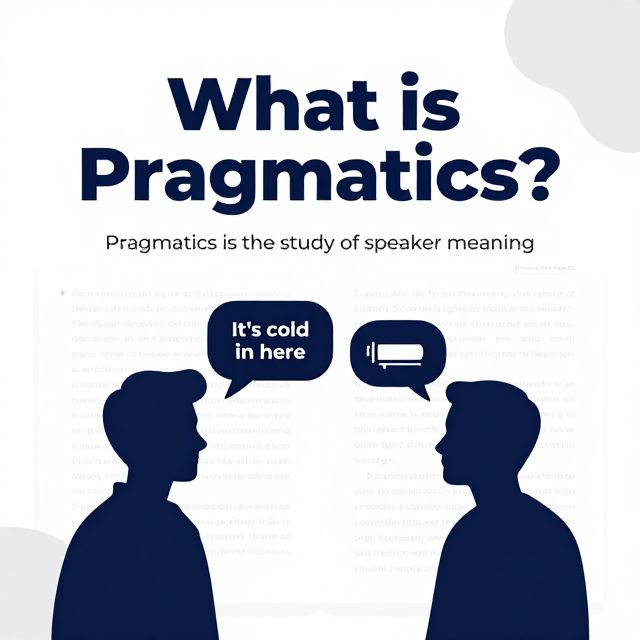
Pragmatics is the study of how individuals understand and produce communicative acts or speech acts within concrete speech situations, typically conversations. It distinguishes between two types of meaning in verbal communication:
- Informative Intent (Sentence Meaning): The literal meaning of the words and grammatical structure.
- Communicative Intent (Speaker Meaning): The meaning the speaker intends to convey, which often goes beyond the literal words.
- Scholarly References: Leech (1983), Sperber and Wilson (1986).
1.2. Pragmatic Competence ✅
Pragmatic competence refers to the ability to investigate and understand the communicative intentions of language users. It enables individuals to:
- Produce and interpret discourse effectively.
- Link utterances, sentences, and texts with their meanings.
- Connect meanings with the intentions of language users.
- Relate meanings to the relevant features of the language use setting.
- Scholarly Reference: Bachman and Palmer (2010).
2. Kinds of Pragmatics 📊
Pragmatics can be categorized into three distinct types, each focusing on a different aspect of language use:
2.1. Pragmalinguistics
- Focus: The linguistic resources available for conveying communicative acts and relational or interpersonal meanings.
- Resources: Includes pragmatic strategies such as directness and indirectness, routines, and other linguistic forms that can soften or intensify communicative acts.
2.2. Sociopragmatics
- Focus: The social perceptions underlying a participant's interpretation and performance of communicative action.
- Essence: Concerns appropriate social behavior in communication.
- Scholarly Reference: Leech (1983).
2.3. Psychopragmatics
- Focus: The cognitive side of pragmatics, examining how and to what extent pragmatic performance is subjected to specific cognitive conditions.
- Scholarly Reference: Naoum (2001).
3. The Concept of Context 🌍
Context is defined as "the environment in which a discourse occurs" (Song, 2010). It is crucial for understanding the intended meaning of an utterance. Li (2007) identifies four main types of context:
3.1. Linguistic Context
- Definition: Refers to what has already been said within the utterance or discourse.
- Example: In "I saw her yesterday," the meaning of "her" depends on previous mentions of a female.
3.2. Physical Context
- Definition: Encompasses the physical environment where communication takes place, including objects present and ongoing events.
- Example: Saying "Put it there" requires the listener to see where "there" is in the physical space.
3.3. Social Context
- Definition: Pertains to the social relationship between speakers and hearers.
- Example: The way you speak to a close friend differs from how you speak to a professor.
3.4. Epistemic Context
- Definition: Indicates the shared knowledge between both the speaker and the hearer.
- Example: An inside joke relies on shared epistemic context between the participants.
4. Speech Act Theory 🗣️
Originated by Austin, Speech Act Theory posits that speakers use language not just to say things, but to do things.
4.1. Austin's Three Components of Speech Acts
- Locutionary Act: 💬 The utterance of a sentence with a determinate sense and reference. It's the act of saying something.
- Example: Saying the words "It's cold in here."
- Illocutionary Act: 🎯 The making of a statement, offer, promise, etc., by virtue of the conventional force associated with the utterance. It's the intention or force behind what is said.
- Example: By saying "It's cold in here," the speaker might be requesting someone to close the window.
- Perlocutionary Act: 👂 The bringing about of effects on the audience by means of uttering the sentence. These effects are specific to the circumstances of the utterance.
- Example: The listener, upon hearing "It's cold in here," closes the window (the effect).
4.2. Searle's Five Illocutionary Points
Searle further refined the theory, proposing five types of illocutionary points speakers can achieve:
- Assertive: 📝 Speakers represent how things are in the world (e.g., stating, claiming, reporting).
- Commissive: 🙏 Speakers commit themselves to doing something (e.g., promising, vowing, offering).
- Directive: 🗣️ Speakers try to get hearers to do something (e.g., ordering, requesting, advising).
- Declarative: ✨ Speakers do things in the world at the moment of the utterance solely by virtue of saying that they do (e.g., declaring war, marrying, baptizing).
- Expressive: 🎭 Speakers express their attitudes about objects and facts of the world (e.g., thanking, apologizing, congratulating).
- Scholarly Reference: Nordquist (2014).
4.3. Critique of Speech Act Theory ⚠️
As Barron (2003) notes, Speech Act Theory has been criticized for:
- Regarding the hearer as playing a passive role.
- Disregarding interactional aspects of conversation.
- Being limited in explaining real conversational dynamics because it overlooks the relationship of speech acts to other speech acts within a broader discourse context.
5. The Cooperative Principle ✅
To explain the distinction between what is directly uttered and what is implied, Grice proposed the Cooperative Principle. This principle suggests that participants in a conversation operate under a covert assumption to ensure effective communication.
5.1. Grice's Cooperative Principle
"Make your conversational contribution such as is required, at the stage at which it occurs, by the accepted purpose or direction of the talk exchange in which you are engaged."
5.2. Grice's Four Maxims
This principle is elaborated through four maxims, which include nine sub-maxims:
5.2.1. Maxims of Quantity
- Make your contribution as informative as is required.
- Do not make your contribution more informative than is required.
5.2.2. Maxims of Quality
- Try to make your contribution one that is true.
- Do not say what you believe to be false.
- Do not say that for which you lack adequate evidence.
5.2.3. Maxim of Relation
- Be relevant.
5.2.4. Maxims of Manner
- Be perspicuous (clear).
- Avoid obscurity of expression.
- Avoid ambiguity.
- Be brief.
- Be orderly.
5.3. Example: Doctor-Patient Dialogue 🩺
Consider this exchange:
- Doctor: "What is your complaint?"
- Patient: "I cannot lose weight. I am getting fatter and fatter."
- Doctor: "Eat less and do sports regularly."
- Patient: "O.K. Thanks!"
In this example:
- The patient's response adheres to the Maxim of Quantity (informative enough) and the Maxim of Relation (relevant to the doctor's question).
- The doctor's advice, based on the patient's information, also follows the Cooperative Principle by providing a relevant and informative solution. The interaction is cooperative, even if the doctor's advice lacks a direct directive force regarding compliance.
Conclusion
This overview has systematically presented the core tenets of pragmatics. We have defined pragmatics as the study of meaning in context and pragmatic competence as the ability to interpret communicative intentions. The discussion then moved to the various kinds of pragmatics—pragmalinguistics, sociopragmatics, and psychopragmatics—each addressing different facets of language use. The critical role of context was explored through its linguistic, physical, social, and epistemic dimensions. Furthermore, Speech Act Theory, with its locutionary, illocutionary, and perlocutionary acts, and Searle's five illocutionary points, provided a framework for understanding language as action. Finally, Grice's Cooperative Principle and its maxims of Quantity, Quality, Relation, and Manner were detailed as fundamental guidelines for effective and coherent conversation. These concepts collectively form the bedrock for analyzing and understanding the intricate nature of human communication.