Podit
Podit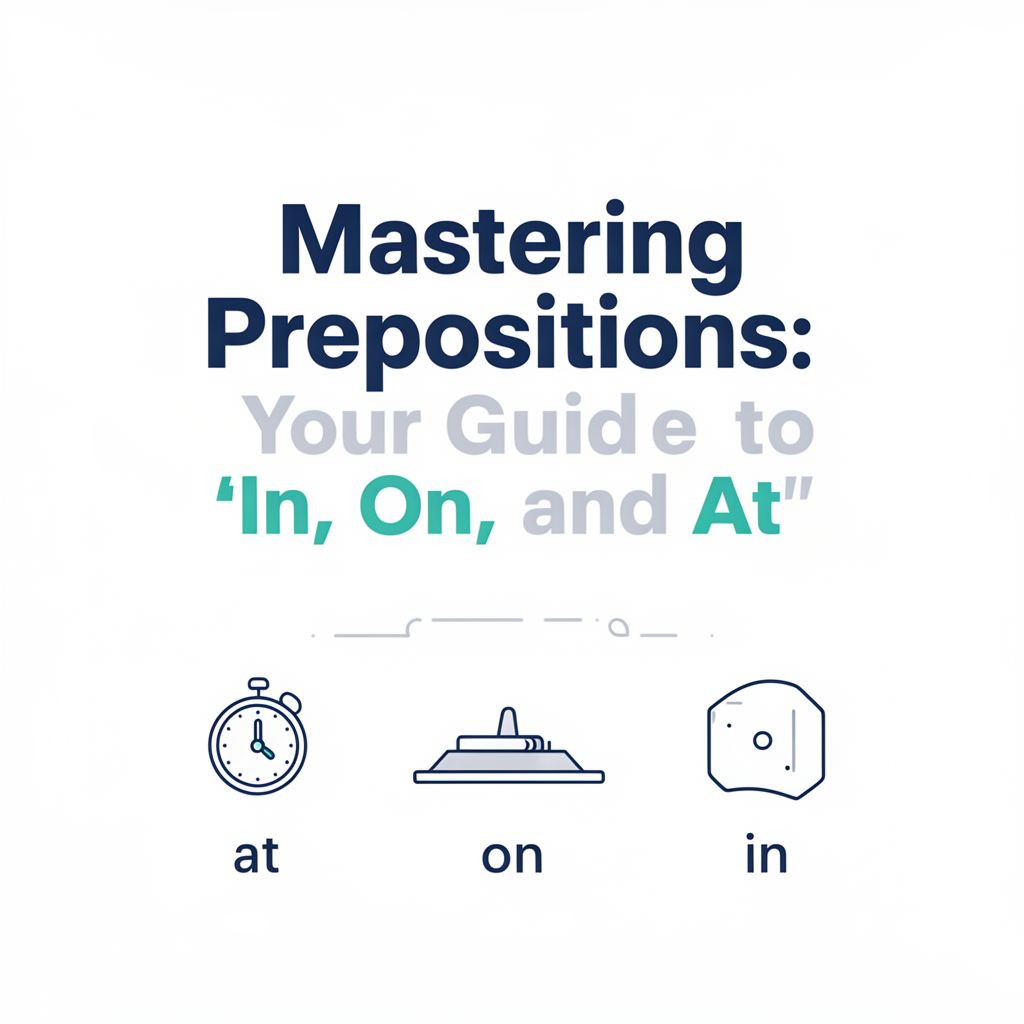
Sesli Özet
4 dakikaKonuyu otobüste, koşarken, yolda dinleyerek öğren.
Sesli Özet
Mastering Prepositions: Your Guide to 'In,' 'On,' and 'At'
Flash Kartlar
25 kartKarta tıklayarak çevir. ← → ile gez, ⎵ ile çevir.
Tüm kartları metin olarak gör
1. What is the primary function of a preposition?
A preposition shows the relationship between a noun or pronoun and other words in a sentence, often indicating location, time, or direction.
2. What three main types of relationships do prepositions typically show?
Prepositions typically show relationships concerning location, time, or direction within a sentence.
3. Why are prepositions considered important in English grammar?
They are crucial because they connect ideas, provide context, and add precision to sentences, preventing confusion.
4. What would happen to sentences without prepositions?
Without prepositions, sentences would be incredibly confusing and lack precision, making it difficult to understand relationships between words.
5. Give an example of how a preposition changes sentence meaning.
The phrase 'The book is the table' makes no sense, but 'The book is *on* the table' clearly indicates its location.
6. Which three prepositions are often considered the most common and confusing?
The three prepositions often considered the most common and confusing are 'in,' 'on,' and 'at.'
7. When is 'at' used for place?
'At' is used for a very specific point or location, like pointing a finger at a spot.
8. Provide an example of 'at' used for a specific place.
An example is 'I'm *at* the bus stop' or 'She's waiting *at* the corner.'
9. What analogy is used to describe 'at' for place?
The analogy used to describe 'at' for place is that ''At' is a pin,' indicating a precise point.
10. When is 'on' used for place?
'On' is used for surfaces or lines, suggesting something resting on top of another object or along a path.
11. Give an example of 'on' used for a surface.
An example is 'The picture is *on* the wall' or 'We live *on* Main Street.'
12. What analogy is used to describe 'on' for place?
The analogy used to describe 'on' for place is that ''on' is a sticker,' implying adherence to a surface.
13. When is 'in' used for place?
'In' is used for enclosed spaces or larger, more general areas, like being inside something.
14. Provide an example of 'in' used for an enclosed space.
An example is 'The keys are *in* my pocket' or 'I live *in* London.'
15. What analogy is used to describe 'in' for place?
The analogy used to describe 'in' for place is that ''in' is a container,' representing an enclosed area.
16. When is 'at' used for time?
'At' is used for very specific times, such as a particular hour or moment.
17. Give an example of 'at' used for a specific time.
An example is 'Let's meet *at* 7 PM' or 'The store closes *at* midnight.'
18. When is 'on' used for time?
'On' is used for specific days or dates, indicating a particular day of the week or a calendar date.
19. Provide an example of 'on' used for a specific date.
An example is 'My birthday is *on* July 15th' or 'We have a meeting *on* Tuesday.'
20. When is 'in' used for time?
'In' is used for longer periods like months, years, or seasons.
21. Give an example of 'in' used for a longer period of time.
An example is 'I was born *in* October' or 'We'll go on vacation *in* the summer.'
22. What is the key takeaway regarding prepositions?
The key takeaway is that prepositions are small but mighty words essential for making English precise and natural.
23. What are the best ways to master prepositions?
The best ways to master prepositions are to read a lot, listen to native speakers, and consistently practice using them.
24. How do prepositions contribute to sentence clarity?
Prepositions add vital context and clarity by showing relationships between nouns/pronouns and other sentence elements.
25. What is a common challenge when learning prepositions?
A common challenge is mixing them up, but consistent practice helps make their usage more intuitive over time.