English Vocabulary: A Foundational Lexical Overview - kapak
Eğitim#english vocabulary#language learning#lexicon#grammar

English Vocabulary: A Foundational Lexical Overview

An academic summary of a foundational English vocabulary list, focusing on words beginning with 'A', their grammatical functions, and their significance for language acquisition.

medyaFebruary 14, 2026 ~25 dk toplam
01

Sesli Özet

7 dakika

Konuyu otobüste, koşarken, yolda dinleyerek öğren.

Sesli Özet

English Vocabulary: A Foundational Lexical Overview

0:006:49
02

Flash Kartlar

25 kart

Karta tıklayarak çevir. ← → ile gez, ⎵ ile çevir.

1 / 25
Tüm kartları metin olarak gör
  1. 1. What is the primary focus of this English vocabulary compilation?

    The primary focus of this English vocabulary compilation is to present a foundational list of English words. It specifically concentrates on terms beginning with the letter 'A' and includes a diverse range of lexical items such as nouns, verbs, adjectives, and adverbs. This provides a basic yet comprehensive overview for language acquisition.

  2. 2. According to the text, what does the noun 'ability' denote?

    According to the text, the noun 'ability' denotes a capacity or skill. It represents an abstract concept, highlighting a person's inherent or acquired power to perform a particular action or task effectively. This term is crucial for discussing personal capabilities.

  3. 3. Define the noun 'absence' as described in the foundational vocabulary section.

    The noun 'absence' is described as signifying a state of not being present. It refers to the condition of someone or something being away from a particular place or situation, often implying a lack or a void. This concept helps describe states of being.

  4. 4. What are two meanings provided for the noun 'account' in the text?

    The text provides two meanings for the noun 'account': it can refer to a record, such as a written or spoken report of an event, or it can signify a financial statement, detailing monetary transactions. This versatility makes 'account' a key term in both narrative and financial contexts.

  5. 5. Explain the meaning of the verb 'abandon' as presented in the foundational vocabulary.

    The verb 'abandon' means to cease to support or look after someone or something. It implies leaving a person, place, or thing permanently, often due to necessity, desertion, or giving up on an effort. This verb expresses a dynamic interaction of disengagement.

  6. 6. How is the verb 'accept' defined in the context of foundational vocabulary?

    The verb 'accept' is defined as meaning to receive willingly. This implies taking something offered, agreeing to something, or acknowledging something as true or appropriate without resistance. It is fundamental for expressing agreement or reception.

  7. 7. What does the verb 'achieve' signify according to the text?

    The verb 'achieve' signifies successfully bringing about or reaching a desired objective. It implies the successful completion of a goal or the attainment of a particular outcome through effort and determination. This verb is essential for describing accomplishments.

  8. 8. Describe the meaning of the adjective 'able' and its contrast with 'unable'.

    The adjective 'able' describes possessing the necessary power or skill to do something, indicating capability. In contrast, 'unable' indicates a lack thereof, meaning not having the power, skill, or opportunity to do something. These antonyms provide clear distinctions in describing capacity.

  9. 9. What does the adjective 'absolute' convey?

    The adjective 'absolute' conveys certainty or completeness. It suggests something is total, unconditional, or without any doubt or limitation, often used to emphasize a strong belief or a definitive state. This adjective adds precision to descriptions.

  10. 10. Provide the definition of the adjective 'accurate' from the text.

    The adjective 'accurate' refers to being correct in all details. It implies precision, exactness, and freedom from error, ensuring that information or measurements are true and without deviation. This term is vital for describing correctness and reliability.

  11. 11. How do adverbs like 'absolutely', 'accidentally', and 'accurately' function in sentences?

    Adverbs like 'absolutely', 'accidentally', and 'accurately' provide essential details about the manner, cause, or precision of actions. They modify verbs, adjectives, or other adverbs, with 'absolutely' emphasizing certainty, 'accidentally' indicating an unintentional action, and 'accurately' denoting precision. They enrich the description of actions and states.

  12. 12. Name three fundamental prepositions mentioned in the text and their general function.

    Three fundamental prepositions mentioned are 'about', 'above', and 'across'. These prepositions are vital for indicating spatial relationships, topics, or positions, helping to show the connection between a noun or pronoun and other words in a sentence. They are crucial for constructing elementary English sentences.

  13. 13. What is the purpose of the phrase 'according to' as presented in the text?

    The phrase 'according to' is presented as a means of attributing information to a source. It is used to indicate that what is being said or written comes from a particular person, document, or statement. This phrase is essential for citing information and giving credit.

  14. 14. Explain the meaning of the multi-word expression 'take action'.

    The multi-word expression 'take action' illustrates a common expression for initiating activity. It means to do something in order to deal with a problem or achieve an objective, signifying the start of an active response. This phrase is a practical example of idiomatic language.

  15. 15. What is the primary difference between the foundational and expanding vocabulary sections?

    The foundational vocabulary section provides a robust base for basic communication, covering core concepts and everyday occurrences. The expanding vocabulary section builds upon this, introducing a more nuanced and expansive set of words, often describing complex interactions and specific attributes, thereby enhancing precision and covering more abstract ideas. This progression supports advanced linguistic development.

  16. 16. How is the verb 'adapt' defined in the expanding vocabulary section?

    In the expanding vocabulary section, the verb 'adapt' is defined as meaning to make something suitable for a new use or purpose. It implies modifying or adjusting something to fit new conditions or requirements, often for survival or improved functionality. This verb describes a process of change and suitability.

  17. 17. What does the verb 'adjust' signify?

    The verb 'adjust' signifies altering or moving something slightly to achieve a desired fit or result. It implies making small changes to improve accuracy, comfort, or effectiveness, often in response to specific needs. This verb is key for describing fine-tuning and modification.

  18. 18. Differentiate between the verbs 'admire' and 'appreciate' based on the text.

    Both 'admire' and 'appreciate' convey positive emotional responses. 'Admire' denotes respect and approval for someone or something, often for their qualities or achievements. 'Appreciate' signifies recognition of value or importance, often involving gratitude or understanding the worth of something. While both are positive, 'admire' focuses on respect for qualities, and 'appreciate' on recognizing worth.

  19. 19. What are the two possible meanings of the verb 'admit' mentioned in the text?

    The verb 'admit' can mean to confess, acknowledging something as true, often reluctantly. Alternatively, it can mean to allow entry, granting permission for someone or something to enter a place or organization. These two distinct meanings highlight its versatility in expressing confession or permission.

  20. 20. Define the noun 'advertisement' and its abbreviated form 'ad'.

    'Advertisement' and its abbreviated form 'ad' are nouns related to commercial communication. They refer to a notice or announcement in a public medium promoting a product, service, or event, designed to attract public attention. These terms are essential for discussing marketing and media.

  21. 21. What emotional responses are represented by the nouns 'admiration' and 'affection'?

    The nouns 'admiration' and 'affection' represent positive emotional responses. 'Admiration' signifies respect and warm approval, often for someone's qualities or achievements. 'Affection' denotes a gentle feeling of fondness or liking, typically towards another person. Both terms describe positive human emotions.

  22. 22. How do 'anniversary' and 'annual' relate to temporal markers?

    'Anniversary' and 'annual' are nouns related to temporal markers. An 'anniversary' is a date on which an event took place in a previous year, celebrated or remembered. 'Annual' refers to something occurring once every year, indicating a yearly cycle. They both mark specific points or periods in time.

  23. 23. Describe the emotional states conveyed by 'anger' and 'anxiety'.

    'Anger' and 'anxiety' convey distinct emotional states. 'Anger' signifies strong displeasure, often accompanied by hostility or frustration. 'Anxiety' refers to a state of apprehension, worry, or unease, typically about an imminent event or something with an uncertain outcome. These terms are crucial for describing negative emotional experiences.

  24. 24. What do the nouns 'application', 'appointment', and 'approval' represent in administrative or social processes?

    In administrative or social processes, 'application' is a formal request, often in writing, for something like a job or permit. 'Appointment' is a scheduled meeting or arrangement to meet someone. 'Approval' refers to official sanction or agreement, indicating that something is acceptable or authorized. These nouns are fundamental for understanding formal procedures.

  25. 25. Give three examples of adjectives from the expanding vocabulary section that provide specific descriptors.

    Three examples of adjectives providing specific descriptors are 'additional' (meaning extra), 'adequate' (signifying sufficient), and 'advanced' (describing something highly developed). These adjectives allow for greater precision in communication by detailing attributes, conditions, and levels of development. They enhance the descriptive power of language.

03

Bilgini Test Et

15 soru

Çoktan seçmeli sorularla öğrendiklerini ölç. Cevap + açıklama.

Soru 1 / 15Skor: 0

What is the primary focus of the English vocabulary compilation discussed in the text?

04

Detaylı Özet

8 dk okuma

Tüm konuyu derinlemesine, başlık başlık.

This study material compiles essential English vocabulary, primarily focusing on words beginning with the letter 'A'. It integrates information from a copy-pasted text and a lecture audio transcript to provide a structured and comprehensive resource for language learners.


English Vocabulary Compilation: Mastering 'A' Words 📚

This study guide is designed to help you effectively learn and memorize a foundational set of English vocabulary. It combines a direct list of words with contextual explanations from a lecture, focusing on clear definitions and practical application.

1. Understanding English Vocabulary: Direct Meaning & Memorization 💡

Learning new vocabulary is crucial for language acquisition. The most effective way to build your word bank is by understanding the direct meaning of each word and actively practicing its use. While grammatical categories (like noun, verb, adjective) are important for sentence construction, the primary focus here is on grasping the core concept each word represents.

Tips for Effective Memorization:

  • Focus on Core Meaning: Understand what the word means first and foremost.
  • Contextual Learning: Try to use the word in a simple sentence or imagine a situation where it would be used.
  • Active Recall: Regularly test yourself. Don't just read the words; try to recall their meanings without looking.
  • Repetition: Review the words multiple times over several days.
  • Pronunciation Practice: Although not provided here, actively listening to and practicing the pronunciation of each word is vital for speaking and understanding. Use online dictionaries for audio pronunciation.

2. Foundational Vocabulary: Core Concepts and Actions (A-Words)

This section covers essential words that form a robust base for basic communication and comprehension. Each entry includes the English word, its part of speech, and a concise English definition.

Nouns 📚

  • Ability (Noun): The power or skill to do something.
    • Example: Her ability to solve complex problems is impressive.
  • Absence (Noun): The state of being away or not present.
    • Example: His absence from the meeting was noted.
  • Account (Noun): A record or statement, often financial; a report of an event.
    • Example: Please check your bank account.
  • Accident (Noun): An unfortunate incident that happens unexpectedly and unintentionally.
    • Example: The car accident caused a delay.
  • Accommodation (Noun): A place to live or stay, such as lodging or housing.
    • Example: We found excellent accommodation for our trip.
  • Achievement (Noun): A thing done successfully, often through effort or skill.
    • Example: Winning the award was a great achievement.
  • Action (Noun): The process of doing something, typically to achieve an aim.
    • Example: We need to take action to solve this problem.
  • Activity (Noun): The state of being active; a thing that a person does.
    • Example: Reading is a quiet activity.
  • Actor (Noun): A person whose profession is acting in plays or films.
  • Actress (Noun): A female actor.
  • Apple (Noun): A common round fruit, typically red or green.

Verbs ✅

  • Abandon (Verb): To cease to support or look after; to leave behind.
    • Example: They had to abandon their car in the snow.
  • Absorb (Verb): To take in or soak up; to understand fully.
    • Example: It's hard to absorb so much information at once.
  • Accept (Verb): To receive willingly; to agree to take.
    • Example: She accepted the job offer.
  • Accompany (Verb): To go somewhere with someone as a companion or escort.
    • Example: He will accompany me to the event.
  • Accuse (Verb): To charge someone with an offense or crime.
    • Example: They accused him of cheating.
  • Achieve (Verb): To successfully bring about or reach an objective by effort.
    • Example: She hopes to achieve her goals.
  • Acknowledge (Verb): To accept or admit the existence or truth of.
    • Example: He acknowledged his mistake.
  • Acquire (Verb): To gain possession of something; to obtain.
    • Example: The company aims to acquire new customers.
  • Act (Verb): To take action or perform a role.
    • Example: He decided to act immediately.

Adjectives ✅

  • Able (Adjective): Having the necessary power or skill to do something.
    • Example: She is able to speak three languages.
  • Unable (Adjective): Lacking the power or skill to do something.
  • Absent (Adjective): Not present in a place.
  • Absolute (Adjective): Complete; total; without doubt.
    • Example: That's an absolute truth.
  • Acceptable (Adjective): Able to be agreed on; satisfactory.
  • Unacceptable (Adjective): Not satisfactory or allowable.
  • Accidental (Adjective): Happening by chance or unintentionally.
  • Accurate (Adjective): Correct in all details; exact.
    • Example: The report provided accurate information.
  • Active (Adjective): Engaged in action or movement; busy.
  • Ancient (Adjective): Belonging to the very distant past.
  • Angry (Adjective): Feeling or showing strong annoyance or hostility.

Adverbs ✅

  • Absolutely (Adverb): Completely; totally; without doubt.
    • Example: "Are you sure?" "Absolutely!"
  • Accidentally (Adverb): By chance; unintentionally.
    • Example: I accidentally dropped my phone.
  • Accurately (Adverb): In a way that is correct in all details; precisely.
    • Example: He measured the ingredients accurately.
  • Actively (Adverb): In an active manner; energetically.
  • Angrily (Adverb): In an angry manner.

Prepositions & Phrases ✅

  • About (Preposition): On the subject of; approximately.
  • Above (Preposition): At a higher level than.
  • Abroad (Adverb): In or to a foreign country.
  • Across (Preposition): From one side to the other of.
  • According to (Phrase): As stated by or in.
  • Take action (Phrase): To do something in order to deal with a problem.

3. Expanding Vocabulary: Advanced Concepts and Nuances (More A-Words)

Building on the foundational terms, this section introduces a more nuanced set of words, further enriching your capacity for detailed expression.

Nouns 📚

  • Ad (Noun): Short for advertisement.
  • Addition (Noun): The action or process of adding something.
  • Address (Noun): The particulars of the place where someone lives.
  • Admiration (Noun): Respect and warm approval.
  • Adult (Noun): A person who is fully grown or developed.
  • Advantage (Noun): A condition that puts one in a favorable position.
    • Example: His experience gave him an advantage.
  • Adventure (Noun): An unusual and exciting experience.
  • Advertisement (Noun): A public notice promoting a product or service.
  • Advice (Noun): Guidance or recommendations offered.
  • Affair (Noun): A matter of public or private concern.
  • Affection (Noun): A gentle feeling of fondness or liking.
  • Agency (Noun): A business providing a particular service.
  • Age (Noun): The length of time a person has lived.
  • Anger (Noun): A strong feeling of displeasure or hostility.
  • Ankle (Noun): The joint connecting the foot with the leg.
  • Anniversary (Noun): The date on which an event took place in a previous year.
  • Anxiety (Noun): A feeling of worry, nervousness, or unease.
  • Appearance (Noun): The way that someone or something looks.
  • Application (Noun): A formal request or a program.
  • Appointment (Noun): A formal arrangement to meet someone.
  • Approval (Noun): Official agreement or acceptance.
  • Approach (Noun): A way of dealing with something.

Verbs ✅

  • Adapt (Verb): To make something suitable for a new use or purpose; to adjust.
    • Example: We need to adapt to new technologies.
  • Add (Verb): To join something to something else.
  • Adjust (Verb): To alter or move something slightly to achieve a desired result.
    • Example: Please adjust the volume.
  • Admire (Verb): To regard with respect or warm approval.
    • Example: I admire her dedication.
  • Admit (Verb): To confess to be true; to allow entry.
  • Adopt (Verb): To take on or assume an idea; to legally take a child.
  • Advance (Verb): To make progress or move forward.
    • Example: The army began to advance.
  • Advertise (Verb): To promote a product or service publicly.
  • Advise (Verb): To offer suggestions about the best course of action.
  • Affect (Verb): To have an effect on; to make a difference to.
    • Example: The weather will affect our plans.
  • Afford (Verb): To have enough money to pay for something.
  • Announce (Verb): To make a public statement.
  • Annoy (Verb): To make someone a little angry; to irritate.
  • Anticipate (Verb): To regard as probable; expect.
  • Apologize (Verb): To express regret for something done wrong.
  • Appeal (Verb): To make a serious or urgent request.
  • Appear (Verb): To become visible or noticeable; to seem.
  • Apply (Verb): To make a formal request; to put something into use.
  • Appoint (Verb): To assign a job or role to someone.
  • Appreciate (Verb): To recognize the full worth of; to be grateful for.
    • Example: I appreciate your help.
  • Approve (Verb): To officially agree to or accept as satisfactory.

Adjectives ✅

  • Additional (Adjective): Extra; supplementary.
  • Adequate (Adjective): Satisfactory or acceptable in quality or quantity.
    • Example: The food supply was barely adequate.
  • Advanced (Adjective): Far on or ahead in development or progress.
    • Example: She is studying advanced mathematics.
  • Afraid (Adjective): Feeling fear or anxiety; frightened.
  • Aged (Adjective): Of a specified age; old.
  • Annual (Adjective): Occurring once every year.
  • Anxious (Adjective): Feeling or showing worry or unease.
  • Apparent (Adjective): Clearly visible or understood; obvious.
  • Appropriate (Adjective): Suitable or proper in the circumstances.
  • Approving (Adjective): Showing or expressing approval.
  • Approximate (Adjective): Close to the actual, but not precisely accurate.
  • Actual (Adjective): Existing in fact; real.

Adverbs ✅

  • Actually (Adverb): In fact; in reality.
    • Example: I thought it was easy, but it was actually quite difficult.
  • Adequately (Adverb): In a satisfactory or sufficient way.
  • Afterwards (Adverb): At a later or subsequent time.
  • Again (Adverb): Another time; once more.
  • Anyway (Adverb): In any case; regardless.
  • Anywhere (Adverb): In or to any place.
  • Apart (Adverb): Separated by a distance; into pieces.
  • Apparently (Adverb): As far as one knows or can see; seemingly.

Other Important Words & Phrases ✅

  • And (Conjunction): Used to connect words, phrases, or clauses.
  • Against (Preposition): In opposition to; contrary to.
  • Another (Determiner/Pronoun): One more; an additional.
  • Any (Determiner/Pronoun): Used to refer to one or some indiscriminately.
  • Anyone (Pronoun): Any person.
  • Anything (Pronoun): A thing of any kind.
  • Anti- (Prefix): Opposed to; against.
  • Apart from (Phrase): Except for; besides.
  • In addition to (Phrase): As well as; besides.
  • In advance (Phrase): Before a particular time; ahead of time.
  • Take advantage of (Phrase): To make good use of opportunities.

Conclusion 📈

This compilation provides a structured overview of essential English words, predominantly those starting with 'A'. By focusing on direct meanings and utilizing the suggested memorization techniques, you can effectively build your vocabulary. Understanding these words and their usage is a fundamental step towards achieving fluency and confidence in English communication. Keep practicing, and your vocabulary will grow steadily!


Kendi çalışma materyalini oluştur

PDF, YouTube videosu veya herhangi bir konuyu dakikalar içinde podcast, özet, flash kart ve quiz'e dönüştür. 1.000.000+ kullanıcı tercih ediyor.

Sıradaki Konular

Tümünü keşfet
English Vocabulary for Precision and Clarity

English Vocabulary for Precision and Clarity

Explore key English vocabulary terms like 'adore,' 'advance,' 'adverse,' and 'advocates,' understanding their precise meanings and usage for enhanced communication.

Özet 25 15
Mastering Past Tenses: Simple Past and Present Perfect

Mastering Past Tenses: Simple Past and Present Perfect

Explore the nuances of English past tenses, including irregular verbs, and learn to discuss life events and experiences effectively.

25 15
Language in Use: Exploring a New Photography Hobby

Language in Use: Exploring a New Photography Hobby

This podcast analyzes a text about starting photography as a new hobby, focusing on the correct grammatical and lexical choices within the narrative to enhance understanding of English language usage.

Özet 25 15
Master Your A2 English Exit Exam

Master Your A2 English Exit Exam

Prepare for your A2 English exit exam with this comprehensive guide. Learn about the A2 level, exam structure, key grammar, vocabulary, and practical tips for success in reading, writing, listening, and speaking.

5 dk Özet 25 15
Essential English Vocabulary for Relationships

Essential English Vocabulary for Relationships

This podcast explores key English vocabulary for describing relationships, from initial meetings to marriage and various social connections.

5 dk Özet 21 15
Mastering Prepositions: Your Guide to 'In,' 'On,' and 'At'

Mastering Prepositions: Your Guide to 'In,' 'On,' and 'At'

Ever wonder how to use 'in,' 'on,' and 'at' correctly? This podcast breaks down prepositions, explaining their role in English and giving you clear examples for time, place, and direction.

4 dk 25
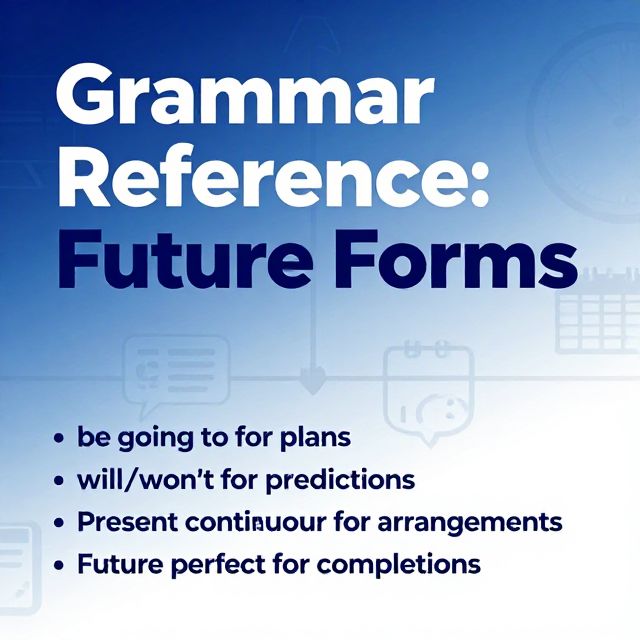
English Grammar Essentials: Future Forms, Reported Speech, and Passives

English Grammar Essentials: Future Forms, Reported Speech, and Passives

An educational overview of key English grammar concepts including future tenses, reported speech, passive structures, and causatives, designed for language learners.

25 15
7th Grade English Language Homework Overview

7th Grade English Language Homework Overview

A comprehensive summary of a 7th-grade English homework assignment, detailing vocabulary, a comprehension text, grammar exercises on conditionals, passives, reflexives, and compound adjectives, and open-ended questions.

7 dk Özet 25 15