Podit
Podit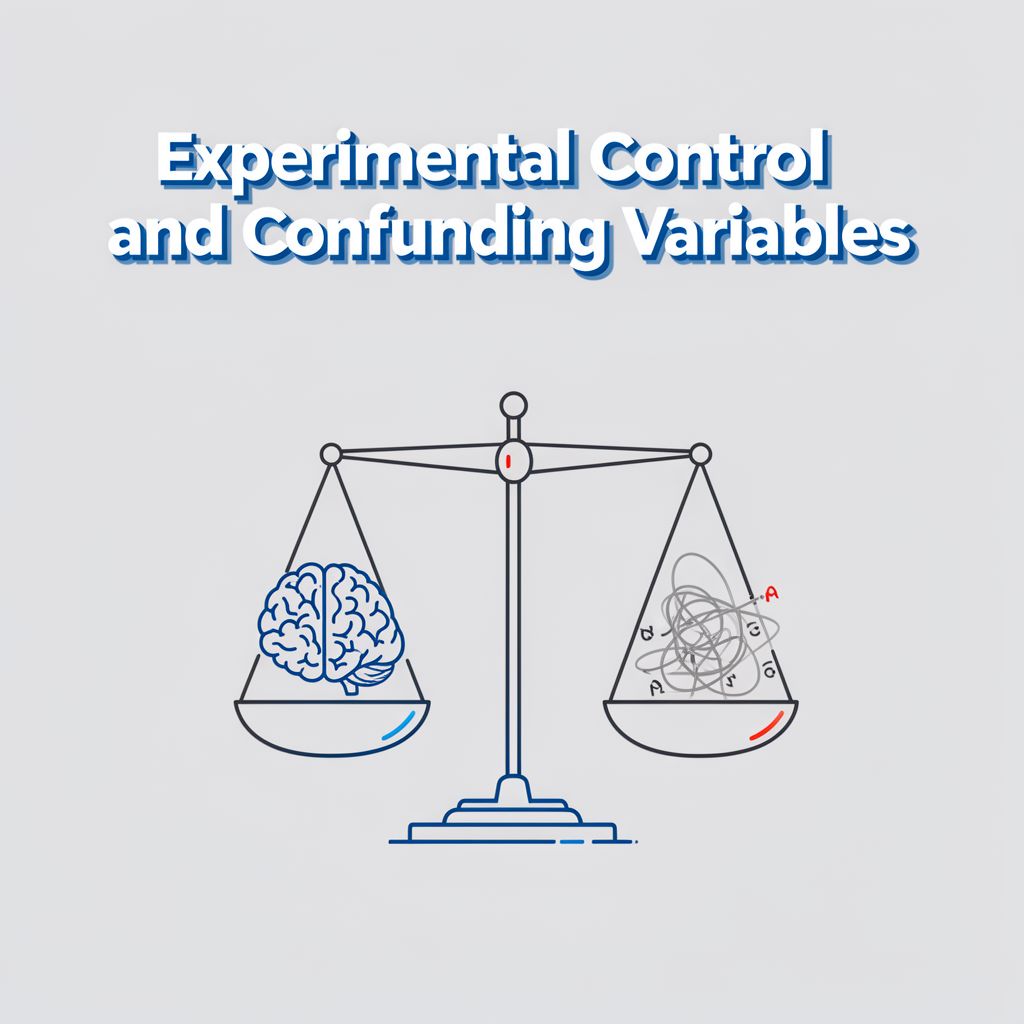
This study material has been compiled from a copy-pasted text and a lecture audio transcript.
📚 Experimental Control and Internal Validity
🎯 Introduction to Experimental Control
Experimental control is a fundamental concept in research methodology, particularly in experimental studies. It refers to the set of procedures a researcher implements to isolate the effect of the independent variable on the dependent variable and minimize the influence of all other factors. The primary goal is to confidently state that a change in the independent variable is the sole and true cause of the observed change in the dependent variable.
✅ Goal of Experimentation
The main objective is to identify the causal effect of the independent variable. To achieve this, a study must possess high internal validity.
💡 Internal Validity
Internal validity ensures that the observed effect on the dependent variable is solely due to the change in the independent variable, and not to any other extraneous factors. If the measured effect is exclusively caused by the independent variable, then internal validity is achieved.
📚 Confounding Variables
A confounding variable (also known as an extraneous variable) is a variable, other than the independent variable, that affects the dependent variable. If not controlled, it can distort the true relationship between the independent and dependent variables.
- Example 1: Churches and Beer Consumption 🍺⛪
- A study found a high correlation between the number of churches and beer consumption.
- Explanation: This doesn't mean churches cause increased beer consumption. A third confounding variable, such as population density or general socio-economic status, might explain this. Denser populations might have both more churches and higher overall beer consumption.
- Example 2: Height and Manual Skills 📏✍️
- If studying the relationship between height and manual skills, age could be a confound. Younger children are typically shorter and have less developed manual skills.
- Example 3: Grades and Teaching Method 📝👩🏫
- Hypothesis: "Grades are affected by teaching method."
- Potential Confounds: Intelligence, student care/effort, teacher quality.
- If the group receiving a new teaching method has significantly higher average intelligence, any improvement in grades cannot be solely attributed to the teaching method. Intelligence, in this case, is a confounding variable that must be controlled.
⚠️ Threat to Internal Validity: Confounding variables pose a serious threat to internal validity. If they are not controlled, it becomes impossible to draw a valid conclusion about the causal relationship between the independent and dependent variables.
🛠️ How to Control Confounding Variables
The first step in achieving control is to accurately identify potential confounding variables. Once identified, various strategies can be employed:
1️⃣ Elimination
This involves completely removing potential confounding variables from the experimental environment.
- Examples: Controlling light, noise, or experimenter effects. Standardizing the experimental setting helps eliminate or minimize such variables.
2️⃣ Keeping Constant
This strategy involves holding the value of a potential confounding variable the same across all experimental groups.
- Example: If gender might confound the relationship between experience and driving skills, one could use only male drivers, thereby keeping gender constant.
- Challenge: While possible for variables like gender or nationality, it's difficult for others like "learning skill" because it cannot be measured precisely and shows wide distribution. Some variables (e.g., motivation, fatigue) also change during the experiment, making constancy impossible.
📉 Specific Extraneous Variables (Threats to Internal Validity)
Shadish et al. (2002) identified several extraneous variables that can affect a study's internal validity:
1. 🕰️ History Variable
An extraneous event occurring between the pre- and post-measurement of the dependent variable, other than the independent variable.
- Example 1: Dietary Change and Aggression 🍎🥊
- Schoenthaler (1983) investigated the impact of dietary change on violent behavior in institutionalized juveniles. They recorded behavior 3 months before and 3 months after the dietary change, finding less aggressive behavior.
- Confound: During the 6-month period, other events within the institution (e.g., new programs, changes in staff) could have influenced behavior. This is a "history effect."
- Example 2: Drunk Driving Campaign 🚗🚫
- If measuring the effectiveness of a campaign against drunk driving, and fines for drunk driving increase simultaneously, it becomes unclear whether observed changes are due to the campaign or the increased fines.
- Solution: A control group that does not experience "differential history" (where one group experiences the historical event, but the other does not) is a good solution. The longer the time between pre- and post-measures, the higher the probability of a rival hypothesis due to history.
2. 📈 Maturation
Changes in biological and psychological conditions that occur with the passage of time.
- Examples: Age, fatigue, learning, boredom, hunger.
- Example 1: New Teaching Technique and IQ 🧠📚
- Liddle and Long (1958) gave extra help to slow learners. After two years, their IQ increased by 1.75 points.
- Confound: Over two years, children naturally mature and develop cognitively. The IQ increase might be due to natural maturation, not solely the teaching technique.
- Example 2: Proofreading Performance 😴📝
- In a proofreading study, performance might decrease between pre- and post-tests simply due to fatigue (a maturation effect), even if a treatment had a positive effect. This "fatigue-maturation effect" can mask true treatment effects.
3. ⚙️ Instrumentation
Changes during the process of measuring the dependent variable.
- Physical measurements (e.g., scales) may show minor differences and require calibration.
- Human Observers/Interviewers: They can gain skill, get tired, change their criteria, or become more aware of the experiment's purpose over time. This affects the consistency and reliability of measurements.
- Solution: Inter-rater comparisons and training are crucial to reduce instrumentation effects.
4. 📝 Measurement (Testing Effect)
Participants can become sensitized to the subject by completing a pre-test.
- A pre-test can draw participants' attention to the study's purpose or specific topics, influencing their behavior or performance on a post-test, independent of any treatment.
- Example: In an attitude change study, pre-test questions might make participants reflect on their attitudes, leading to changes in post-test responses that are not solely due to the intervention.
5. 👥 Selection Bias
This bias occurs when differential selection procedures are used for placing subjects into various comparison groups. When subject selection is not randomized but based on criteria, rival hypotheses can be introduced.
- Example: Brady's "Executive Monkeys" (1958) 🐒⚡
- Aim: To investigate if stress from electric shocks caused illness in monkeys and if control over shocks interacted with this.
- Method: Monkeys received electric foot shocks signaled by a tone. They were paired: one "executive monkey" could press a lever to avoid shocks, while the "yoked animal" received all shocks but couldn't avoid them.
- Brady's Finding: After 23 days, executive monkeys died of gastric ulceration, while yoked monkeys remained healthy. Brady concluded that trying to avoid shocks (having control) was the stressful element.
- ⚠️ Selection Mistake: Brady had chosen faster learners (more emotional, more fearful, better learners) as the executive monkeys. This was a selection bias.
- 💡 Later Replication (Weiss): Weiss replicated the study with rats, controlling for selection bias, and found the opposite results: subjects with control experienced less stress.
- Conclusion: Brady's original finding was confounded by selection bias. The study also highlights ethical concerns regarding animal welfare.
6. 📊 Statistical Regression (Regression Artifact)
The tendency for extreme scores in a distribution to move, or regress, toward the mean of the distribution upon repeated measurement.
- Threat: Selecting subjects with extreme scores (e.g., very low or very high) can be a threat to internal validity, especially in pre-post test designs.
- Example: Participants selected for a special reading program because they read very slowly will likely perform better on the next assessment, even if they don't attend the program. Their initial extreme low score might partly be due to random error; on re-testing, this error tends to average out, and their score regresses towards the mean.
- Reason: This occurs because measurement tools are not perfectly reliable, and the first and second measurements do not provide a perfect correlation.
7. 💀 Mortality (Attrition)
The loss of subjects from a study (death for animals, missing post-experiment measurements for humans).
- Problem: The issue isn't just losing subjects, but when the lost subjects create differences between groups that cannot be attributed to the experimental treatment. This happens when attrition is not random.
- Example: If studying conformity and mostly females (who might have higher conformity scores) drop out, post-test conformity scores might decrease. It becomes unclear if this decrease is due to the treatment or biased attrition.
➕ Additive Effects with Selection
Sometimes, selection bias can interact with other threats, creating more complex challenges to internal validity:
1. 👥📈 Selection-Maturation Effect
Changes in one group due to maturation are greater than in another group.
- Example: If first-year college students are the experimental group and sophomores are the control group, changes in the first year might be naturally greater due to maturation. Any intervention might show larger differences for first-year students, not solely due to the intervention but also due to their developmental stage.
2. 👥🕰️ Selection-History Effect
When events occurring in time have a different effect on one group of participants than on another.
- Example: An AIDS awareness campaign conducted on two campuses. If a student dies from AIDS on one campus during the campaign, that group will be differentially affected by history, confounding the campaign's true impact.
3. 👥📝 Selection-Measurement Effect
If a test instrument is more sensitive to one group's performance than to changes in another's.
- Example: Comparing an experimental group with reading disabilities to a control group of normal readers. If the reading test has a "ceiling effect" for the control group (they already score perfectly and can't improve), then after training, only the experimental group will show improvement. The perceived effect is not solely due to training but also because the instrument was not sensitive enough for the good readers.
⚠️ Challenges Even True Experiments May Not Control
Even well-designed true experiments can face issues that affect external validity or generalizability:
1. 🗣️ Contamination
Happens when information about the experiment is communicated between groups of participants. This can lead to:
- Rivalry: Control group participants might become competitive if they learn about the experimental group's treatment.
- Resentment: Control group participants might feel deprived or resentful.
- Diffusion of Treatment: Control group participants might try to imitate the experimental treatment.
- Example: In a study on the effect of monetary reward on athletic performance, if the non-rewarded group learns about the rewarded group, their motivation might change, distorting results.
2. ✨ Novelty Effect (Hawthorne Effect)
People's behavior changes simply because of an innovation that produces excitement, energy, and enthusiasm, rather than the intervention itself.
- Hawthorne Effect: Named after studies at the Hawthorne Works factory (1924-1932) where researchers found that any change in working conditions (both improvements and deteriorations) led to increased productivity.
- Explanation: The change in behavior resulted from the workers' awareness that they were part of an experiment and that someone was interested in them. They responded to the special attention and novelty, not necessarily the specific intervention.
- Implication: An intervention might appear successful due to the novelty effect, rather than its inherent effectiveness.
📅 Important Dates
- Research Proposal Part-A: December 2, 2025
- (Problem, Hypothesis, References)