Global Connections: From EU's Birth to Geopolitics - kapak
Siyaset#european union#eu history#maastricht treaty#ecsc

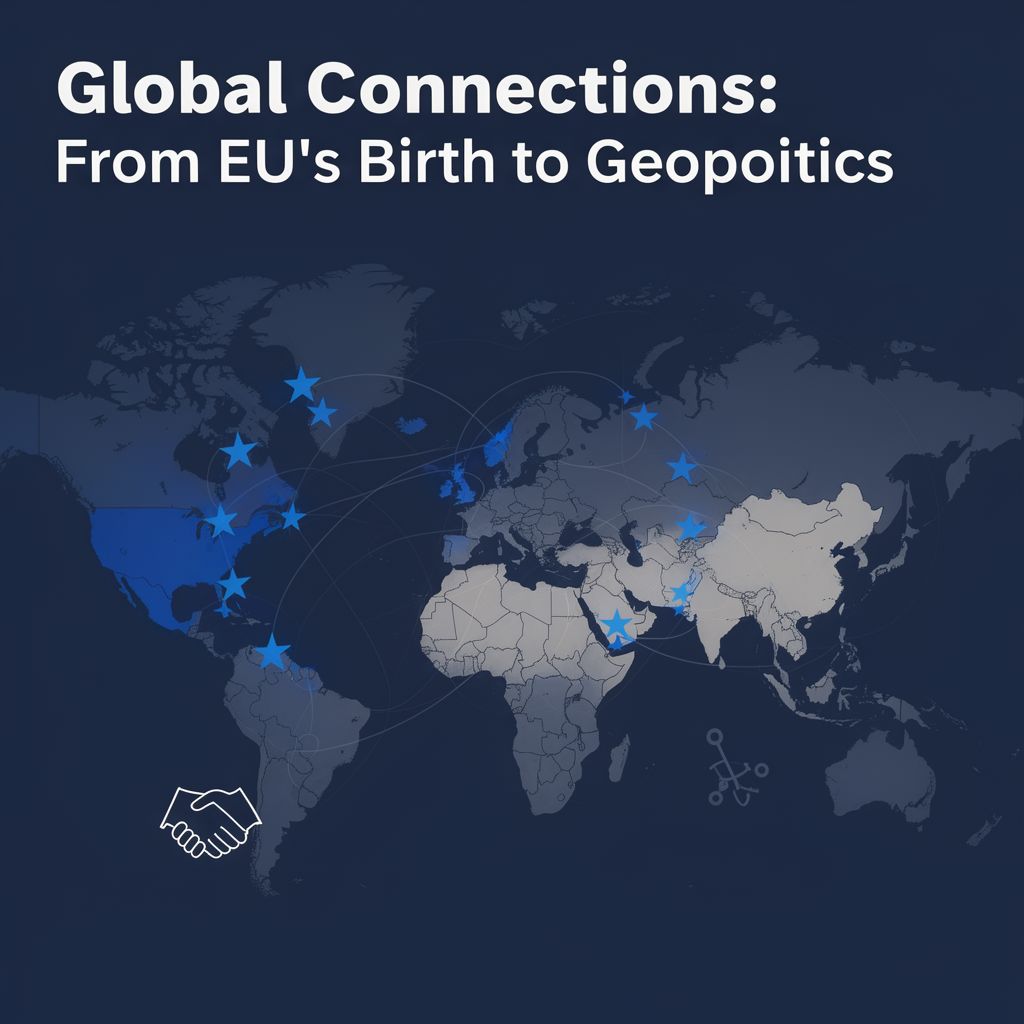
Global Connections: From EU's Birth to Geopolitics

Explore the European Union's journey from its post-war origins to its modern form, and touch upon key geopolitical hotspots in the Middle East and Asia. You'll understand how international cooperation shapes our world.

ldntut7fJanuary 13, 2026 ~18 dk toplam
01

Sesli Özet

5 dakika

Konuyu otobüste, koşarken, yolda dinleyerek öğren.

Sesli Özet

Global Connections: From EU's Birth to Geopolitics

0:005:04
02

Flash Kartlar

24 kart

Karta tıklayarak çevir. ← → ile gez, ⎵ ile çevir.

1 / 24
Tüm kartları metin olarak gör
  1. 1. What was the primary motivation for European integration after World War II?

    The primary motivation was to prevent future conflicts by fostering cooperation and interdependence among European nations.

  2. 2. What was the first major step towards European integration?

    The first major step was the establishment of the European Coal and Steel Community (ECSC).

  3. 3. When and by which treaty was the European Coal and Steel Community (ECSC) established?

    The ECSC was established in 1951 by the Treaty of Paris.

  4. 4. What was the revolutionary idea behind the European Coal and Steel Community (ECSC)?

    The idea was to pool the production of coal and steel under a common authority, making it harder for any one country to rearm secretly.

  5. 5. Name the six founding members of the European Coal and Steel Community (ECSC).

    The six founding members were Germany, France, Italy, Belgium, the Netherlands, and Luxembourg.

  6. 6. What concept describes how integration in one sector can spread to others?

    This concept is known as the 'spill-over effect', where initial cooperation leads to broader integration in other areas.

  7. 7. What organization was created by the Treaty of Rome in 1957?

    The Treaty of Rome in 1957 created the European Economic Community (EEC).

  8. 8. What was the main goal of the European Economic Community (EEC)?

    The EEC aimed for a broader common market, promoting the free movement of goods, services, capital, and people.

  9. 9. When was the European Union officially established, and by which treaty?

    The European Union was officially established with the Maastricht Treaty in 1992.

  10. 10. What key concepts were introduced by the Maastricht Treaty?

    The Maastricht Treaty deepened political cooperation, introduced European citizenship, and laid the groundwork for a single currency.

  11. 11. In what year was the transition to the Euro completed?

    The transition to the Euro, a significant step towards economic unity, was completed in 2002.

  12. 12. Which three countries joined the European Economic Community in 1973?

    The United Kingdom, Ireland, and Denmark joined the EEC in 1973.

  13. 13. Which treaty introduced the right for a member state to withdraw from the EU?

    The Lisbon Treaty, formalized in 2008, introduced the right for a member state to withdraw from the European Union.

  14. 14. How many member states currently constitute the European Union?

    Following the UK's departure (Brexit), the European Union now consists of 27 member states.

  15. 15. What major historical event in the Middle East occurred in 1948 and sparked long-standing conflict?

    The establishment of Israel in 1948 sparked a long-standing conflict, particularly the Israel-Palestine conflict.

  16. 16. Name two recent events that have dramatically reshaped the Middle East.

    The Arab Spring and the Syrian Civil War are two recent events that have significantly reshaped the Middle East.

  17. 17. What is ASEAN, and what is its purpose?

    ASEAN stands for the Association of Southeast Asian Nations, and it fosters economic and political cooperation in Southeast Asia.

  18. 18. Why are Central Asia and the Caucasus considered strategically important regions?

    These regions are crucial due to their energy resources, security concerns, and complex ethnic dynamics, influencing global markets and security.

  19. 19. What were coal and steel considered after WWII, making their pooling revolutionary?

    Coal and steel were considered two crucial resources for war, making their joint control under a common authority a revolutionary peace-building measure.

  20. 20. What does the free movement principle within the EEC/EU encompass?

    It encompasses the free movement of goods, services, capital, and people across member states within the common market.

  21. 21. What is the overall theme of understanding global politics as presented in the text?

    The overall theme is that global politics is interconnected, and decisions made decades ago still shape our present world.

  22. 22. What was the initial feeling about global politics mentioned at the beginning of the session?

    At the beginning of the session, it was mentioned that global politics can sometimes feel a bit overwhelming.

  23. 23. How did the ECSC make it harder for countries to rearm secretly?

    By pooling the production of coal and steel under a common authority, it became much more difficult for any single country to secretly build up its military resources.

  24. 24. What was the significance of the Euro's transition in 2002 for the EU?

    The transition to the Euro in 2002 was a huge step towards achieving greater economic unity and integration within the European Union.

03

Bilgini Test Et

15 soru

Çoktan seçmeli sorularla öğrendiklerini ölç. Cevap + açıklama.

Soru 1 / 15Skor: 0

What was the primary motivation for European leaders to pursue integration after World War II?

04

Detaylı Özet

3 dk okuma

Tüm konuyu derinlemesine, başlık başlık.

📚 Global Politics: European Integration and Key Geopolitical Dynamics

This study material provides a comprehensive overview of the historical development of European integration, leading to the formation of the European Union, and explores significant geopolitical dynamics in other key regions of the world. It combines insights from a lecture and a curated list of essential facts to offer a structured learning experience.


1️⃣ The Genesis of European Integration: From Conflict to Community

After the devastation of World War II, European leaders sought innovative ways to prevent future conflicts and foster lasting peace. This led to the groundbreaking idea of economic cooperation as a foundation for political stability.

  • Post-World War II Context: The primary motivation was to prevent future wars by integrating key industries.
  • European Coal and Steel Community (ECSC)
    • Establishment: Founded in 1951.
    • Founding Treaty: The Treaty of Paris.
    • Purpose: To pool the production of coal and steel under a common authority, making it difficult for any single nation to rearm for war independently.
    • Founding Members:
      • Germany
      • France
      • Italy
      • Belgium
      • Netherlands
      • Luxembourg
  • European Economic Community (EEC)
    • Establishment: Founded in 1957.
    • Founding Treaty: The Treaty of Rome.
    • Expansion of Scope: Expanded cooperation beyond coal and steel to create a broader common market, aiming for the free movement of goods, services, capital, and people.
  • 📚 Key Concept: Spill-over Effect
    • 💡 This principle describes how integration starting in one sector (e.g., economics) naturally spreads and encourages integration in other areas, leading to deeper overall cooperation.

2️⃣ Evolution of the European Union

The initial economic communities gradually evolved into a more comprehensive political and economic union.

  • Official Establishment of the European Union (EU)
    • Treaty and Year: Officially established by the Maastricht Treaty in 1992.
    • Significance: This treaty deepened political cooperation, introduced the concept of European citizenship, and laid the groundwork for a single currency.
  • Economic Integration: Euro Transition
    • Completion Year: The transition to the Euro as a single currency was completed in 2002.
  • EU Enlargement and Membership
    • 1973 Accessions: The United Kingdom, Ireland, and Denmark joined the European Community in 1973.
  • Withdrawal from the EU: Brexit
    • Right to Withdraw: The 2008 Lisbon Treaty introduced the right for a member state to withdraw from the EU.
    • Brexit: Following the UK's departure, the EU transitioned to a structure of 27 member states.

3️⃣ Key Geopolitical Dynamics Beyond Europe

Global politics is interconnected, and significant events in various regions have far-reaching implications.

  • The Middle East
    • Establishment of Israel: The state of Israel was established in 1948.
    • ⚠️ Israel-Palestine Conflict: This event initiated a long-standing conflict, which remains a major flashpoint in the region.
    • Recent Developments:
      • Arab Spring: A series of anti-government protests, uprisings, and armed rebellions across much of the Arab world in the early 2010s.
      • Syrian Civil War: An ongoing multi-sided armed conflict in Syria, highlighting complex internal and external forces.
  • Southeast Asia: ASEAN
    • Organization Name: The Association of Southeast Asian Nations (ASEAN).
    • Purpose: Fosters economic and political cooperation among its member states in Southeast Asia.
  • Central Asia and the Caucasus
    • 📈 Strategic Importance: These regions hold significant strategic importance due to:
      • Energy Resources: Rich in oil and natural gas.
      • Security Concerns: Geopolitical rivalries and regional instability.
      • Ethnic Dynamics: Complex ethnic compositions often leading to internal and cross-border tensions.

Conclusion

Understanding the historical progression of European integration, from the ECSC to the modern EU, provides insight into how international cooperation can evolve. Simultaneously, recognizing the critical geopolitical dynamics in regions like the Middle East, Southeast Asia, and Central Asia is essential for comprehending the complex and interconnected nature of global affairs today.
Kendi çalışma materyalini oluştur

PDF, YouTube videosu veya herhangi bir konuyu dakikalar içinde podcast, özet, flash kart ve quiz'e dönüştür. 1.000.000+ kullanıcı tercih ediyor.

Sıradaki Konular

Tümünü keşfet
Islamism and the Middle East: A World in Disorder

Islamism and the Middle East: A World in Disorder

An in-depth analysis of the historical, ideological, and geopolitical forces shaping the Middle East, focusing on the clash between Islamic universalist visions and the Westphalian international order.

21 dk Özet
Toward an Asian Order: Confrontation or Partnership?

Toward an Asian Order: Confrontation or Partnership?

An in-depth analysis of the historical and contemporary approaches of China and the United States to world order, exploring their contrasting philosophies and the challenges of their relationship.

21 dk Özet
US, Iran, and Asia: Approaches to Global Order

US, Iran, and Asia: Approaches to Global Order

An in-depth analysis of Iran's revolutionary vision, its nuclear ambitions, and the diverse historical and modern approaches to international order in Asia, focusing on Japan and India.

21 dk Özet
National Security and Its Dimensions

National Security and Its Dimensions

This podcast explores the concept of national security, its fundamental importance, and its four crucial dimensions: military, political, economic, and social security, based on the provided lesson.

Özet 25 15
Turkey-Greece Relations: Treaties and Disputes

Turkey-Greece Relations: Treaties and Disputes

An in-depth analysis of Turkey-Greece relations, focusing on the Treaty of Lausanne (1923) and the Paris Peace Treaty (1947), covering Aegean islands, minority rights, and population exchange.

Özet 25 15
Abolition of Caliphate and Turkish Constitutional Evolution

Abolition of Caliphate and Turkish Constitutional Evolution

This summary examines the abolition of the Caliphate in Turkey and the subsequent constitutional developments, including the 1921 and 1924 Constitutions, and the integration of secular principles.

6 dk Özet 25 15
Contemporary British Sociopolitical and Cultural Dynamics

Contemporary British Sociopolitical and Cultural Dynamics

An academic overview of Britain's social and cultural context, examining political challenges, demographic shifts, gender equality, LGBTQ+ rights, and the evolving role of arts and popular culture in the 21st century.

8 dk Özet 25 15
British Social and Cultural Context: 1979-2014

British Social and Cultural Context: 1979-2014

An academic overview of Britain's social and cultural landscape from the late 1970s through the early 2010s, focusing on the Thatcher era, New Labour, and subsequent challenges.

9 dk Özet 25 15