 Podit
Podit
This study material is compiled from various sources, including a copy-pasted text and a lecture audio transcript by Dr. Murat Hişmanoğlu.
📚 Introduction to Linguistics: A Comprehensive Study Guide
This guide explores the multifaceted nature of human language, covering its evolution, historical changes, and intricate relationship with society and culture. It delves into the development of writing systems, the dynamics of language change, sociolinguistic variations, cultural influences on language, and the interdisciplinary field of stylistics.
1. ✍️ Evolution of Writing Systems
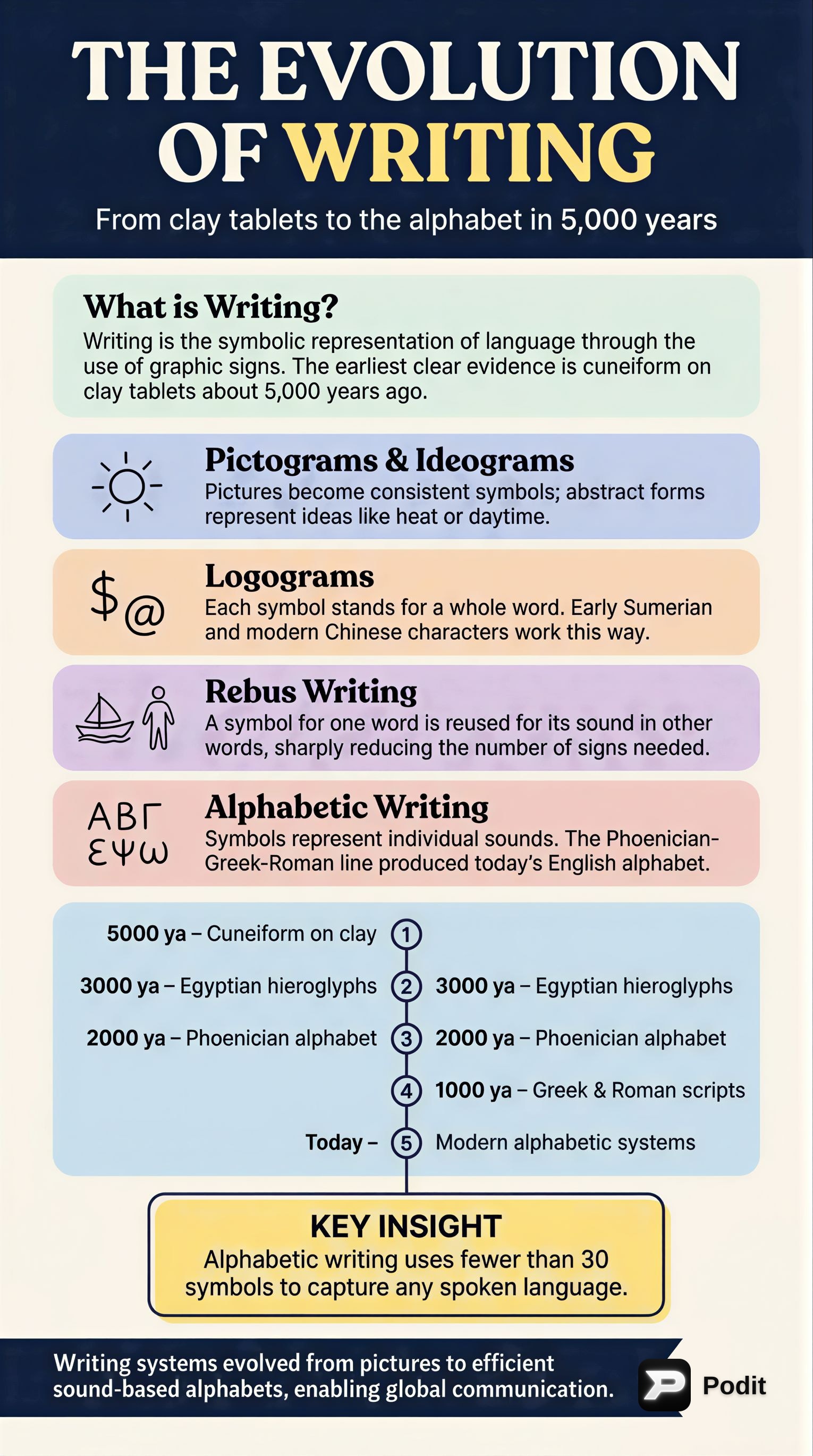
Writing is the symbolic representation of language through graphic signs. Its development marks a significant milestone in human communication.
1.1. Early Forms of Writing
- Cuneiform: The earliest clear evidence of writing, dating back approximately 5,000 years, found on clay tablets.
- Pictograms: Consistent pictures representing specific images.
- ✅ Example: A symbol like '☀️' used consistently for the sun. A conventional relationship between the symbol and its meaning is essential.
- Ideograms: Symbols that represent concepts or ideas, moving beyond visible objects.
- ✅ Example: The '☀️' symbol evolving to represent "heat" or "daytime," not just the sun itself.
- Logograms: Symbols used to represent entire words in a language.
- ✅ Example: Early Sumerian writing, Chinese characters, and modern English symbols like '$' (dollar) or '&' (and).
1.2. Sound-Based Writing Systems
- Rebus Writing: Uses existing symbols to represent the sounds of spoken words. This process significantly reduces the number of symbols needed.
- ✅ Example: If a symbol for "boat" (pronounced 'ba') is used, then two such symbols could represent "baba" (father).
- Syllabic Writing: Employs symbols where each represents the pronunciation of a syllable.
- ✅ Example: Modern Japanese uses a partially syllabic system (syllabary).
- Alphabetic Writing: A system where each symbol represents a single sound type or phoneme.
- 🌍 Origins: The Phoenician script is the basic source for most alphabets.
- ➡️ Development:
- Greek: Revised the Phoenician alphabet.
- Roman: Adapted the Greek alphabet, becoming the basis for Western European languages, including English.
- Cyrillic: A modified Greek system used for Slavic languages (e.g., Russian).
1.3. English Orthography
- Inconsistencies: English orthography often shows a mismatch between written forms and spoken sounds (e.g., "you know" vs. "yu no").
- Historical Changes: The Great Vowel Shift (1400-1600) significantly altered English pronunciation, but spelling often retained older forms.
- Silent Letters: Letters like the 'k' in "knight" or 'gh' in "gnaw" are remnants of older pronunciations.
2. 📜 Language History and Change
Languages are dynamic systems that continuously evolve over time.
2.1. Language Families and Relationships
- Family Trees: In the 19th century, philology used "family trees" to show how languages are related.
- Indo-European: The largest language family globally, but one of about thirty major families.
- Cognates: Words in different languages that have a similar form and meaning, indicating a common ancestor.
- ✅ Example: English "mother," "father," "friend" are cognates of German "Mutter," "Vater," "Freund."
2.2. Comparative Reconstruction
This procedure aims to reconstruct the "proto-form" of words in a common ancestral language.
- 1️⃣ Majority Principle: If most words in a cognate set share a sound, that sound is likely the original.
- ✅ Example: If three words begin with [p] and one with [b], [p] is likely older.
- 2️⃣ Most Natural Development Principle: Certain sound changes are more common than others.
- ✅ Examples:
- Final vowels often disappear (e.g., Latin vino → Spanish vin).
- Voiceless sounds become voiced between vowels (e.g., Latin muta → Spanish muda).
- Stops become fricatives (e.g., Latin ripa → Spanish riva).
- Consonants become voiceless at the end of words (e.g., Latin rizu → Spanish ris).
- ✅ Examples:
2.3. The History of English
English history is traditionally divided into four periods:
- 1. Old English (before 1100):
- Origins: Developed from Germanic languages of Angles, Saxons, and Jutes.
- Vocabulary: Basic terms like "mann" (man), "wif" (woman), "hus" (house).
- Influences: Latin (Christian conversion: "angel," "church"), Old Norse (Viking settlers: "give," "law," "sky").
- 2. Middle English (1100-1500):
- Norman Conquest (1066): French became the language of the ruling class, government, and law.
- Vocabulary: French words entered English (e.g., "army," "court," "mutton," "beef," "pork"). This led to distinctions like "cow" (Old English) vs. "beef" (French).
- 3. Early Modern English (1500-1700):
- Great Vowel Shift: A significant change in the pronunciation of long vowel sounds.
- Printing Press (1476): Standardized spelling, often preserving older pronunciations not reflected in later sound changes.
- 4. Modern English (after 1700): Continues to evolve.
2.4. Types of Language Change
- External Change: Influences from other languages (e.g., Norman French on English).
- Sound Changes:
- Sound Loss: Disappearance of sounds (e.g., initial 'h' in hlud → "loud").
- Epenthesis: Addition of a sound within a word (e.g., "sumpthing" for "something").
- Prothesis: Addition of a sound to the beginning of a word (e.g., Latin schola → Spanish escuela).
- Syntactic Changes: Shifts in sentence structure.
- Word Order: Old English had more flexible word order than modern English's Subject-Verb-Object.
- Loss of Inflectional Suffixes: Many suffixes differentiating verb forms in Old English are no longer used.
- Semantic Changes: Changes in word meanings.
- Obsolescence: Words falling out of use (e.g., "foin," "were").
- Broadening: Meaning becomes more general (e.g., "holiday" from religious feast to general break).
- Narrowing: Meaning becomes more specific (e.g., "hound" from any dog to specific breeds).
2.5. Diachronic vs. Synchronic Variation
- Diachronic: Studying language from a historical perspective, focusing on change through time.
- Synchronic: Studying language at a particular point in time, focusing on differences within a language in different places or among different groups.
3. 🗣️ Sociolinguistics: Language and Society
Sociolinguistics investigates the relationship between language and society, exploring how social factors influence language use and structure.
3.1. Language Variation
- Standard Language: A variety associated with administrative, commercial, and educational centers, often taught to second language learners.
- Accent: Aspects of pronunciation that identify a speaker's regional or social origin.
- Dialect: Encompasses features of grammar, vocabulary, and pronunciation, distinguishing it from an accent.
- Dialectology: The study of dialects to distinguish between different dialects of the same language (mutually intelligible) and different languages (not mutually intelligible).
- Regional Dialect (Regiolect/Topolect): A distinct form of a language spoken in a particular geographical area.
- Vernacular: A child's native regional dialect.
- Isoglosses: Geographical boundary lines marking the distribution of a distinctive linguistic feature (phonological, lexical, etc.). Bundles of isoglosses mark major dialect divisions.
3.2. Bilingualism and Multilingualism
- Bilingualism: The ability to use two languages effectively. More than half of the world's population is bilingual or multilingual.
- Political Bilingualism: Refers to a country's language policies.
- ✅ Example: Canada is officially bilingual; India uses a "three-language formula" promoting multilingualism.
- Principles: "Personality" (preserves individual rights) and "Territorial" (ensures bilingualism within an area).
- Individual Bilingualism: Arises from personal circumstances (e.g., parents speaking different languages). One language often becomes dominant.
- Social Bilingualism: Interrelationship between linguistic and non-linguistic factors, influencing language contact, maintenance, and shift.
- ⚠️ Note: In some societies, bilingualism is valued; in others, it's suppressed.
3.3. Diglossia
- Definition: The coexistence of two varieties of the same language within a speech community, where one is a literary/prestige dialect and the other is a common spoken dialect.
- ✅ Example: Classical Arabic alongside colloquial Arabic in the Arab world; Katharevusa (prestige) and Demotic (popular) in Greece.
3.4. Language Planning
Governmental efforts to create policies around language issues.
- Reasons:
- Maintain cultural integrity/identity (e.g., French in Quebec).
- Balance diversity with assimilation (e.g., attitudes towards minority languages).
- Promote gender equality (e.g., gender-neutral language).
3.5. Pidgins and Creoles
- Pidgin: A simplified version of a language, combining vocabulary from different languages, used for communication between groups without a common language (e.g., trade, colonization).
- ✅ Characteristics: No native speakers, simplified grammar.
- Superstrate Language: The dominant language contributing most vocabulary.
- Substrate Languages: Minority languages contributing to the pidgin.
- Creole: Develops from a pidgin when it becomes the first language of a community.
- ✅ Characteristics: A complete natural language with its own grammar and expanded vocabulary.
- Example: Haitian Creole (French-based), Gullah (English-based).
3.6. Social Dialects and Markers
- Sociolect (Social Dialect): A variety of language associated with a social group (e.g., socioeconomic class, age group).
- Idiolect: An individual's specific, unique way of speaking.
- Social Marker: A language feature whose usage correlates with both social group and speech style.
- ✅ Examples:
- Pronunciation of '-ing' as '[n]' (e.g., "sittin'") often associated with working-class speech.
- 'H-dropping' (e.g., "I'm so 'ungry") associated with lower class/less education.
- ✅ Examples:
3.7. Speech Styles and Accommodation
- Speech Style: The form of language characterized by its level of formality.
- 1️⃣ Frozen Style: Fixed speech, used in respectful or formal ceremonies (e.g., Shakespearean plays).
- 2️⃣ Formal Style: Uses formal words, seen in writing, avoids contractions.
- 3️⃣ Consultative Style: Unplanned speech with speaker-listener participation and feedback.
- 4️⃣ Casual Style: Informal, used among friends/insiders, free participation.
- 5️⃣ Intimate Style: Used between very close individuals, economy of words, high nonverbal communication.
- Style-shifting: Alternation between different speech styles by an individual speaker.
- Prestige:
- Overt Prestige: Adopting a widely recognized "dominant" accent (e.g., RP in England) to gain respect.
- Covert Prestige: Valuing features that mark membership in a social group, even if not considered "standard," prioritizing group solidarity.
- Speech Accommodation: Modifying one's speech style towards or away from an interlocutor's perceived style.
- Convergence: Reducing social distance by using similar forms.
- ✅ Example: A teenager asking a friend: "C'mon Tony, gizzalook." Asking a friend's mother: "Excuse me. Could I have a look at your photos too, Mrs. Hall?"
- Divergence: Emphasizing social distance by using distinctly different forms.
- ✅ Example: A Scottish teenager shifting to "Look, I cannae dae it so" to assert difference from a teacher.
- Convergence: Reducing social distance by using similar forms.
3.8. Register, Jargon, and Slang
- Register: Specific lexical and grammatical choices made by speakers depending on situational context, participants, and function of language.
- Jargon: Specialized language of a professional or occupational group, often meaningless to outsiders (e.g., "legalese" for lawyers).
- Slang: Informal language used by a particular group (e.g., teenagers) or occupation, creating identity and excluding outsiders. Some slang terms eventually enter standard English.
3.9. African American English (AAE/AAVE/Ebonics)
- Definition: Distinctive speech varieties of African Americans. "Ebonics" (black speech) was coined to avoid negative connotations.
- Features: Omission of final consonants (e.g., "pas'" for "past"), 'th' as 't' or 'f' (e.g., "bat" for "bath"), specific vowel pronunciations.
- Origins Debate: Some emphasize English origins (nonstandard dialects of indentured servants); others emphasize African origins (West African language structures, tense-aspect systems).
4. 🌍 Language, Culture, and Cognition
Language is deeply intertwined with culture, shaping how individuals perceive and categorize the world.
4.1. Culture and Categories
- Culture: Socially acquired knowledge, ideas, and assumptions learned as members of social groups. Language transmits culture and provides category labels.
- Categories: Groups with common features. Vocabulary reflects culturally relevant categories.
- ✅ Examples: Varying numbers of words for "rain" or "colors" across languages reflect cultural needs and perceptions.
- Kinship Terms: All languages have kinship terms, but they categorize family members differently.
- ✅ Example: English "uncle" covers both paternal and maternal brothers, while some languages lexicalize this distinction (e.g., Watam aes for father's brother, akwae for mother's brother).
- Time Concepts: Cultural constructs reflected in language.
- ✅ Example: Hopi traditionally lacked terms for units like "two hours" or "week," reflecting a different conceptualization of time.
4.2. Linguistic Relativity and Determinism
- Linguistic Relativity (Weak Version): The structure of our language influences how we perceive and think about the world.
- Linguistic Determinism (Strong Version): Language determines thought, meaning we can only think in categories provided by our language.
- Sapir-Whorf Hypothesis: Argues that languages like Hopi lead speakers to view the world differently from European language speakers.
- ✅ Example: Whorf claimed Hopi's grammatical distinction between "animate" and "inanimate" (including clouds and stones as animate) led them to believe these entities were living.
- 💡 Insight: While language provides categories, humans can manipulate language to create new expressions for non-lexicalized concepts (e.g., "powdery snow").
4.3. Classifiers and Social Categories
- Classifiers: Words used with numbers to indicate the type of thing being counted.
- ✅ Example: Japanese ni-hon (two long thin things for bananas), ni-mai (two flat thin things for shirts).
- English: Distinguishes countable/non-countable nouns, using classifier-type expressions like "item of" or "piece of" (e.g., "an item of clothing").
- Social Categories: Words used to define social organization and relationships.
- ✅ Example: "Uncle" or "brother" can extend beyond technical family definitions to mark social connections or group membership.
4.4. Address Terms
Words or phrases used to address someone, chosen to establish social distance or solidarity.
- ✅ Example: "Brother, can you spare a dollar?" (solidarity) vs. "Sir" (unequal power).
- T/V Distinction: Choice between pronouns for socially close (e.g., French tu) versus distant (e.g., French vous) addressees.
- Gendered Address Terms: English "Mr., Mrs., Miss, Ms." often reveal social status, particularly for women.
4.5. Gender in Language
- Biological Gender: Distinction between male and female sex.
- Grammatical Gender: Classification of nouns (e.g., masculine/feminine in Spanish).
- Social Gender: Distinction made when using words like "man" and "woman" to classify individuals by social roles.
- Gendered Words: Differences in words used by men and women, or words used to talk about them.
- ✅ Example: Japanese boku (men's "I"), watashi (women's "I"). English "hero" vs. "heroine" (derivation from male form).
- Gendered Speech: Differences in speech patterns between genders.
- Women: Tend to use higher pitch range, more pitch movement, rising intonation at end of statements, hedges ("sort of"), and tag questions ("isn't it?"). These often invite agreement.
- Men: Tend to use lower pitch range, more assertive forms, and "strong" language.
- Gendered Interaction:
- Women: Often facilitate turn-taking, use more "back-channels" (e.g., "yeah," "hmm") to indicate listening.
- Men: May take longer turns, produce fewer back-channels, and interpret them as agreement.
5. 📖 Linguistics and Literature: Stylistics
Stylistics bridges linguistics and literary criticism, analyzing how linguistic choices create meaning and effect in texts.
5.1. Relationship between Linguistics and Literature
- Interdisciplinary: Both fields study language but from different epistemological perspectives.
- Intersection: The literary text is a concrete area of intersection, though its nature and interpretation evolve.
- Purpose: Linguistics helps shed light on the "literarity" of a text and other characteristics by viewing it as a discursive form in communication.
5.2. What is Stylistics?
- Definition: The study and interpretation of texts from a linguistic perspective. It examines the particular choices made by individuals and social groups in their use of language.
- Focus: Dialogue, regional accents, dialects, descriptive language, grammar (active/passive voice), sentence lengths, registers.
- Goal: To determine connections between linguistic form and effects within a variety of language.
5.3. Categories of Stylistics
- Linguistic Stylistics (General Stylistics): Investigates how meaning is made through language, using linguistic models and theories as analytical tools. Concentrates on phonological, lexical, grammatical, semantic, pragmatic, or discoursal traits.
- Non-linguistic Stylistics (Literary Stylistics): Concerned with the aesthetic aspect and prescriptive harmony of writing or speaking language, often linked with literary criticism and appreciation.
5.4. Subdisciplines of Stylistics
- Literary Stylistics: Studies forms like poetry, drama, prose.
- Interpretive Stylistics: How linguistic elements create meaningful art.
- Evaluative Stylistics: How an author's style works (or doesn't).
- Corpus Stylistics: Studies frequency of elements in a text (e.g., for authenticity).
- Discourse Stylistics: How language in use creates meaning (e.g., parallelism, alliteration).
- Feminist Stylistics: Commonalities in women's writing, how writing is gendered.
- Computational Stylistics: Uses computers to analyze text and determine writing style.
- Cognitive Stylistics: Studies mental processes when encountering language.
💡 Conclusion
The study of language reveals a complex interplay between its structural evolution, historical transformations, and its profound connection to society and culture. From the earliest cuneiform to the nuances of modern sociolinguistics and stylistics, language is a dynamic and fundamental aspect of human experience. Understanding these dimensions provides crucial insights into communication, identity, and cognition.