 Podit
Podit
📚 Phrasal Verbs: Essential for Daily English
🎯 Study Material Overview
This study material provides a comprehensive guide to understanding and using common phrasal verbs in English. It covers their definition, how they function, and offers practical examples of frequently used phrasal verbs. The aim is to demystify these essential linguistic units and help you use them confidently in everyday communication.
Source Information: This content is compiled from a lecture audio transcript and general educational knowledge on the topic of phrasal verbs.
1. 💡 Introduction to Phrasal Verbs
Have you ever encountered an English phrase where you understood each individual word, but the combined meaning was confusing? You likely came across a phrasal verb! Phrasal verbs are crucial for sounding natural and understanding everyday English conversations. While they might seem tricky at first, mastering them significantly enhances your fluency.
2. 📚 What Are Phrasal Verbs?
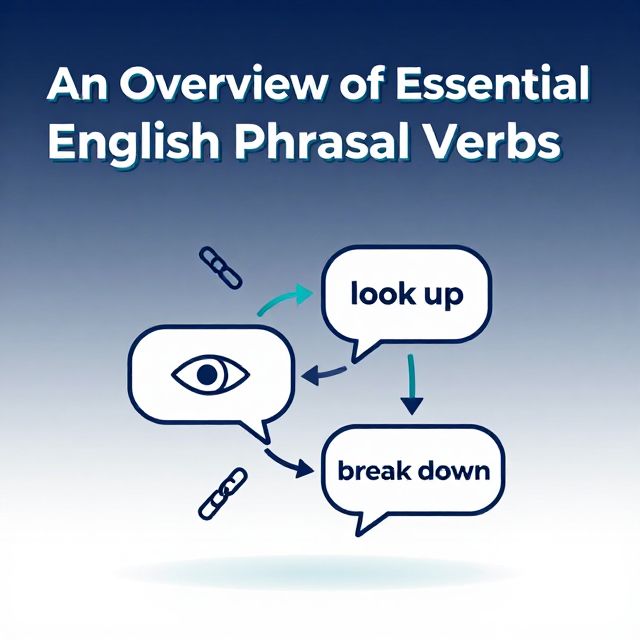
A phrasal verb is a combination of a verb and a particle (which is usually a preposition or an adverb). The key characteristic is that the combination often creates a new meaning that is different from the original verb alone. Think of them as mini-idioms.
- Verb + Particle = New Meaning
Example:
- The verb "look" means to see with your eyes.
- When combined with the particle "up," "look up" means to search for information (e.g., "look up a word in the dictionary"). The meaning has completely changed!
3. 🛠️ How Phrasal Verbs Work
Phrasal verbs function as a single unit of meaning. The particle fundamentally alters the verb's sense.
3.1. 🔄 Meaning Transformation
The particle's presence is what transforms the verb's meaning.
- Example:
- "Give" means to hand over something.
- "Give up" means to stop trying or surrender.
3.2. 🧩 Separable vs. Inseparable Phrasal Verbs
Some phrasal verbs can be separated by an object, while others cannot.
-
Separable Phrasal Verbs: The object can come between the verb and the particle, or after the particle.
- ✅ "I looked the word up."
- ✅ "I looked up the word."
- ⚠️ Important: If the object is a pronoun (e.g., it, them, him), it must go between the verb and the particle.
- ✅ "I looked it up."
- ❌ "I looked up it."
-
Inseparable Phrasal Verbs: The verb and particle must always stay together. The object always comes after the particle.
- ✅ "I ran into my friend at the store."
- ❌ "I ran my friend into at the store."
4. ✅ Common Phrasal Verbs for Daily Use
Here are some frequently used phrasal verbs with their definitions and examples:
-
Give up
- Meaning: To stop trying to do something; to surrender.
- Example: "Don't give up on your dreams, even if they seem hard to reach!"
-
Call off
- Meaning: To cancel something.
- Example: "They had to call off the outdoor concert because of the heavy rain."
-
Take off
- Meaning 1: (For a plane) to depart from the ground.
- Example 1: "The plane will take off in ten minutes."
- Meaning 2: To remove something, especially clothing.
- Example 2: "Please take off your shoes before you come inside."
-
Put off
- Meaning: To postpone or delay doing something.
- Example: "I really need to stop putting off my homework until the last minute!"
-
Look up
- Meaning: To search for information (in a dictionary, online, etc.).
- Example: "If you don't know the meaning of a word, you should look it up in a dictionary."
-
Get up
- Meaning: To rise from bed; to stand up.
- Example: "I usually get up at 7 AM on weekdays."
-
Turn on / Turn off
- Meaning: To start / stop a device or light.
- Example: "Could you please turn on the lights? It's getting dark."
- Example: "Remember to turn off your phone during the movie."
-
Find out
- Meaning: To discover information or a fact.
- Example: "I need to find out what time the meeting starts."
-
Come across
- Meaning: To find or meet someone or something by chance.
- Example: "I came across an old photo album while cleaning the attic."
-
Go on
- Meaning: To continue; to happen.
- Example: "Please go on with your story, I'm listening."
- Example: "What's going on here?"
5. 📈 Tips for Phrasal Verb Mastery
Mastering phrasal verbs takes time and practice. Here are some strategies to help you:
- Consistent Exposure: 🎧 Pay attention to phrasal verbs when you read, listen to, or watch English content.
- Context is Key: 💡 Always try to understand the meaning from the surrounding words and situation.
- Practice Regularly: ✍️ Try to use one or two new phrasal verbs in your own sentences each day.
- Don't Memorize Lists: 🚫 Avoid trying to learn huge lists all at once. Focus on common ones and learn them in context.
- Embrace Mistakes: 🚀 Don't be afraid to make errors; they are a natural part of the learning process.
- Keep a Journal: 📝 Note down new phrasal verbs you encounter, along with their meanings and example sentences.
6. 🎉 Conclusion
Phrasal verbs are an integral part of the English language, adding richness and naturalness to communication. By understanding their structure and practicing their use, you will significantly improve your comprehension and ability to express yourself in English. Keep practicing, and you'll soon be using them like a native speaker!