Podit
Podit
This content is based on a YouTube video.
📚 Mustafa Kemal Atatürk's Life: 1881 - 1938
This study material provides a comprehensive overview of Mustafa Kemal Atatürk's life, from his birth in 1881 to his passing in 1938. It covers his early life, military career, leadership during the Turkish War of Independence, and his transformative reforms as the first President of the Republic of Turkey. This structured guide is designed to be particularly useful for students preparing for national examinations such as KPSS önlisans, offering detailed insights into key historical events and concepts.
1️⃣ Early Life and Education (1881 - 1905)
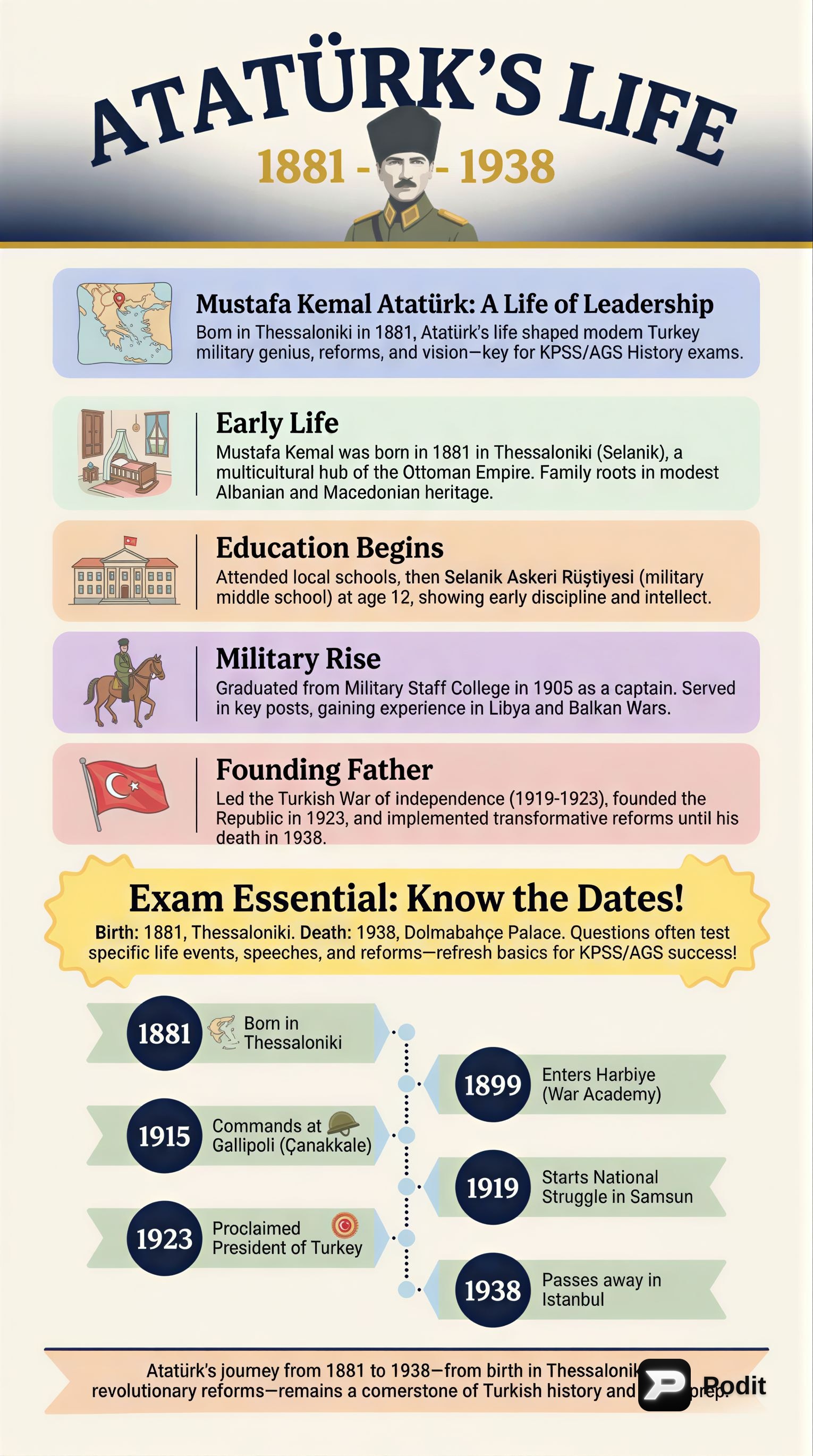
Mustafa Kemal Atatürk, the revered founder of the Republic of Turkey, was born in 1881 in Salonica (modern-day Thessaloniki), which was then a significant city within the Ottoman Empire. His formative years were characterized by a strong inclination towards military education, laying the foundation for his future leadership.
✅ Key Milestones:
- Birth: 1881, Salonica (Ottoman Empire)
- Educational Path: His early education instilled a deep understanding of military strategy.
- Attended various military schools.
- Graduated from the Military Academy in Istanbul in 1905 as a Staff Captain.
- Intellectual Development:
- Exposed to Enlightenment ideals and Western thought.
- These influences profoundly shaped his vision for a modern, independent Turkish nation.
- He developed a commitment to modernizing the state.
2️⃣ Military Career and the Turkish War of Independence (1911 - 1922)
Atatürk's military career unfolded during the turbulent final decades of the Ottoman Empire, where he gained invaluable experience and demonstrated exceptional strategic acumen.
2.1 ⚔️ Pre-War of Independence Engagements
- Italo-Turkish War (1911): Participated in Libya, gaining combat experience.
- Balkan Wars (1912-1913): Further honed his strategic skills.
- World War I (1914-1918):
- Battle of Gallipoli (1915): Distinguished himself significantly. His leadership was crucial in repelling the Allied invasion.
- Eastern and Syrian Fronts: Served with distinction, earning recognition for his tactical brilliance and resilience.
2.2 🇹🇷 Turkish War of Independence (1919 - 1922)
Following the Ottoman Empire's defeat in World War I and the signing of the Armistice of Mudros in 1918, the country faced occupation by Allied powers. Atatürk recognized this as an existential threat to Turkish sovereignty and initiated the national struggle.
✅ Key Events and Leadership:
- May 19, 1919: Landed in Samsun, marking the official beginning of the Turkish War of Independence.
- Organization of Resistance:
- Organized nationalist forces through congresses in Erzurum and Sivas.
- Consolidated the resistance movement.
- Establishment of Grand National Assembly (GNA):
- Founded in Ankara in 1920.
- Became the governing body of the nationalist movement.
- Military Victories:
- Under his command, the Turkish National Forces achieved decisive victories against occupying powers.
- Culminated in the Great Offensive in 1922, which secured Turkish independence and sovereignty.
3️⃣ Establishment of the Turkish Republic and Reforms (1922 - 1938)
With independence secured, Atatürk embarked on the monumental task of transforming the remnants of an empire into a modern, secular nation-state.
3.1 🏛️ Founding the Republic
- Abolition of the Sultanate: On November 1, 1922, the Sultanate was abolished, ending centuries of Ottoman rule.
- Proclamation of the Republic: On October 29, 1923, the Republic of Turkey was officially proclaimed.
- First President: Mustafa Kemal was elected as the first President of the Republic of Turkey.
3.2 💡 The Atatürk Reforms (Kemalist Revolutions)
Atatürk's presidency was defined by a series of radical and comprehensive reforms aimed at transforming Turkey into a secular, modern, and Western-oriented nation-state. These reforms fundamentally reshaped Turkish society, politics, and culture.
📊 Key Reforms and Their Impact:
- 1924: Abolition of the Caliphate: Ended the religious and political authority of the Caliph, separating religion from state affairs.
- 1924: Unification of Education (Tevhid-i Tedrisat Kanunu): All educational institutions were brought under state control, promoting a secular and national curriculum.
- Closure of Religious Courts: Replaced by a secular legal system.
- 1925: Hat Law: Mandated Western-style headwear, symbolizing a break from traditional Ottoman attire.
- 1925: Closure of Dervish Lodges (Tekke and Zaviye): Suppressed religious orders and their influence on public life.
- 1926: Adoption of the Civil Code: Based on Swiss law, it granted equal rights to women.
- 1928: Adoption of the Latin Alphabet: Replaced the Arabic script, significantly impacting literacy rates and cultural identity.
- Women's Rights:
- 1930: Granted suffrage in local elections.
- 1934: Granted suffrage in national elections, a pioneering move for its time.
- Economic Development: Pursued through state-led industrialization and agricultural modernization policies.
These reforms laid the institutional and ideological foundations for the modern Turkish Republic, emphasizing secularism, nationalism, republicanism, statism, populism, and revolutionism (the six arrows of Kemalism).
4️⃣ Conclusion and Enduring Legacy
Mustafa Kemal Atatürk's life (1881-1938) represents a period of profound transformation for the Turkish nation. His leadership successfully transitioned a collapsing empire into a sovereign republic, characterized by secularism, democracy, and modernization.
✅ Atatürk's Enduring Contributions:
- Military Genius: Secured national independence against formidable odds.
- Visionary Reforms: Established the institutional and ideological framework of contemporary Turkey.
- Kemalism: His principles continue to influence Turkish political and social life.
- Nation-Building: His contributions are recognized globally for their impact on nation-building and modernization in the 20th century.
Atatürk passed away on November 10, 1938, leaving behind a legacy as a transformative leader who not only founded a nation but also initiated a comprehensive societal overhaul that continues to shape Turkey today.