 Podit
Podit
This content is based on a YouTube video.
📚 The Ottoman Empire in the 18th Century: A Period of Decline
Introduction: Understanding the Ottoman Decline 🌍
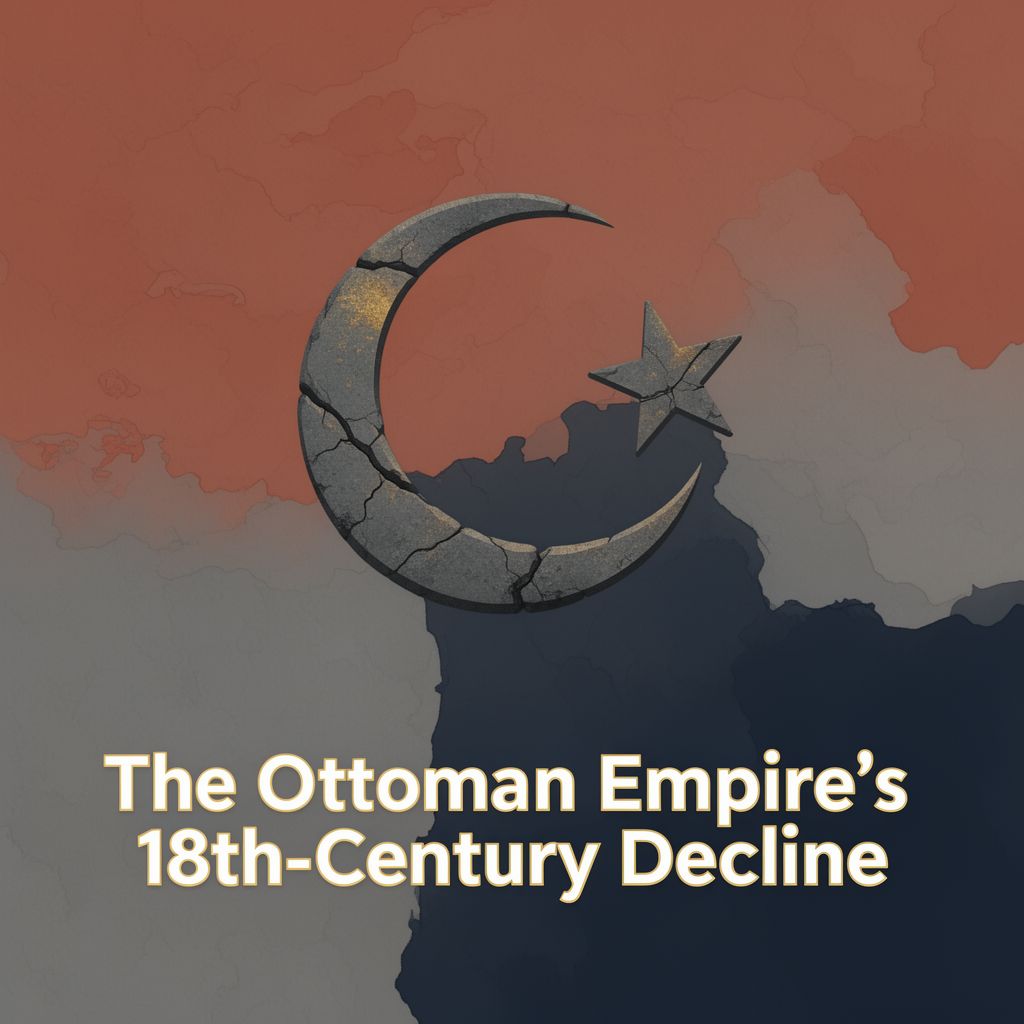
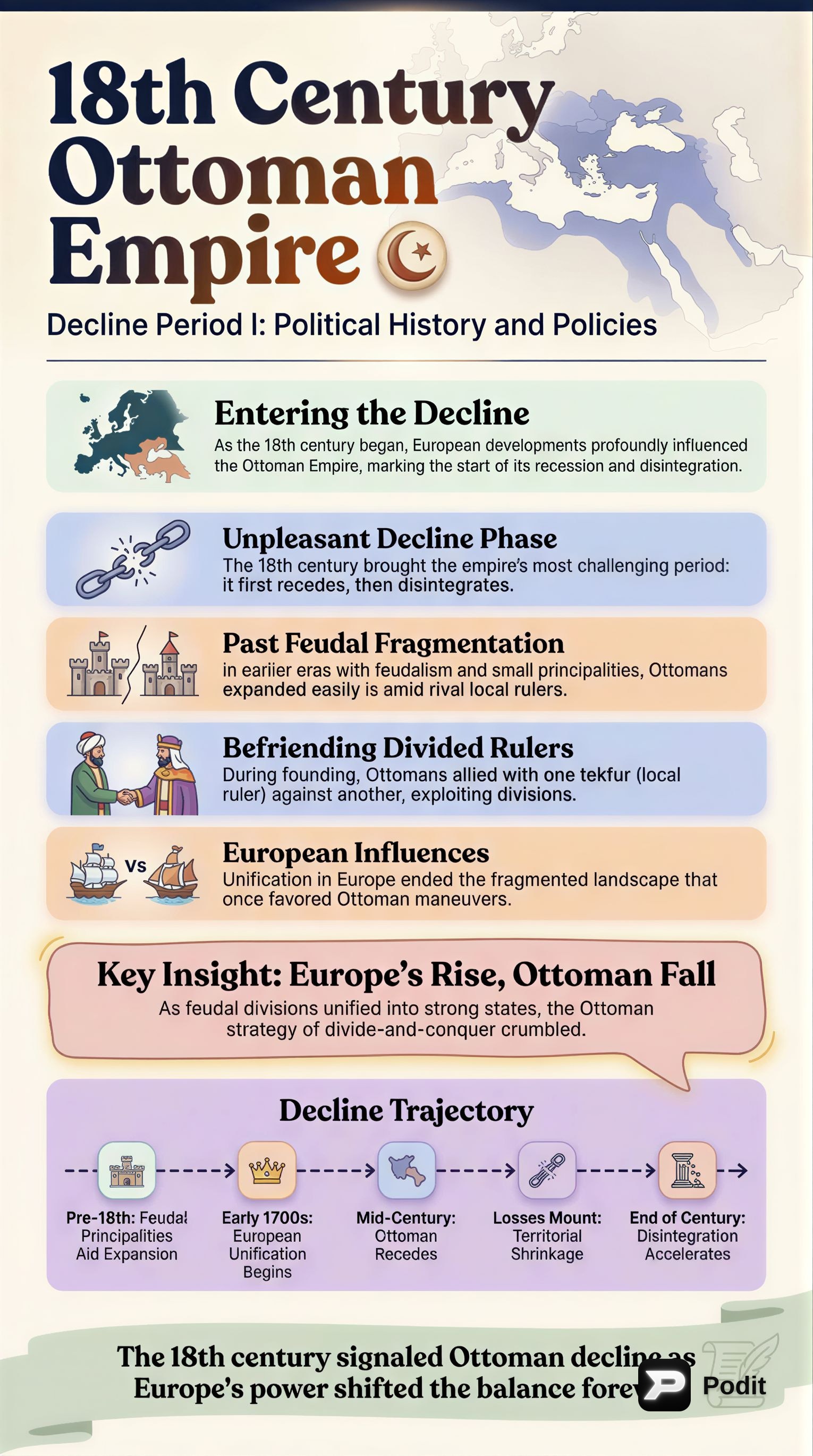
The 18th century marks a pivotal and often challenging period for the Ottoman Empire, frequently referred to as its "Period of Decline." It's crucial to understand that this wasn't a sudden, catastrophic collapse, but rather a gradual and complex process of weakening across its political, economic, and military structures. This decline was particularly evident when contrasted with the simultaneous rise of European powers. This study material will delve into the multifaceted internal and external factors that contributed to this significant shift, providing a comprehensive overview of why the once-mighty empire began to falter. By examining administrative issues, economic struggles, and major military setbacks, we will gain insight into the complexities of this transformative era.
I. Internal Factors: The Empire's Weakening Core 📉
Just like a grand old house whose foundations slowly erode, the Ottoman Empire faced significant internal challenges that undermined its strength from within. These issues created vulnerabilities that made the empire susceptible to both internal instability and external pressures.
A. Weakening of Central Authority and Administration 🏛️
One of the most critical internal problems was the erosion of the central government's power and the efficiency of its administration.
- Rampant Corruption: Corruption became widespread throughout the administrative system. This wasn't just about individual acts of bribery; it permeated various levels of governance, leading to a general decay of ethical standards and accountability.
- Decline of Meritocracy: The merit-based system of appointments, which had historically been a cornerstone of Ottoman strength and efficiency, was increasingly abandoned. Positions were often filled based on favoritism, personal connections, or financial inducements rather than competence or experience.
- Consequence: This meant that capable and dedicated individuals were frequently overlooked, leading to less effective governance, poor decision-making, and a general decline in the quality of public service. The state's ability to implement policies, collect taxes fairly, and maintain order was severely compromised.
- Loss of Control: The central authority, embodied by the Sultan and his divan (imperial council), found it increasingly difficult to exert full control over distant provinces and even within the capital. Local potentates and factions gained more autonomy, often acting in their own interests rather than those of the empire.
B. The Janissaries: From Elite Force to Political Faction ⚔️
The Janissaries, once the formidable elite infantry of the Ottoman army, underwent a profound transformation that ultimately contributed to the empire's internal instability.
- Transformation: Originally a highly disciplined and loyal fighting force, the Janissaries evolved into a powerful, often rebellious, political faction. Their initial purpose was to serve the Sultan directly, but over time, they gained significant privileges, including the right to marry and engage in trades, which diluted their military focus.
- Interference in State Affairs: By the 18th century, the Janissaries frequently interfered in state affairs, using their collective power to influence appointments, policies, and even the succession of sultans.
- Dethroning Sultans: Their ability to depose and enthrone sultans demonstrated their immense political leverage, further destabilizing the imperial government and undermining the Sultan's authority. This constant threat of military intervention made it difficult for any Sultan to implement necessary reforms or maintain consistent policies.
- Military Ineffectiveness: As their political power grew, their military effectiveness declined. They resisted modernization, clung to outdated tactics, and often prioritized their own corporate interests over the empire's defense. This made them less reliable as a fighting force against increasingly modern European armies.
C. Economic Challenges and Disadvantages 💰
The Ottoman Empire faced significant economic hurdles that further exacerbated its internal weaknesses.
- Shift of Major Trade Routes: The Age of Discovery in the 15th and 16th centuries led to a fundamental shift in global trade routes. Major commercial arteries moved from the Mediterranean, which the Ottomans largely controlled, to the Atlantic Ocean.
- Impact on Revenues: This rerouting severely impacted Ottoman revenues, as the empire lost significant income from customs duties, transit fees, and the bustling trade that once flowed through its territories. Cities that had thrived as trade hubs began to decline.
- Inflation and Outdated Tax System: The empire struggled with persistent inflation, which eroded the value of its currency and destabilized its economy. Coupled with an outdated and inefficient tax collection method, this created widespread financial distress.
- Exploitation and Unrest: The tax system often led to exploitation of the populace by tax farmers and local officials, causing widespread discontent, peasant revolts, and a general sense of injustice among the people. This further strained the relationship between the state and its subjects.
- Capitulations: Economic Disadvantage: The Capitulations were a series of trade agreements and treaties granting special rights and privileges to European merchants and nations within the Ottoman Empire.
- Nature of Capitulations: These agreements typically exempted European traders from local laws and taxes, allowed them to trade with minimal tariffs, and granted them extraterritoriality (meaning they were subject to their own laws, not Ottoman ones).
- Impact on Local Economy: While initially intended to encourage trade, by the 18th century, the Capitulations put Ottoman artisans and traders at a severe disadvantage. European goods, often produced more efficiently and subject to fewer taxes, could undersell local products. This hindered local economic development, stifled Ottoman industry, and led to a drain of wealth from the empire.
II. External Pressures and Military Setbacks 🛡️
While internal issues created a fertile ground for decline, the Ottoman Empire also faced immense external pressures from increasingly powerful and ambitious European states. These external challenges, combined with the empire's internal weaknesses, led to significant territorial losses and a diminishing international standing.
A. Rising European Powers and Expansionist Policies 📈
The 18th century saw the consolidation and aggressive expansion of several European powers, particularly on the Ottoman Empire's borders.
- Russia's Aggression: The most prominent external challenge came from the Russian Empire. Under dynamic leaders like Peter the Great (late 17th-early 18th century) and Catherine the Great (late 18th century), Russia pursued an aggressive expansionist policy.
- Targets: Russia's primary objectives were to gain access to warm-water ports on the Black Sea and to expand its influence into the Balkans, often at the direct expense of Ottoman territory. This ambition led to a series of costly wars.
- Habsburg Monarchy of Austria: The Habsburg Monarchy, centered in Austria, continued its long-standing rivalry with the Ottomans. It consistently challenged Ottoman control in Central Europe, particularly in Hungary and the Balkan regions, seeking to reclaim lost territories and expand its own sphere of influence.
- Shifting Balance of Power: The overall balance of power in Europe was shifting decisively in favor of these rising states, which possessed more centralized governments, stronger economies, and increasingly modern armies compared to the Ottomans.
B. Military Decline and Technological Gap 🚀
The Ottoman army, once the envy of Europe, began to fall significantly behind its European counterparts in terms of technology, training, and tactics.
- Technological Stagnation: While European armies were rapidly adopting new firearms, artillery, and military engineering techniques, the Ottomans often clung to traditional methods and were slow to integrate technological advancements. This created a widening gap in military capabilities.
- Training and Tactics: European armies were also developing more sophisticated training regimes, logistical systems, and tactical doctrines. The Janissaries, as discussed, resisted reform and modernization, making the Ottoman military less adaptable and effective on the battlefield.
- Consequences of the Gap: This technological and tactical disparity led to a series of devastating defeats for the Ottoman Empire in its conflicts with Russia and Austria. These losses were not just territorial; they also eroded the empire's prestige and confidence.
C. The Treaty of Küçük Kaynarca (1774): A Landmark Defeat 📜
A pivotal moment symbolizing the Ottoman Empire's decline and the growing power of Russia was the Treaty of Küçük Kaynarca, signed in 1774. This treaty followed a major Ottoman defeat in the Russo-Turkish War of 1768-1774.
- Significant Territorial Losses: The treaty forced the Ottomans to cede significant territories to Russia, including parts of the Black Sea coast and the strategically important Kerch Strait, granting Russia direct access to the Black Sea.
- Independence of Crimea: The Crimean Khanate, a long-standing Ottoman vassal state, was declared independent, though it was effectively brought under Russian influence shortly thereafter. This was a major blow to Ottoman prestige and control over the Black Sea region.
- Right to Protect Orthodox Christians: Crucially, the treaty granted Russia the right to protect Orthodox Christians within the Ottoman Empire.
- Pretext for Intervention: This 'protection' clause provided Russia with a convenient and recurring pretext for future interventions in Ottoman internal affairs. It allowed Russia to portray itself as the defender of a significant portion of the Ottoman population, thereby justifying political and military interference.
- Beginning of the 'Eastern Question': The Treaty of Küçük Kaynarca is widely regarded as marking the beginning of the 'Eastern Question.' This term refers to the diplomatic and political problem posed by the decay of the Ottoman Empire from the 18th to the early 20th centuries, and the struggle among European powers (especially Russia, Austria, Britain, and France) over its future and the division of its territories. The treaty effectively formalized the Ottoman Empire's status as the "Sick Man of Europe," a declining power whose fate was increasingly determined by external forces.
- Diminished Prestige: This period saw the empire losing significant territories and its prestige diminishing on the international stage. It was no longer seen as a formidable power but rather as a declining entity whose territories were ripe for the taking by its more powerful neighbors.
Conclusion: A Complex and Gradual Decline ✅
The 18th-century decline of the Ottoman Empire was a multifaceted and gradual process, far from a simple, sudden collapse. We have explored how a combination of profound internal weaknesses and relentless external pressures systematically eroded the empire's strength and influence.
Key Takeaways:
- Internal Decay: Administrative corruption, the transformation of the Janissaries into a disruptive political force, and severe economic challenges (like the shift in trade routes and the disadvantages of the Capitulations) weakened the empire from within. These internal cracks made the empire less resilient and less capable of adapting to changing global dynamics.
- External Aggression: Simultaneously, the empire faced aggressive expansionist policies from rising European powers, particularly Russia and the Habsburg Monarchy. The widening military and technological gap between the Ottoman army and its European counterparts led to a series of devastating defeats.
- Landmark Event: The Treaty of Küçük Kaynarca (1774) stands out as a symbolic and concrete manifestation of this decline. It not only resulted in significant territorial losses but also granted Russia a powerful tool for future intervention through the 'protection of Orthodox Christians' clause, effectively initiating the 'Eastern Question.'
Understanding this period is crucial because it laid the groundwork for the 19th-century reform efforts (Tanzimat) and ultimately for the eventual dissolution of the empire in the early 20th century. It serves as a powerful historical lesson: even the mightiest empires are susceptible to decline when internal cohesion falters, and external challenges are not met with adaptability, innovation, and effective governance. History, in this sense, offers valuable insights into the dynamics of power, change, and resilience across different contexts.