Podit
Podit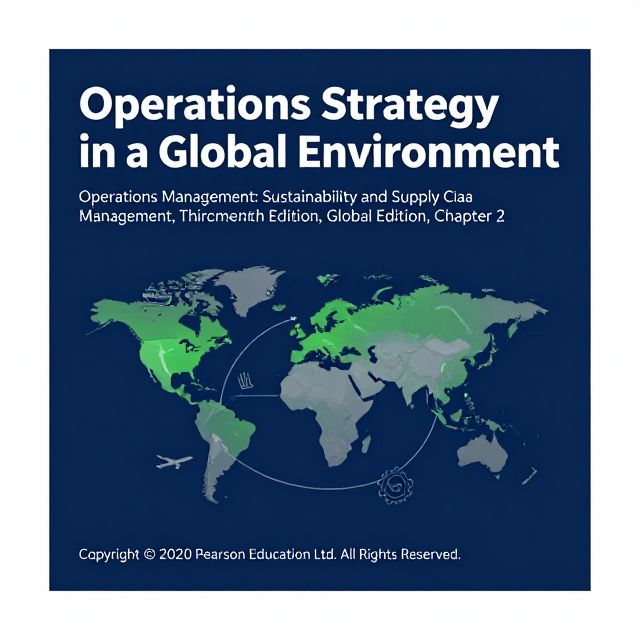
Operations Strategy in a Global Environment: A Study Guide
Source Information: This study material is compiled from a copy-pasted text (likely from a textbook or presentation slides) and an audio lecture transcript on Operations Management, specifically Chapter 2: Operations Strategy in a Global Environment.
🌍 Introduction to Global Operations and Globalization
In today's interconnected world, businesses increasingly operate on a global scale. Globalization means that customers, talent, and suppliers are no longer confined to national borders; they are worldwide. This global reach necessitates innovative strategies where firms compete not just with their own internal expertise but by leveraging the talent and resources across their entire global supply chain. This shift sets new standards for global competitiveness, impacting critical areas such as quality, variety, customization, convenience, timeliness, and cost.
🌐 Global Strategies: Navigating the International Landscape
Global strategies involve designing and managing operations that span multiple countries to achieve competitive advantage. This often means optimizing various aspects of the business, from sales and supply chains to production and talent acquisition, on an international level.
✅ Key Characteristics of Global Strategies:
- Worldwide Sales and Supply Chains: Companies manage complex networks of suppliers, production facilities, and distribution channels across the globe.
- Flexibility and Responsiveness: The ability to adapt quickly to changing market demands and local conditions in different regions.
- International Sourcing: Procuring components and raw materials from the most advantageous locations worldwide.
- Global Production and Assembly: Manufacturing and assembly operations are strategically located to optimize costs, access markets, or utilize specialized labor.
- Global Talent Pool: Accessing and deploying skilled labor and management from anywhere in the world.
💡 Examples of Companies Employing Global Strategies:
- Boeing: A prime example, with its sales and supply chain extending across the entire globe. Components might come from dozens of countries, and aircraft are sold to airlines worldwide.
- Benetton: Excels in global distribution by building flexibility into its design, production, and distribution processes. This allows them to move inventory to stores around the world faster than competitors, adapting to fashion trends and local demands.
- Sony: Demonstrates international sourcing by purchasing components from suppliers in diverse locations like Thailand, Malaysia, and other countries, optimizing for cost and specialized manufacturing capabilities.
- Volvo: Though historically a Swedish company, its current structure reflects deep globalization. It was purchased by a Chinese company (Geely), and its vehicles, like the S40, are assembled in various countries (e.g., Belgium, Malaysia) on platforms shared with other global manufacturers (e.g., Mazda 3 from Japan, Ford Focus from six countries). This illustrates global ownership, shared platforms, and distributed manufacturing.
- Haier: A Chinese company that has established a significant presence in the U.S. market by producing compact refrigerators and wine cabinets in South Carolina and other appliances in Kentucky. This strategy allows them to be closer to their U.S. customers, understand the market better, and potentially reduce logistics costs and tariffs.
These examples highlight how companies leverage global resources and markets to enhance their competitiveness and reach.
🎯 Six Reasons for Globalizing Operations
Companies choose to globalize their operations for several strategic advantages:
-
Improve the Supply Chain: 📈
- Locating facilities closer to unique resources, whether human expertise, low-cost labor, or specific raw materials.
- Example: Auto-styling studios gravitate to Southern California for specialized design talent; perfume manufacturers establish a presence in Grasse, France, known for its unique floral essences.
-
Reduce Costs and Exchange Rate Risks: 💰
- Taking advantage of changing currency values and less stringent government regulations (e.g., environmental, health, safety) in certain regions.
- Leveraging trade agreements (e.g., WTO, NAFTA, EU, APEC) to reduce tariffs and operating costs.
- Example: Maquiladoras in Mexico allow manufacturers to reduce costs by paying only for the value added by Mexican workers. The EU has reduced trade barriers through standardization and a common currency (the euro).
-
Improve Operations: ⚙️
- Learning from global best practices and different approaches to business.
- Example: Japanese companies have improved inventory management, Germans are leaders in robotics, and Scandinavians have contributed significantly to ergonomics.
- Enhancing response time and customer service by locating facilities closer to international customers.
-
Understand Markets: 📊
- Interacting with foreign customers, suppliers, and competitors provides insights into new product and service opportunities.
- Extending the product life cycle by introducing mature products to less-developed countries where they may be considered state-of-the-art.
- Example: Cell phone design innovations have moved from Europe to Japan and India, reflecting evolving market demands.
-
Improve Products: 💡
- Fostering a free flow of ideas and engaging in joint ventures to reduce development risks and enhance product offerings.
- Example: Toyota and BMW collaborate on battery research for green cars, sharing development costs and risks. This partnership also provides Toyota with BMW's diesel engines for the European market, benefiting both companies. Samsung and Bosch also jointly produce batteries.
-
Attract and Retain Global Talent: 🧑🤝🧑
- Offering better employment opportunities and career growth paths.
- Providing insulation against unemployment during economic downturns by relocating personnel to more prosperous locations within the global firm.
📚 Developing Missions and Strategies
A clear mission and well-defined strategy are fundamental for successful global operations.
-
Mission: 🎯
- Defines an organization's purpose for being and answers "What do we contribute to society?"
- Provides boundaries and focus for the organization.
- Each functional area (e.g., operations, marketing) then develops supporting missions aligned with the overall organizational mission.
- Example: Turkish Airlines' mission focuses on becoming a preferred European carrier with a global network, emphasizing safety, reliability, and service quality while maintaining its identity.
-
Strategy: 🗺️
- An action plan developed by managers to achieve the organization's mission.
- Ensures that all functional areas have supporting strategies.
- Aims to exploit opportunities, leverage strengths, neutralize threats, and avoid weaknesses.
🏆 Strategies for Competitive Advantage
Operations managers play a crucial role in creating customer value efficiently and sustainably through three primary strategies:
-
Differentiation: ✨
- Offering products or services that are "better" or "different" in a way that customers value.
- Uniqueness can extend beyond physical characteristics to service attributes and the overall customer experience.
- Example: Safeskin Corporation differentiated itself by producing latex exam gloves designed to prevent allergic reactions, building a reputation for reliable, state-of-the-art products.
- Experience Differentiation: Engaging customers through imaginative use of the five senses to create an "experience."
- Example: Theme parks use sight, sound, and smell; movie theaters add moving seats and mists; restaurants use music, aroma, and open kitchens.
-
Cost Leadership: 💲
- Achieving maximum value as defined by the customer at the lowest possible cost.
- Requires relentless effort across all operations decisions to drive down costs while meeting customer expectations.
- Example: Southwest Airlines achieves low costs through secondary airports, no-frills service, and efficient equipment utilization. Walmart maintains low costs through minimal overhead, efficient distribution, and high inventory turnover.
-
Response: ⏱️
- Being more responsive to market changes and customer needs.
- Flexibility: The ability to match changes in the marketplace, including design innovations and volume fluctuations.
- Example: Hewlett-Packard demonstrates flexibility in design and volume changes in the volatile personal computer market.
- Reliability: Consistently meeting schedules and commitments.
- Example: German machine firms are known for meaningful schedules and reliable performance, communicating results to customers.
- Quickness: Speed in design, production, and delivery.
- Example: Pizza Hut emphasizes quick delivery.
🤝 Strategic Planning, Core Competencies, and Outsourcing
Outsourcing involves transferring activities traditionally performed internally to external suppliers. It's a critical global strategy that adds complexity but can offer significant benefits.
- Acceleration of Outsourcing: Driven by:
- Increased technological expertise globally.
- More reliable and cheaper transportation.
- Rapid development and deployment of telecommunications and computer advancements.
- Subcontracting/Contract Manufacturing: A long-standing practice where production activities are outsourced, often on a continuing basis.
- Theory of Comparative Advantage: 💡 This economic concept is a primary driver of outsourcing. It states that if an external provider can perform activities more productively (i.e., at a lower cost or higher quality) than the purchasing firm, then the external provider should do the work, regardless of geographic location. This allows the purchasing firm to focus on its core competencies – what it does best.
- Example: DuPont outsourcing legal services to the Philippines, IBM handling travel services for other companies, or Audi/Mercedes outsourcing convertible production to specialized manufacturers like Wilheim Karmann.
⚠️ Risks of Outsourcing: While offering advantages, outsourcing carries significant risks:
| Advantages | Disadvantages | | :------------------------------------------ | :------------------------------------------------ | | Cost savings | Increased logistics and inventory costs | | Gaining outside expertise/specialization | Loss of control (quality, delivery, intellectual property) | | Improving operations and service | Potential creation of future competitors | | Maintaining focus on core competencies | Negative impact on employees (job loss) | | Accessing outside technology | Risks may not manifest for years |
- Other Issues for Operations Managers: Reduced employment levels, changes in facility requirements, adjustments to quality control systems, and expanded logistics issues (insurance, tariffs, customs, timing).
- Rating Outsourcing Providers: Decisions should be based on thorough analysis. The factor-rating method provides an objective way to evaluate potential providers by assigning weights to critical factors (e.g., client reviews, financial condition, IT capabilities, government stability) and scoring providers against these factors.
📈 Global Operations Strategy Options
- International Business: Any firm engaged in international trade or investment.
- Multinational Corporation (MNC): A firm with extensive international business involvement, often with facilities and significant sales/profits in multiple countries.
- Example: IBM, which imports components from over 50 countries, exports to over 130, has facilities in 45, and earns more than half its sales and profits abroad.
⚠️ Cultural and Ethical Issues
Operating globally introduces challenges related to diverse social and cultural behaviors. Managers must navigate issues like bribery, child labor, and environmental standards, which can vary significantly across countries. International laws, agreements, and codes of conduct are evolving to define ethical behavior in a global context.
✅ Key Considerations for Global Operations
Companies need to carefully consider various factors when planning and executing global operations:
- National literacy rate
- Rate of innovation and technology change
- Number of skilled workers
- Political stability
- Product liability laws
- Export restrictions
- Variations in language and work ethic
- Tax rates and inflation
- Availability of raw materials
- Interest rates
- Population demographics
- Transportation infrastructure
- Communication systems