Republican Era Turkish Poetry: Part 2 - kapak
Edebiyat#republican era#turkish literature#turkish poetry#i̇kinci yeni

Republican Era Turkish Poetry: Part 2

An academic overview of significant poetic movements and figures in Republican Era Turkish literature, focusing on post-1950s developments including the İkinci Yeni movement and other trends.

ilkim3May 8, 2026 ~22 dk toplam
01

Sesli Özet

7 dakika

Konuyu otobüste, koşarken, yolda dinleyerek öğren.

Sesli Özet

Republican Era Turkish Poetry: Part 2

0:007:11
02

Görsel Özet

İnfografik

Konunun tüm parçalarını tek bakışta gör.

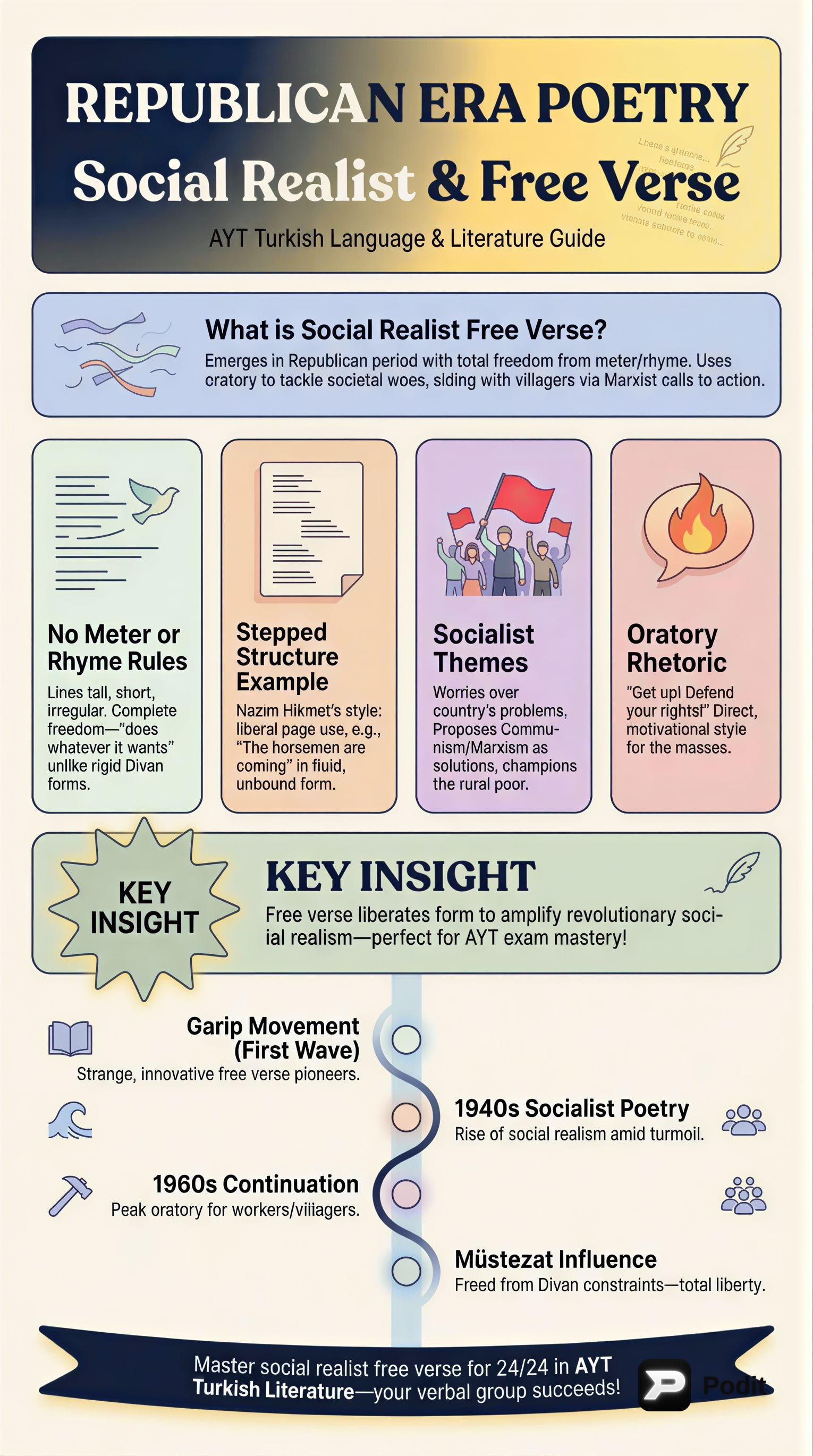
Republican Era Turkish Poetry: Part 2 - görsel özet infografik
Tam boyutta görüntüle →
03

Flash Kartlar

25 kart

Karta tıklayarak çevir. ← → ile gez, ⎵ ile çevir.

1 / 25
Tüm kartları metin olarak gör
  1. 1. When did the Republican Era in Turkish literature, which includes its poetry, officially begin?

    The Republican Era in Turkish literature commenced with the establishment of the Turkish Republic in 1923. This period marked profound transformations in poetic expression, building upon earlier foundational shifts. It set the stage for the diverse movements and individual voices that would define Turkish poetry for decades to come.

  2. 2. What is the primary focus of this content regarding Republican Era Turkish Poetry?

    This content primarily focuses on the later significant movements and individual poets within Republican Era Turkish Poetry, particularly emphasizing the post-1950s landscape. It delves into how this period marked a departure from earlier traditions and introduced new aesthetic paradigms, reflecting evolving socio-political and cultural dynamics.

  3. 3. What does the "İkinci Yeni" movement translate to in English, and when did it emerge?

    The "İkinci Yeni" movement translates to "Second New" in English. It emerged in the mid-1950s as a significant reaction against the perceived simplicity and social realism of the earlier Garip movement. This period aimed to redefine poetic expression through new aesthetic principles.

  4. 4. What earlier Turkish poetry movement did İkinci Yeni react against, and why?

    The İkinci Yeni movement reacted against the earlier Garip (First New) movement. They opposed Garip's perceived simplicity, colloquialism, and social realism, seeking instead to introduce more abstract, ambiguous, and intellectually deep forms of poetry. This reaction aimed to elevate poetry beyond direct communication.

  5. 5. List three key characteristics of the İkinci Yeni movement's poetic style.

    Three key characteristics of the İkinci Yeni movement include an emphasis on abstract imagery, surrealism, and ambiguity. They also focused on the intrinsic qualities of language itself, often detaching words from conventional meanings, and rejected narrative structure in favor of a more individualistic and obscure poetic voice.

  6. 6. How did İkinci Yeni poets view the role of language in their poetry?

    İkinci Yeni poets viewed language as central to their poetic expression, often detaching words from their conventional meanings to create new, unexpected associations. Their primary focus was on the intrinsic qualities of language itself, aiming to liberate poetry from utilitarian functions and elevate it to an art form focused purely on its linguistic and imaginative potential.

  7. 7. What was the primary focus of İkinci Yeni poetry regarding direct communication or social commentary?

    The primary focus of İkinci Yeni poetry was on aesthetic experience rather than direct communication or social commentary. They deliberately moved away from everyday language and rejected narrative structure, prioritizing the artistic and imaginative potential of language over any utilitarian or social function.

  8. 8. Name two prominent figures of the İkinci Yeni movement.

    Two prominent figures of the İkinci Yeni movement are Cemal Süreya and Edip Cansever. Other notable poets include Turgut Uyar, İlhan Berk, Ece Ayhan, and Ülkü Tamer, all of whom contributed significantly to the movement's distinct style and themes.

  9. 9. Describe Cemal Süreya's poetic style within the İkinci Yeni movement.

    Cemal Süreya, a prominent figure of İkinci Yeni, was known for his intense and sensual imagery. His poetry often explored themes of love, desire, and urban life with a unique blend of intellectual depth and emotional resonance. He contributed significantly to the movement's emphasis on abstract and evocative language.

  10. 10. What themes did Edip Cansever explore in his poetry?

    Edip Cansever, another key İkinci Yeni poet, explored themes of urban alienation and existential angst in his work. His poetry often delved into the complexities of modern life and the human condition, using a challenging and introspective style that reflected the movement's focus on ambiguity and intellectual depth.

  11. 11. How did Turgut Uyar's poetry contribute to the İkinci Yeni movement?

    Turgut Uyar's poetry within the İkinci Yeni movement delved into the complexities of human relationships and societal structures. He often explored the inner world of individuals and their interactions with the broader society, contributing to the movement's intellectual depth and its departure from simpler, more direct forms of expression.

  12. 12. What distinguished İlhan Berk's approach to poetry within the İkinci Yeni movement?

    İlhan Berk was distinguished by his prolific experimentation with form and language within the İkinci Yeni movement. He constantly pushed the boundaries of poetic expression, exploring new structures and linguistic possibilities. His work exemplified the movement's commitment to innovation and its rejection of conventional poetic norms.

  13. 13. What was Ece Ayhan recognized for in his poetic style?

    Ece Ayhan was recognized for his unique, often dark and subversive style within the İkinci Yeni movement. His poetry frequently employed unconventional language and imagery to challenge societal norms and explore complex psychological landscapes. He contributed to the movement's reputation for being hermetic and challenging.

  14. 14. How did Ülkü Tamer blend poetic elements in his work?

    Ülkü Tamer's work blended elements of folk poetry with modern sensibilities, offering a unique contribution to the İkinci Yeni movement. While embracing the movement's abstract tendencies, he also incorporated a lyrical quality that resonated with traditional forms. This fusion allowed him to explore contemporary themes with a distinctive voice.

  15. 15. Who was Sezai Karakoç, and what made his voice distinct despite being grouped with İkinci Yeni?

    Sezai Karakoç was a significant poet often grouped with İkinci Yeni, but his voice was distinct due to his integration of Islamic mysticism and metaphysical concerns into his poetic framework. He crafted a unique synthesis of modern poetic techniques with profound religious and philosophical inquiries, adding a layer of complexity not typically found in other İkinci Yeni poets.

  16. 16. What was the lasting influence of the İkinci Yeni movement on Turkish literature?

    The İkinci Yeni movement profoundly influenced subsequent generations of Turkish poets and remains a cornerstone of modern Turkish literary studies. It redefined poetic expression by emphasizing abstract imagery, ambiguity, and intellectual depth, liberating poetry from utilitarian functions and elevating its artistic potential.

  17. 17. Name one significant poetic trend that continued and evolved beyond the İkinci Yeni movement in the Republican Era.

    One significant poetic trend that continued and evolved beyond the İkinci Yeni movement was Mystical and Metaphysical Poetry. This trend deepened the exploration of spiritual, existential, and Islamic themes, with poets like Sezai Karakoç and later İsmet Özel contributing significantly to its development.

  18. 18. Which poets are associated with the continuation of Mystical and Metaphysical Poetry in the Republican Era?

    Poets associated with the continuation of Mystical and Metaphysical Poetry include Necip Fazıl Kısakürek, whose influence extended into this period, and more prominently, Sezai Karakoç. Later, İsmet Özel also transitioned towards more metaphysical and ideological concerns in his works, reflecting this enduring trend.

  19. 19. How did Sezai Karakoç contribute to Mystical and Metaphysical Poetry?

    Sezai Karakoç made a unique contribution to Mystical and Metaphysical Poetry by crafting a synthesis of modern poetic techniques with profound religious and philosophical inquiries. His work integrated Islamic mysticism, creating a body of poetry that resonated deeply with readers interested in spiritual and existential themes.

  20. 20. What shift did İsmet Özel undergo in his poetic concerns?

    İsmet Özel, initially associated with social realism, transitioned towards more metaphysical and ideological concerns in his later works. This shift reflected a broader intellectual change within the Republican Era, moving from direct social commentary to deeper spiritual and philosophical explorations in his poetry.

  21. 21. What was the main focus of Social Realist and Leftist Poetry in the Republican Era?

    The main focus of Social Realist and Leftist Poetry in the Republican Era was on social justice, political commentary, and the struggles of the common people. While rooted in earlier periods, this trend evolved to employ more sophisticated poetic language and nuanced perspectives, often reflecting the turbulent political climate.

  22. 22. Name two poets associated with Social Realist and Leftist Poetry in the Republican Era.

    Two poets associated with Social Realist and Leftist Poetry in the Republican Era are Ataol Behramoğlu and Süreyya Berfe. They maintained a focus on social justice and political commentary, using more sophisticated poetic language to address the struggles of the common people and the turbulent political climate.

  23. 23. When did the "1980 Generation Poetry" emerge, and what characterized its context?

    The "1980 Generation Poetry" emerged in the aftermath of the 1980 military coup in Turkey. This context significantly influenced their work, leading to a re-evaluation of previous movements and a search for new forms of expression that sometimes incorporated postmodern elements.

  24. 24. What was a key difference between 1980 Generation Poetry and the İkinci Yeni movement?

    A key difference was that 1980 Generation Poetry often sought a return to narrative and questioned the extreme abstraction of the İkinci Yeni movement. While İkinci Yeni prioritized ambiguity and aesthetic experience, the 1980 Generation looked for new forms and expressions, sometimes incorporating postmodern elements, but often with a more accessible approach.

  25. 25. Name two figures who exemplify the 1980 Generation Poetry.

    Haydar Ergülen and Enis Batur are two figures who exemplify the diverse approaches of the 1980 Generation Poetry. Their works reflect the generation's re-evaluation of previous movements, a questioning of extreme abstraction, and a search for new forms and expressions, sometimes incorporating postmodern elements.

04

Bilgini Test Et

15 soru

Çoktan seçmeli sorularla öğrendiklerini ölç. Cevap + açıklama.

Soru 1 / 15Skor: 0

The Republican Era in Turkish literature, which saw profound transformations in poetic expression, commenced with what significant event?

05

Detaylı Özet

5 dk okuma

Tüm konuyu derinlemesine, başlık başlık.

This content is based on a YouTube video.


Republican Era Turkish Poetry: Part 2 🇹🇷📚

Introduction

This study material explores the second part of Republican Era Turkish Poetry, focusing on significant movements and individual poets, particularly from the post-1950s period. This era, beginning with the establishment of the Turkish Republic in 1923, witnessed profound transformations in poetic expression. It is characterized by a rich diversity of styles, thematic concerns, and philosophical underpinnings, reflecting Turkey's evolving socio-political and cultural dynamics. This section delves into movements that marked a departure from earlier traditions and introduced new aesthetic paradigms.

The İkinci Yeni (Second New) Movement (Mid-1950s Onwards) 👥

The İkinci Yeni, or Second New, movement emerged in the mid-1950s as a significant reaction against the perceived simplicity, colloquialism, and social realism of the earlier Garip (First New) movement. Poets of İkinci Yeni aimed to redefine poetry by emphasizing abstract imagery, surrealism, ambiguity, and intellectual depth.

Key Characteristics of İkinci Yeni Poetry ✅

  • Rejection of Simplicity: A direct opposition to the straightforward language and social commentary of previous movements.
  • Focus on Language: Prioritized the intrinsic qualities of language, often detaching words from conventional meanings to create new associations.
  • Abstract & Ambiguous: Frequent use of abstract imagery and deliberate ambiguity, leading to hermetic and challenging poetry.
  • Aesthetic Over Communication: Prioritized aesthetic experience over direct communication or social commentary.
  • Rejection of Narrative: Moved away from traditional narrative structures.
  • Exploration of Subconscious: Delved into subconscious and existential themes.
  • Individualistic Voice: Championed a highly individualistic and often obscure poetic voice.
  • Liberation of Poetry: Aimed to free poetry from utilitarian functions, elevating it as an art form focused purely on linguistic and imaginative potential.

Prominent Poets and Their Works (İkinci Yeni) ✍️

The İkinci Yeni movement profoundly influenced subsequent generations and remains a cornerstone of modern Turkish literary studies. Here are its key figures:

  • Cemal Süreya: Known for his intense and sensual imagery. His poetry often explored themes of love, urban life, and the complexities of human emotions with a unique blend of intellectualism and raw feeling.
  • Edip Cansever: Explored urban alienation and existential angst. His works often depicted the struggles of individuals in modern city life, using a fragmented and introspective style.
  • Turgut Uyar: Delved into the complexities of human relationships and societal structures. Uyar's poetry is characterized by its deep psychological insights and often melancholic tone.
  • İlhan Berk: A prolific poet who experimented extensively with form and language. Berk was known for his avant-garde approach, constantly pushing the boundaries of poetic expression.
  • Ece Ayhan: Recognized for his unique, often dark and subversive style. Ayhan's poetry is dense, challenging, and frequently uses unconventional syntax and vocabulary to create a distinct voice.
  • Ülkü Tamer: His work blended elements of folk poetry with modern sensibilities. Tamer created a bridge between traditional Turkish poetic forms and contemporary themes.
  • Sezai Karakoç: Although often grouped with İkinci Yeni, Karakoç developed a distinct voice. He integrated Islamic mysticism and metaphysical concerns into his poetic framework, adding a layer of spiritual and philosophical depth to the era's literary landscape.

Other Significant Poetic Trends and Independent Voices (1960s Onwards) 💡

Beyond the dominant İkinci Yeni movement, the Republican Era, particularly from the 1960s onwards, fostered several other important poetic trends and nurtured a multitude of independent voices.

1. Mystical and Metaphysical Poetry 🌌

This trend continued and evolved, deepening the exploration of spiritual, existential, and Islamic themes.

  • Necip Fazıl Kısakürek: His influence extended well into this period, known for his profound spiritual and ideological poetry.
  • Sezai Karakoç: Crafted a unique synthesis of modern poetic techniques with profound religious and philosophical inquiries, creating a body of work that resonated deeply with a segment of the readership.
  • İsmet Özel: Initially associated with social realism, Özel later transitioned towards more metaphysical and ideological concerns in his works, reflecting a broader intellectual shift.

2. Social Realist and Leftist Poetry ✊

While having roots in earlier periods, this trend continued to evolve, focusing on social justice and political commentary.

  • Ataol Behramoğlu: Maintained a focus on social justice, political commentary, and the struggles of the common people, often employing sophisticated poetic language.
  • Süreyya Berfe: Also focused on social issues, using nuanced perspectives to reflect the turbulent political climate of the late 20th century.

3. 1980 Generation Poetry 🔄

This movement emerged in the aftermath of the 1980 military coup, often characterized by a re-evaluation of previous movements.

  • Characteristics: These poets frequently sought a return to narrative, questioned İkinci Yeni's extreme abstraction, and searched for new forms and expressions, sometimes incorporating postmodern elements.
  • Haydar Ergülen: Exemplifies this generation's diverse approaches, known for his lyrical and often melancholic style.
  • Enis Batur: Another prominent figure, known for his intellectual depth and experimental approach to poetry and prose.

4. Independent Voices 👤

The period was enriched by numerous poets who did not strictly adhere to any single movement but developed highly distinctive styles.

  • Behçet Necatigil: Celebrated for his introspective poetry that explored urban life, the inner world of individuals, and the subtle anxieties of modern existence. His work often depicted the quiet struggles of ordinary people.
  • Fazıl Hüsnü Dağlarca: A prolific and versatile poet who explored a vast array of themes, from national epics to philosophical musings and the mysteries of the universe, often with a powerful and original use of language. He is known for his epic scope and unique poetic voice.

Conclusion: The Rich Tapestry of Republican Era Turkish Poetry 🎨

In conclusion, Republican Era Turkish poetry, particularly in its later phases, demonstrates a rich tapestry of styles, philosophies, and thematic concerns. From the abstract and intellectual explorations of the İkinci Yeni movement, which challenged conventional poetic norms, to the deeply spiritual verses of metaphysical poets, the socially conscious narratives of leftist poets, and the diverse expressions of independent voices, this period solidified Turkish poetry's place within modern literary traditions.

The continuous evolution and diversification underscore the dynamic nature of literary creation in the Turkish Republic. This era not only produced a wealth of influential poets and groundbreaking works but also fostered a vibrant critical discourse that continues to shape the understanding and appreciation of Turkish literature today. The legacy of these poets and movements remains a vital component of Turkish cultural heritage, offering profound insights into the human condition and the complexities of modern Turkish identity.
Kendi çalışma materyalini oluştur

PDF, YouTube videosu veya herhangi bir konuyu dakikalar içinde podcast, özet, flash kart ve quiz'e dönüştür. 1.000.000+ kullanıcı tercih ediyor.

Sıradaki Konular

Tümünü keşfet
Imagist Poetry: Characteristics and Key Figures

Imagist Poetry: Characteristics and Key Figures

This audio summary explores Imagist Poetry, detailing its historical context, core principles, and the contributions of prominent figures such as Amy Lowell, H.D., and William Carlos Williams.

6 dk Özet 25 15
The Time Machine: Final Journeys and Disappearance

The Time Machine: Final Journeys and Disappearance

An academic summary of the Time Traveller's harrowing encounters with Morlocks, his journey into Earth's distant future, and his enigmatic final disappearance, as depicted in H.G. Wells' classic novel.

6 dk Özet 25 15
The Time Traveller's Future World: Eloi and Morlocks

The Time Traveller's Future World: Eloi and Morlocks

An academic summary of the Time Traveller's initial encounters, evolving theories on future humanity, and preparations for retrieving his Time Machine in H.G. Wells' 'The Time Machine'.

6 dk Özet 25 15
The Time Machine: Initial Journey and Future Society

The Time Machine: Initial Journey and Future Society

This summary explores the Time Traveller's initial exposition of the Fourth Dimension, his maiden voyage into the distant future, and his early observations and theories regarding the bifurcated human society of the Eloi and Morlocks.

6 dk Özet 25 15
Development of Contemporary African American Fiction

Development of Contemporary African American Fiction

An academic overview of the development of contemporary African American fiction, exploring its narrative techniques, linguistic features, and key socio-historical and theoretical concepts.

7 dk Özet 25 15
Milton's Paradise Lost: Books III and IV Summary

Milton's Paradise Lost: Books III and IV Summary

An academic summary of John Milton's Paradise Lost, focusing on Book III's divine council and the Son's sacrifice, and Book IV's depiction of Satan's journey to Eden and his first encounter with humanity.

6 dk Özet 25 15
Cumhuriyet Dönemi Türk Şiiri: Akımlar ve Temsilciler

Cumhuriyet Dönemi Türk Şiiri: Akımlar ve Temsilciler

Bu içerik, Cumhuriyet Dönemi Türk şiirindeki önemli akımları ve bu akımların önde gelen temsilcilerini akademik bir yaklaşımla ele almaktadır. Şiirdeki dönüşümler ve etkileşimler incelenmektedir.

6 dk Özet 25 15 Görsel
Ottoman Empire Culture and Civilization

Ottoman Empire Culture and Civilization

An academic overview of the Ottoman Empire's culture and civilization, encompassing its administrative structure, social organization, economic systems, educational institutions, and artistic achievements.

8 dk Özet 25 15 Görsel