 Podit
Podit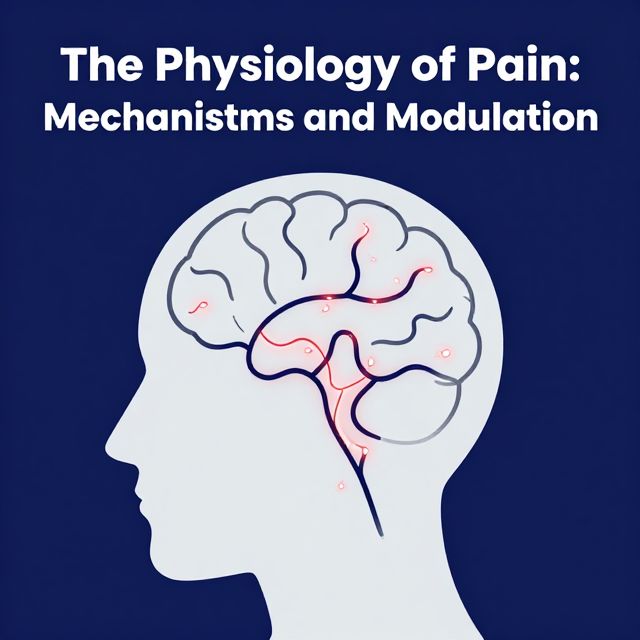
📚 Pain Physiology: A Comprehensive Study Guide
This study material has been compiled and organized from various sources, including copy-pasted text and a lecture audio transcript.
🎯 Introduction to Pain Physiology
Pain is a complex and vital physiological phenomenon, serving as a protective mechanism that alerts the body to potential or actual tissue damage. Understanding its mechanisms, from initial detection to central processing and modulation, is crucial in medicine and healthcare. This guide explores the definition, classification, pathways, and modulation of pain, along with specific chronic and specialized pain conditions.
1. 📚 Definition and Classification of Pain
Pain is more than just a physical sensation; it's a multifaceted experience.
- Definition of Pain:
- An unpleasant sensory and emotional experience 🧠.
- Associated with actual or potential tissue damage ⚠️.
- Serves as a protective physiological response ✅.
- Nociception: Refers to the unconscious physiological process of detecting harmful stimuli. It involves a pathway:
- Injury
- Nociceptor (detects harm)
- Spinal Cord
- Thalamus
- Cortex
- Pain Perception (conscious experience)
1.1. Classification of Pain
Pain is broadly categorized into two main types based on its duration and characteristics:
- Acute Pain:
- Onset: Sudden.
- Nature: Fast, sharp, well-localized.
- Function: Protective physiological response.
- Duration: Disappears as healing occurs.
- Example: Touching a hot stove, a sprained ankle.
- Chronic Pain:
- Onset: Slow, persistent.
- Nature: Burning or aching, often poorly localized.
- Function: Pathological, persists after healing.
- Duration: Can cause severe suffering and is often difficult to treat.
- Example: Chronic back pain, fibromyalgia.
2. 🔬 Nociceptors: The Pain Detectors
Nociceptors are specialized sensory receptors that detect harmful stimuli.
- Characteristics:
- They are free nerve endings located throughout the body.
- Detect harmful stimuli (noxious stimuli).
- Show little adaptation, meaning they continue to fire as long as the stimulus is present.
- Activation Mechanisms:
- Extreme Temperature:
- Heat threshold ≈ 43°C (e.g., detected by TRPV1 receptors).
- Cold threshold ≈ 25°C (e.g., detected by TRPM8 receptors).
- Mechanical Damage:
- Require strong stimulation (e.g., pinch, strong pressure, tissue injury).
- Do NOT respond to light touch.
- Chemical Stimuli:
- C fiber nociceptors respond to chemicals from external irritants, tissue injury, and inflammatory mediators.
- Extreme Temperature:
2.1. Nociceptor Fibers
Two main types of nerve fibers transmit nociceptive signals:
| Feature | Aδ Fibers | C Fibers | | :----------- | :-------------------------------------- | :------------------------------------------- | | Speed | Fast | Slow | | Pain Type| Sharp, pricking, well-localized | Burning, aching, dull, poorly localized | | Myelination| Myelinated (faster conduction) | Unmyelinated (slower conduction) | | Stimulus | Mechanical / Thermal | Mechanical / Thermal / Chemical |
2.2. Neurotransmitters in Pain
Several neurotransmitters play a crucial role in pain signaling:
- Major Neurotransmitters:
- Glutamate: Primary excitatory neurotransmitter.
- Substance P: Neuropeptide involved in pain transmission.
- CGRP (Calcitonin Gene-Related Peptide): Potent vasodilator and pain modulator.
- Release: These are released in spinal cord synapses and at the injury site, increasing nociceptor activation and enhancing pain signals.
3. 📈 Sensitization of Peripheral Receptors
Tissue injury can lead to increased sensitivity of nociceptors, a process called peripheral sensitization.
- Mechanism: Tissue injury causes the release of inflammatory mediators (e.g., bradykinin, prostaglandins). These substances:
- Increase nociceptor sensitivity ✅.
- Lower their activation threshold (making them fire more easily) 💡.
- Consequences of Sensitization:
- Hyperalgesia: An increased response to a stimulus that is normally painful.
- Example: Sunburned skin feels much more painful to touch than normal skin.
- Allodynia: Pain caused by a stimulus that does not normally provoke pain.
- Example: Light touch on sunburned skin causes pain.
- Silent Nociceptors: These are normally inactive but become activated during inflammation, increasing pain signals and expanding the painful area.
- Hyperalgesia: An increased response to a stimulus that is normally painful.
4. 🧠 Pain Processing in the Spinal Cord
The spinal cord acts as the first major relay station for pain signals.
- First Synapse: Occurs in the posterior (dorsal) horn of the spinal cord.
- Aδ and C fibers primarily synapse in the superficial layers (Lamina I and II).
- Aβ fibers (touch/pressure) project to deeper layers.
- Spinal Cord Neurons:
- Nociceptive Specific (NS) Neurons: Respond only to painful stimuli.
- Wide Dynamic Range (WDR) Neurons: Respond to both painful and non-painful stimuli, integrating sensory information.
- Signal Transmission:
- Nociceptor activation.
- Signal enters the dorsal horn.
- Synapse with a second-order neuron.
- Neurotransmitter release (excitatory: Glutamate, Substance P, CGRP).
- Signal ascends to the brain.
- Wind-Up Phenomenon: Repeated C fiber stimulation can lead to an increasing response in WDR neurons, amplifying the pain signal. This contributes to central sensitization.
- Central Sensitization: Repeated nociceptive input causes:
- Increased neuron excitability.
- Amplified pain perception.
- Prolonged hyperalgesia.
- Can be protective but often maladaptive in chronic pain.
5. ⬆️ Ascending Nociceptive Pathways
Pain signals travel from the spinal cord to the brain via several ascending pathways, which can be broadly categorized:
- 1. Lateral Sensory-Discriminative Pathway (Neospinothalamic Tract):
- Function: Responsible for the location, intensity, and quality of pain.
- Characteristics: Fast conduction, transmits sharp, well-localized pain.
- Fibers: Mainly carried by Aδ fibers.
- Projection: Primarily to the somatosensory cortex.
- 2. Medial Affective-Motivational Pathways:
- Function: Responsible for the emotional response, motivation, and behavior associated with pain.
- Characteristics: Produces dull, aching, poorly localized pain.
- Fibers: Mainly carried by C fibers.
- Projection: To limbic structures (e.g., amygdala, anterior cingulate cortex).
- Other Tracts:
- Spinomesencephalic Tract: Projects to the Periaqueductal Gray (PAG) and superior colliculus, involved in pain modulation and orientation to injury.
- Spinoreticular Tract: Projects to the reticular formation, locus coeruleus, and raphe nuclei, influencing motor responses and pain modulation.
- Projections to Hypothalamus & Limbic System: Influence stress hormone release, emotional responses, and autonomic functions.
6. 🧠 Cortical Pain Matrix
There is no single "pain center" in the brain. Instead, pain perception involves a complex network of interconnected brain regions known as the Cortical Pain Matrix.
- Key Areas:
- Somatosensory Cortex: Processes sensory aspects (location, intensity).
- Limbic Structures: Involved in emotional and affective components (e.g., amygdala, insula, anterior cingulate cortex).
- Association Cortex: Integrates cognitive aspects of pain.
- These systems are highly integrated and necessary for the full appreciation of pain.
7. ⚖️ Pain Modulation
Pain perception is not static; it can be significantly modified (inhibited or facilitated) by various mechanisms.
- Types of Pain Modulation:
- Gate Control Mechanism
- Descending Inhibition
- Endogenous Opioid System
7.1. Pain Modulation in the Spinal Cord (Gate Control Theory)
- Mechanism: Pain signals can be reduced by non-noxious sensory input.
- Touch fibers (Aβ fibers) activate inhibitory interneurons in the dorsal horn.
- These interneurons then inhibit the transmission of pain signals from Aδ and C fibers to second-order neurons.
- Result: Reduced pain perception.
- Example: Rubbing an injured area to alleviate pain.
7.2. Descending Influences from the Brainstem
The brain can actively suppress pain signals.
- Brainstem Structures:
- Periaqueductal Gray (PAG)
- Locus Coeruleus
- Raphe Nuclei
- These structures send descending fibers to the spinal cord, releasing neurotransmitters like serotonin, norepinephrine, and glutamate.
- These neurotransmitters activate inhibitory interneurons in the spinal cord, leading to a reduction in pain signal transmission.
7.3. Endogenous Opioid System
The body possesses its own natural analgesic system.
- Opioid Receptors: Found in the cortex, brainstem, and spinal cord, they reduce pain transmission.
- Natural Opioid Peptides:
- Endorphins
- Enkephalins
- Dynorphins
- These peptides bind to opioid receptors (μ, δ, κ), producing strong analgesic effects.
8. ⚠️ Chronic and Specialized Pain Conditions
8.1. Chronic Pain Categories
- Chronic Nociceptive Pain:
- Cause: Continuous activation of nociceptors due to ongoing tissue damage.
- Example: Osteoarthritis, inflammatory bowel disease.
- Chronic Neuropathic Pain:
- Cause: Damage to the nervous system itself (peripheral or central).
- Features: Spontaneous pain, hyperalgesia, allodynia, persistent pain even after injury heals.
- Example: Diabetic neuropathy, post-herpetic neuralgia.
8.2. Mechanisms of Chronic Pain
- Summation: Repeated weak stimuli can lead to increasing pain intensity, common in neuropathic pain.
- Maladaptive Peripheral Sensitization: Nociceptors undergo changes (e.g., increased Na⁺ channels, lower activation threshold, spontaneous firing), leading to persistent pain signals.
- Maladaptive Central Sensitization: Changes in the spinal cord (increased neuron activity, reduced pain threshold, abnormal pain perception) cause non-painful stimuli to be perceived as painful.
- Glial Signaling: Glial cells (astrocytes, microglia) in the nervous system participate in pain mechanisms by modulating synaptic activity and influencing pain transmission.
8.3. Deep and Visceral Pain
- Origin: Internal organs.
- Causes: Ischemia, chemical irritation, muscle spasm, organ distention.
- Transmission: Usually by C fibers, often perceived as dull and aching.
8.4. Referred Pain
- Definition: Pain felt in a location distant from its actual source.
- Mechanism (Convergence-Projection Theory): Visceral and somatic (skin/muscle) nerve fibers converge on the same second-order neurons in the spinal cord. The brain misinterprets the visceral pain as originating from the more common somatic area.
- Example: Heart attack pain radiating to the left arm or jaw.
8.5. Phantom Pain
- Definition: Pain perceived in a limb or organ that has been amputated or removed.
- Possible Mechanisms:
- Brain reorganization (cortical remapping).
- Changes in the thalamus.
- Nerve damage at the amputation site.
- The brain's continued representation of the missing body part.