 Podit
Podit
📚 Clinical Intervention and Psychotherapy: A Comprehensive Study Guide
This study material synthesizes information from a lecture audio transcript and copy-pasted text, providing a structured overview of clinical intervention and psychotherapy.
🎯 Introduction to Clinical Intervention
Clinical intervention refers to the professional actions taken by clinicians to facilitate positive changes in a client's behavior, thoughts, emotions, or social circumstances. This process is designed to move the client towards a more desirable and healthier state.
✅ Forms of Intervention:
- Individual psychotherapy
- Couples therapy
- Family therapy
- Group psychotherapy
- Psychosocial rehabilitation
- Prevention strategies
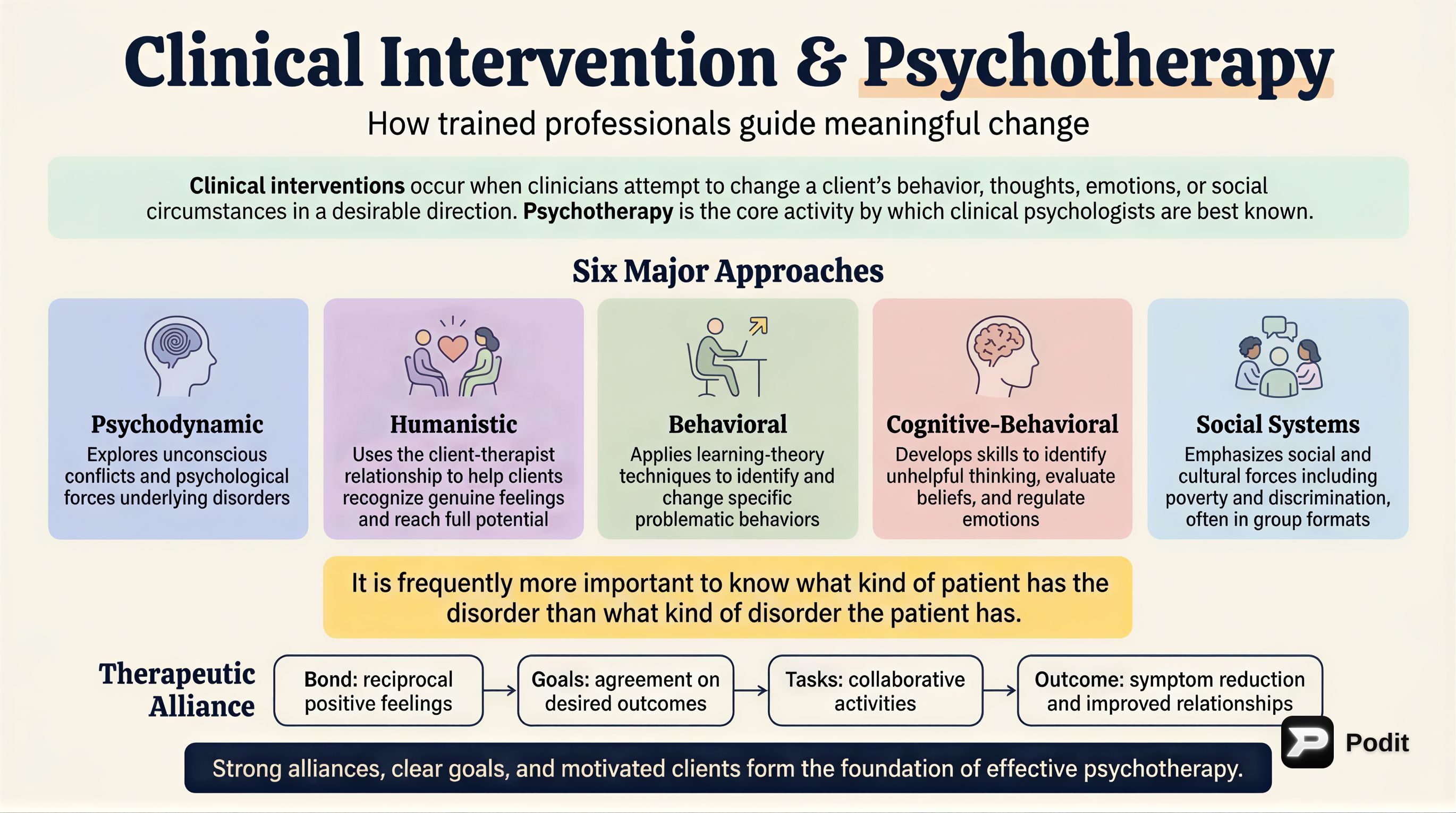
Among these, psychotherapy is the intervention activity for which clinical psychologists are most widely recognized.
🧠 What is Psychotherapy?
📚 Definition: Psychotherapy involves treatment techniques administered by trained mental health professionals within a structured professional relationship, aimed at helping clients overcome psychological problems.
💡 Key Facts:
- There are at least 600 "brand name" therapies, a number that continues to grow.
- However, only about a dozen "essential" forms constitute the core of modern clinical practice, representing empirically supported and widely utilized methods.
- Psychotherapy typically involves at least one client and one therapist.
- It can also involve multiple clients (e.g., couples, family, group therapy) or multiple therapists (e.g., co-therapists, therapeutic teams).
📊 Major Approaches to Psychotherapy
Modern clinical practice is guided by several foundational approaches:
-
Psychodynamic Approach:
- Emphasizes the exploration of unconscious conflicts and other psychological forces that underlie behavior disorders.
- Often involves delving into past experiences and their impact on present functioning.
-
Humanistic Approach:
- Focuses on using the client-therapist relationship to create conditions where clients can recognize and act on genuine feelings.
- Aims to help clients reach their full growth potential, emphasizing self-actualization.
-
Behavioral Approach:
- Emphasizes techniques derived from learning theory.
- Aims to identify and alter specific behaviors associated with psychological disorders through methods like conditioning and reinforcement.
-
Cognitive, Cognitive Behavioral (CBT), and Acceptance-Based Approaches:
- Emphasize the development of cognitive skills.
- Focus on identifying unhelpful thinking, evaluating and modifying beliefs, and learning to observe painful thoughts without self-criticism.
- Goals include changing problematic behaviors, regulating emotions, and relating to others in new ways.
-
Social Systems Approach:
- Emphasizes the influence of social and cultural forces (e.g., poverty, discrimination) on clients' lives.
- Often conducted in group and family formats, recognizing the systemic nature of many psychological issues.
👤 The Client in Psychotherapy
A common characteristic of individuals seeking therapy is that their usual coping strategies (e.g., support from friends/family, vacation) are no longer sufficient to manage their problems effectively.
✅ Key Client Characteristics:
- Prevalence of Disorders: Mental disorders are found, with minor variations, in all segments of society globally.
- Onset: Disorders can occur at any point, but more serious ones often appear early, frequently by age 14. Untreated, they are likely to persist or worsen.
- Important Predictor: The nature of the problem to be addressed is one of the most important variables for treatment selection and outcome prediction.
- Poor Predictors: Demographic characteristics (sex, age, ethnicity, socioeconomic status, intelligence, religious attitudes) are relatively poor predictors of therapeutic outcome.
- Crucial Factor: Client motivation to change is directly related to therapeutic outcome. Research shows that increased motivation during therapy correlates with decreased symptoms.
- Motivation is influenced by beliefs and expectations; hope for improvement and less fear of change lead to greater engagement.
- Other Important Factors: Level of distress, autonomy, attachment style, previous trauma, tendency toward somatization, social context, and coping style (e.g., externalizing or internalizing).
💡 Insight: "It is frequently more important to know what kind of patient has the disorder than what kind of disorder the patient has."
👩⚕️ The Therapist in Psychotherapy
Similar to clients, a therapist's broad demographic characteristics (age, sex, ethnicity, socioeconomic status) play relatively insignificant roles in the overall effectiveness of therapy.
✅ Essential Skills and Traits of Effective Therapists:
- Strong Interpersonal Skills: Proficient in communication, relationship-building, and self-monitoring.
- Authenticity & Support: Communicate sincerity, warmly support clients without judgment, and firmly remind clients of their capacity for change.
- Personal Well-being: Possess a secure attachment style, good coping and self-management skills, clear self-awareness, and a positive attitude toward clinical work.
🌟 Characteristics of Master Therapists:
- Voracious learners who draw heavily on accumulated experience.
- Aware of how their emotional health impacts their work.
- Emotionally receptive, valuing cognitive complexity and ambiguity.
- Strong sense of ethics and professionalism.
- Willingness for introspection and self-reflection.
- Cognitive complexity and tolerance for ambiguity.
- Virtue, including prioritizing clients' well-being.
- Mindful awareness of experiences.
- Social justice orientation; appreciation of diversity and multiculturalism.
- Strong relationship skills.
- Mentally healthy, mature, and attend to their own well-being.
- Belief in the working alliance.
- Cultural sensitivity, competencies, and respect for others.
- Personal mental health, self-respect, and appropriate use of power.
- Empathy and capacity for intimacy with good personal boundaries.
- Resiliency, positive orientation, and stamina, especially in the face of adversity.
⚠️ Challenges in Therapeutic Work:
- Competency-related: Issues with skills or knowledge.
- Personality-based: Individual traits of client or therapist.
- Situational: External circumstances impacting therapy.
🤝 The Therapeutic Alliance
The therapeutic alliance describes the way the client and therapist connect, behave, and engage with each other throughout the treatment process.
✅ Three Core Components:
- Personal Bond: Reciprocal positive feelings between client and therapist.
- Agreement on Goals: Shared understanding of what the therapy aims to achieve.
- Agreement on Tasks: Mutual understanding of the methods and activities used to reach the goals.
💡 Carl Rogers' Perspective:
- Believed a productive alliance develops if the therapist conveys genuineness, empathy, and unconditional positive regard.
- Argued that the relationship itself, not just specific techniques, is the main curative factor.
- From a humanistic view, the alliance is not merely the context for treatment; it is the treatment.
📈 Impact and Dynamics:
- Positive Effects: Can help clients improve relationships with others, leading to symptom reduction. May activate neurobiological mechanisms (e.g., mirror neurons, oxytocin) promoting trust and social closeness.
- Cause and Effect: The alliance can be both a cause and an effect of positive treatment outcomes.
✅ Promoting Alliance Strength:
- Matching clients and therapists on demographics has little effect.
- Matching therapy type to clients' attitudes can be beneficial.
- From the Client's View: Perceiving the therapist as competent and warm, feeling understood, appreciated, tolerated, and supported; gaining hope; overcoming initial apprehension.
- Therapist Factors: Combining technical interventions with interpersonal warmth, genuine desire to understand, supporting client's capacity to change, creating safety, attention to body language, and providing helpful first session experiences.
⚠️ Ruptures in the Alliance:
- Definition: Deterioration signaled by disagreement about goals, reduced collaboration, and a strained emotional bond.
- Pattern: Alliances often follow a high-low-high pattern of growth.
- Repair: Clinicians must recognize and actively work to avoid or repair ruptures, as overcoming obstacles can re-strengthen the alliance.
🎯 Goals of Clinical Intervention
The overarching goals of clinical intervention aim to facilitate profound positive change:
- Building a Strong Therapeutic Relationship: Establishing trust and rapport.
- Developing Faith, Hope, and Expectations for Change: Empowering clients to believe in their capacity for improvement.
- Assigning Therapeutic Tasks (Homework): Extending therapeutic work beyond sessions and promoting active engagement.
- Fostering Insight: Helping clients understand connections between past/present experiences, relationship patterns, and how challenges, emotions, and symptoms are linked.
- Providing New Information (Education): Equipping clients with knowledge and tools to understand and manage their conditions.
🏥 Settings for Psychotherapy
Psychotherapy can be delivered in various environments:
- Outpatient Settings:
- Most common.
- Includes therapists' private offices, school counseling centers, and community centers.
- Clients attend sessions and return to their daily lives.
- Inpatient Settings:
- Facilities like hospitals, prisons, or residential treatment centers.
- Patients reside for days, months, or rarely, years, receiving intensive and continuous care.
📝 Various Considerations in the Psychotherapy Process
- Treatment Duration: Can range significantly from one day (e.g., crisis intervention) to several years.
- Fees: Vary substantially based on location, therapist type, insurance coverage, and other factors.
- Ethical Standards: Therapists are ethically required to maintain records including identifying information, service dates/types, fees, assessment results, treatment plans, and consultations.
- Case Formulation and Treatment Selection: Guided by the therapist's theoretical orientation, empirical research on effective treatments for specific disorders, client values, goals, preferences, or a combination of these.
- Therapist Self-Disclosure: Involves potential benefits and risks. The decision to self-disclose should always be informed by what is best for the client.
- Termination:
- Successful treatment termination is typically a positive experience for both client and therapist.
- Premature termination can be problematic but is often preventable through effective therapeutic strategies.