Understanding Economic Profits, the Invisible Hand, and Market Efficiency - kapak
Ekonomi#economics#accounting profit#economic profit#normal profit

Understanding Economic Profits, the Invisible Hand, and Market Efficiency

Explore the distinctions between accounting, economic, and normal profits, delve into Adam Smith's invisible hand theory, and analyze market equilibrium, economic rent, and the impact of price controls.

ezginnMay 20, 2026 ~21 dk toplam
01

Görsel Özet

İnfografik

Konunun tüm parçalarını tek bakışta gör.

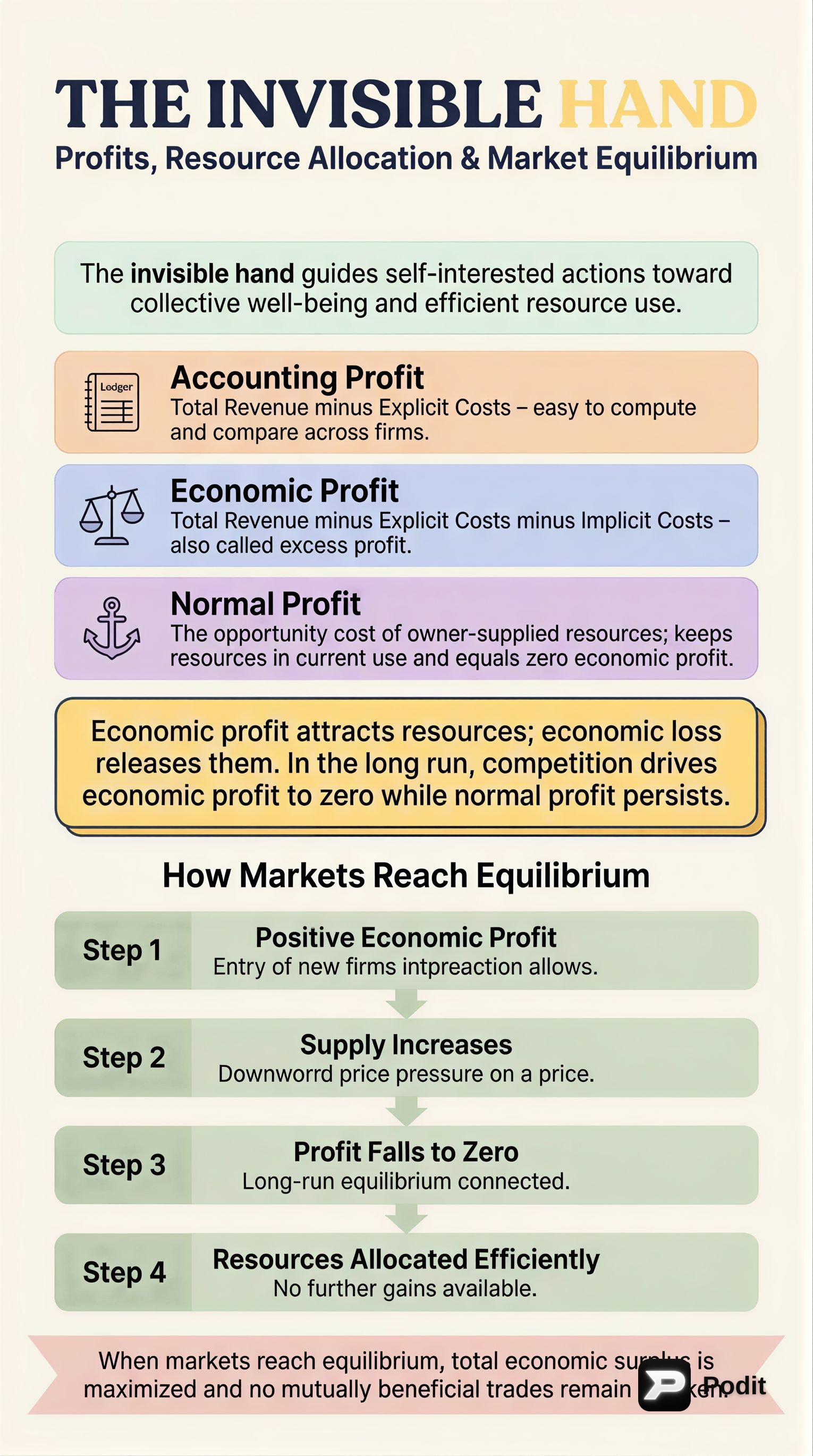
Understanding Economic Profits, the Invisible Hand, and Market Efficiency - görsel özet infografik
Tam boyutta görüntüle →
02

Flash Kartlar

25 kart

Karta tıklayarak çevir. ← → ile gez, ⎵ ile çevir.

1 / 25
Tüm kartları metin olarak gör
  1. 1. What is Accounting Profit?

    Accounting profit is a straightforward measure of a firm's financial performance. It is calculated by subtracting explicit costs from total revenue. This type of profit is relatively easy to calculate and compare across different firms, focusing on tangible monetary transactions.

  2. 2. How is Accounting Profit calculated?

    Accounting profit is calculated by taking a firm's total revenue and subtracting its explicit costs. Explicit costs are the direct, out-of-pocket expenses for resources like labor, land, or goods purchased from other firms. The formula is: Accounting Profit = Total Revenue - Explicit Costs.

  3. 3. What are Explicit Costs?

    Explicit costs are the direct, tangible monetary payments made by a firm for resources or goods and services purchased from other entities. These are easily quantifiable expenses such as wages for employees, rent for facilities, raw material costs, and utility bills. They represent the actual cash outflows of a business.

  4. 4. What is Economic Profit?

    Economic profit provides a more comprehensive view of a firm's profitability than accounting profit. It is calculated by subtracting both explicit and implicit costs from total revenue. Economic profit, also known as supernormal profit, indicates whether a firm is earning more than the minimum return required to keep its resources in their current use.

  5. 5. How is Economic Profit calculated?

    Economic profit is calculated by subtracting both explicit costs and implicit costs from total revenue. Implicit costs represent the opportunity cost of resources owned and used by the firm, such as the income foregone from the next best alternative use of those resources. The formula is: Economic Profit = Total Revenue - Explicit Costs - Implicit Costs.

  6. 6. What are Implicit Costs?

    Implicit costs are the opportunity costs of resources owned and used by a firm. Unlike explicit costs, they do not involve a direct monetary payment. They represent the income that could have been earned if the firm's resources (like the owner's time or capital) were employed in their next best alternative use. These costs are crucial for determining economic profit.

  7. 7. What is Opportunity Cost in the context of implicit costs?

    Opportunity cost, in the context of implicit costs, refers to the value of the next best alternative that must be foregone when a choice is made. For a business, it's the income or benefit that could have been earned if the firm's resources, such as the owner's labor or capital, were used in their most profitable alternative. This foregone income is an implicit cost.

  8. 8. What is Normal Profit?

    Normal profit is the minimum level of profit required to keep a firm's resources in their current use. It represents the opportunity cost of the entrepreneur's time and capital, essentially covering all implicit costs. When a firm earns zero economic profit, it is said to be earning normal profit, meaning it is covering all its costs, both explicit and implicit.

  9. 9. How does Economic Profit differ from Accounting Profit?

    Economic profit differs from accounting profit primarily by including implicit costs in its calculation. Accounting profit only considers explicit, out-of-pocket expenses, while economic profit accounts for both explicit and implicit costs (opportunity costs). Consequently, economic profit is always less than or equal to accounting profit, providing a more accurate picture of a firm's true profitability and resource allocation efficiency.

  10. 10. Explain Pudge Buffet's example where economic profit is positive.

    In Pudge Buffet's example, if his total farming revenue is $22,000 and explicit costs are $10,000, his accounting profit is $12,000. If his implicit cost (opportunity cost of working in retail) is $11,000, his economic profit is $1,000 ($22,000 - $10,000 - $11,000). A positive economic profit indicates that farming is a better use of his resources than the next best alternative, so he should continue farming.

  11. 11. Explain Pudge Buffet's example where economic profit is negative.

    If Pudge's total farming revenue drops to $20,000, with explicit costs at $10,000, his accounting profit becomes $10,000. Given his implicit cost of $11,000 (from the retail job opportunity), his economic profit would be -$1,000 ($20,000 - $10,000 - $11,000). A negative economic profit suggests that he would be better off pursuing his next best alternative, like the retail job, as he is not covering his opportunity costs in farming.

  12. 12. How does inheriting land affect Pudge's cost structure and decision-making?

    If Pudge inherits the land, the rent payments he previously made would shift from an explicit cost to an implicit cost (the opportunity cost of not renting it out). While this changes the composition of his costs, it doesn't alter the fundamental decision rule. If his economic profit remains negative after accounting for the implicit cost of the land, he should still exit farming, as his resources could earn a higher return elsewhere.

  13. 13. What is Adam Smith's Invisible Hand theory?

    Adam Smith's Invisible Hand theory posits that individuals pursuing their own self-interest in a free market inadvertently promote the collective well-being of society. The profit motive drives the production of valuable goods and services, and resources are allocated to their highest-valued uses. This mechanism, without central planning, guides market participants to achieve an efficient outcome.

  14. 14. What is the first function of price according to the Invisible Hand theory?

    The first function of price, according to the Invisible Hand theory, is its rationing function. Prices serve to distribute scarce goods to consumers who value them most. Those willing and able to pay the market price are the ones who receive the goods, ensuring that limited resources are allocated to those with the highest demand and purchasing power.

  15. 15. What is the second function of price according to the Invisible Hand theory?

    The second function of price is its allocating function. Prices direct resources away from overcrowded markets and towards underserved markets. When prices are high due to high demand, it signals to producers to allocate more resources to that market. Conversely, low prices signal a need to reallocate resources elsewhere, ensuring efficient resource distribution across the economy.

  16. 16. How do economic profits attract resources in a market?

    When firms in a particular industry earn economic profits, it signals that resources in that sector are generating returns above their opportunity cost. This positive signal attracts new firms to enter the market, seeking to capture a share of those profits. The influx of new firms increases supply, which eventually drives down prices and reduces economic profits towards zero in the long run.

  17. 17. How do economic losses lead to resources leaving a market?

    Economic losses in an industry indicate that resources are not earning their opportunity cost; they could be more profitably employed elsewhere. This negative signal prompts existing firms to exit the market. As firms leave, the supply in that industry decreases, which in turn causes prices to rise and economic losses to diminish, eventually leading to a long-run equilibrium where losses are eliminated.

  18. 18. What is the long-run tendency of economic profit in competitive markets?

    In competitive markets with free entry and exit, the long-run tendency is for economic profits to approach zero. If firms are earning positive economic profits, new firms enter, increasing supply and lowering prices until profits disappear. If firms are incurring economic losses, some exit, decreasing supply and raising prices until losses are eliminated. This ensures resources are efficiently allocated.

  19. 19. What critical condition is necessary for the Invisible Hand to work effectively?

    For the Invisible Hand to work effectively and ensure efficient resource allocation, the critical condition of free entry and exit must be met. This means there should be no significant barriers preventing new firms from entering profitable markets or existing firms from leaving unprofitable ones. Without this freedom, markets cannot adjust to eliminate economic profits or losses, leading to inefficiencies.

  20. 20. What are entry barriers?

    Entry barriers are any forces that prevent new firms from entering a particular industry. These can be legal restrictions, such as patents or licenses, or practical factors like high start-up costs, control over essential resources, or strong brand loyalty. The presence of significant entry barriers can hinder the Invisible Hand's ability to allocate resources efficiently, allowing economic profits or losses to persist.

  21. 21. Explain the example of hairdressing and Pilates markets in relation to the Invisible Hand.

    If demand for hairdressing falls and demand for Pilates rises, hairdressers face losses while Pilates instructors earn economic profits. The Invisible Hand prompts hairdressers to exit their industry and new instructors to enter the Pilates market. This reallocation of resources continues until both markets reach a new equilibrium where economic profits are again zero, demonstrating efficient resource movement based on changing consumer preferences.

  22. 22. What is Economic Rent?

    Economic rent is the portion of a payment to a factor of production that exceeds its reservation price. The reservation price is the minimum amount required to keep that factor in its current use. Essentially, it's the extra earnings above what a person or resource would accept to remain employed, often due to unique skills, location, or non-reproducible inputs.

  23. 23. How does Economic Rent differ from Economic Profit?

    Economic rent differs from economic profit in its nature and persistence. Economic profit tends towards zero in the long run in competitive markets due to entry and exit. Economic rent, however, can persist in the long run, especially for unique or non-reproducible inputs or talents. It represents a surplus payment to a factor, whereas economic profit is a surplus return to the firm as a whole.

  24. 24. Provide an example of Economic Rent.

    An example of economic rent is a highly skilled chef who loves their job and would work for a lower salary, but due to their unique talent and the high demand for their skills, they command a much higher wage. The difference between their actual salary and the minimum they would accept (their reservation price) is economic rent. This rent is a return on their unique, non-reproducible talent.

  25. 25. What is the 'no cash on the table' principle?

    The 'no cash on the table' principle suggests that in an efficient market, all opportunities for mutually beneficial transactions have been exploited. It implies that there are no unexploited opportunities to make someone better off without making someone else worse off. This principle reflects the constant search for better opportunities by individuals, which drives markets towards equilibrium and efficiency.

03

Bilgini Test Et

15 soru

Çoktan seçmeli sorularla öğrendiklerini ölç. Cevap + açıklama.

Soru 1 / 15Skor: 0

Which type of profit is calculated by subtracting only explicit costs from total revenue?

04

Detaylı Özet

11 dk okuma

Tüm konuyu derinlemesine, başlık başlık.

Understanding Market Dynamics: Profits, the Invisible Hand, and Efficiency

This study material compiles information from various sources, including copy-pasted text (likely presentation slides or notes) and a lecture audio transcript, to provide a comprehensive overview of key economic concepts.


📚 1. Defining Profit Types

Understanding different types of profit is fundamental to analyzing firm behavior and market dynamics.

1.1. Accounting Profit

📚 Definition: Accounting profit is the total revenue a firm earns minus its explicit costs.

  • Explicit Costs: These are direct, out-of-pocket payments made by firms to purchase resources (e.g., labor, land, raw materials) and products from other firms. They are tangible and easily quantifiable.
  • Calculation: Accounting Profit = Total Revenue – Explicit Costs
  • 💡 Characteristics: It is relatively easy to compute and compare across different firms, providing a basic measure of financial performance.

1.2. Economic Profit

📚 Definition: Economic profit is the total revenue a firm earns minus both its explicit and implicit costs. It is also referred to as "excess profit."

  • Implicit Costs: These are the opportunity costs of resources supplied by the firm's owners. They represent the income that could have been earned if these resources (e.g., owner's time, owner's capital, owned land) were used in their next best alternative.
  • Calculation: Economic Profit = Total Revenue – Explicit Costs – Implicit Costs
  • 💡 Significance: Economic profit provides a more comprehensive picture of a firm's true profitability, as it considers all costs, including the value of foregone alternatives. It is crucial for decision-making regarding resource allocation.

1.3. Normal Profit

📚 Definition: Normal profit is the difference between accounting profit and economic profit. It represents the minimum amount of profit necessary to keep a firm's resources in their current use, covering all opportunity costs.

  • Relationship: When a firm earns zero economic profit, it is said to be earning a normal profit. This means all explicit and implicit costs are covered, and the owner is earning a return equivalent to what they could get in their next best alternative.
  • 💡 Role: Normal profits are essential for the long-term sustainability of a business, ensuring that resources are not diverted to other uses.

1.4. Example: Pudge Buffet's Farming Decision

Let's illustrate these concepts with Pudge Buffet, a farmer considering whether to continue farming or work in retail.

  • Scenario 1: Positive Economic Profit

    • Opportunity Cost (Implicit Cost): Pudge could earn $11,000 per year in retail.
    • Explicit Farm Costs: $10,000
    • Total Farm Revenue: $22,000
    • Accounting Profit: $22,000 - $10,000 = $12,000
    • Economic Profit: $12,000 (Accounting Profit) - $11,000 (Implicit Cost) = $1,000
    • Decision: Since economic profit is positive ($1,000), Pudge should continue farming. He is earning more than his next best alternative.
  • Scenario 2: Negative Economic Profit

    • Opportunity Cost (Implicit Cost): $11,000
    • Explicit Farm Costs: $10,000
    • Total Farm Revenue: $20,000
    • Accounting Profit: $20,000 - $10,000 = $10,000
    • Economic Profit: $10,000 (Accounting Profit) - $11,000 (Implicit Cost) = -$1,000
    • Decision: Since economic profit is negative (-$1,000), Pudge should quit farming. He would be better off working in retail.
  • Scenario 3: Impact of Owned Inputs

    • If Pudge inherits the farmland, the $6,000 rent (previously an explicit cost) becomes an implicit cost.
    • New Explicit Costs: $10,000 - $6,000 = $4,000
    • New Implicit Costs: $11,000 (retail) + $6,000 (foregone rent) = $17,000
    • Total Farm Revenue: $20,000
    • Accounting Profit: $20,000 - $4,000 = $16,000
    • Economic Profit: $16,000 (Accounting Profit) - $17,000 (Implicit Costs) = -$1,000
    • Decision: Even with owned land, if economic profit is negative, Pudge should still quit farming. This highlights how implicit costs are crucial for sound economic decisions.

🤝 2. The Invisible Hand Theory

The concept of the "Invisible Hand," introduced by Adam Smith, describes how individual self-interest can lead to collective well-being and efficient resource allocation in a free market.

2.1. Core Principle

  • Individuals, acting in their own self-interest, make decisions about what to buy, sell, and produce.
  • The profit motive drives firms to produce highly valued goods and services.
  • This decentralized decision-making, guided by prices and profits, ultimately directs resources to their most valued uses, benefiting society as a whole.

2.2. Two Functions of Price

Prices play a dual role in guiding the Invisible Hand:

  1. Rationing Function: Prices distribute scarce goods and services to the consumers who value them most highly and are willing and able to pay for them.
  2. Allocative Function: Prices direct resources away from overcrowded markets (where profits are low or negative) and towards underserved markets (where economic profits are high).

2.3. Resource Allocation and Economic Profit/Loss

The Invisible Hand mechanism works through the entry and exit of firms in response to economic profits and losses:

  • Response to Economic Profits:

    • When firms in an industry earn positive economic profit, it signals that resources in that industry are generating a return higher than their opportunity cost.
    • This attracts new firms to enter the market, seeking to capture some of these "excess profits."
    • As new firms enter, the market supply increases (shifts right).
    • This increased supply leads to a decrease in market prices.
    • As prices fall, the economic profits of individual firms shrink, eventually tending towards zero in the long run.
    • Outcome: Resources are efficiently allocated to industries where they are most valued.
  • Response to Economic Losses:

    • When firms in an industry incur economic losses (negative economic profit), it signals that resources in that industry are not covering their opportunity costs.
    • This prompts existing firms to exit the market, seeking better opportunities elsewhere.
    • As firms exit, the market supply decreases (shifts left).
    • This decreased supply leads to an increase in market prices.
    • As prices rise, the economic losses of the remaining firms shrink, eventually tending towards zero in the long run.
    • Outcome: Resources are efficiently reallocated away from industries where they are less valued.
  • Long-Run Equilibrium: In the long run, competitive markets tend towards a state of zero economic profit. At this point, firms are earning a normal profit, meaning they are covering all their explicit and implicit costs, and there is no incentive for firms to enter or exit the industry.

2.4. Conditions for the Invisible Hand

For the Invisible Hand to function effectively, free entry and exit into and out of markets are crucial.

  • Barriers to Entry: Any force (legal constraints, practical factors, high startup costs) that prevents firms from entering a new industry can hinder the Invisible Hand's ability to reallocate resources efficiently.
  • 💡 Example: Haircut and Pilates Markets
    • Imagine both markets are in long-run equilibrium (zero economic profit).
    • If demand for haircuts drops and demand for Pilates increases:
      • Hair salons face lower prices and economic losses.
      • Pilates studios experience higher prices and economic profits.
    • In the short run, hairstylists suffer losses, and Pilates instructors earn excess profits.
    • The Invisible Hand guides resources: Hairstylists may leave the industry or retrain, while new instructors enter the Pilates market.
    • This reallocation continues until both markets return to long-run equilibrium with zero economic profit.

💰 3. Economic Rent vs. Economic Profit

While economic profits tend towards zero in the long run, individuals can still become wealthy due to economic rent.

📚 Definition: Economic Rent Economic rent is the portion of a payment to a factor of production (e.g., labor, land, capital) that exceeds the owner's reservation price. The reservation price is the minimum amount the owner would accept to supply that factor.

  • Key Difference from Economic Profit: Economic profit is a temporary signal for resource reallocation, tending to disappear in competitive markets. Economic rent, however, can persist, especially for unique or non-reproducible inputs.
  • Sources of Economic Rent:
    • Unique Talent: A highly skilled chef with a unique culinary talent can command a salary (economic rent) far exceeding what they could earn in their next best alternative. This talent is non-reproducible.
    • Non-Reproducible Inputs: Owning a prime piece of land in a desirable location can generate economic rent because the land itself is unique and cannot be replicated.
    • Love for Work: Individuals who genuinely love their work might accept a lower monetary payment, but if they receive more than their reservation price, the excess is economic rent.
  • 💡 Insight: People can get rich by earning significant economic rent, even if the industries they operate in only yield normal profits (zero economic profit) in the long run.

📈 4. Market Equilibrium and Efficiency

The Invisible Hand guides markets towards equilibrium, which is often associated with efficiency.

4.1. The "No-Cash-on-the-Table" Principle

This principle suggests that in an efficient market, all opportunities for mutually beneficial exchange have been exploited. There's no "easy money" or obvious unexploited gains left.

  • Example: Supermarket Checkout Lines: People naturally gravitate towards the shortest or fastest-moving line. If a line becomes significantly shorter, people quickly switch, making it longer again. This constant adjustment reflects the principle that individuals seek to exploit any perceived advantage, quickly eliminating "cash on the table."

4.2. Cost-Saving Innovations

  • In competitive markets, firms are typically price takers.
  • When a firm introduces a cost-saving innovation, it initially earns short-run economic profits due to its lower costs.
  • However, information about such innovations tends to spread quickly. Competitors will eventually copy the innovation.
  • As the innovation becomes widespread, industry-wide costs decrease, leading to an increase in overall supply.
  • This increased supply drives down the market equilibrium price by the amount of the cost savings.
  • In the long run, the initial innovator, along with all other firms, will again earn zero economic profit. The benefit of the innovation is passed on to consumers through lower prices.
  • Example: Shipping Innovation: If one of 40 shipping companies finds a way to save $20,000 per trip, it earns short-run economic profit. Once competitors adopt the innovation, the industry's cost per trip drops by $20,000, and the equilibrium price for shipping also falls by $20,000, eliminating the economic profit.

4.3. Market Equilibrium and Social Efficiency

📚 Definition: Economic Efficiency (Pareto Efficiency) Economic efficiency exists when no change can be made to benefit one party without harming another. In other words, all resources are allocated in such a way that it's impossible to make anyone better off without making someone else worse off.

  • Equilibrium Price and Quantity: In perfectly competitive markets, the equilibrium price and quantity are considered economically efficient. At this point:
    • Buyers' marginal benefits equal sellers' marginal costs.
    • Society's marginal benefits equal society's marginal costs.
  • Inefficiency: Prices set above or below the equilibrium price lead to inefficiency, as opportunities for mutually beneficial trades are missed.
    • Price Below Equilibrium: Some buyers value the good more than the current price, and some sellers are willing to sell for less than the current price, but they cannot connect, leading to shortages and lost surplus.
    • Price Above Equilibrium: Some sellers are willing to sell for less than the current price, and some buyers are willing to buy for more than the current price, but they cannot connect, leading to surpluses and lost surplus.

4.4. Earning Big Payoffs in Equilibrium

Even in equilibrium, where no further opportunities for mutually beneficial exchange remain for individuals to gain, people can still earn significant wealth through:

  1. Exceptional Hard Work: Dedication and effort can lead to higher productivity and earnings.
  2. Unique Skill or Talent: Possessing rare abilities that are highly valued in the market can generate economic rent.
  3. Luck: Fortuitous circumstances or being in the right place at the right time can lead to substantial gains.

📊 5. The Cost of Preventing Price Adjustments

Government policies that prevent markets from reaching equilibrium can lead to inefficiencies and a reduction in total economic surplus.

5.1. Price Ceilings

📚 Definition: A price ceiling is a maximum allowable price, specified by law, that sellers can charge for a good or service.

  • Impact: If a price ceiling is set below the equilibrium price, it creates a shortage.
    • Reduced Quantity: Less of the good is supplied than demanded.
    • Lost Surplus: Both consumer and producer surplus are reduced, leading to a "deadweight loss" or lost total surplus.
    • Non-Market Costs: Shortages can lead to non-monetary costs like waiting in line, black markets, or side payments, further reducing overall welfare.
  • ⚠️ Example: Heating Oil Market: A price ceiling on heating oil, while intended to help consumers, can lead to a significant loss of total surplus (e.g., $800/day in the example) and create shortages, disproportionately affecting those with lower reservation prices. Income transfers are often a more efficient way to assist low-income consumers than price controls.

5.2. Price Subsidies

📚 Definition: A price subsidy is a government payment to producers or consumers to encourage the production or consumption of a good.

  • Impact: Subsidies typically lower the effective price for consumers and/or increase the effective price for producers, leading to an increase in the quantity traded.
    • Increased Consumption: Consumers buy more of the subsidized good.
    • Government Cost: The subsidy requires government funding, which comes from taxpayers.
    • Net Benefit: While consumer surplus might increase, the government's cost often outweighs this gain, leading to a net loss in total surplus (deadweight loss) for society.
  • ⚠️ Example: Bread Subsidy: A government subsidy on bread might increase consumer surplus. However, if the government loses $1 on every loaf sold (e.g., importing for $2 and selling for $1), the total government loss can exceed the increase in consumer surplus, resulting in a net loss of total surplus for the economy.

✅ Conclusion

The study of profit types, the Invisible Hand, and market efficiency reveals how decentralized decisions in competitive markets can lead to optimal resource allocation. While economic profits drive these adjustments, they tend to disappear in the long run, leaving only normal profits. Economic rent, however, can persist for unique factors. Policies that interfere with market prices, such as price ceilings and subsidies, often create inefficiencies and reduce overall societal welfare, highlighting the importance of allowing markets to reach their natural equilibrium.
Kendi çalışma materyalini oluştur

PDF, YouTube videosu veya herhangi bir konuyu dakikalar içinde podcast, özet, flash kart ve quiz'e dönüştür. 1.000.000+ kullanıcı tercih ediyor.

Sıradaki Konular

Tümünü keşfet
Fundamental Economic Principles and Applications

Fundamental Economic Principles and Applications

Explore essential economic concepts, from market dynamics and elasticity to macroeconomic indicators and policy responses, as covered in a university-level economics exam.

Özet 25 15 Görsel
Foundational Principles of Economics and Business Analysis

Foundational Principles of Economics and Business Analysis

This summary explores core microeconomic and macroeconomic concepts, including scarcity, supply and demand, GDP, inflation, and unemployment, alongside key business analysis frameworks.

8 dk Özet 25 15 Görsel
Inflation: Causes, Types, Consequences, and Management

Inflation: Causes, Types, Consequences, and Management

This summary explores inflation, its causes, classifications, socio-economic impacts, and the monetary and non-monetary policy instruments used for its management and control.

6 dk 25 15
Economics and Economic Reasoning: Core Concepts

Economics and Economic Reasoning: Core Concepts

Explore the fundamental principles of economics, including scarcity, microeconomics, macroeconomics, marginal analysis, opportunity cost, and the interplay of economic, social, and political forces.

Özet 25 15
Economic Growth and Macroeconomic Indicators

Economic Growth and Macroeconomic Indicators

This summary explores economic growth, its extensive and intensive paths, and key macroeconomic indicators like GDP and GNP, examining their calculation and impact on quality of life.

6 dk 25 15
Cognitive Biases and Heuristics in Behavioral Economics

Cognitive Biases and Heuristics in Behavioral Economics

An academic summary exploring key cognitive biases and heuristics, their impact on human decision-making, and their role in behavioral economics, contrasting with traditional economic theory.

5 dk Özet 25 15
Air Cargo Operations: Fees, Methods, and Market Dynamics

Air Cargo Operations: Fees, Methods, and Market Dynamics

An academic overview of air cargo operations, covering overflight and airport fees, chargeable weight, transportation methods, ground handling, and global market trends.

7 dk Özet 25 15
Game Theory in Action: Matching Problems and Stability

Game Theory in Action: Matching Problems and Stability

This summary explores matching problems, stable matching theory, and algorithms like Gale-Shapley. It covers applications, properties of stable matchings, strategic considerations, and extensions of the core model.

6 dk Özet 25 15