 Podit
Podit
William Carlos Williams and Modernist Poetry: A Study Guide
Source Information: This study material has been compiled from a lecture audio transcript and copy-pasted text provided by the user.
📚 Introduction to William Carlos Williams
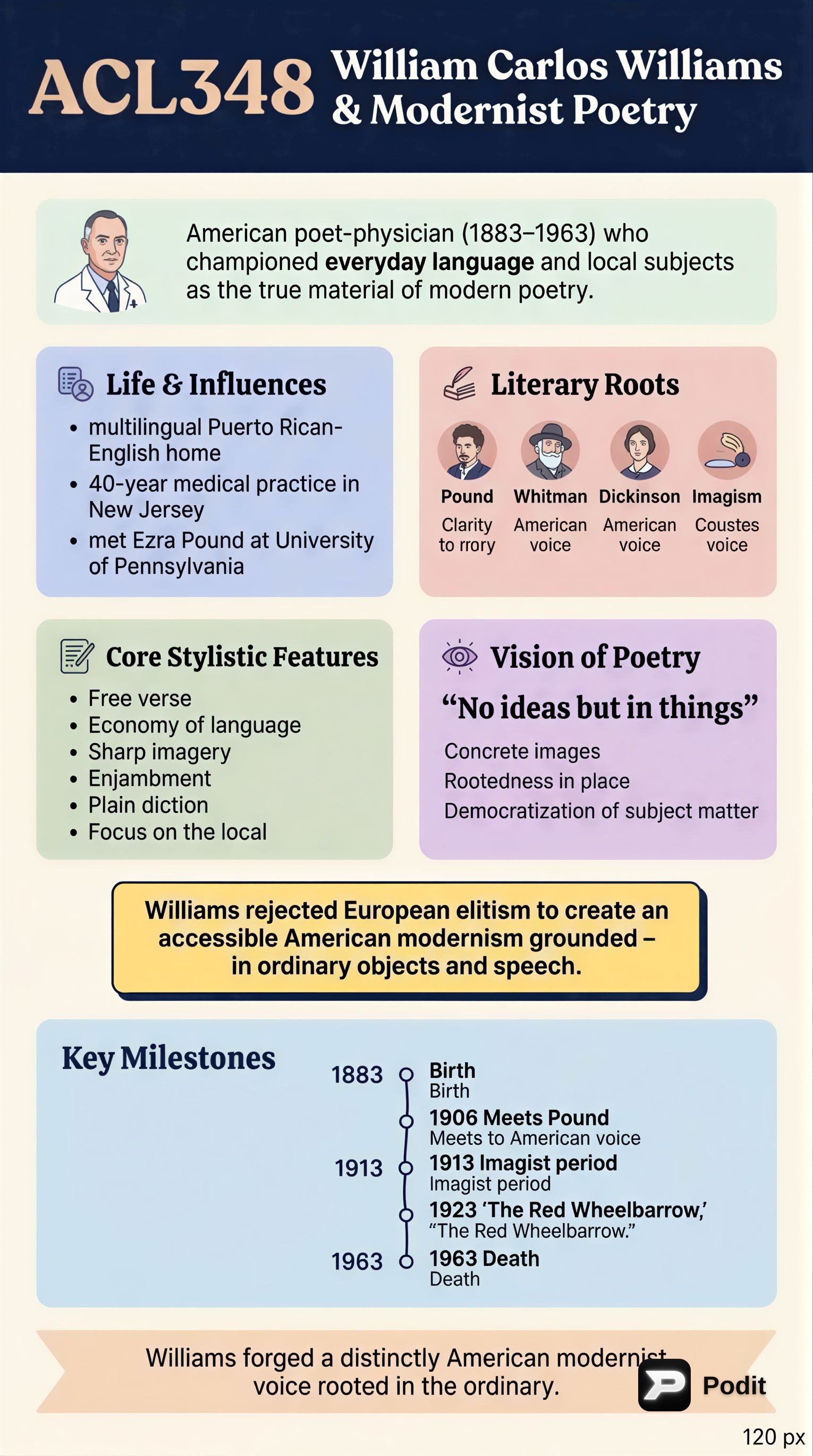
William Carlos Williams (1883-1963) stands as a pivotal figure in American Modernist poetry. He championed a distinctively American voice, deeply rooted in everyday life and concrete experience, setting him apart from many of his contemporaries. His unique background as a physician profoundly influenced his literary output and stylistic innovations, making his work both accessible and profoundly insightful.
1️⃣ Biographical Context and Influences
🌍 Personal Background
- Multilingual Home: Born in 1883, Williams grew up in a household with a Puerto Rican mother and an English immigrant father. This environment fostered a keen sensitivity to sound and rhythm, which became a hallmark of his poetic style.
- Lifelong Profession: For over four decades, Williams served as a general practitioner (physician) in his hometown of Rutherford, New Jersey. He believed his medical practice was intrinsically linked to his poetry, integrating the realities of daily life and human experience into his artistic expression.
💡 Key Influences
- Ezra Pound: Met at the University of Pennsylvania Medical School. Pound was a key literary influence and lifelong friend, serving as a mentor during Williams's early Imagist phase.
- Walt Whitman: Williams shared Whitman's commitment to American subjects and vernacular voices, seeking to capture the essence of the American experience.
- Emily Dickinson: Her minimalism and economy of expression influenced Williams's approach to language.
- Imagism: Briefly aligned with this movement, adopting its emphasis on clarity, conciseness, and vivid imagery.
- Cubism (Cézanne): Inspired by visual artists like Cézanne, Williams explored how form could be conveyed through suggestion rather than strict realism, influencing his poetic structure.
- American Pragmatism: This philosophical belief in usefulness, practicality, and rootedness resonated deeply with Williams, informing his focus on the tangible and immediate.
- Medical Practice: His daily encounters with patients and the community provided a rich tapestry of human experience, deeply informing his poetic voice.
- Democratic Values: Williams advocated for the everyday and the accessible, believing that poetry should reflect and celebrate common life.
2️⃣ Core Stylistic Features
Williams's poetry is characterized by a set of distinctive stylistic choices that aimed to create an authentic American voice:
- ✅ Free Verse: Deliberately avoided traditional meter and rhyme schemes to achieve a more natural, conversational rhythm.
- ✅ Economy of Language: Employed a minimalist, direct, and often deceptively simple style, stripping away unnecessary words.
- ✅ Sharp Imagery: Provided vivid and clear descriptions of physical objects, allowing meaning to emerge directly from the concrete.
- ✅ Use of Enjambment: Strategically broke lines to create specific rhythms, emphasize certain words or phrases, and control the reader's pace.
- ✅ Plain Diction: Meticulously crafted language to emulate the cadences and vocabulary of everyday American speech, enhancing accessibility and authenticity.
- ✅ Focus on the Local and Specific: Aimed to reflect the life immediately surrounding him, particularly the landscapes of New Jersey and urban American settings.
3️⃣ Poetic Vision: "No ideas but in things"
Central to Williams's overarching poetic philosophy was his iconic dictum: "No ideas but in things."
- 📚 Meaning from Concrete: This principle asserted that profound meaning should arise from concrete images, tangible realities, and sensory perceptions, rather than from abstract concepts or intellectual constructs.
- Emphasis on the Physical: He placed paramount emphasis on the physical and immediate world, believing that authentic poetry should be deeply rooted in the poet's lived environment and direct observations.
- Poetry Rooted in Place: Williams believed poetry should grow out of the poet's immediate surroundings and experiences.
- Democratization of Subject Matter: He found inherent value and poetic potential in ordinary people, fleeting everyday moments, and common language, elevating them to a position of significant artistic consideration.
4️⃣ Role in Modernism
William Carlos Williams occupied a unique and critically significant position within American Modernism.
- Distinct American Voice: While undeniably a Modernist, his approach diverged from the more intellectual and European-centric "high modernists" like T.S. Eliot. Williams consciously sought to cultivate a distinctly American voice.
- Rejection of European Elitism: He actively rejected what he perceived as elitism and intellectualism in certain European literary traditions, championing local, concrete subjects instead.
- Opposition to T.S. Eliot's The Waste Land: Williams famously opposed Eliot's seminal work, arguing it relied excessively on obscure European literary references and classical allusions, thereby alienating the common American reader and failing to engage with immediate American experience.
- Modernism Rooted in Ordinary Life: Despite this divergence, Williams's work reflects the fragmentation, experimentation, and formal innovation characteristic of the Modernist era, but his experimentation remained firmly rooted in the ordinary, tangible fabric of American life and its vernacular.
5️⃣ Key Poems: Exemplifying Williams's Vision
Williams's profound contributions to American poetry are powerfully exemplified by celebrated works that embody his stylistic features and poetic vision.
🌾 "The Red Wheelbarrow" (1923)
This short, iconic poem is a perfect illustration of Williams's "no ideas but in things" philosophy and his commitment to sharp imagery and plain diction.
- Structure and Imagery:
so much depends upon a red wheel barrow glazed with rain water beside the white chickens. - Analysis:
- "No ideas but in things": The poem presents a simple, concrete image without explicit interpretation or abstract commentary. The meaning arises entirely from the visual details.
- Sharp Imagery: The vivid description of the "red wheelbarrow," "glazed with rainwater," and "white chickens" creates a clear, almost photographic mental picture.
- Economy of Language: Every word is essential; there are no superfluous adjectives or adverbs.
- Enjambment: The line breaks (e.g., "depends / upon") force the reader to pause, emphasizing each word and slowing the reading pace, drawing attention to the significance of the ordinary objects.
- Significance: The opening line, "so much depends / upon," elevates the seemingly mundane objects to a position of profound importance, suggesting that the beauty and utility of everyday things are fundamental to human experience. It celebrates the overlooked details of rural life.
🌳 "Spring and All" (1923)
This poem, also from 1923, showcases Williams's ability to depict a landscape with stark realism while imbuing it with deeper thematic resonance, reflecting the struggle and renewal of life.
- Themes and Imagery: The poem opens with a desolate, winter-worn landscape, describing "leafless vines" and "dead, brown leaves." It then shifts to the subtle, almost imperceptible stirrings of spring.
- Analysis:
- Modernist Fragmentation: The poem's structure and imagery reflect a sense of fragmentation and disarray, characteristic of Modernism, as it depicts a world recovering from winter's harshness.
- Struggle and Renewal: Williams portrays the "contagious" and "stiff" new life emerging from the "waste of broad, muddy fields." This isn't a romanticized spring but a gritty, determined rebirth.
- Plain Diction and Specificity: The language remains grounded and precise, describing the "cold, familiar wind" and "standing water" with unadorned clarity.
- "No ideas but in things": The poem conveys the idea of renewal and the persistent force of life through the direct observation of the landscape's transformation, rather than through abstract statements about hope or rebirth. The "all" in the title refers to the entire process of life, death, and renewal, observed through concrete details.
- Focus on the Local: The landscape described feels specific and real, likely drawing from Williams's observations of the New Jersey countryside.
✅ Conclusion
William Carlos Williams stands as a foundational figure in American Modernist poetry. His unique blend of a physician's observational precision and a poet's linguistic sensitivity led to a body of work that celebrated the concrete, the local, and the accessible. Through his commitment to an authentically American voice and his influential principle of "No ideas but in things," Williams profoundly shaped the trajectory of 20th-century poetry, leaving an enduring legacy of clarity, immediacy, and democratic vision.