 Podit
Podit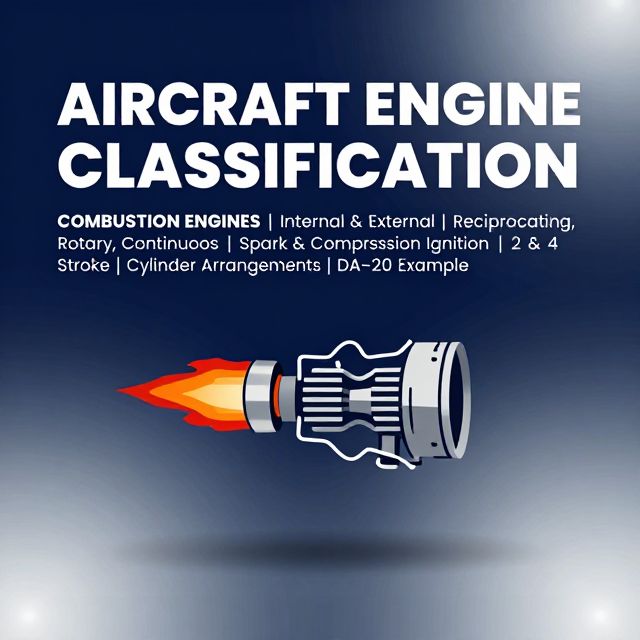
✈️ Aircraft Engine Classification: A Comprehensive Study Guide
Source Information: This study material has been compiled and organized from a lecture audio transcript and supplementary copy-pasted text.
📚 Introduction to Aircraft Engine Classification
Understanding how aircraft engines work and are categorized is fundamental to aviation studies. This guide will explore the core principles of combustion engines, delve into their various classifications, and provide practical examples to illustrate these concepts. Our primary focus will be on internal combustion engines, which are crucial for most aircraft applications due to their efficiency and power-to-weight ratio.
🔥 Combustion Engines: The Core Principle
At its heart, an aircraft engine is a type of combustion engine.
- 📚 Definition of Combustion: The process of burning fuel with an oxidizer (typically air) to generate heat.
- 💡 Role of a Heat Engine: A heat engine is a device that converts the chemical energy stored in fuel into thermal energy (heat), which is then transformed into useful mechanical power.
- ✅ Combustion Engine Function: Specifically, a combustion engine generates mechanical power directly through this process of fuel combustion.
Combustion engines are broadly categorized into two main types:
- Internal Combustion Engines (ICE):
- Combustion occurs inside the engine's working chambers.
- Example: Piston engines, which are widely used in smaller aircraft.
- External Combustion Engines:
- Combustion occurs outside the engine's working chambers, heating a separate working fluid.
- Example: Steam engines. While historically significant, these are not typically used in modern aircraft.
⚙️ Internal Combustion Engines (ICE): Detailed Classification
Internal Combustion Engines, the primary focus for aircraft, can be further categorized based on their operational mechanisms:
1️⃣ Reciprocating Engines
- 📚 Principle: These engines convert the linear (back-and-forth) motion of pistons within cylinders into rotational motion.
- Historical Note: The design was famously devised by Dr. Otto in 1876.
- Example: Traditional piston engines found in many propeller-driven aircraft.
2️⃣ Rotary Engines
- 📚 Principle: Unlike reciprocating engines, rotary engines use a rotor (a triangular-shaped component) to generate power, offering a different approach to converting combustion into mechanical work.
- Example: The Wankel engine.
3️⃣ Continuous Combustion Engines (Reaction Engines)
- 📚 Principle: In these engines, combustion occurs continuously, producing a high-velocity exhaust stream that generates thrust for propulsion.
- Example: Turbojet engines, commonly found in jet aircraft.
🚀 Reciprocating Engines: Ignition and Stroke Cycles
Reciprocating engines, being a significant category for aircraft, are further classified based on two critical operational characteristics: their ignition method and the number of strokes in their operational cycle.
Ignition Types
The method by which the fuel-air mixture is ignited defines two primary types:
- Spark Ignition (SI) Engines:
- ✅ Mechanism: A spark plug generates an electrical spark to ignite the compressed fuel-air mixture.
- ⛽ Fuel Type: Typically run on petrol or gasoline.
- 💡 Pioneer: Nicolaus Otto is credited with pioneering this principle.
- Compression Ignition (CI) Engines (Diesel Engines):
- ✅ Mechanism: Air is compressed to a very high temperature, and then fuel is injected into this hot air, causing it to ignite spontaneously without a spark plug.
- ⛽ Fuel Type: Commonly use jet fuel or kerosene.
- 💡 Pioneer: Rudolf Diesel developed this robust ignition method.
Stroke Cycles
The number of piston movements (strokes) required to complete one full power cycle classifies reciprocating engines into:
- 2-Stroke Engines:
- ✅ Cycle: Complete a power cycle in just two distinct piston movements (one up, one down).
- Characteristics: Often simpler in design, lighter, and produce power more frequently per revolution.
- 4-Stroke Engines:
- ✅ Cycle: Complete a power cycle in four distinct piston movements (intake, compression, power, exhaust).
- Characteristics: Generally more fuel-efficient, quieter, and produce less emissions than 2-stroke engines, making them common in many aircraft.
🛢️ Cylinder Arrangements
Beyond ignition and stroke cycles, the physical arrangement of cylinders within a reciprocating engine is another important classification. Various configurations exist, each offering advantages in terms of balance, cooling, and compactness. Common arrangements include inline, V-type, radial, and horizontally opposed.
✈️ Example: The DA-20 Engine
To illustrate how these classifications come together in a real-world application, let's examine the DA-20 engine:
- Manufacturer: Continental
- Engine Type: This is a Spark Ignition (SI), 4-Stroke reciprocating engine.
- Cylinder Configuration: It features 4 cylinders arranged in a horizontally opposed configuration.
- 💡 Benefit: This arrangement, where cylinders are in opposing pairs, helps achieve a compact design and contributes to smoother operation due to balanced forces.
- Cooling System: It is air-cooled, meaning it relies on airflow over its cylinders to dissipate heat, rather than a liquid cooling system.
- Performance:
- 📊 Max. Power: 125 horsepower (hp)
- 📈 Max. RPM: 2800 revolutions per minute (rpm)
- Safety Feature: For enhanced reliability and safety, the DA-20 engine is equipped with two independent ignition systems. This is a common and critical feature in aircraft engines, ensuring continuous operation even if one system fails.
This example of the DA-20 engine perfectly demonstrates how the various classification criteria—from combustion type to ignition, stroke cycle, and cylinder arrangement—are integrated into a functional aircraft engine.