Podit
Podit
This content is based on a YouTube video.
🇹🇷 The Life and Legacy of Mustafa Kemal Atatürk (1881-1938)
📚 Introduction: Architect of Modern Turkey
Mustafa Kemal Atatürk stands as one of the 20th century's most transformative figures. He was not only a brilliant military leader but also the visionary founder and first President of the Republic of Turkey. His life's work fundamentally reshaped a nation, transitioning it from a crumbling empire into a modern, secular state. This study material will explore his early life, his pivotal role in the Turkish War of Independence, and the profound legacy of his transformative reforms, crucial for understanding contemporary Turkey and for exam preparation.
1️⃣ Early Life and Military Ascendancy (1881-1919)
Mustafa Kemal's formative years laid the groundwork for his future leadership.
-
Birth and Family:
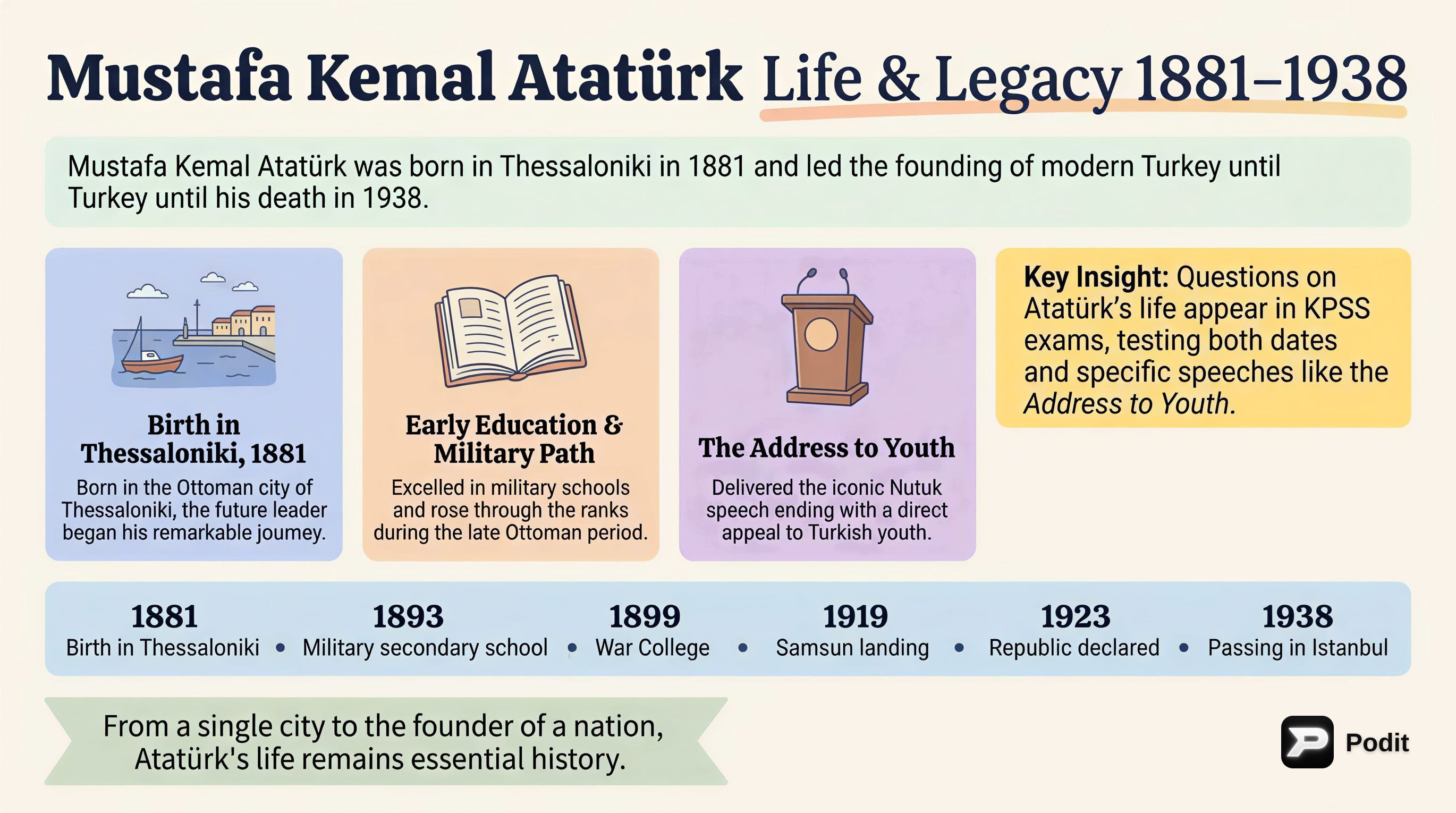
- Born in 1881 in Salonica (modern-day Thessaloniki, Greece), then a significant Ottoman city.
- Father: Ali Rıza Efendi (timber merchant).
- Mother: Zübeyde Hanım (devout woman).
- His father's early death significantly impacted his childhood.
-
Education and the Name "Kemal":
- Showed a strong aptitude for mathematics, leading him to pursue a military education against his mother's initial wishes.
- Attended the Monastir Military High School.
- Later, the Istanbul War Academy and Staff College.
- Graduated in 1905 as a Staff Captain.
- 💡 Key Detail: His mathematics teacher bestowed upon him the additional name 'Kemal', meaning 'perfection' or 'maturity,' recognizing his exceptional abilities.
-
Early Military Career:
- Involved in suppressing rebellions.
- Served in the Italo-Turkish War in Libya.
- Participated in the Balkan Wars.
- ✅ These experiences were crucial in honing his strategic thinking and leadership skills.
-
World War I (1914-1918):
- His military genius truly emerged during WWI.
- Gallipoli Campaign (1915): Gained international recognition for his brilliant defense against Allied forces. His famous command: "I am not ordering you to attack, I am ordering you to die!" saved Constantinople (Istanbul) from invasion.
- Continued to serve with distinction on the Eastern Front (against Russians) and the Syrian Front (against British).
- Despite his personal successes, the Ottoman Empire was on the losing side.
- The war concluded for the Ottomans with the Armistice of Mudros in October 1918, leading to Allied occupation of Ottoman territories. This set the stage for the Turkish War of Independence.
2️⃣ The War of Independence and Birth of the Republic (1919-1923)
Following WWI, Mustafa Kemal spearheaded the national resistance movement.
-
Igniting the Resistance:
- Post-armistice, the Ottoman Empire was in disarray, with Allied powers occupying strategic regions.
- On May 19, 1919, Mustafa Kemal landed in Samsun. Ostensibly to oversee disarmament, his true mission was to ignite national resistance. This date is considered the beginning of the Turkish War of Independence.
- From Samsun, he traveled to Amasya, Erzurum, and Sivas, organizing national congresses and rallying the people.
-
Principle of National Sovereignty:
- He articulated that the nation's will, not the Sultan's, would determine its future.
- On April 23, 1920, the Grand National Assembly (GNA) was inaugurated in Ankara, establishing a new, legitimate government separate from the Sultanate in Istanbul.
-
Key Military Victories:
- As commander-in-chief, Mustafa Kemal led Turkish forces through crucial battles:
- First and Second Battles of İnönü
- Battle of Sakarya
- The decisive Great Offensive, culminating in the Battle of Dumlupınar in August 1922.
- ✅ These victories successfully drove occupying forces out of Anatolia.
- As commander-in-chief, Mustafa Kemal led Turkish forces through crucial battles:
-
Establishment of the Republic:
- The war concluded with the signing of the Treaty of Lausanne in 1923, which recognized the full sovereignty of the new Turkish state within its current borders.
- The Sultanate was abolished in 1922, clearing the way for a new political system.
- On October 29, 1923, the Republic of Turkey was officially proclaimed.
- Mustafa Kemal was unanimously elected as its first President. This marked the end of a centuries-old empire and the birth of a modern nation-state.
3️⃣ The Atatürk Reforms and Lasting Legacy (1923-1938)
As President, Atatürk initiated a comprehensive program of reforms, known as the Atatürk Revolutions or Kemalism, aimed at transforming Turkey into a modern, secular, and Western-oriented nation.
-
📚 The Six Principles of Kemalism (Altı Ok): These core principles guided all his reforms and remain enshrined in the Turkish constitution.
- Republicanism (Cumhuriyetçilik): Emphasizes a republican form of government, where sovereignty belongs to the nation.
- Nationalism (Milliyetçilik): Fosters national unity and identity, based on shared culture and language, rejecting Ottoman cosmopolitanism.
- Populism (Halkçılık): Aims for social equality and justice, ensuring that government serves the people's interests.
- Statism (Devletçilik): Advocates for state intervention in the economy, especially in industrialization and development, to ensure national progress.
- Secularism (Laiklik): Separates religion from state affairs and education, ensuring freedom of conscience and belief.
- Revolutionism/Reformism (İnkılapçılık): Embraces continuous change and modernization, rejecting traditionalism that hinders progress.
-
Key Reform Areas:
-
Political Reforms:
- 1924: Abolition of the Caliphate, completely separating religious and state affairs.
-
Social Reforms:
- 1925: Hat Law, replacing the fez with Western-style headwear.
- Closure of dervish lodges and religious orders.
- Granting equal rights to women, including the right to vote and hold office, significantly ahead of many Western countries.
- 1934: Surname Law, requiring all citizens to adopt a hereditary surname. The Grand National Assembly bestowed upon him the surname 'Atatürk' (Father of the Turks).
-
Legal Reforms:
- Replaced Islamic law (Sharia) with a secular legal system:
- Civil Code based on the Swiss model.
- Penal Code based on the Italian model.
- Commercial Code based on the German model.
- Replaced Islamic law (Sharia) with a secular legal system:
-
Education and Cultural Reforms:
- Unified the education system under state control.
- 1928: Replaced the Arabic script with the Latin alphabet, a monumental step to boost literacy.
- Established the Turkish Language Association and the Turkish Historical Society to promote Turkish culture and history.
-
Economic Reforms:
- Pursued a policy of Statism, where the state played a significant role in industrialization and development, establishing state banks and factories.
-
-
Death and Enduring Impact:
- Atatürk worked tirelessly until his health deteriorated.
- Passed away on November 10, 1938, at Dolmabahçe Palace in Istanbul.
- His legacy continues to shape Turkey today. He is remembered as a military hero and a statesman who transformed a nation. His principles remain enshrined in the Turkish constitution, guiding the nation he founded.
💡 Conclusion: Atatürk's Enduring Impact
Mustafa Kemal Atatürk's journey from a bright student in Salonica to the founder of modern Turkey is a testament to his extraordinary leadership and vision. He led the Turkish War of Independence, established the Republic, and then, as its first President, initiated sweeping reforms that transformed a traditional empire into a modern, secular nation-state. His dedication to national sovereignty, secularism, and modernization laid the foundations for contemporary Turkey. Understanding Atatürk's life is crucial for grasping the historical and political landscape of modern Turkey and for success in related examinations.