Podit
Podit
Sesli Özet
6 dakikaKonuyu otobüste, koşarken, yolda dinleyerek öğren.
Sesli Özet
Pre-Islamic Turkish History: Origins and Early States
Görsel Özet
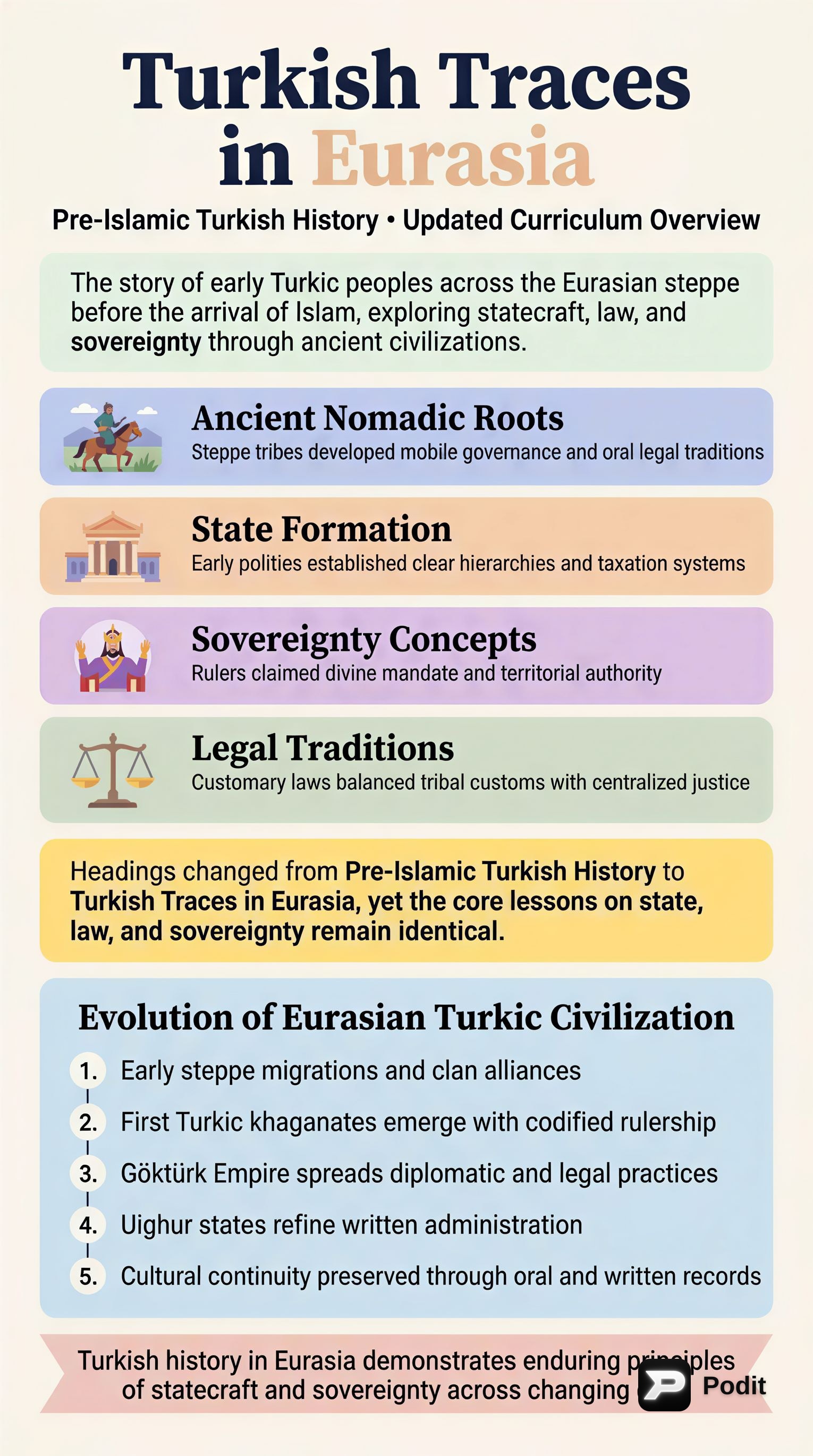
İnfografikKonunun tüm parçalarını tek bakışta gör.
Flash Kartlar
25 kartKarta tıklayarak çevir. ← → ile gez, ⎵ ile çevir.
Tüm kartları metin olarak gör
1. What period does Pre-Islamic Turkish history primarily encompass?
Pre-Islamic Turkish history primarily spans from ancient times up to the 10th century CE. This era focuses on the Turkic peoples before their widespread conversion to Islam. It is crucial for understanding the foundational cultural, political, and social structures that shaped subsequent Turkic civilizations.
2. What was the geographical center of early Turkic tribes?
The geographical center of early Turkic tribes was primarily Central Asia. This vast steppe environment fostered their unique nomadic lifestyles and military strategies. Their presence in this region left a significant impact on Eurasian history through their state-building traditions.
3. What were the key characteristics of Turkic tribes in the pre-Islamic era?
Key characteristics included a unique nomadic lifestyle, sophisticated military strategies, and distinct state-building traditions. These traits were developed in response to the harsh environmental conditions of the Central Asian steppe. Their adaptability and resilience allowed them to establish powerful polities across Eurasia.
4. How did Pre-Islamic Turkish history impact Eurasian history?
Pre-Islamic Turkish history had a significant impact on Eurasian history by shaping foundational cultural, political, and social structures. Their nomadic lifestyles, military prowess, and state-building traditions influenced vast regions. They facilitated extensive cultural and economic exchanges along the Silk Road, connecting diverse civilizations.
5. Where are the origins of Turkic peoples generally traced?
The origins of Turkic peoples are generally traced to the Altai Mountains region of Central Asia. Archaeological and linguistic evidence supports a deep historical presence in this vast steppe environment. This region served as the cradle for their unique cultural and social development.
6. What was the primary economic activity of early Turkic societies?
Early Turkic societies were predominantly nomadic, characterized by a pastoral economy. This economy centered on animal husbandry, particularly horses, sheep, and cattle. This lifestyle provided sustenance and resources, influencing their social organization and military capabilities.
7. How did the nomadic lifestyle influence early Turkic societies?
The nomadic lifestyle necessitated a high degree of mobility and adaptability, influencing their social organization, military prowess, and cultural practices. It fostered a resilient and self-sufficient culture where tribal affiliations and kinship ties were crucial for social cohesion. This mobility also contributed to their widespread migrations across Eurasia.
8. What factors drove the significant migrations of Turkic groups?
Significant migrations of Turkic groups were driven by factors such as climate change, population growth, resource competition, and conflicts with neighboring peoples. These pressures led to their dispersal across vast areas of Eurasia. Their adaptability allowed them to establish diverse communities and interact with numerous other ethnic groups.
9. Across what areas did Turkic groups disperse during their migrations?
Turkic groups dispersed across vast areas of Eurasia, ranging from Siberia to Eastern Europe. These migrations led to the establishment of diverse communities in various regions. They interacted with numerous other ethnic groups, including Iranians, Slavs, and Chinese, enriching the cultural tapestry of the continent.
10. Which other ethnic groups did Turkic peoples interact with during their migrations?
During their migrations, Turkic peoples interacted with numerous other ethnic groups. These included Iranians, Slavs, and Chinese. These interactions led to significant cultural exchange, trade, and sometimes conflict, shaping the historical development of all involved groups.
11. What is considered the earliest identifiable political entity with a significant Turkic component?
The Xiongnu Confederation, which emerged in the 3rd century BCE, is often considered the earliest identifiable political entity with a significant Turkic component. While its precise ethnic composition is debated, many scholars identify a strong Turkic element within its ruling elite and general populace. This confederation established a powerful steppe empire.
12. What were the characteristics of the Xiongnu Confederation?
The Xiongnu Confederation established a powerful steppe empire known for its sophisticated military organization, particularly highly effective cavalry. They also possessed a complex political administration for a nomadic society. This confederation posed a formidable challenge to the Han Dynasty of China.
13. Which Chinese dynasty did the Xiongnu Confederation challenge?
The Xiongnu Confederation posed a formidable challenge to the Han Dynasty of China. Their military prowess, especially their cavalry, and their complex political administration made them a significant rival. This rivalry led to prolonged conflicts and diplomatic engagements between the two powers.
14. What led to the decline of the Xiongnu Confederation?
The decline of the Xiongnu Confederation in the 1st and 2nd centuries CE was primarily due to internal strife and Chinese military pressure. This decline led to further fragmentation of the Xiongnu and westward movements of various Turkic groups. This fragmentation set the stage for the rise of subsequent Turkic empires.
15. Which Turkic state was the first to explicitly use 'Turk' as a political identity?
The Göktürk Khaganate, established in the 6th century CE, was the first Turkic state to explicitly use the ethnonym 'Turk' as a political identity. This marked a pivotal moment in Turkic history, solidifying a collective identity. They also left behind invaluable written records, the Orkhon Inscriptions.
16. What is the significance of the Orkhon Inscriptions?
The Orkhon Inscriptions, dating from the 8th century, are invaluable written records left by the Göktürk Khaganate. They provide unparalleled insights into their political ideology, social structure, historical events, and worldview. These monumental inscriptions emphasize key concepts like 'Töre' (law/tradition) and 'Kut' (divine mandate), offering a direct window into early Turkic thought.
17. What key concepts are emphasized in the Orkhon Inscriptions?
The Orkhon Inscriptions emphasize key concepts such as 'Töre' (law/tradition) and 'Kut' (divine mandate). 'Töre' refers to the established laws, customs, and traditions that governed Turkic society. 'Kut' signifies the divine grace or mandate believed to be bestowed upon the Khagan, legitimizing his rule. These concepts were central to Göktürk political ideology and worldview.
18. What was the geographical extent of the Göktürk Khaganate?
The Göktürk Khaganate created a vast empire stretching from Manchuria to the Black Sea. This extensive domain demonstrated their advanced military tactics and sophisticated administrative capabilities. Their ability to manage such a widespread territory highlights their political and organizational strength.
19. What was a notable military strength of the Göktürks?
A notable military strength of the Göktürks was their highly disciplined cavalry. This elite force was crucial for their rapid expansion and control over vast territories. Their advanced military tactics allowed them to establish and maintain a powerful empire across Eurasia.
20. Describe the social hierarchy within the Göktürk Khaganate.
Göktürk society was structured hierarchically, with a ruling elite comprising the khagan and various noble clans at the top. Below them were the free commoners, known as 'Kara Bodun'. A smaller class of slaves also existed at the bottom of the social structure. This hierarchy reflected their nomadic warrior society.
21. How was the economy of the Göktürk Khaganate characterized?
The economy of the Göktürk Khaganate was a dynamic blend of pastoral nomadism and extensive trade. Pastoral nomadism provided sustenance and military strength through animal husbandry. Trade along the Silk Road facilitated significant cultural exchange and economic prosperity with sedentary civilizations, bringing in goods and wealth.
22. What was a common characteristic of the Göktürk Khaganate's political system?
The Göktürk Khaganate's political system was often characterized by a dualistic structure, with eastern and western wings. This division, while allowing for broader control, frequently led to succession disputes and internal conflicts. These internal struggles ultimately contributed to the Khaganate's eventual decline and fragmentation.
23. What factors contributed to the decline of the Göktürk Khaganate?
The decline of the Göktürk Khaganate was primarily due to internal conflicts, particularly succession disputes. The dualistic political structure, with eastern and western wings, often exacerbated these internal struggles. These divisions and external pressures eventually led to the fragmentation and collapse of the Khaganate.
24. Which khaganate succeeded the Second Göktürk Khaganate in the 8th century?
The Uyghur Khaganate succeeded the Second Göktürk Khaganate in the 8th century. This new state marked a shift in Turkic history, establishing a more settled and urbanized culture. They also adopted Manichaeism as their state religion, showcasing a departure from previous religious practices.
25. What were some characteristics of the Uyghur Khaganate?
The Uyghur Khaganate, succeeding the Göktürks, established a more settled and urbanized culture. They adopted Manichaeism as their state religion, which was a significant cultural and religious shift. This khaganate demonstrated a move towards a more sedentary lifestyle compared to earlier nomadic Turkic empires.
Bilgini Test Et
15 soruÇoktan seçmeli sorularla öğrendiklerini ölç. Cevap + açıklama.
Which geographical region is generally considered the origin point for Turkic peoples?