Pre-Islamic Turkish Political History: Part 1 - kapak
Tarih#turkish history#pre-islamic#great hun empire#göktürk khaganate

Pre-Islamic Turkish Political History: Part 1

Explore the political history of early Turkish states before Islam, focusing on the Great Hun Empire, Göktürks, and Uyghurs, their state structures, and impact.

aydn1May 14, 2026 ~23 dk toplam
01

Sesli Özet

13 dakika

Konuyu otobüste, koşarken, yolda dinleyerek öğren.

Sesli Özet

Pre-Islamic Turkish Political History: Part 1

0:0013:12
02

Görsel Özet

İnfografik

Konunun tüm parçalarını tek bakışta gör.

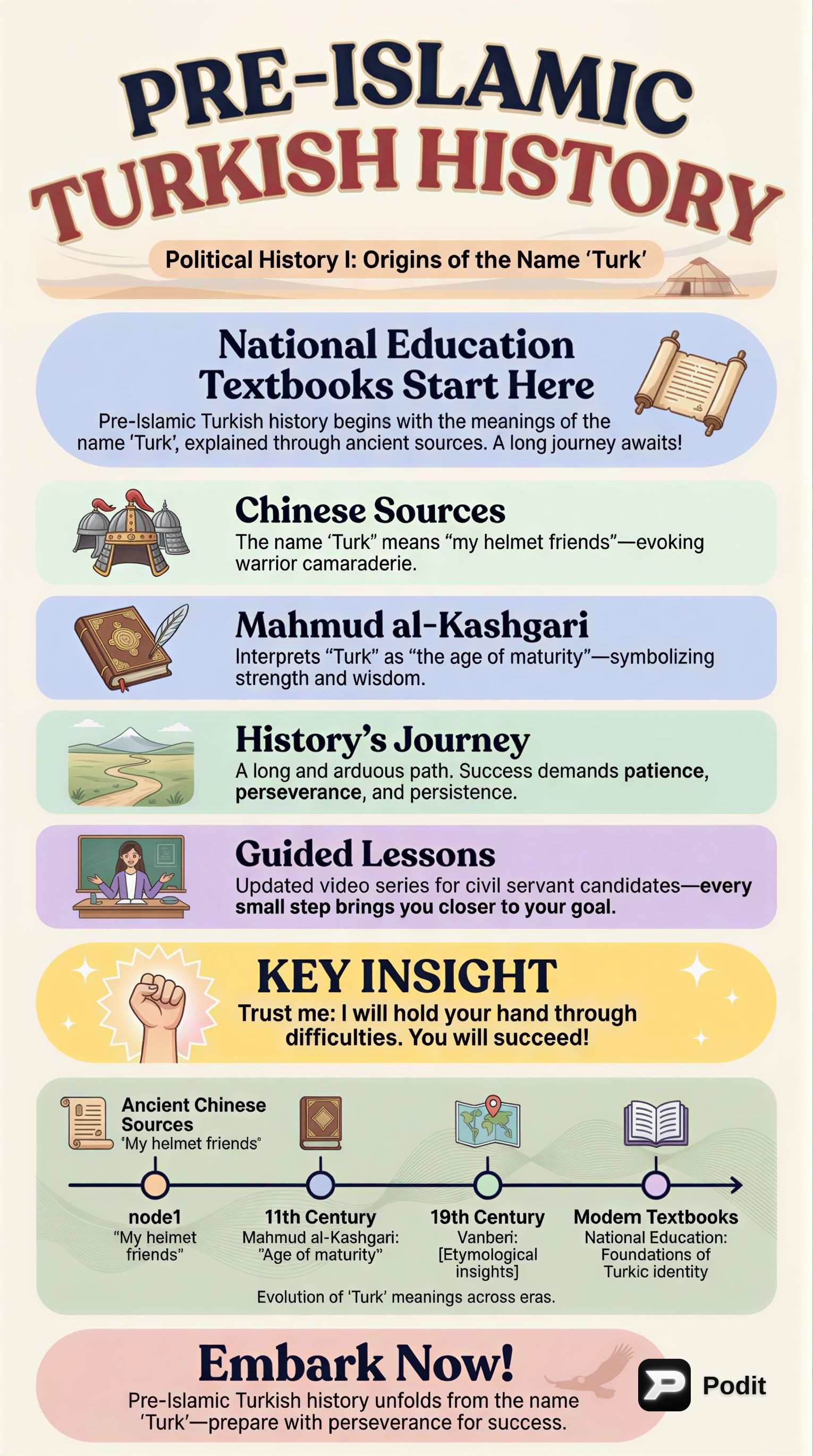
Pre-Islamic Turkish Political History: Part 1 - görsel özet infografik
Tam boyutta görüntüle →
03

Flash Kartlar

25 kart

Karta tıklayarak çevir. ← → ile gez, ⎵ ile çevir.

1 / 25
Tüm kartları metin olarak gör
  1. 1. What is the primary focus of studying Pre-Islamic Turkish Political History?

    The primary focus is to understand the foundations of Turkish statehood, military traditions, and cultural identity before the advent of Islam. It delves into how early Turkish states like the Great Hun Empire, Göktürk Khaganates, and Uyghur Khaganate were formed, governed, and interacted with neighboring powers. This study provides crucial insights into the political dynamics and significant contributions of these early Turkish states.

  2. 2. Which key empires and khaganates are covered in the study of Pre-Islamic Turkish Political History?

    The study primarily covers the Great Hun Empire, the Göktürk Khaganates (First and Second), and the Uyghur Khaganate. These entities represent significant periods in the political evolution of early Turkish peoples, showcasing their rise, political structures, interactions with powers like China, and eventual decline. Understanding these three major powers is essential for grasping the era.

  3. 3. When and where did the Great Hun Empire emerge?

    The Great Hun Empire emerged in the vast steppes of Central Asia around the 3rd century BCE. It is often considered the first major Turkish state in history. Their emergence marked the beginning of a powerful nomadic presence that would significantly influence the political landscape of Central Asia and beyond for centuries.

  4. 4. What were the key characteristics that made the Huns a powerful and influential force?

    The Huns were primarily a nomadic people, and their lifestyle was central to their power. Their exceptional mobility, superior horsemanship, and mastery of archery gave them a distinct advantage in warfare, allowing them to conduct swift and effective campaigns across vast distances. These characteristics enabled them to establish and maintain a formidable empire.

  5. 5. Who was Modu Chanyu and what was his significance for the Great Hun Empire?

    Modu Chanyu was a prominent figure in the late 3rd century BCE who unified various nomadic tribes under his rule. He transformed the Hunnic state from a loose confederation into a formidable empire. Under his leadership, a highly centralized military and administrative system was established, which was quite advanced for its time and crucial for the empire's power and expansion.

  6. 6. Describe the political structure of the Great Hun Empire under Modu Chanyu.

    Under Modu Chanyu, the Hunnic state established a highly centralized military and administrative system. The empire was structured hierarchically, with the Chanyu, or supreme ruler, at the top. Below him were various princes and tribal leaders who helped manage the vast territory. This structure ensured effective control over diverse tribal groups and a wide geographical area.

  7. 7. How did the Great Hun Empire interact with China, particularly the Han Dynasty?

    The Huns' political history was largely defined by their complex interactions with China, especially the Han Dynasty. They frequently launched raids into Chinese territory, demanding tribute and asserting their dominance. These interactions were not solely military; they also involved intricate diplomatic relations, including treaties and even marriage alliances, showcasing a blend of conflict and cooperation.

  8. 8. What challenges led to the weakening and fragmentation of the Great Hun Empire?

    The vastness of the Hunnic Empire made maintaining control over its diverse and geographically dispersed population a constant struggle. Internal conflicts, succession disputes among leaders, and persistent external pressures, particularly from China's 'divide and conquer' tactics, eventually led to its weakening. These factors combined to cause the empire's fragmentation.

  9. 9. What was the fate of the Great Hun Empire after its fragmentation in the 1st century CE?

    By the 1st century CE, the Great Hun Empire had split into Southern and Northern Huns. The Southern Huns eventually submitted to China, becoming vassals. The Northern Huns, however, migrated westward, eventually playing a significant role in the collapse of the Western Roman Empire under Attila, demonstrating the immense reach and lasting impact of the Hunnic people.

  10. 10. What is the enduring political legacy of the Great Hun Empire?

    The Huns established a foundational model for nomadic empires, demonstrating how a mobile society could create a powerful and enduring state. Their military prowess and administrative innovations laid significant groundwork for future steppe empires, including subsequent Turkish and even Mongol empires. They proved that a nomadic lifestyle could be compatible with sophisticated statecraft.

  11. 11. Why are the Göktürk Khaganates particularly significant in Turkish history?

    The Göktürk Khaganates are significant because they were the first to explicitly use the name 'Turk' for their state, marking a crucial moment in the development of Turkish identity. Their establishment solidified a distinct Turkish political entity and laid the groundwork for future Turkish states. They also left behind invaluable written records that define their legacy.

  12. 12. Who founded the First Göktürk Khaganate and what was the context of its establishment?

    The First Göktürk Khaganate was founded in the mid-6th century CE by Bumin Khagan. Before their rise, the Göktürks were vassals of the Rouran Khaganate. Bumin Khagan rebelled against the Rourans, defeated them, and established his own independent state, showcasing their military strength and ambition to forge their own destiny.

  13. 13. Describe the political structure and expansion of the First Göktürk Khaganate.

    The Göktürk Empire quickly expanded, becoming one of the largest empires of its time, stretching from the Black Sea to Manchuria. Its political structure was highly organized, centered around the Khagan, who held supreme political and military authority. The Khaganate was often divided into eastern and western wings, ruled by the Khagan and a lesser Khagan (Yabgu) respectively, to manage its vast territory.

  14. 14. How did the Göktürks interact with Chinese dynasties like the Sui and Tang?

    Like the Huns, the Göktürks engaged in complex diplomatic and military relations with China. They often intervened in Chinese internal affairs, sometimes supporting one dynasty against another, and at other times facing concerted Chinese efforts to weaken them. These interactions were a constant dance of power, alliances, and warfare, shaping the political landscape of the region.

  15. 15. What significant cultural contribution are the Göktürks known for, and why is it important?

    The Göktürks are renowned for the Orkhon Inscriptions, which are the earliest known examples of writing in a Turkic language. These inscriptions provide invaluable insights into their history, political organization, and worldview. They detail the deeds of their khagans, their struggles, and their advice to future generations, emphasizing the importance of unity and strong leadership.

  16. 16. What factors led to the decline of the First Göktürk Khaganate?

    The First Göktürk Khaganate eventually collapsed in the late 7th century due to a combination of internal divisions and persistent external pressure. Internal strife, particularly between the eastern and western wings of the Khaganate, weakened its unity. This internal instability, coupled with continuous pressure from China, ultimately led to its downfall.

  17. 17. How did the Second Göktürk Khaganate emerge after the fall of the first?

    A resurgence occurred with the establishment of the Second Göktürk Khaganate, also known as the Kutlug Khaganate, founded by Kutlug Khagan (Ilterish Khagan) in the late 7th century. This second khaganate aimed to restore the glory of its predecessor. It rose from the ashes of the first, demonstrating the resilience and ambition of the Göktürk people to re-establish their state.

  18. 18. Who were some key figures instrumental in the revival and consolidation of the Second Göktürk Khaganate?

    Figures like Bilge Khagan, Kul Tigin, and the wise minister Tonyukuk were instrumental in the revival and consolidation of the Second Göktürk Khaganate. Their efforts are immortalized in the Orkhon Inscriptions, which serve as primary historical sources detailing their leadership, military campaigns, and political wisdom. They played crucial roles in restoring Göktürk power.

  19. 19. What led to the ultimate overthrow of the Second Göktürk Khaganate?

    Despite its efforts to restore glory, the Second Göktürk Khaganate also faced internal challenges and external threats. Ultimately, it was overthrown by a coalition of Uyghurs, Karluks, and Basmyls in the mid-8th century. This defeat paved the way for the rise of the Uyghur Khaganate, marking the end of the Göktürk dominance in Central Asia.

  20. 20. What is the lasting legacy of the Göktürks in history?

    The Göktürks left an indelible mark on history not just as a powerful empire, but as the originators of a distinct Turkish identity and written language. Their Orkhon Inscriptions are a testament to their cultural and political sophistication. They established a strong tradition of statecraft and military organization that influenced subsequent Turkish peoples.

  21. 21. How did the Uyghur Khaganate emerge and what was its relationship to the Göktürks?

    The Uyghur Khaganate emerged as the dominant power in Central Asia in the mid-8th century, following the fall of the Second Göktürk Khaganate. The Uyghurs were one of the Turkic tribes that had previously been part of the Göktürk Empire. Their rise represents a significant shift in the political and cultural trajectory of the Turkish peoples, succeeding their former overlords.

  22. 22. What significant shift characterized the Uyghur Khaganate compared to its predecessors?

    While initially maintaining a nomadic lifestyle, the Uyghur Khaganate gradually adopted a more sedentary way of life, a significant shift from the purely nomadic Huns and Göktürks. This transition was influenced by interactions with China and the adoption of new religions. It led to the establishment of permanent settlements and a more urbanized society.

  23. 23. How did Manichaeism influence the Uyghur Khaganate's development?

    Manichaeism became the state religion under Bögü Khagan in 762 CE and had profound political and cultural implications. Its emphasis on agriculture and urban living encouraged the Uyghurs to establish permanent settlements and cities, moving away from a purely nomadic existence. This religious shift led to the development of a more sophisticated urban culture and administration within the Khaganate.

  24. 24. Describe the political structure and diplomatic ties of the Uyghur Khaganate.

    The Uyghur Khaganate's political structure was similar to the Göktürks, with a Khagan at the apex, supported by a hierarchical system of officials and tribal leaders. They maintained strong diplomatic and economic ties with China, often acting as protectors of the Tang Dynasty against internal rebellions. In return, the Uyghurs received substantial tribute, fueling their prosperity.

  25. 25. What cultural and administrative developments occurred in the Uyghur Khaganate?

    The Uyghurs developed their own writing system, adapting the Sogdian alphabet, which facilitated their cultural and administrative development. Their cities became centers of trade and culture, reflecting a more settled and sophisticated society compared to earlier nomadic empires. This marked a transition towards a more urbanized and culturally diverse empire.

04

Detaylı Özet

5 dk okuma

Tüm konuyu derinlemesine, başlık başlık.

This content is based on a YouTube video.


📚 Pre-Islamic Turkish Political History: An Overview

This study material explores the political history of early Turkish states before the advent of Islam, focusing on their formation, governance, challenges, and lasting legacies. Understanding this period is crucial for grasping the foundations of Turkish statehood, military traditions, and cultural identity. We will delve into the Great Hun Empire, the Göktürk Khaganates, and the Uyghur Khaganate, examining their rise, political structures, interactions with neighboring powers (especially China), and eventual decline.

1. The Great Hun Empire: A Nomadic Powerhouse 🐎

The Great Hun Empire is often regarded as the first major Turkish state in history, emerging in the vast steppes of Central Asia around the 3rd century BCE.

Key Characteristics & Political Structure:

  • Nomadic Lifestyle ✅: Their mobility, horsemanship, and mastery of archery provided significant military advantages, enabling swift and effective strikes across vast distances.
  • Modu Chanyu 👑: Unified various nomadic tribes in the late 3rd century BCE, transforming a loose confederation into a formidable empire.
  • Centralized System 🏛️: Modu established a highly centralized military and administrative system, advanced for its time.
  • Hierarchical Structure 📊:
    • Chanyu (supreme ruler) at the top.
    • Followed by various princes and tribal leaders.
    • Ensured control over a vast territory and diverse tribal groups.

Interactions with China:

  • Constant Threat ⚔️: The Huns posed a significant threat to Chinese dynasties, particularly the Han Dynasty, frequently launching raids.
  • Diplomacy & Warfare 🤝: Interactions involved demands for tribute, assertions of dominance, complex diplomatic relations, treaties, and marriage alliances.

Challenges & Decline:

  • Vast Territory ⚠️: Maintaining control over a geographically dispersed population from Manchuria to the Aral Sea was a constant struggle.
  • Internal Conflicts 📉: Succession disputes and internal strife weakened the empire.
  • External Pressures 🇨🇳: China's 'divide and conquer' tactics contributed to its fragmentation.
  • Fragmentation 💔: By the 1st century CE, the empire split into Southern and Northern Huns.
    • Southern Huns submitted to China.
    • Northern Huns migrated westward, eventually playing a role in the collapse of the Western Roman Empire under Attila.

Legacy 💡:

  • Established a model for nomadic empires, demonstrating how a mobile society could create a powerful state.
  • Influenced subsequent Turkish and Mongol empires.
  • Laid groundwork for future steppe empires with their military prowess and administrative innovations.

2. The Göktürk Khaganates: The First Turkish Empire 🦅

Following the Huns, the Göktürk Khaganates rose to prominence. They are significant for being the first to explicitly use the name 'Turk' for their state.

2.1. The First Göktürk Khaganate (Mid-6th Century CE)

  • Founder 👑: Bumin Khagan, who rebelled against and defeated the Rouran Khaganate.
  • Expansion 🌍: Became one of the largest empires, stretching from the Black Sea to Manchuria.
  • Political Structure 🏛️:
    • Centered around the Khagan, holding supreme political and military authority.
    • Often divided into eastern and western wings, ruled by the Khagan and a lesser Khagan (Yabgu) respectively.
    • This dual administration, while effective, also became a source of internal strife.
  • Interactions with China 🇨🇳: Engaged in complex diplomatic and military relations with the Sui and Tang dynasties, often intervening in Chinese internal affairs.
  • Cultural Contributions ✍️:
    • Orkhon Inscriptions 📜: Earliest known examples of writing in a Turkic language.
    • Provide insights into their history, political organization, and worldview.
    • Emphasize unity and strong leadership.
  • Decline 💔: Internal divisions (especially between eastern and western wings) and persistent Chinese pressure led to its collapse in the late 7th century.

2.2. The Second Göktürk Khaganate (Kutlug Khaganate - Late 7th Century CE)

  • Resurgence ✨: Founded by Kutlug Khagan (Ilterish Khagan) to restore the glory of its predecessor.
  • Key Figures 🌟: Bilge Khagan, Kul Tigin, and the wise minister Tonyukuk were instrumental in its revival and consolidation. Their deeds are immortalized in the Orkhon Inscriptions.
  • Decline ⚔️: Overthrown by a coalition of Uyghurs, Karluks, and Basmyls in the mid-8th century.

Legacy 💡:

  • Left an indelible mark as the originators of a distinct Turkish identity and written language.

3. The Uyghur Khaganate: A Shift Towards Sedentary Life 🏘️

Following the fall of the Second Göktürk Khaganate, the Uyghur Khaganate emerged as the dominant power in Central Asia in the mid-8th century.

Key Characteristics & Political Structure:

  • Transition to Sedentary Life 🏡: A significant shift from purely nomadic existence, influenced by interactions with China and new religions.
  • Manichaeism 🙏: Became the state religion under Bögü Khagan in 762 CE.
    • Emphasized agriculture and urban living.
    • Encouraged establishment of permanent settlements and cities.
    • Led to a more sophisticated urban culture and administration.
  • Political Structure 🏛️: Similar to Göktürks, with a Khagan at the apex, supported by a hierarchical system of officials and tribal leaders.
  • Ties with China 🤝: Maintained strong diplomatic and economic ties.
    • Acted as protectors of the Tang Dynasty (e.g., during the An Lushan Rebellion).
    • Received substantial tribute from China, fueling economic prosperity.

Cultural & Economic Development:

  • Writing System ✍️: Developed their own writing system, adapting the Sogdian alphabet.
  • Urban Centers 🏙️: Cities became centers of trade and culture, reflecting a more settled and sophisticated society.

Challenges & Decline:

  • Vulnerability ⚠️: Close relationship with China made them vulnerable to political maneuvering.
  • Internal Strife 💔: Internal power struggles.
  • Natural Disasters 🌾: A severe famine.
  • External Pressure ⚔️: Rebellion by the Kirghiz led to the collapse of the Khaganate in 840 CE.
  • Dispersion 🗺️: Many Uyghurs migrated, establishing new states like the Qocho Kingdom in Eastern Turkestan, where they continued their cultural development and played a role in the Silk Road trade.

Legacy 💡:

  • Represents a pivotal moment in Turkish history, showcasing a transition from nomadic statehood to a more settled, urbanized, and culturally diverse empire.
  • Contributions to art, literature, and urban development.

Key Takeaways and Enduring Legacy ✅

  • Great Hun Empire 🐎: Established the first major nomadic state, demonstrating military prowess and administrative innovation under Modu Chanyu. Set a precedent for future steppe empires.
  • Göktürk Khaganates 🦅: Explicitly identified as 'Turk' and left invaluable written records (Orkhon Inscriptions), showcasing a sophisticated political and cultural identity.
  • Uyghur Khaganate 🏘️: Marked a significant transition towards a more sedentary and urbanized lifestyle, influenced by new religions and close ties with China.

These empires, while distinct, contributed to a continuous tradition of Turkish statecraft, characterized by strong leadership, military organization, and complex diplomatic relations. They faced common challenges such as maintaining unity across vast territories, managing succession, and navigating the powerful influence of China. Their political structures, military tactics, and cultural developments laid the groundwork for later Turkish states and left an enduring legacy on the history of Central Asia and beyond. This period highlights the resilience, adaptability, and political ingenuity of the early Turkish peoples.
Kendi çalışma materyalini oluştur

PDF, YouTube videosu veya herhangi bir konuyu dakikalar içinde podcast, özet, flash kart ve quiz'e dönüştür. 1.000.000+ kullanıcı tercih ediyor.

Sıradaki Konular

Tümünü keşfet
Pre-Islamic Turkish Political History

Pre-Islamic Turkish Political History

Explore the political history of early Turkish states before Islam, covering their nomadic origins, state structures, military prowess, and key empires like the Huns and Göktürks.

11 dk Özet 25 Görsel
Pre-Islamic Turkish Political History: Early States

Pre-Islamic Turkish Political History: Early States

An academic overview of the political history of early Turkic states before the advent of Islam, focusing on the Xiongnu, Göktürk, and Uyghur Khaganates.

7 dk Özet 25 15 Görsel
Pre-Islamic Turkish Political History

Pre-Islamic Turkish Political History

An academic overview of the political history of Turkic states before the advent of Islam, exploring their foundational characteristics, key empires, and enduring legacies.

4 dk Özet 25 15 Görsel
Pre-Islamic Turkish History

Pre-Islamic Turkish History

An academic overview of the foundational period of Turkic peoples, exploring their origins, early migrations, and the significant empires and cultural developments before the advent of Islam.

5 dk Özet 25 15
Pre-Islamic Turkish History

Pre-Islamic Turkish History

An academic overview of Pre-Islamic Turkish history, exploring early origins, nomadic empires, and key cultural developments in Central Asia before the advent of Islam.

5 dk Özet 25 15
Pre-Islamic Turkish Political History: Part 1

Pre-Islamic Turkish Political History: Part 1

Explore the fascinating political history of pre-Islamic Turkish states, their nomadic origins, military prowess, unique state traditions, and key empires like the Huns, Göktürks, and Uyghurs.

8 dk Özet 25 Görsel
Pre-Islamic Turkish History: Early Nomadic Empires

Pre-Islamic Turkish History: Early Nomadic Empires

Explore the fascinating origins of Turkish history before Islam, focusing on the nomadic lifestyle, Central Asian roots, and the rise of powerful early states like the Xiongnu and Göktürks.

Özet 25
Turkish-Islamic Political History: Early States

Turkish-Islamic Political History: Early States

An academic overview of the political history of early Turkish-Islamic states, including their formation, key empires like the Seljuks, and their lasting administrative and cultural impact.

1 dk Özet 25 15 Görsel