Pre-Islamic Turkish Political History: Part 1 - kapak
Tarih#turkish history#pre-islamic turks#ancient turks#huns

Pre-Islamic Turkish Political History: Part 1

Explore the fascinating political history of pre-Islamic Turkish states, their nomadic origins, military prowess, unique state traditions, and key empires like the Huns, Göktürks, and Uyghurs.

aydn1May 14, 2026 ~18 dk toplam
01

Sesli Özet

9 dakika

Konuyu otobüste, koşarken, yolda dinleyerek öğren.

Sesli Özet

Pre-Islamic Turkish Political History: Part 1

0:008:34
02

Görsel Özet

İnfografik

Konunun tüm parçalarını tek bakışta gör.

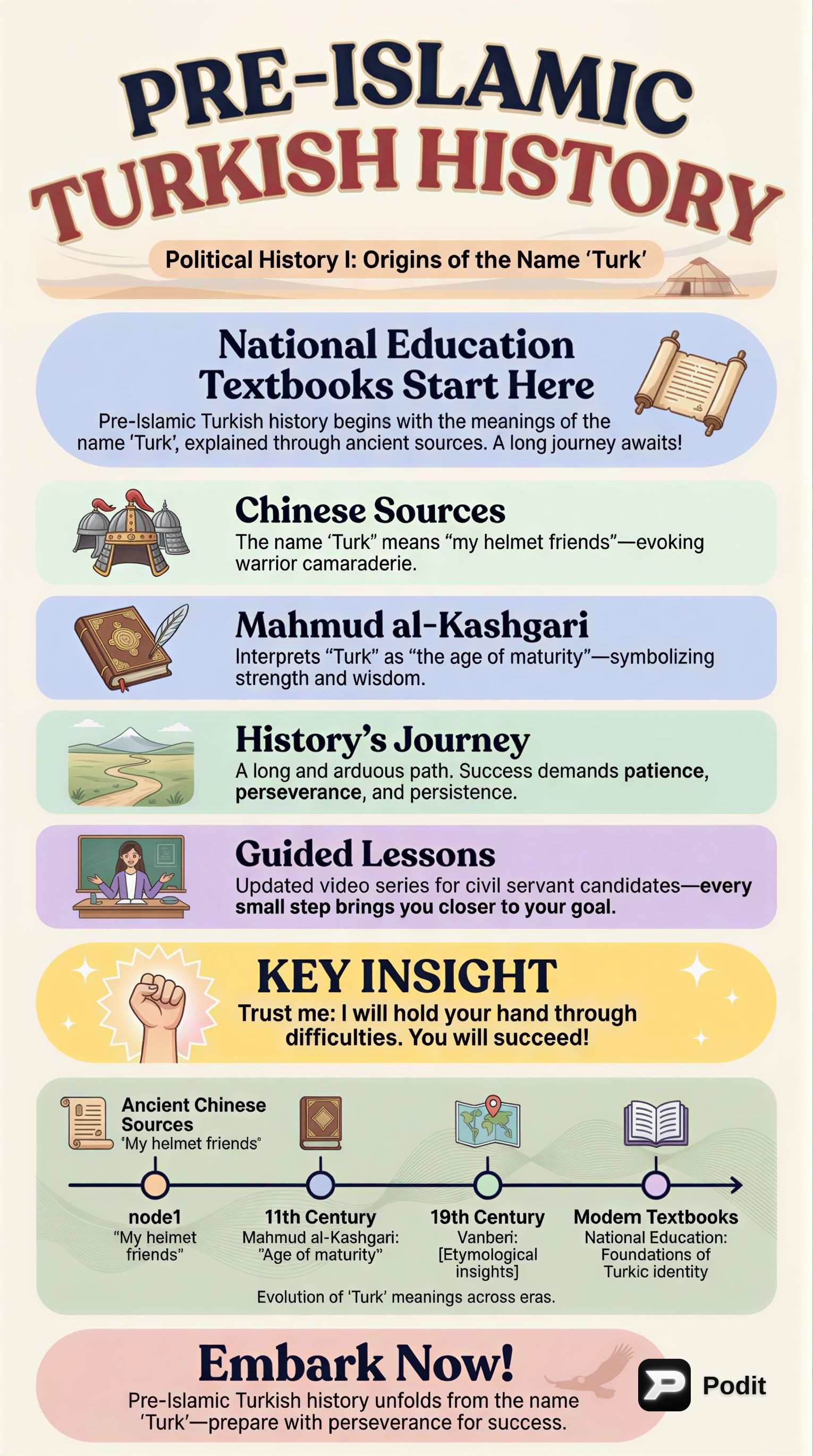
Pre-Islamic Turkish Political History: Part 1 - görsel özet infografik
Tam boyutta görüntüle →
03

Flash Kartlar

25 kart

Karta tıklayarak çevir. ← → ile gez, ⎵ ile çevir.

1 / 25
Tüm kartları metin olarak gör
  1. 1. What is the main topic of this content?

    The main topic is Pre-Islamic Turkish Political History, focusing on the political landscape, characteristics, and major empires of early Turkish states before the adoption of Islam. It aims to provide foundational understanding of Turkish statecraft, military organization, and cultural identity during this crucial period.

  2. 2. Which three major pre-Islamic Turkish empires will be discussed in this lesson?

    This lesson will focus on the Huns, the Göktürks, and the Uyghurs. These empires were prominent in shaping the political and cultural landscape of Central Asia, leaving significant legacies before the widespread adoption of Islam in the region.

  3. 3. What was a fundamental characteristic of early Turkish societies that influenced their political and military organization?

    A fundamental characteristic was their largely nomadic lifestyle, centered around animal husbandry and seasonal migrations across the vast Central Asian steppes. This nomadic existence made them highly mobile, adaptable, and self-sufficient, profoundly shaping their governance and military strategies.

  4. 4. How did the nomadic background of early Turkish states influence their military capabilities?

    Their nomadic background led to the development of a highly skilled cavalry, renowned for its swiftness, archery skills from horseback, and tactical brilliance. This mobility and expertise made Turkish armies formidable adversaries and efficient in administering vast territories.

  5. 5. Explain the 'decimal system' in the context of early Turkish military organization.

    The decimal system was a military organization method where units were systematically divided into groups of ten, hundred, thousand, and ten thousand. Famously perfected by Mete Khan of the Huns, this system allowed for rapid mobilization, effective command, and precise control over large military forces.

  6. 6. What is the concept of 'Kut' in early Turkish political thought?

    'Kut' refers to the divine mandate or heavenly blessing bestowed upon the ruler, the Khagan, by Tengri, the sky god. This belief legitimized the Khagan's rule and ensured loyalty, as challenging the Khagan was seen as challenging divine will, making it a powerful political tool for unification.

  7. 7. Describe the 'dual administration' system prevalent in early Turkish states.

    The dual administration system involved dividing the state into eastern and western wings. The Khagan typically ruled the eastern part, which was considered more prestigious, while a close relative, often a younger brother, governed the western part. This system helped manage vast territories but frequently led to internal power struggles and divisions.

  8. 8. How was early Turkish society structured socially?

    Early Turkish society was structured around tribes, known as 'Oghuz', which were further divided into clans and families. While loyalty to the tribe was paramount, the Khagan's authority aimed to transcend these tribal loyalties, striving to unite them under a single, overarching banner.

  9. 9. What were the primary economic activities of pre-Islamic Turkish states?

    The economy was primarily dominated by animal husbandry, particularly horses, sheep, and cattle, reflecting their nomadic lifestyle. Additionally, trade, especially along the Silk Road, played a vital role, bringing immense wealth and influence and often leading to conflicts with neighboring powers like China.

  10. 10. Who were the Huns, and by what other name were they known in Chinese sources?

    The Huns were a major nomadic empire that significantly challenged settled civilizations. In Chinese sources, they were known as the Xiongnu. They are arguably recognized as the first major nomadic power to emerge and exert widespread influence in Central Asia.

  11. 11. Who was Mete Khan, and what was his significant contribution to military organization?

    Mete Khan was a legendary leader of the Asian Huns, ruling from 209 to 174 BCE. He is credited with perfecting the decimal system in military organization, which created a highly disciplined and effective army. His reign saw the Huns dominate Central Asia and frequently clash with the Han Dynasty.

  12. 12. What was a major strategic objective for the Huns that brought them economic prosperity?

    Controlling key sections of the Silk Road was a major strategic objective for the Huns. This control brought immense wealth and influence through trade, contributing significantly to their economic prosperity and often leading to conflicts with neighboring powers, particularly China.

  13. 13. How did the European Huns impact the Roman Empire in the 4th and 5th centuries CE?

    Under the leadership of Attila, often called the 'Scourge of God,' the European Huns launched devastating campaigns into Gaul and Italy in the 5th century. Their military actions played a crucial role in the collapse of the Western Roman Empire and the subsequent reshaping of the European political landscape.

  14. 14. What is the significance of the Göktürk Khaganate in Turkish history?

    The Göktürk Khaganate, established in 552 CE, holds a special place in Turkish history as it was the first state to explicitly use the name 'Turk' for its people and state. This marked a significant milestone in the development of a distinct Turkish identity and statehood.

  15. 15. Who founded the Göktürk Khaganate?

    The Göktürk Khaganate was founded by Bumin Khagan in 552 CE. He rapidly established a vast empire stretching from the Black Sea to Manchuria, inheriting and adapting many military and administrative traditions from earlier nomadic groups like the Huns.

  16. 16. What are the Orkhon Inscriptions, and why are they important?

    The Orkhon Inscriptions are monumental stone steles dating back to the early 8th century, written in the Old Turkic script. They are the earliest known examples of written Turkish and provide invaluable insights into Göktürk history, culture, and political thought, including speeches of key figures.

  17. 17. Which key figures are mentioned in the Orkhon Inscriptions?

    The Orkhon Inscriptions include the speeches and narratives of important Göktürk figures such as Bilge Khagan, Kül Tigin, and the wise minister Tonyukuk. These inscriptions offer direct perspectives on their leadership, wisdom, and the challenges faced by the Göktürk state.

  18. 18. What were some themes emphasized in the Orkhon Inscriptions?

    The Orkhon Inscriptions emphasized the critical importance of unity among the Turkish people, unwavering loyalty to the Khagan, and the dangers of Chinese influence and assimilation. They served as both a historical record and a moral guide, urging future generations to preserve their heritage.

  19. 19. What led to the decline of the Göktürk Khaganate?

    The Göktürk Khaganate declined due to a combination of factors, including significant internal conflicts, particularly after its division into Eastern and Western Khaganates. External pressures, primarily from the powerful Chinese dynasties, also played a crucial role in weakening and ultimately leading to its collapse.

  20. 20. When did the Uyghurs emerge, and after the fall of which empire?

    The Uyghurs emerged in the mid-8th century CE, following the fall of the Second Göktürk Khaganate. Initially maintaining a nomadic lifestyle, they later underwent significant cultural and political transformations that set them apart from their predecessors.

  21. 21. What significant cultural and political shift did the Uyghurs undergo around 762 CE?

    Around 762 CE, the Uyghurs adopted Manichaeism as their state religion. This conversion was a profound cultural and political shift, encouraging them to transition from a purely nomadic existence to a more settled, urban lifestyle, fostering cities, agriculture, and a rich artistic culture.

  22. 22. How did the adoption of Manichaeism affect the Uyghur way of life?

    Manichaeism, with its emphasis on asceticism and a settled lifestyle, encouraged the Uyghurs to move away from their traditional nomadic practices. They established cities, developed agriculture, and fostered a rich artistic and literary culture, marking a significant departure from the warrior traditions of earlier Turkic empires.

  23. 23. What kind of power did the Uyghur Khaganate become, despite not being as militarily expansive as earlier empires?

    The Uyghur Khaganate became a significant cultural and economic power in Central Asia. While not as militarily expansive as the Huns or Göktürks, they controlled key trade routes, which brought them immense wealth and influence, allowing them to develop a rich artistic and literary tradition.

  24. 24. What led to the eventual fall of the Uyghur empire in the mid-9th century?

    The Uyghur empire fell in the mid-9th century primarily due to a combination of internal strife and attacks from other nomadic groups. Despite their cultural achievements and economic strength, these internal divisions and external pressures proved too great to sustain their empire.

  25. 25. What enduring legacy did the early Turkish states leave on the broader Eurasian continent?

    These early Turkish states laid crucial foundations for future Turkish states and left a lasting impact on the broader Eurasian continent. Their innovations in statecraft, military strategy, and cultural exchange, along with their complex interactions with neighboring powers, significantly shaped the region's history and development.

04

Detaylı Özet

4 dk okuma

Tüm konuyu derinlemesine, başlık başlık.

This content is based on a YouTube video.


📚 Pre-Islamic Turkish Political History: Foundations of Turkic States

This study material explores the political history of early Turkish states before the adoption of Islam. This period is crucial for understanding the foundational elements of Turkish statecraft, military organization, and cultural identity, laying the groundwork for future Turkish empires and leaving a lasting impact on Eurasia.

🌍 General Characteristics of Early Turkish States

To understand the political landscape of pre-Islamic Turkish states, it's essential to grasp their defining characteristics:

1️⃣ Nomadic Lifestyle & Military Prowess

  • Nomadic Existence: These societies were largely nomadic, centered around animal husbandry and seasonal migrations across the vast Central Asian steppes. This lifestyle fostered mobility, adaptability, and self-sufficiency.
  • Formidable Cavalry: The nomadic background directly influenced their military. Turkish armies were renowned for:
    • Swiftness and high mobility.
    • Exceptional archery skills from horseback.
    • Tactical brilliance.
  • Decimal System: A hallmark of their military organization, famously perfected by Mete Khan of the Huns.
    • Units were divided into groups of ten, hundred, thousand, and ten thousand.
    • Enabled rapid mobilization and effective command and control over large forces.

2️⃣ Political Structure & Governance

  • The Concept of 'Kut' (Divine Mandate):
    • 📚 Definition: 'Kut' refers to the divine blessing or heavenly mandate bestowed upon the ruler (Khagan) by Tengri, the sky god.
    • Legitimacy: This belief legitimized the Khagan's rule and ensured loyalty, as challenging the Khagan was seen as challenging divine will. It served as a powerful political tool for unification.
  • Dual Administration System:
    • The state was often divided into eastern and western wings.
    • The Khagan typically ruled the eastern part (considered more prestigious).
    • A close relative (often a younger brother) governed the western part.
    • Purpose: Helped manage vast territories.
    • Challenge: Frequently led to internal power struggles and divisions.

3️⃣ Social Structure & Economy

  • Tribal Organization: Turkish society was structured around tribes or 'Oghuz,' further divided into clans and families. Loyalty to the tribe was paramount.
  • Khagan's Authority: The Khagan's authority aimed to transcend tribal loyalties, uniting them under a single banner.
  • Economy:
    • Dominated by animal husbandry (horses, sheep, cattle).
    • Trade: Played a vital role, especially along the Silk Road.
    • Strategic Importance: Controlling key sections of the Silk Road brought immense wealth and influence, leading to frequent conflicts with neighboring powers like China.

⚔️ Major Pre-Islamic Turkish Empires

Let's delve into some of the most significant pre-Islamic Turkish empires:

1. The Huns (Xiongnu)

  • First Major Nomadic Empire: Arguably the first to challenge settled civilizations.
  • Asian Huns (3rd Century BCE):
    • Leaders: Teoman and his son, Mete Khan.
    • Mete Khan (209-174 BCE): A legendary figure credited with perfecting the decimal military system.
    • Impact: Unified various nomadic tribes, established a vast empire, dominated Central Asia, clashed with the Han Dynasty (often forcing tribute), and controlled the Silk Road.
    • Decline: Faced internal strife and external pressures, leading to their eventual split.
  • European Huns (4th Century CE):
    • Leader: Attila, known as the 'Scourge of God.'
    • Impact: Launched devastating campaigns into Gaul and Italy in the 5th century, playing a crucial role in the collapse of the Western Roman Empire and reshaping Europe. His military tactics left a lasting impression.

2. The Göktürks (Celestial Turks)

  • First to use 'Turk': Holds a special place as the first state to explicitly use the name 'Turk' for its people and state.
  • Founding: Established by Bumin Khagan in 552 CE.
  • Empire: Quickly established a vast empire stretching from the Black Sea to Manchuria.
  • Legacy: Orkhon Inscriptions (Early 8th Century):
    • Monumental stone steles written in the Old Turkic script.
    • Significance: Earliest known examples of written Turkish.
    • Content: Provide invaluable insights into Göktürk history, culture, and political thought, including speeches of Bilge Khagan, Kül Tigin, and the minister Tonyukuk.
    • Themes: Emphasize unity, loyalty to the Khagan, and the dangers of Chinese influence.
  • Decline: Experienced division into Eastern and Western Khaganates, leading to decline due to internal conflicts and external pressures, particularly from China.

3. The Uyghurs

  • Emergence: Arose in the mid-8th century after the fall of the Second Göktürk Khaganate.
  • Cultural & Political Shift:
    • Initially maintained a nomadic lifestyle.
    • Key Event: Adopted Manichaeism as their state religion around 762 CE.
    • Impact of Manichaeism: Encouraged a transition from nomadism to a more sedentary, urban existence, emphasizing asceticism.
  • Development: Established cities, developed agriculture, and fostered a rich artistic and literary culture.
  • Influence: Became a significant cultural and economic power in Central Asia, controlling key trade routes.
  • Decline: Fell in the mid-9th century due to internal strife and attacks from other nomadic groups.
  • Legacy: Their cultural legacy, particularly their script and artistic achievements, influenced later Turkic peoples.

✅ Conclusion: The Enduring Legacy

The pre-Islamic Turkish period laid crucial foundations for future Turkish states and left a lasting impact on the broader Eurasian continent.

  • Military Innovation: The nomadic lifestyle shaped formidable military prowess, exemplified by the decimal system and skilled cavalry.
  • Political Concepts: Unique political concepts like 'Kut' (divine mandate) legitimized rulers, while the dual administration system managed vast territories.
  • Pioneering Empires:
    • The Huns challenged major world powers.
    • The Göktürks gave the Turkish people their name and first written language.
    • The Uyghurs demonstrated remarkable cultural evolution, transitioning to a settled, urban civilization.
  • Cultural Exchange: These states were not just conquerors but innovators in statecraft, military strategy, and cultural exchange, with complex interactions with neighbors like China.

Understanding this era is essential for grasping the full scope of Turkish history, showcasing resilience, adaptability, and an enduring spirit that shaped a significant part of the world. 💡
Kendi çalışma materyalini oluştur

PDF, YouTube videosu veya herhangi bir konuyu dakikalar içinde podcast, özet, flash kart ve quiz'e dönüştür. 1.000.000+ kullanıcı tercih ediyor.

Sıradaki Konular

Tümünü keşfet
Pre-Islamic Turkish Political History

Pre-Islamic Turkish Political History

Explore the political history of early Turkish states before Islam, covering their nomadic origins, state structures, military prowess, and key empires like the Huns and Göktürks.

11 dk Özet 25 Görsel
Pre-Islamic Turkish Political History

Pre-Islamic Turkish Political History

An academic overview of the political history of Turkic states before the advent of Islam, exploring their foundational characteristics, key empires, and enduring legacies.

4 dk Özet 25 15 Görsel
Pre-Islamic Turkish History

Pre-Islamic Turkish History

An academic overview of Pre-Islamic Turkish history, exploring early origins, nomadic empires, and key cultural developments in Central Asia before the advent of Islam.

5 dk Özet 25 15
Political History of Pre-Islamic Turkic States

Political History of Pre-Islamic Turkic States

This summary explores the political evolution of Turkic peoples before Islam, covering major empires like the Xiongnu, Göktürks, and Uyghurs, their state structures, and historical impact.

7 dk Görsel
Pre-Islamic Turkish History

Pre-Islamic Turkish History

An academic overview of the foundational period of Turkic peoples, exploring their origins, early migrations, and the significant empires and cultural developments before the advent of Islam.

5 dk Özet 25 15
Pre-Islamic Turkish Political History: Part 1

Pre-Islamic Turkish Political History: Part 1

Explore the political history of early Turkish states before Islam, focusing on the Great Hun Empire, Göktürks, and Uyghurs, their state structures, and impact.

13 dk Özet 25 Görsel
Pre-Islamic Turkish History: Early Nomadic Empires

Pre-Islamic Turkish History: Early Nomadic Empires

Explore the fascinating origins of Turkish history before Islam, focusing on the nomadic lifestyle, Central Asian roots, and the rise of powerful early states like the Xiongnu and Göktürks.

Özet 25
Turkish-Islamic Political History: Early States

Turkish-Islamic Political History: Early States

An academic overview of the political history of early Turkish-Islamic states, including their formation, key empires like the Seljuks, and their lasting administrative and cultural impact.

1 dk Özet 25 15 Görsel