Early Turkic States: Origins and Empires - kapak
Tarih#early turkic states#central asia history#xiongnu#hunnu

Early Turkic States: Origins and Empires

This academic summary explores the foundational early Turkic states, examining their origins, political structures, cultural contributions, and historical impact across Central Asia and Eurasia.

2dgqds24June 29, 2026 ~28 dk toplam
01

Sesli Özet

11 dakika

Konuyu otobüste, koşarken, yolda dinleyerek öğren.

Sesli Özet

Early Turkic States: Origins and Empires

0:0010:57
02

Görsel Özet

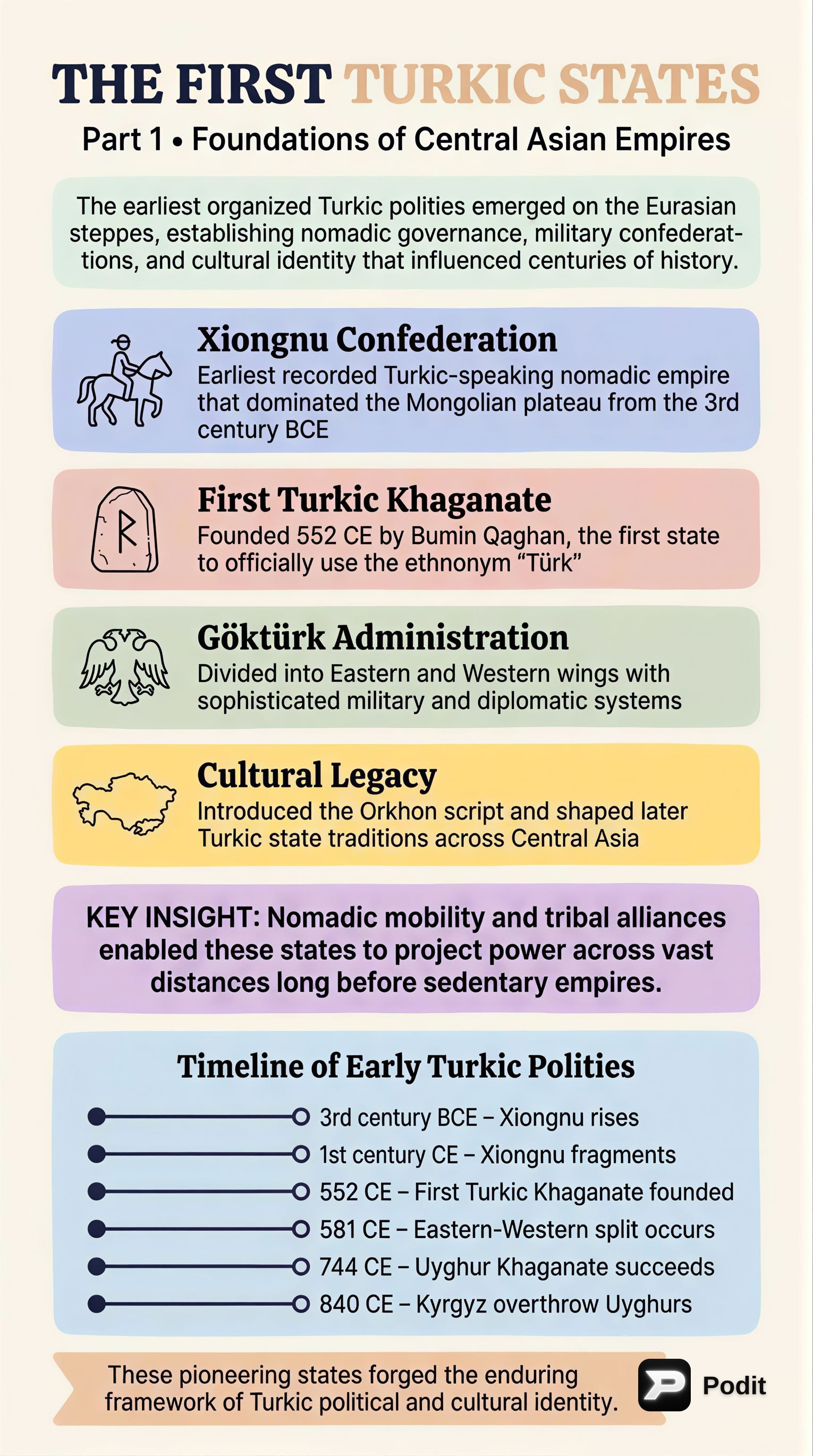
İnfografik

Konunun tüm parçalarını tek bakışta gör.

Early Turkic States: Origins and Empires - görsel özet infografik
Tam boyutta görüntüle →
03

Flash Kartlar

25 kart

Karta tıklayarak çevir. ← → ile gez, ⎵ ile çevir.

1 / 25
Tüm kartları metin olarak gör
  1. 1. What is the primary importance of studying early Turkic states?

    Studying early Turkic states is crucial for understanding the historical development of Central Asia and its significant impact on Eurasian civilizations. These states played a pivotal role in shaping political, cultural, and economic landscapes for centuries, influencing military strategy, administration, and cultural exchange. Their legacy provides essential insights into the subsequent trajectory of Turkic peoples and their influence on world history.

  2. 2. Where are the origins of Turkic peoples generally traced to?

    The origins of Turkic peoples are generally traced to the Altai Mountains region of Central Asia. This vast geographical area, characterized by steppes, deserts, and mountain ranges, is where linguistic and archaeological evidence suggests proto-Turkic groups inhabited as early as the second millennium BCE. This region provided the environmental context for their nomadic pastoralist lifestyle.

  3. 3. What was the typical lifestyle of early Turkic groups, and what advantages did it provide?

    Early Turkic groups primarily led a nomadic pastoralist lifestyle, centered around horse breeding and herding. This lifestyle provided them with crucial mobility and military advantages, which were essential for their expansion and dominance in the vast steppes. It also fostered a resilient and adaptable culture, emphasizing self-sufficiency and a strong warrior ethos.

  4. 4. How were early Turkic societies typically organized politically?

    Early Turkic societies were typically organized into tribal confederations. Leadership within these confederations was often based on martial prowess and the ability to unite disparate clans. This structure allowed for the mobilization of large groups for military and migratory purposes, reflecting the decentralized yet effective governance common among nomadic peoples.

  5. 5. What environmental factors influenced the culture of early Turkic peoples?

    The harsh environmental conditions of the Central Asian steppe significantly influenced the culture of early Turkic peoples. These conditions fostered a resilient and adaptable culture, emphasizing self-sufficiency and a strong warrior ethos. The need to survive in such an environment shaped their societal values and practices.

  6. 6. Which major political entity is widely considered to represent one of the first with significant Turkic components?

    The Xiongnu, also known as Hunnu, are widely considered to represent one of the first major political entities with significant Turkic components. Flourishing from the 3rd century BCE to the 1st century CE, their precise ethnic and linguistic composition is debated, but a strong Turkic-speaking presence is accepted. They were a formidable nomadic empire that significantly impacted Central Asian history.

  7. 7. What were the primary drivers behind the migratory patterns of early Turkic peoples?

    The migratory patterns of early Turkic peoples were often driven by a combination of ecological factors and political pressures. Ecological factors included climate change and the availability of pastures, which were vital for their nomadic pastoralist lifestyle. Political pressures from rival groups or expanding empires also compelled these movements, leading to the widespread dissemination of Turkic languages and cultural practices.

  8. 8. When did the Xiongnu Empire flourish, and what was its significance?

    The Xiongnu Empire flourished from the 3rd century BCE to the 1st century CE. It represents one of the earliest and most formidable nomadic empires in Central Asian history. Its significance lies in its powerful political and military structure, its continuous threat to the Han Dynasty, and its profound influence on subsequent nomadic empires.

  9. 9. Who was the supreme ruler of the Xiongnu confederation?

    The supreme ruler of the Xiongnu confederation was known as the 'Chanyu'. This centralized leadership commanded a vast network of tribal chiefs, enabling the Xiongnu to maintain control over their extensive territories and mobilize large forces. The Chanyu's authority was crucial for the empire's political stability and military effectiveness.

  10. 10. How did the Xiongnu economy primarily function?

    The Xiongnu economy primarily relied on pastoralism, which involved raising livestock like horses and sheep. This was supplemented by tribute and plunder obtained from agricultural societies, particularly from the neighboring Han Dynasty of China. This dual economic approach allowed them to sustain their nomadic lifestyle while also accumulating wealth and resources.

  11. 11. Describe the nature of the Xiongnu's interactions with the Han Dynasty of China.

    The Xiongnu's interactions with the Han Dynasty were complex and multifaceted, involving periods of intense warfare, diplomatic negotiations, and trade. They often posed a continuous military threat, leading to the construction of the Great Wall of China. Diplomacy sometimes included the 'heqin' system of marriage alliances, aiming to maintain a fragile peace.

  12. 12. What was the 'heqin' system, and how was it used in Xiongnu-China relations?

    The 'heqin' system was a diplomatic strategy involving marriage alliances, typically between Chinese princesses and Xiongnu rulers. It was used by the Han Dynasty to appease the powerful Xiongnu and maintain a fragile peace, often accompanied by gifts and trade agreements. While not always successful in preventing conflict, it was a significant tool in their complex relationship.

  13. 13. What was one significant response by China to the Xiongnu threat?

    One significant response by China to the Xiongnu threat was the construction of the Great Wall. This massive defensive fortification was built and expanded over centuries, primarily to protect China's northern borders from Xiongnu raids and invasions. It stands as a testament to the continuous military pressure exerted by the Xiongnu.

  14. 14. What cultural aspects characterized the Xiongnu?

    The Xiongnu developed a distinctive material culture, including advanced metalworking and sophisticated equestrian equipment. Their societal organization, military tactics, and administrative innovations profoundly influenced subsequent nomadic empires in the region. Their cultural legacy reflects their adaptation to a nomadic lifestyle and their military prowess.

  15. 15. What factors contributed to the decline of the Xiongnu Empire?

    The decline of the Xiongnu Empire in the 1st century CE was attributed to a combination of internal strife, succession disputes among their leadership, and sustained military pressure from the Han Dynasty. These factors led to its fragmentation into northern and southern branches, weakening its overall power and influence.

  16. 16. What is the historical association of the remnants of the Northern Xiongnu?

    The remnants of the Northern Xiongnu are often associated with the Huns who later migrated westward into Europe. This association demonstrates the far-reaching impact of this early Turkic-related polity and its role in the broader movements of nomadic peoples across Eurasia. It highlights a potential link between Central Asian and European history.

  17. 17. Which empire holds the distinction of being the first explicitly identified as 'Turkic' in historical records?

    The Göktürk Khaganate holds the distinction of being the first empire explicitly identified as 'Turkic' in historical records. Established in the mid-6th century CE, it marked a significant milestone in the development of Turkic statehood and identity. Its emergence solidified a distinct Turkic presence on the Eurasian steppe.

  18. 18. Who founded the First Göktürk Khaganate?

    The First Göktürk Khaganate was founded by Bumin Khagan. He successfully united various Turkic tribes, leading to the rapid expansion of the empire. His leadership was instrumental in establishing this powerful polity that stretched across a vast territory from Manchuria to the Black Sea.

  19. 19. What was the geographical extent of the First Göktürk Khaganate?

    The First Göktürk Khaganate rapidly expanded to control a vast territory stretching from Manchuria in the east to the Black Sea in the west. This extensive geographical reach made it one of the largest nomadic empires of its time, demonstrating its military strength and organizational capacity.

  20. 20. What significant cultural advancement did the Göktürks make in terms of writing?

    The Göktürks made a significant cultural advancement by developing their own runic script, known as the Orkhon-Yenisei script. This unique writing system is preserved in monumental inscriptions, providing invaluable primary source material for understanding early Turkic language, literature, and political thought. It represents a distinct Turkic identity.

  21. 21. What are the Orkhon Inscriptions, and why are they important?

    The Orkhon Inscriptions are monumental stone steles bearing the Orkhon-Yenisei script, developed by the Göktürks. They are important because they provide invaluable primary source material for understanding early Turkic language, literature, and political thought. These inscriptions detail the history, laws, and cultural values of the Göktürk Khaganate.

  22. 22. Describe the political system of the Göktürk Khaganate.

    The Göktürk Khaganate's political system was based on a dualistic structure, with an Eastern and a Western Khagan. These two rulers governed semi-autonomously but were ultimately under the authority of a supreme Khagan. This system facilitated the governance of a vast and diverse population spread across their extensive empire.

  23. 23. How did the Göktürks benefit economically from their geographical position?

    The Göktürks benefited economically from their geographical position by controlling key segments of the Silk Road. This control allowed them to profit significantly from trade between East and West, facilitating the exchange of goods, ideas, and technologies. Their strategic location made them crucial intermediaries in Eurasian commerce.

  24. 24. What was a key aspect of the Göktürk military prowess?

    A key aspect of the Göktürk military prowess was their highly mobile cavalry. This elite force allowed them to project power effectively and maintain dominance over numerous subject peoples across their vast empire. Their equestrian skills and tactical innovations were central to their military success.

  25. 25. What factors led to the collapse of the First Göktürk Khaganate?

    The collapse of the First Göktürk Khaganate in the late 7th century was primarily due to internal divisions, succession struggles among its leadership, and external pressures. The most significant external pressure came from the powerful Tang Dynasty of China, which exploited internal weaknesses to undermine the Khaganate.

04

Bilgini Test Et

15 soru

Çoktan seçmeli sorularla öğrendiklerini ölç. Cevap + açıklama.

Soru 1 / 15Skor: 0

Which of the following statements best synthesizes the primary significance of studying early Turkic states, as presented in the text?

05

Detaylı Özet

7 dk okuma

Tüm konuyu derinlemesine, başlık başlık.

This content is based on a YouTube video.

📚 Early Turkic States: A Comprehensive Study Guide

Introduction to Early Turkic States

The study of early Turkic states is fundamental to understanding the historical development of Central Asia and its profound impact on Eurasian civilizations. These states, emerging from the vast steppes, played a pivotal role in shaping political, cultural, and economic landscapes for centuries. Their legacy extends from the establishment of complex nomadic empires to significant contributions in military strategy, administration, and cultural exchange. This study guide will delineate the chronological and thematic progression of these early polities, focusing on their origins, key characteristics, and enduring historical significance. We will examine the foundational elements that defined Turkic statehood, including their societal structures, economic bases, and interactions with neighboring sedentary civilizations, particularly China. Understanding these early formations is crucial for appreciating the subsequent trajectory of Turkic peoples and their influence on world history.

🗺️ Origins and Early Migrations of Turkic Peoples

The origins of Turkic peoples are generally traced to the Altai Mountains region of Central Asia. This vast geographical area is characterized by steppes, deserts, and mountain ranges.

Key Characteristics of Early Turkic Societies:

  • Geographical Origin ✅: Altai Mountains region of Central Asia.
  • Timeframe ✅: Linguistic and archaeological evidence suggests proto-Turkic groups inhabited this region as early as the second millennium BCE.
  • Lifestyle ✅:
    • Nomadic Pastoralism 🐑🐎: Centered around horse breeding and herding.
    • Provided mobility and military advantages crucial for expansion.
  • Societal Organization ✅:
    • Typically organized into tribal confederations.
    • Leadership often based on martial prowess and the ability to unite disparate clans.
    • Harsh environmental conditions of the steppe fostered a resilient and adaptable culture.
    • Emphasized self-sufficiency and a strong warrior ethos ⚔️.
  • Interactions with Neighbors ✅:
    • Engaged in extensive interactions with Indo-European, Mongolic, and various indigenous Siberian peoples.
    • Led to complex cultural and genetic exchanges.
  • Early Identification 💡: The precise identification of the earliest Turkic-speaking groups remains a subject of ongoing academic debate, but the Xiongnu are widely considered to represent one of the first major political entities with significant Turkic components.
  • Migration Drivers ✅:
    • Often driven by ecological factors such as climate change and pasture availability.
    • Also influenced by political pressures from rival groups or expanding empires.
    • These movements facilitated the dissemination of Turkic languages and cultural practices across a vast geographical expanse, laying the groundwork for more formalized state structures.

🏹 The Xiongnu Empire (Hunnu): A Proto-Turkic Power

The Xiongnu, also known as Hunnu, represent one of the earliest and most formidable nomadic empires in Central Asian history.

Key Aspects of the Xiongnu Empire:

  • Time Period ✅: Flourished from the 3rd century BCE to the 1st century CE.
  • Ethnic/Linguistic Composition 💡: While their precise ethnic and linguistic composition is debated, a significant Turkic-speaking component is widely accepted.
  • Dominance ✅: Emerged as a dominant force on the northern borders of China, posing a continuous military threat to the Han Dynasty.
  • Political Structure ✅:
    • Centralized leadership under a 'Chanyu' 📚 (supreme ruler).
    • The Chanyu commanded a vast network of tribal chiefs.
    • Sophisticated military hierarchy enabling rapid mobilization and effective coordination of large cavalry forces ⚔️.
  • Economic Basis 💰:
    • Relied primarily on pastoralism.
    • Supplemented by tribute and plunder obtained from agricultural societies, particularly China.
  • Interactions with China 🤝:
    • Complex relationship involving periods of intense warfare ⚔️, diplomatic negotiations, and trade.
    • Often utilized the 'heqin' system 📚 (marriage alliances) for diplomacy.
    • The construction of the Great Wall of China was, in part, a direct response to the Xiongnu threat.
  • Cultural Aspects ✅:
    • Developed a distinctive material culture.
    • Included advanced metalworking and equestrian equipment 🐎.
    • Their societal organization, military tactics, and administrative innovations profoundly influenced subsequent nomadic empires in the region.
  • Decline and Fragmentation 📉:
    • Attributed to internal strife and succession disputes.
    • Sustained military pressure from the Han Dynasty.
    • Led to fragmentation into northern and southern branches.
    • The remnants of the Northern Xiongnu are often associated with the Huns who later migrated westward into Europe, demonstrating the far-reaching impact of this early Turkic-related polity.

📜 The Göktürk Khaganate: The First Turkic Empire

The Göktürk Khaganate holds the distinction of being the first empire explicitly identified as 'Turkic' in historical records.

The First Göktürk Khaganate (Mid-6th Century CE - Late 7th Century CE):

  • Establishment ✅: Founded in the mid-6th century CE by Bumin Khagan, who united various Turkic tribes.
  • Significance 💡: Represented a significant advancement in Turkic statecraft with a more formalized administrative structure and a distinct Turkic identity.
  • Territorial Extent 🗺️: Rapidly expanded to control a vast territory stretching from Manchuria to the Black Sea.
  • Cultural Achievements 📜:
    • Developed their own runic script, known as the Orkhon-Yenisei script 📚.
    • Preserved in monumental inscriptions called the Orkhon Inscriptions 📚.
    • These inscriptions provide invaluable primary source material for understanding early Turkic language, literature, and political thought.
  • Political System ✅:
    • Based on a dualistic structure.
    • An Eastern and Western Khagan ruled semi-autonomously but under the ultimate authority of the supreme Khagan.
    • This system facilitated the governance of a vast and diverse population.
  • Economic Role 💰: Controlled key segments of the Silk Road, profiting from trade between East and West.
  • Military Prowess ⚔️: Their highly mobile cavalry allowed them to project power and maintain dominance over numerous subject peoples.
  • Decline 📉:
    • Internal divisions and succession struggles.
    • External pressures, primarily from the Tang Dynasty of China.
    • Led to the collapse of the First Göktürk Khaganate in the late 7th century.

The Second Göktürk Khaganate (Eastern Turkic Khaganate) (682 - 744 CE):

  • Resurgence ✅: A resurgence occurred with the establishment of the Second Göktürk Khaganate.
  • Founders ✅: Founded by Kutlug Khagan (also known as Ilterish Khagan) and his brother Kapagan Khagan.
  • Key Figure ✅: Significant contributions from Tonyukuk, a prominent statesman.
  • Impact 💡: This second period saw a revival of Turkic power and cultural expression, further solidifying the Turkic identity and leaving an indelible mark on Central Asian history.
  • Dissolution 📉: Eventually dissolved, leading to the rise of the Uyghur Khaganate.

🌍 Other Early Turkic States and Cultural Legacy

Beyond the Xiongnu and Göktürks, numerous other early Turkic states and tribal confederations emerged and flourished across Eurasia, each contributing to the rich tapestry of Turkic history.

Notable Other Turkic Polities:

  • Uyghur Khaganate ✅:
    • Succeeded the Second Göktürk Khaganate in 744 CE.
    • Established a more sedentary and urbanized empire in Mongolia.
    • Adopted Manichaeism 📚 as a state religion.
    • Developed a sophisticated administrative system.
  • Karluks ✅: Played a crucial role in the formation of later Islamic Turkic states.
  • Pechenegs and Cumans ✅:
    • Dominated the Pontic Steppe 🗺️.
    • Had extensive interactions with Byzantium and Kievan Rus'.
  • Khazars ✅:
    • Established a powerful empire in Eastern Europe.
    • Famously converted to Judaism.

Common Cultural Elements of Early Turkic Polities:

  • Lifestyle ✅: A nomadic or semi-nomadic lifestyle, centered on horse culture 🐎, remained a defining characteristic for many.
  • Religion ✅:
    • Shamanism 📚: With its animistic beliefs and reverence for nature, it was the predominant religious practice.
    • Later, widespread adoption of Buddhism, Manichaeism, and Islam occurred.
  • Military Organization ⚔️:
    • Highly developed, emphasizing cavalry tactics, archery, and disciplined formations.
  • Governance ✅: The concept of 'Töre' 📚, an unwritten code of laws and customs, provided a framework for governance and social order.
  • Language ✅: Turkic languages, belonging to the Altaic language family, spread widely, influencing the linguistic landscape of vast regions.
  • Artistic Expressions ✅:
    • Particularly in metalwork, textiles, and rock carvings.
    • Often featured animal motifs and geometric patterns.

Enduring Legacy of Early Turkic States:

  • Empire Building ✅: Not only established powerful empires that shaped the geopolitical map of Eurasia.
  • Cultural Exchange ✅: Facilitated cultural exchange, technological diffusion, and the spread of ideas across continents.
  • Foundational Impact ✅: Their administrative innovations, military strategies, and cultural achievements laid the groundwork for subsequent Turkic empires.
  • Modern Relevance ✅: Continue to resonate in the historical and cultural identities of modern Turkic nations.

Conclusion: Enduring Impact of Early Turkic States

In conclusion, the early Turkic states represent a critical chapter in world history, characterized by dynamic political formations, significant cultural developments, and extensive geopolitical influence. From the formidable Xiongnu confederation to the expansive Göktürk Khaganates and subsequent Turkic polities, these entities demonstrated remarkable adaptability, military prowess, and organizational capacity.

They were instrumental in shaping the demographic and cultural landscape of Central Asia and beyond, acting as crucial intermediaries in the exchange of goods, ideas, and technologies along the Silk Road 💰. The innovations in statecraft, military organization ⚔️, and the development of unique cultural expressions, such as the Orkhon script 📜, underscore their lasting contributions.

The interactions of these nomadic empires with sedentary civilizations, particularly China, were complex and multifaceted, ranging from conflict to diplomacy and trade 🤝, profoundly influencing both parties. The study of early Turkic states provides essential insights into the mechanisms of nomadic empire building, the dynamics of inter-civilizational contact, and the enduring legacy of a people who played a central role in the historical narrative of Eurasia. Their foundational achievements continue to be a subject of rigorous academic inquiry, illuminating the intricate pathways of human civilization.
Kendi çalışma materyalini oluştur

PDF, YouTube videosu veya herhangi bir konuyu dakikalar içinde podcast, özet, flash kart ve quiz'e dönüştür. 1.000.000+ kullanıcı tercih ediyor.

Sıradaki Konular

Tümünü keşfet
Pre-Islamic Turkish Political History: Early States

Pre-Islamic Turkish Political History: Early States

An academic overview of the political history of early Turkic states before the advent of Islam, focusing on the Xiongnu, Göktürk, and Uyghur Khaganates.

7 dk Özet 25 15 Görsel
Pre-Islamic Turkish History

Pre-Islamic Turkish History

An academic overview of the foundational period of Turkic peoples, exploring their origins, early migrations, and the significant empires and cultural developments before the advent of Islam.

5 dk Özet 25 15
Pre-Islamic Turkish Political History: Part 1

Pre-Islamic Turkish Political History: Part 1

Explore the political history of early Turkish states before Islam, focusing on the Great Hun Empire, Göktürks, and Uyghurs, their state structures, and impact.

13 dk Özet 25 Görsel
Pre-Islamic Turkish History

Pre-Islamic Turkish History

An academic overview of Pre-Islamic Turkish history, exploring early origins, nomadic empires, and key cultural developments in Central Asia before the advent of Islam.

5 dk Özet 25 15
Pre-Islamic Turkish Political History

Pre-Islamic Turkish Political History

Explore the political history of early Turkish states before Islam, covering their nomadic origins, state structures, military prowess, and key empires like the Huns and Göktürks.

11 dk Özet 25 Görsel
Pre-Islamic Turkish Political History: Part 1

Pre-Islamic Turkish Political History: Part 1

Explore the fascinating political history of pre-Islamic Turkish states, their nomadic origins, military prowess, unique state traditions, and key empires like the Huns, Göktürks, and Uyghurs.

8 dk Özet 25 Görsel
Political History of Pre-Islamic Turkic States

Political History of Pre-Islamic Turkic States

This summary explores the political evolution of Turkic peoples before Islam, covering major empires like the Xiongnu, Göktürks, and Uyghurs, their state structures, and historical impact.

7 dk Görsel
Pre-Islamic Turkish Political History

Pre-Islamic Turkish Political History

An academic overview of the political history of Turkic states before the advent of Islam, exploring their foundational characteristics, key empires, and enduring legacies.

4 dk Özet 25 15 Görsel