 Podit
Podit
This study material compiles information from a copy-pasted text and an audio transcript to provide a comprehensive overview of British cultural developments in art, architecture, and popular music and fashion from the late 20th to early 21st century.
🇬🇧 British Cultural Developments: Late 20th - Early 21st Century
This period in Britain was marked by significant transformations across art, architecture, and popular music, driven by new movements, technological advancements, and evolving societal landscapes. It was an era of vibrant creative expression and cultural redefinition.
🎨 Contemporary British Art and its Commercialization
The late 1980s witnessed a dynamic shift in the British art scene, characterized by a new wave of artists who challenged traditional norms and embraced entrepreneurial spirit.
1. Young British Artists (YBAs)
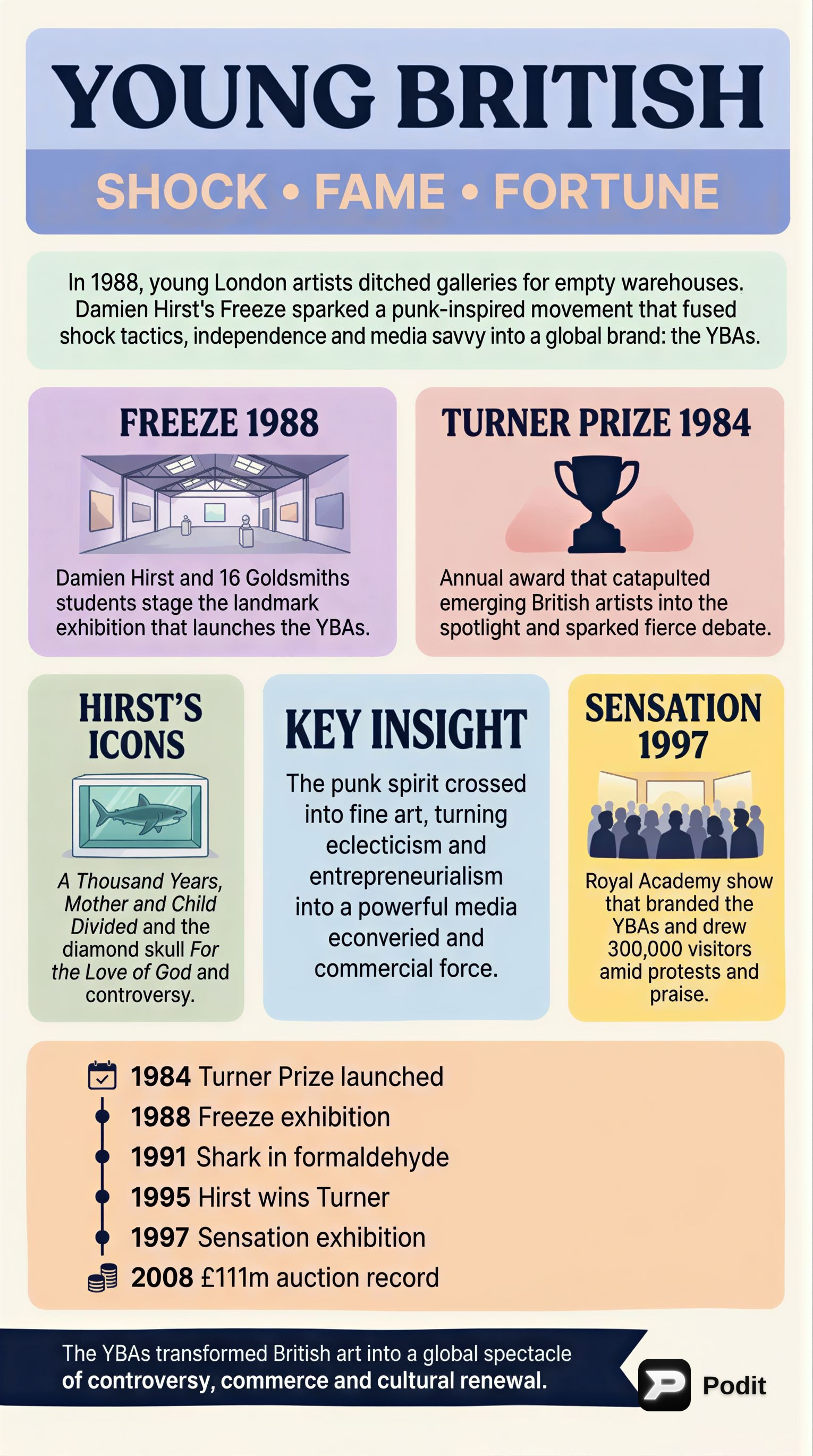
- Emergence (1988): The movement began with Damien Hirst's "Freeze" exhibition in a London Docklands warehouse, showcasing work by Goldsmiths Art College students.
- Characteristics: YBAs were known for:
- ✅ Exhibiting independently in unconventional spaces.
- ✅ Attracting significant media attention.
- ✅ Embracing eclecticism, shock tactics, independence, and entrepreneurialism.
- Key Figures: Damien Hirst, Gary Hume, Michael Landy, Sarah Lucas.
- Branding: The term "YBAs" was coined by Art Monthly magazine in 1996, effectively creating a label and a brand.
2. The Turner Prize
- Purpose: Introduced in 1984, it aimed to raise the profile of new artists by publicizing the work of four shortlisted candidates.
- Criticism: Faced complaints for:
- ⚠️ Focusing too heavily on contemporary London artists.
- ⚠️ Encouraging competitors to prioritize prize money and commercial sponsorship over traditional artistic concerns.
3. Prominent YBA Artists
a. Damien Hirst (b. 1965)
- Pioneering Role: Organized the first warehouse show, "Freeze," in 1988.
- Controversial Works:
- 📚 "A Hundred Years" (1990): Represents the life cycle with a dead cow's head, flies, maggots, and an insectocutor in vitrines. A larger version, "A Thousand Years," gained huge publicity.
- 📚 "The Physical Impossibility of Death in the Mind of Somebody Living" (1991): A 14-foot shark suspended in formaldehyde, symbolizing fear, death, and the unknown.
- 📚 "Mother and Child Divided" (1993): A bisected cow and calf displayed in separate tanks, for which he won the Turner Prize in 1995.
- 📚 "Pharmacy" (1998): An installation of shelves with packets of tablets and medicines, exploring themes of death and its postponement in humans.
- Other Styles: Known for "dot" paintings (resembling pills) and "spin" paintings (paint thrown onto revolving canvases).
- Later Works: "For the Love of God" (2007), a platinum skull adorned with 8,601 diamonds, priced at £50 million. His 2008 auction, "Beautiful Inside My Head Forever," raised £111 million.
- Impact: Became one of the wealthiest and best-known contemporary artists, admired (if not always understood) by a wide audience.
b. Tracey Emin (b. 1963)
- Confessional Art: Uses intimate topics from her childhood and adolescence.
- Key Works:
- 📚 "Everyone I've Ever Slept With 1963–1995" (1995): A tent with names of people she had slept with sewn inside.
- 📚 "My Bed" (1998): An unmade bed surrounded by personal items like empty vodka bottles and soiled underwear, representing a period of depression. It was later bought by Charles Saatchi.
- Style: Raw, confessional storytelling, mixing the sexual and abject with humor and melancholy.
c. Banksy
- Anonymous Street Artist: Known for satirical street art with a sharp sense of humor and social commentary.
- Themes: Often anti-war, anti-capitalist, or anti-establishment, featuring rats, apes, and soldiers.
- Example: In 2005, he placed a cave painting depicting a human hunting with a shopping trolley in the British Museum.
4. "BritArt" and Commercialization
- "Sensation" Exhibition (1997): Captured public imagination, emphasizing emotion over intellect.
- Diversity: Works were highly varied in content and style, often contemplating life, death, and the body, using diverse media (film, video, sculpture, everyday objects).
- Controversy: Exhibits like Marcus Harvey's portrait of Myra Hindley (made with child's handprints) were attacked, sparking debates on artistic criteria and exploitation of "bad taste."
- Democratization: Art became more accessible, breaking down barriers between "high" and "low" art.
- Commercial Exploitation: Investors like Charles Saatchi capitalized on the controversy, leading to accusations of manipulating the art market.
- Challenges: The art scene remained London-centric, and public taste often stayed conservative, preferring traditional forms.
🏛️ Evolution of British Architecture
British architecture underwent several transformative periods, adapting to post-war needs, economic shifts, and changing aesthetic preferences.
1. Post-War Modernism (1950s-1960s)
- Reconstruction: Following WWII, a plan to rebuild Britain focused on public sector buildings and social housing.
- Festival of Britain (1951): Showcased futuristic designs, reflecting a socialist vision for an egalitarian society.
- Public Housing: Large-scale provision of "council housing," with tall, imposing modernist apartment blocks (e.g., Alton Estate, Red Road).
- Criticism: Despite initial optimism, these buildings often suffered from poor construction, lack of atmosphere, and maintenance issues.
2. New Brutalism
- Style: A variation of modernism, attributed to Peter and Alison Smithson, characterized by rough, unfinished concrete surfaces.
- Example: The South Bank arts complex in London (Hayward Art Gallery, National Theatre).
- Public Reception: Often unpopular due to their cold, serious appearance and lack of clear entrances, though they gained fans among subcultures like skateboarders.
3. The 1980s: Thatcherism and Postmodernism
- Shift to Private Sector: Public spending cuts led to private sector dominance in architecture.
- American Influence: New styles, particularly "high-tech postmodern," emerged, featuring glass, steel, aluminum, chrome, and exposed structural elements.
- Examples: 1 Finsbury Avenue, London's financial district, and the Docklands redevelopment (Canary Wharf).
- Architecture as "Logo": Buildings became symbols of corporate power and regional identity.
4. Conservation Movement
- Growth: Increased interest in restoring and preserving older buildings.
- Key Organizations: National Trust (protects historic buildings and natural beauty) and English Heritage (government agency advising on conservation).
- Prince Charles's Influence: A vocal critic of modernist architecture, he advocated for community-based, neo-classical, and neo-vernacular styles (e.g., Poundbury).
5. Key Architects and Landmarks
- Richard Rogers (b. 1933):
- ✅ Known for "high-tech" designs.
- Notable Works: Centre Pompidou (Paris), Lloyd's building (London), Millennium Dome (O2 Arena).
- Controversy: Prince Charles famously called his proposed National Gallery extension "a monstrous carbuncle."
- Norman Foster (b. 1935):
- ✅ Pioneer of innovative, high-tech projects.
- Notable Works: Willis Faber building, Hong Kong and Shanghai Bank, 30 St Mary Axe ("The Gherkin"), Wembley Stadium, Millennium Bridge.
- Dame Zaha Hadid (1950-2016):
- ✅ Britain's best-known female architect, first woman to win the Pritzker Prize (2004).
- Notable Works: London Aquatics Centre (2012 Olympic Park), Guangzhou Opera House.
6. New Millennium Architecture
- Iconic Structures: London's skyline transformed with landmarks like The Shard (Renzo Piano), The London Eye, The Walkie-Talkie, and The Cheesegrater (Richard Rogers).
- Design Trends: While height remained important, designs became more restrained and subtle, focusing on functionality and efficiency, though sometimes criticized as bland.
- Conservation of Modernist Buildings: Public taste evolved, leading to the preservation and restoration of previously despised modernist structures (e.g., Trellick Tower, Park Hill estate).
🎶 British Popular Music and Youth Culture
British popular music has consistently reflected and shaped youth identity, social commentary, and fashion trends.
1. Post-War to Rock 'n' Roll (1940s-1950s)
- Post-War Comfort: Initially, "crooning" music offered comfort and romance.
- Rock 'n' Roll Arrival (mid-1950s): Bill Haley's "Rock Around the Clock" electrified British youth, sparking rebellion and the emergence of "Teddy Boys" with their distinctive fashion.
- Skiffle: An acoustic, DIY music style (Lonnie Donegan) gained popularity, fostering a musical revolution among young people.
2. The 1960s: Beatles, R&B, and Mods
- The Beatles: A global phenomenon, evolving from pop to experimental albums like "Sgt. Pepper's Lonely Hearts Club Band," elevating pop music's artistic credibility.
- British Rhythm and Blues (R&B):
- Pioneered by Alexis Korner and bands like The Rolling Stones.
- Characterized by a raw, energetic sound, influenced by black American music.
- The Rolling Stones, with Mick Jagger and Keith Richards, cultivated a wild image and produced hits like "(I Can't Get No) Satisfaction."
- Mods: A subculture known for minimalist fashion, scooters (Vespa, Lambretta), and a love for soul and ska music, contrasting with the "Rockers."
3. The 1970s: Prog, Heavy, and Glam Rock
- Progressive Rock ("Prog"): Bands like Pink Floyd created lengthy concept albums with extended solos and complex arrangements.
- Heavy Rock: Groups like Led Zeppelin and Deep Purple developed a guitar-based, distorted, and aggressive sound.
- Glam Rock:
- Led by Marc Bolan (T. Rex) and David Bowie (Ziggy Stardust).
- Introduced theatricality, gender-bending aesthetics (glitter, make-up, flamboyant costumes), and commercial appeal.
- Bowie's continuous reinvention influenced music, fashion, and gave confidence to LGBTQ+ fans.
4. Mid-1970s: Punk Rock
- Context: Social and economic unrest, youth frustration with existing music scenes.
- The Sex Pistols: Epitomized punk with their loud, primal, and hostile music ("Anarchy in the UK," "God Save the Queen").
- DIY Ethic: Challenged the establishment, fostering independent labels and a new wave of bands (The Clash, The Damned).
- Impact: Provocative fashion (bondage, safety pins, torn clothes) and defiant attitude shocked mainstream society, but also stimulated creativity and independence.
5. Post-Punk to New Romantics (Late 1970s-1980s)
- Post-Punk: Fusion of reggae and punk, notably in the Two Tone movement (The Specials, The Beat), promoting anti-racism and anti-Thatcher messages.
- New Romantics:
- Characterized by synthesizers, glamour, and hedonism (Visage, Boy George, Duran Duran).
- Explored gender-bending aesthetics and a detached entrepreneurialism.
6. Dance Music Revolution (Mid-1980s-1990s)
- Innovations: "Scratching" and "sampling" emerged, shifting power from traditional musicians to DJs.
- House & Acid House: Originated from 1970s disco-funk, evolving into high-energy (Hi-NRG) dance music.
- "Summer of Love" (1988): Ibiza parties and the rise of acid house, fueled by ecstasy, led to large-scale "raves" in the UK.
- Political Act: The Criminal Justice Act (1994) attempted to ban raves, turning dancing into a political act of protest against the government.
- Diversity: Emergence of sub-genres like techno, jungle, Goa trance, and bhangra (Asian dance music).
7. Britpop (1990s)
- Sound: Fused white British pop-rock with acid house influences, creating a distinctively English sound.
- Key Bands: Oasis, Blur, Pulp, Radiohead.
- "Cool Britannia": Celebrated Britishness, coinciding with new trends in fashion and a renewed interest in British popular culture.
- Criticism: Divided opinion, with some seeing it as a nostalgic reworking or a branch of the heritage industry.
💡 Conclusion
The period from the late 20th to the early 21st century in Britain was a crucible of cultural innovation. From the provocative art of the YBAs to the evolving skylines shaped by modernist and high-tech architecture, and the ever-changing soundscapes of popular music, Britain consistently pushed boundaries. These developments, often controversial and commercialized, fostered a dynamic interplay between creative expression, public reception, and societal evolution, leaving an indelible mark on the nation's cultural identity.