Podit
Podit
This study material has been compiled from a copy-pasted text and an audio transcript.
🇬🇧 British Media and Arts: A Comprehensive Study Guide
Introduction
This guide explores the dynamic evolution of British television, radio, art, architecture, and design from the mid-20th century to the present. It highlights the interplay between technological advancements, social changes, and artistic expressions, examining key institutions, movements, and influential figures that have shaped Britain's cultural landscape.
I. 📺 Evolution of British Broadcasting
1. From Niche to Mainstream: The Television Revolution
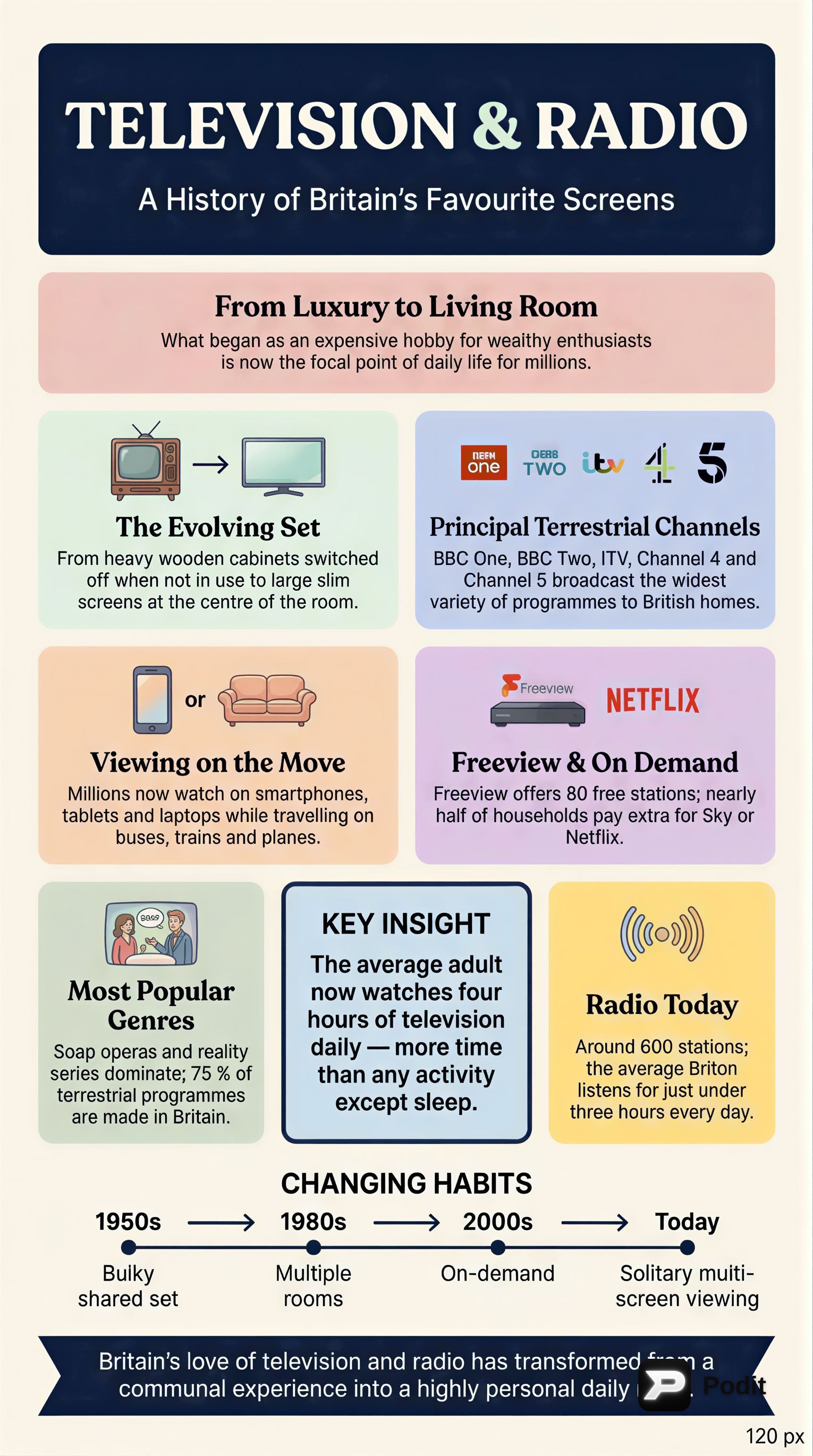
Television in Britain has transformed from an expensive, niche hobby into a central part of daily life. Early bulky sets have given way to slim, large screens, and viewing habits have shifted from communal experiences to individual consumption across various digital devices like smartphones and laptops.
- Key Terrestrial Channels: BBC One, BBC Two, ITV, Channel 4, and Channel 5.
- Digital Expansion: Services like Freeview (offering ~80 free TV stations), satellite, cable, and on-demand platforms (e.g., Netflix) have significantly expanded viewing choices.
- Popular Content: Terrestrial channels remain the most watched, with soap operas and factual/reality series holding the highest appeal. Foreign-language content is rare.
- British Production: Approximately 75% of terrestrial programs are British-made, and over 50% of global television formats originate in the UK, making TV production a successful export.
2. Changing Viewing Habits & Social Impact
The availability of programs 24/7 on diverse devices has increased consumption.
- Increased Viewing Time: The average British adult watches around four hours of TV daily.
- Solitary Pursuit: TV has become less of a shared experience and more individual, especially for younger demographics. This has led to concerns about a "bedroom culture," with many children and young adults having TVs in their rooms and using multiple screens simultaneously.
3. 📻 Radio's Enduring Popularity
Radio remains a popular source of news and entertainment, with around 600 stations in Great Britain.
- BBC Dominance: The BBC is the most prominent broadcaster, offering ten national radio channels and about 40 regional services (some in local languages like Welsh or Scottish Gaelic).
- BBC World Service: Provides news and cultural content in 28 languages globally.
- Commercial Radio: Well-established with three national services (talkSPORT, Absolute Radio, Classic FM) and hundreds of regional stations, funded by advertisements.
4. Regulation and Funding: Ofcom & The BBC Model
Broadcasting content is strictly regulated by Ofcom 📚, an independent government organization.
- Ofcom's Role: Enforces codes of practice on violence, taste, and decency (especially before 9 p.m.), prohibits tobacco and political advertising, and licenses independent services.
- The BBC (British Broadcasting Corporation):
- Establishment: Created by Royal Charter in 1927, based in London with studios nationwide.
- Funding: Funded by an annual TV licence fee 💡, which every household watching or recording live TV must pay. This ensures political and commercial independence.
- Ethos: Operates under a public service ethos, aiming to educate, inform, and entertain without commercial advertisements (except for its own programs). This allows for objective, high-quality, and diverse programming, including exploration of minority issues.
- Controversies: The licence fee model faces scrutiny, especially from younger generations accustomed to free content, and has been subject to scandals regarding presenter fees and employee conduct.
- Commercial Broadcasters: ITV, Channel 4, and Channel 5 rely on advertising revenue and strive to emulate the BBC's high standards.
5. Historical Milestones in Broadcasting
- Formative Years (Pre-1950s): Radio was the senior service, with the BBC emphasizing public service.
- 1950s: First TV pictures broadcast in 1936. ITV launched in 1955, introducing commercial breaks and populist programming, challenging the BBC.
- 1955-1970: Social Realism & Satire:
- Social Realism: Focused on marginalized groups and sensitive social issues (e.g., 'Panorama,' 'Coronation Street').
- Political Satire: 'That Was the Week That Was' (1962-63) critically engaged with the establishment.
- Youth Culture: Pirate radio (e.g., Radio Caroline) catered to youth music, leading the BBC to launch Radio 1 and 'Top of the Pops.'
- Fantasy Dramas: 'Doctor Who' (1963) and Gerry Anderson's puppet series gained popularity.
- 1970s: Conflict & Consumerism: Reflected a liberalizing, multicultural society facing economic challenges. Sitcoms ('Dad's Army,' 'Fawlty Towers') and controversial dramas ('Till Death Us Do Part') captured the public mood.
- 1980s: Thatcherism & Realism: Influenced by Thatcherism, saw a return to tradition alongside critical dramas reflecting unemployment ('Boys from the Blackstuff'). New socially engaged soaps ('Brookside,' 'EastEnders') and political satire ('Spitting Image') emerged.
- 1990s: Competition & Commerce: Broadcasting Act of 1991 increased competition. Channel 5 launched, and digital TV expanded choices. Satellite broadcasters (e.g., BSkyB) gained influence, particularly in sports rights.
- 2000s-Present: Reality Rules: Further channel expansion and the rise of "factual entertainment" or "reality TV" ('Big Brother') became immensely popular despite controversies over quality. New formats in drama and comedy continued to innovate.
6. Future of Broadcasting
The industry faces challenges from globalization, on-demand services, and the public's wariness of data collection. The BBC's funding model is under constant review.
II. 🎨 British Art Movements & Influential Figures
1. Art Institutions & Support
London is a central hub for British art, housing major institutions like the National Gallery, Tate Modern, and the Royal Academy. Arts Councils across the UK provide funding and support for visual arts, including for young artists.
2. Post-War Art (1950s)
- American Influence: British artists were influenced by American avant-garde movements, leading to abstract art.
- St Ives School: A community of artists in Cornwall known for abstract landscapes using muted tones.
- Kitchen Sink School: A realist style closely associated with social realism in other arts, depicting familiar, domestic environments and ordinary people (e.g., John Bratby).
3. Key Artists: Francis Bacon & Lucian Freud
These two artists made highly significant, original contributions to British art, known for their intense representations of the human figure.
- Francis Bacon (1909-1992): Known for disturbing works depicting menace, hysteria, and inner torment. His art often featured blurred, deformed figures and chaotic scenes, achieving record auction prices.
- Lucian Freud (1922-2011): Celebrated for realist portraits and figure paintings, capturing the psychological depth of his subjects with a severe, unforgiving style. His subjects were often people from his life.
4. Pop Art & David Hockney
- British Pop Art: Influenced by American popular culture, it embraced popular, transient, and mass-produced imagery from advertising and mass media. Richard Hamilton's 'Just what is it that makes today’s homes so different, so appealing?' (1956) is a landmark work.
- David Hockney (b. 1937): A versatile artist known for exploring various styles, from early etchings to naturalistic California scenes (e.g., 'A Bigger Splash,' 1967) and innovative photographic collages. He is one of Britain's most widely recognized artists.
5. 🗿 Sculpture
- Henry Moore (1898-1986): Dominant in the 1930s-40s, known for organic, nature-inspired forms with rounded hollows and smooth surfaces.
- Geometry of Fear: Post-1945 movement reflecting war anxieties with tormented, angular, distorted shapes (e.g., Reg Butler, Lynne Chadwick).
- Anthony Caro (1924-2013): Introduced abstract steel sculptures, often painted in bright colors, emphasizing that sculpture could be made from anything.
- Anish Kapoor (b. 1954): Creates elegant, complex public works, often suggesting aspects of the human form (e.g., 'Sky Mirror,' 'Void Field').
- Rachel Whiteread (b. 1963): Known for nostalgic casts of spaces and interiors, including 'Ghost' (a cast of a living room interior) and her contribution to the Fourth Plinth in Trafalgar Square.
- Gilbert and George (b. 1942, b. 1943): Known as "living sculptures," they challenged conventions with performance art, evolving from comical to darker, provocative themes.
6. Conceptual Art & Controversies (1970s)
The 1970s saw a fragmentation of styles and the rise of conceptual art, which often proved controversial.
- Public Outrage: Carl Andre's 'Equivalent VIII' (a stack of bricks) at the Tate Gallery sparked public and media ridicule, symbolizing what many considered the absurdity of modern art.
- Punk Influence: COUM Transmissions' 'Prostitution' exhibition (1976) incorporated punk aesthetics, leading to public shock and parliamentary questions.
7. Young British Artists (YBAs) & Contemporary Art
- Emergence (Late 1980s): A new wave of artists, including Damien Hirst, Tracey Emin, and Sarah Lucas, began exhibiting in unconventional spaces like warehouses.
- Turner Prize: Introduced in 1984, it significantly raised the profile of new artists, though it often sparked controversy.
- Damien Hirst (b. 1965): One of the most famous and controversial YBAs, known for works exploring life and death (e.g., a shark in formaldehyde, 'The Physical Impossibility of Death in the Mind of Somebody Living'; the diamond-adorned skull, 'For the Love of God'). His work achieved immense commercial success.
- Tracey Emin (b. 1963): Known for confessional art using intimate topics from her life (e.g., 'My Bed,' 'Everyone I’ve Ever Slept With').
- Public Art: Antony Gormley's metal sculptures ('Angel of the North') and Banksy's anonymous, satirical street art continue to engage the public.
8. Art and Commerce
British art has become more democratized, integrating into urban popular culture, but also more commercialized.
- Funding Shift: Withdrawal of government subsidies led artists and galleries to seek corporate sponsorship and private funding.
- Market Influence: Figures like Charles Saatchi have significantly influenced the art market, though sometimes controversially.
- Challenges: The art scene remains highly centralized in London, and artists from diverse backgrounds still face challenges in gaining recognition. Public taste often remains conservative.
III. 🏛️ British Architecture & Design
1. Post-War Modernism & Reconstruction
Following WWII, Britain embarked on extensive rebuilding, prioritizing public needs.
- Festival of Britain (1951): Showcased futuristic designs and new materials (nylon, plastic), reflecting a hopeful vision for a classless, egalitarian society.
- Modernist Principles: Young architects designed buildings based on "form follows function," creating light, airy, functional, and sleek structures without superficial decoration.
- Public Housing: Tall, imposing modernist apartment blocks were rapidly erected to address housing shortages, aiming to improve social conditions.
2. Design Evolution
- Consumer Objects: Design became crucial for popular consumer items like TVs and record players.
- Iconic Designs: The Mini car (1959) symbolized modernity and classlessness with its minimal, functional design.
3. Criticisms & New Brutalism
- Public Discontent: Modernist apartment blocks often faced criticism for lack of atmosphere, poor material quality, and maintenance issues.
- New Brutalism: A variation of modernism (Peter and Alison Smithson) emphasized raw, unfinished concrete surfaces, conveying solidity but often lacking visual appeal.
4. Conservation Efforts
Public opinion often favors traditional aesthetics, leading to a strong conservation movement.
- National Trust (NT): A charity founded in 1895 to protect historic buildings and natural beauty.
- English Heritage: A government agency advising on conservation and "listing" (protecting) around 450,000 buildings and monuments.
- RIBA: The Royal Institute of British Architects recognizes excellence through awards like the Stirling Prize.
Conclusion
British media and arts have undergone profound transformations, reflecting and shaping societal changes. The tension between public service and commercial interests in broadcasting, and between tradition and innovation in art and architecture, has been a constant driving force. These sectors continue to evolve, maintaining significant cultural importance and a notable global impact. ✅