Podit
Podit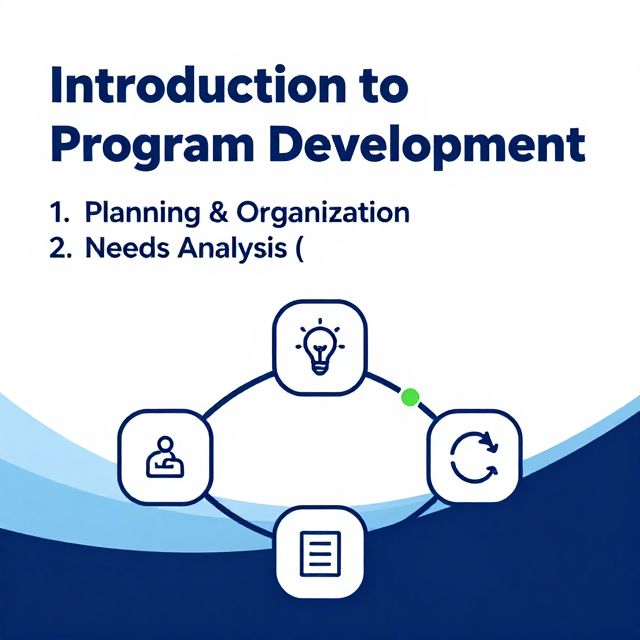
This study material is compiled from a lecture audio transcript titled "Introduction to Program Development" and a copy-pasted visual/textual slide outlining the stages of program development.
📚 Systematic Program Development: A Comprehensive Guide
Developing effective educational programs requires a structured and systematic approach. This guide outlines the five critical stages involved in creating, implementing, and refining learning initiatives, ensuring they are relevant, impactful, and achieve their intended outcomes.
1️⃣ Planning and Organization: Laying the Foundation
The initial phase of program development focuses on meticulous planning and establishing a clear organizational framework. This stage is crucial for identifying the core purpose and direction of the program.
1.1. Needs Analysis 💡
The cornerstone of effective program development is a thorough Needs Analysis. This multi-faceted investigation identifies specific requirements, gaps, and challenges that the program aims to address. It involves examining various dimensions:
- Individual: Understanding the target learners' profiles, prior knowledge, learning styles, motivations, and specific needs.
- Example: For a professional development program, analyzing the skill gaps of employees in a particular department.
- Society: Considering broader societal demands, cultural contexts, ethical implications, and the program's contribution to community development or national goals.
- Example: Assessing the need for digital literacy programs in underserved communities.
- Subject: Delving into the core content, disciplinary knowledge, essential concepts, and skills that must be covered.
- Example: Identifying the fundamental principles of sustainable engineering for a new curriculum.
- Field: Analyzing trends, best practices, future directions, and existing programs within the specific educational or professional domain.
- Example: Researching emerging technologies in artificial intelligence to inform a computer science master's program.
1.2. Candidate Aims and Objectives ✅
Based on the insights from the needs analysis, Candidate Aims and Objectives are formulated. These are preliminary, broad statements of what the program intends to achieve, guiding subsequent design decisions.
1.3. Program Development Working Groups 👥
Effective organization often involves establishing Program Development Working Groups. These teams, comprising subject matter experts, instructional designers, and stakeholders, collaborate to steer the development process.
2️⃣ Program Design Preparation: Crafting the Learning Experience
This stage translates the identified needs and preliminary objectives into a detailed blueprint for the educational program. It integrates theoretical foundations with practical instructional strategies.
2.1. Theoretical Underpinnings 🧠
Program design is informed by critical educational disciplines that provide a robust framework:
- Educational Philosophy: Provides the overarching vision, values, and beliefs about education that will shape the program's purpose and approach.
- Example: A program rooted in progressivism might emphasize experiential learning and problem-solving.
- Educational Sociology: Ensures the program is culturally responsive, addresses social inequalities, and considers the societal impact of learning.
- Example: Designing content that reflects diverse perspectives and promotes inclusive learning environments.
- Educational Economics: Guides resource allocation, cost-effectiveness, and the economic viability and return on investment of the program.
- Example: Balancing the use of expensive lab equipment with virtual simulations to optimize budget.
- Educational Psychology: Informs instructional strategies by considering how individuals learn, including cognitive processes, motivation, and development.
- Example: Incorporating spaced repetition and retrieval practice based on memory research.
2.2. Aims and Objectives to be Achieved ✅
The candidate aims are refined into specific, measurable, achievable, relevant, and time-bound (SMART) Aims and Objectives to be Achieved. These clearly define what learners will know and be able to do upon program completion.
2.3. Content Creation 📝
This involves selecting, sequencing, and structuring the knowledge, skills, and attitudes that will be taught. Content must be relevant to the objectives and appropriate for the target audience.
2.4. Educational Situations: Designing Learning Experiences 🛠️
This crucial component defines the actual learning environment and activities:
- Learning Teaching Models: The pedagogical approaches used (e.g., direct instruction, inquiry-based learning, collaborative learning).
- Learning Teaching Strategies: Specific techniques employed within models (e.g., lectures, discussions, case studies, simulations).
- Learning Styles: Considering diverse learner preferences (e.g., visual, auditory, kinesthetic) to offer varied instructional methods.
- Learning Experiences: The actual activities and interactions learners engage in to acquire knowledge and skills.
- Example: For a language course, incorporating role-playing, authentic conversations, and cultural immersion activities.
- Tools and Materials: The resources used to facilitate learning (e.g., textbooks, software, lab equipment, online platforms).
- Environment Preparation: Creating a conducive physical or virtual learning space that supports the chosen strategies and experiences.
2.5. Feedback 🔄
Integrating mechanisms for continuous Feedback throughout the design process allows for iterative refinement and improvement before full implementation.
3️⃣ Program Piloting: Testing the Waters
Once the program is designed, the next step is Program Piloting (or Program Trial). This involves implementing the program on a small scale with a representative group of learners.
- Purpose: To test the program's feasibility, identify practical challenges, gather initial feedback, and assess the effectiveness of instructional materials and strategies in a controlled environment.
- Outcome: Provides valuable data for making necessary adjustments and improvements before a wider rollout.
4️⃣ Program Evaluation: Assessing Effectiveness
Program Evaluation is a systematic process of assessing whether the program achieved its stated aims and objectives. It determines the program's overall success and impact.
- Methodology: Involves collecting and analyzing data on learner performance, satisfaction, and program outcomes.
- Decision Point: A common practice is to set a success threshold. For instance, if a program achieves 70% or more of its objectives, it is deemed successful (✅ Yes). If it falls short, it indicates a need for significant revision (⚠️ No), prompting a return to earlier design or planning stages.
- Example: Evaluating if 70% of participants in a coding bootcamp achieved certification.
5️⃣ Dissemination: Sharing the Success
The final stage, assuming a successful evaluation, is Dissemination. This involves making the refined and validated program widely available to its target audience.
- Goal: To ensure the program's broader implementation, maximize its reach, and achieve its intended impact on a larger scale.
- Activities: May include marketing, training facilitators, providing support materials, and integrating the program into existing structures.
This systematic approach, moving from meticulous planning and design through piloting and evaluation to widespread dissemination, ensures the development of robust, effective, and impactful educational programs.