 Podit
Podit
This content is based on a YouTube video.
📚 Introduction to Geography: KPSS-AGS Fundamentals
This study material provides a comprehensive overview of introductory geography, specifically tailored for the Public Personnel Selection Examination (KPSS) - Ministry of National Education (MEB) 'Alan Bilgisi Sınavı' (AGS) for the 2026 examination cycle. It draws upon the teachings of Bayram Meral, a recognized educator in this field. This module is foundational for prospective geography teachers, establishing core geographical principles, methodologies, and concepts essential for both exam success and effective teaching.
1️⃣ Understanding Geography as a Discipline
Geography is an academic discipline dedicated to the study of Earth's diverse landscapes, populations, places, and environments. Its primary goal is to comprehend the spatial distribution of phenomena and the complex interplay between human societies and their natural surroundings.
1.1 🌍 Core Branches of Geography
The discipline is broadly divided into two main branches:
-
Physical Geography: Focuses on the natural processes and features of the Earth.
- ✅ Geomorphology: The study of landforms and the processes that create them.
- ✅ Climatology: Examines atmospheric conditions and climate patterns.
- ✅ Hydrology: Investigates the distribution and movement of water on Earth.
- ✅ Biogeography: Analyzes the distribution of life forms (plants and animals) across different regions.
-
Human Geography: Explores the spatial organization and distribution of human activities.
- ✅ Population Geography: Studies the distribution, density, and changes in human populations.
- ✅ Economic Geography: Focuses on the spatial distribution of economic activities and resources.
- ✅ Political Geography: Examines the spatial implications of political processes and boundaries.
- ✅ Urban Geography: Studies cities as spatial entities and the processes of urbanization.
1.2 💡 Key Geographical Principles
Underpinning all geographical studies are several fundamental principles:
- Distribution: How phenomena are spread across space.
- Example: The global distribution of rainforests or major cities.
- Causality: Investigating the causes and effects of geographical patterns.
- Example: How tectonic plate movements cause earthquakes and volcanic activity.
- Correlation: Identifying relationships between different geographical elements.
- Example: The correlation between high rainfall and dense vegetation.
- Change: Recognizing the dynamic nature of geographical systems over time.
- Example: Changes in sea levels or urban sprawl over decades.
2️⃣ Essential Tools and Fundamental Concepts
Modern geography relies on a variety of tools and foundational concepts to analyze and interpret spatial data.
2.1 📊 Geographical Tools and Methods
- Cartography: The art and science of map-making.
- Includes understanding various map projections (e.g., Mercator, Robinson), scales (e.g., 1:10,000), and thematic representations (e.g., population density maps).
- Remote Sensing: Acquiring information about an object or phenomenon without making physical contact, typically using satellites or aircraft.
- Geographic Information Systems (GIS): A system designed to capture, store, manipulate, analyze, manage, and present all types of geographical data. GIS is crucial for data acquisition, analysis, and visualization.
2.2 🧭 Fundamental Spatial Concepts
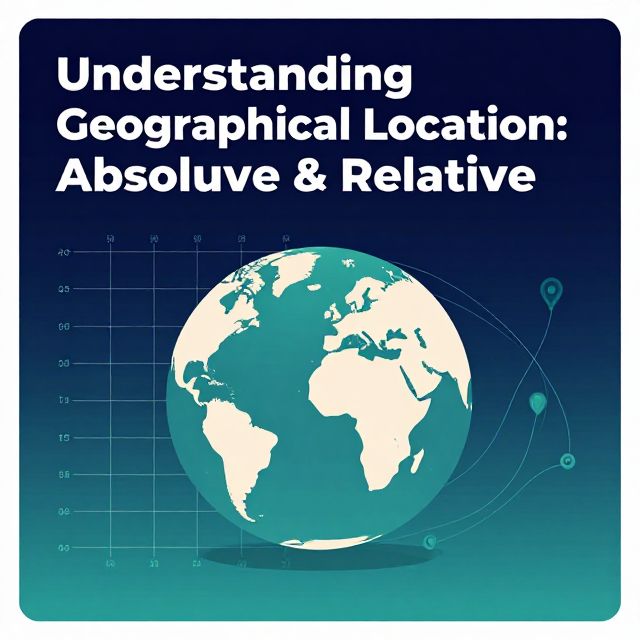
- Absolute Location: A precise point on Earth's surface, often expressed using coordinates.
- Example: 41°N latitude, 29°E longitude for Istanbul.
- Relative Location: Describing a place in relation to other places.
- Example: Turkey is located at the crossroads of Europe and Asia, bordered by the Black Sea to the north.
- Latitude and Longitude: A global grid system used to define absolute locations.
- Latitude: Measures distance north or south of the Equator.
- Longitude: Measures distance east or west of the Prime Meridian.
- Global Time Zones: Divisions of the Earth's surface that use a uniform standard time, based on longitude.
- Earth's Movements and Their Effects:
- Rotation: The Earth spinning on its axis.
- Effect: Causes the cycle of day and night.
- Revolution: The Earth orbiting the Sun.
- Effect: Leads to seasonal variations throughout the year.
- Rotation: The Earth spinning on its axis.
3️⃣ Significance of Geography in Turkish Education
The study of geography holds paramount importance within the Turkish national curriculum, as mandated by the Ministry of National Education (MEB).
3.1 🎯 Educational Role and Interdisciplinary Nature
- Geography is not merely descriptive; it is an analytical science that cultivates critical thinking skills.
- It helps students understand environmental issues, resource management, cultural diversity, and geopolitical dynamics.
- Its inherent interdisciplinary nature connects it with subjects like history, economics, sociology, and environmental sciences, offering a holistic perspective on global and local challenges.
3.2 🧑🏫 Importance for KPSS-AGS Candidates
For prospective teachers preparing for the KPSS-AGS examination:
- Prerequisite for Success: A deep understanding of 'Introduction to Geography' is essential for success in the subject-specific test.
- Foundation for Advanced Topics: It forms the bedrock for comprehending more advanced geographical concepts.
- Assessing Subject Matter Knowledge: The AGS component specifically evaluates the depth of a prospective teacher's knowledge, ensuring educators are well-equipped.
- Developing Pedagogical Approaches: Mastery of these foundational elements enables future teachers to develop robust teaching methods, fostering student engagement and comprehension.
- Skill Development: Teachers learn to explain spatial relationships, analyze geographical data, and interpret maps and other geographical representations.
- Contemporary Relevance: The curriculum often integrates current geographical issues, requiring teachers to possess a dynamic understanding of global and regional developments.
4️⃣ Conclusion: Mastering Foundational Geographical Knowledge
The 'Introduction to Geography' module, particularly within the KPSS-AGS framework for aspiring teachers in Turkey, is a critical academic endeavor. It demands a thorough grasp of the discipline's core principles, diverse branches, and fundamental methodologies. The comprehensive knowledge gained from this foundational study is indispensable for:
- ✅ Achieving success in the rigorous subject-specific examination.
- ✅ Delivering effective and impactful geography education.
- ✅ Imparting a robust and nuanced understanding of geographical phenomena.
- ✅ Fostering critical spatial awareness among students.
- ✅ Cultivating an appreciation for the intricate interconnections between human societies and the natural environment.
Mastery of these concepts, as emphasized by educational resources like those provided by Bayram Meral, is crucial for both professional advancement and the development of geographically literate citizens.