1. What is the main topic discussed in this content?
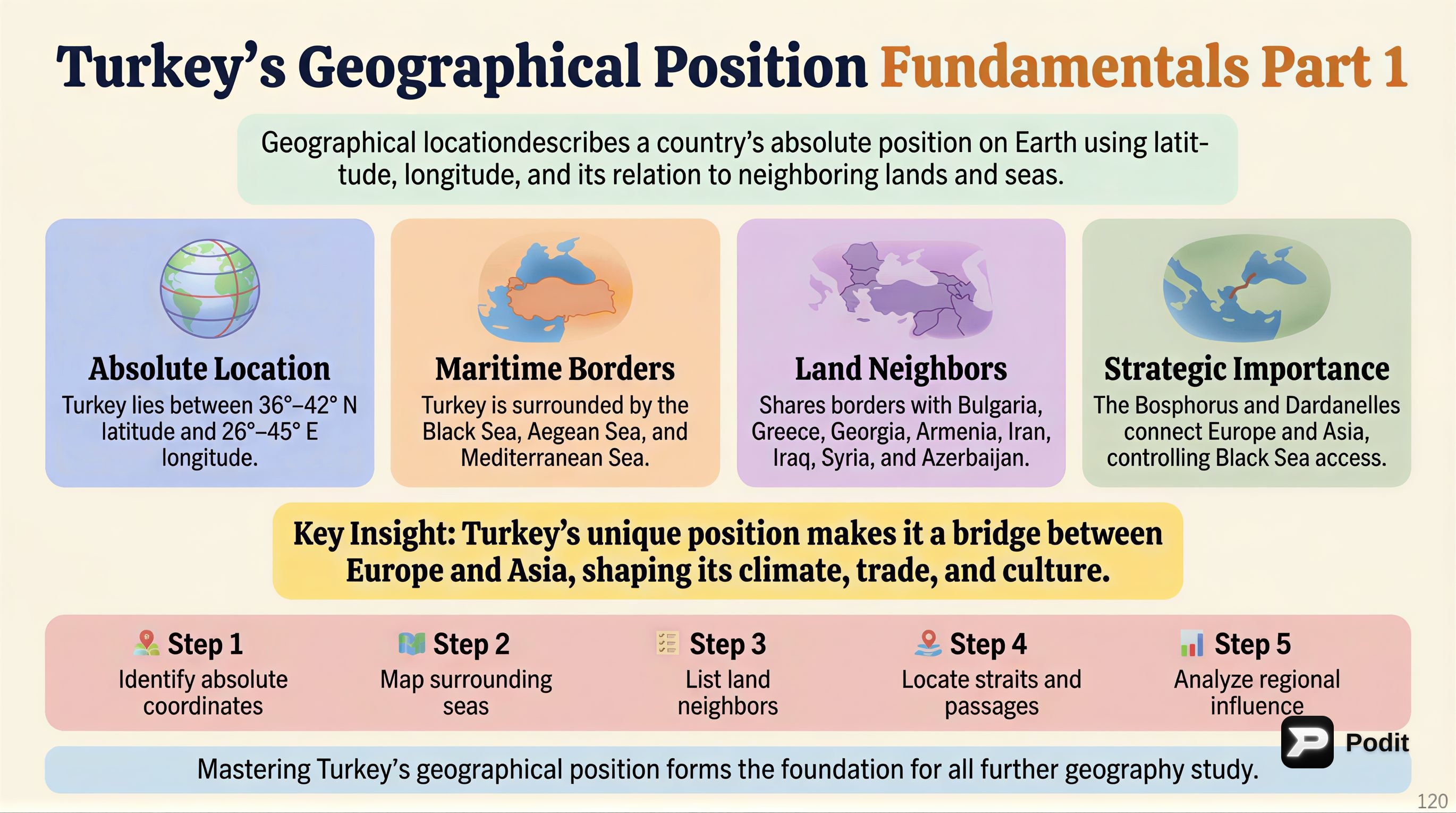
The main topic discussed is Geographical Location. It explores how places on Earth are defined, going beyond just a name on a map to understand their precise and contextual positions. This concept is fundamental to geography.
2. What are the two primary forms of geographical location?
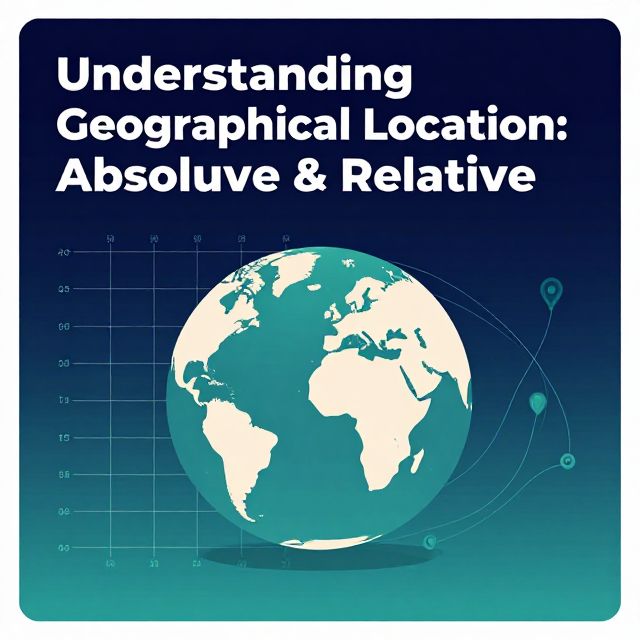
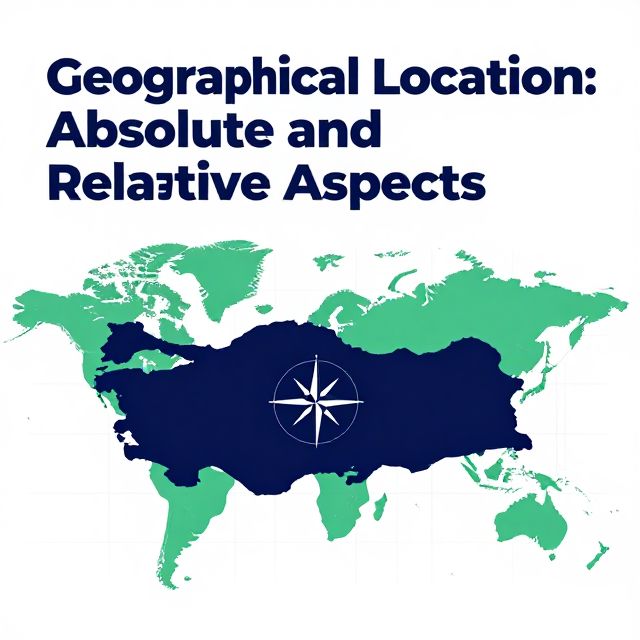
The two primary forms of geographical location are absolute location and relative location. Absolute location refers to a fixed, precise address, while relative location describes a place's position in relation to other features. Both are crucial for a complete geographical understanding.
3. Why is understanding geographical location crucial?
Understanding geographical location is crucial not only for academic success in exams like KPSS but also for making sense of our interconnected world. It helps us pinpoint exactly where we are, both precisely and contextually, and provides a fundamental building block for geographical analysis.
4. Define absolute location.
Absolute location is a place's unique, unchanging address on the planet. It is determined by a precise set of coordinates that never change, providing a fixed point on the Earth's surface irrespective of its surroundings. Think of it as a permanent address for any spot on Earth.
5. How is absolute location determined?
Absolute location is determined using the Earth's grid system, specifically lines of latitude and longitude. These coordinates provide a precise, unchanging set of numbers that pinpoint any given spot on the globe. This system ensures a universal method for identifying exact positions.
6. What is a key characteristic of absolute location regarding its changeability?
A key characteristic of absolute location is that it is unchanging and fixed. Once determined by coordinates, a place's absolute location remains constant, regardless of any changes in its surroundings or context. It represents a permanent address on the Earth's surface.
7. What system is used to find a fixed address on Earth?
The Earth's grid system, comprising lines of latitude and longitude, is used to find a fixed address on Earth. This system provides a precise set of coordinates that uniquely identify any point on the planet. It's a universal method for determining absolute location.
8. What does an absolute location like '40 degrees North, 30 degrees East' represent?
An absolute location like '40 degrees North, 30 degrees East' represents a fixed point on the Earth's surface. The numbers refer to specific lines of latitude and longitude, providing a precise and unchanging address for that particular spot. It tells you exactly where that place is, irrespective of its surroundings.
9. What are latitude lines also known as?
Latitude lines are also known as parallels. This name reflects their characteristic of running horizontally around the Earth, parallel to the Equator. They maintain a consistent distance from each other, forming a series of parallel circles.
10. How do latitude lines run around the Earth?
Latitude lines run horizontally around the Earth, parallel to the Equator. They form imaginary circles that are equidistant from each other, stretching from east to west. These lines help define positions north or south of the Equator.
11. What do latitude lines measure?
Latitude lines measure distance north or south of the Equator. The Equator is designated as 0 degrees latitude, and measurements extend up to 90 degrees North (North Pole) and 90 degrees South (South Pole). This measurement helps pinpoint a location's vertical position on the globe.
12. What is the 0 degrees latitude line called?
The 0 degrees latitude line is called the Equator. It is an imaginary line that circles the Earth midway between the North and South Poles, dividing the planet into the Northern and Southern Hemispheres. It serves as the reference point for all latitude measurements.
13. What is the significance of latitude lines in terms of climate?
Latitude lines are crucial because they help define climate zones. Locations closer to the Equator (lower latitudes) receive more direct sunlight throughout the year, leading to warmer climates. Conversely, areas at higher latitudes tend to be colder due to less direct solar radiation.
14. How does proximity to the Equator affect climate?
Proximity to the Equator significantly affects climate because locations closer to it receive more direct sunlight. This direct solar radiation results in higher average temperatures and generally warmer climates. As one moves further from the Equator, the sunlight becomes less direct, leading to cooler temperatures.
15. Are latitude lines parallel to each other?
Yes, latitude lines are parallel to each other. This is why they are also known as parallels. They never intersect and maintain a consistent distance from one another as they circle the Earth horizontally, parallel to the Equator.
16. What are longitude lines also known as?
Longitude lines are also known as meridians. This term refers to the imaginary lines that run vertically from the North Pole to the South Pole, forming great circles that converge at the poles. They are essential for measuring east-west positions.
17. How do longitude lines run on the Earth?
Longitude lines run vertically on the Earth, extending from the North Pole to the South Pole. Unlike latitude lines, they are not parallel but converge at the poles. These lines help measure distances east or west around the globe.
18. What do longitude lines measure?
Longitude lines measure distance east or west of the Prime Meridian. The Prime Meridian is designated as 0 degrees longitude, and measurements extend up to 180 degrees East and 180 degrees West. This measurement helps pinpoint a location's horizontal position on the globe.
19. What is the 0 degrees longitude line called?
The 0 degrees longitude line is called the Prime Meridian. It is an imaginary line that runs from the North Pole to the South Pole, serving as the reference point for all longitude measurements. It divides the Earth into the Eastern and Western Hemispheres.
20. Through which city does the Prime Meridian pass?
The Prime Meridian passes through Greenwich, England. This historical location was chosen as the international standard for 0 degrees longitude, making it a crucial reference point for global navigation and timekeeping. Its establishment was vital for standardizing maps and charts.
21. What is the significance of longitude lines?
Longitude lines are vital for determining time zones around the world. Because the Earth rotates, different longitudes experience sunrise and sunset at different times. By dividing the Earth into 15-degree segments of longitude, we can establish standard time zones globally.
22. How do longitude lines help determine time zones?
Longitude lines help determine time zones because the Earth rotates approximately 15 degrees per hour. By dividing the globe into 24 sections, each roughly 15 degrees of longitude wide, we can establish distinct time zones. This standardization allows for consistent timekeeping across different regions.
23. Define relative location.
Relative location describes a place's position in relation to other places or features. It's all about context, using landmarks, distances, or directions to describe where something is. Unlike absolute location, it is dynamic and can change over time as the surrounding environment evolves.
24. How does relative location describe a place's position?
Relative location describes a place's position by referencing its relationship to other known places or geographical features. It uses terms like 'north of the mountains,' 'on the coast,' or 'near the capital city' to provide context. This description is comparative and contextual.
25. What is a key characteristic of relative location regarding its changeability?
A key characteristic of relative location is that it is dynamic and can change over time. As human and physical landscapes evolve, a place's relationship to its surroundings can shift. For example, new infrastructure or political alliances can alter its relative importance or accessibility.
 Podit
Podit