Values and Moral Development in Education - kapak
Eğitim#values education#moral development#hidden curriculum#psychology

Values and Moral Development in Education

This podcast explores the hidden curriculum, the definition and importance of values and morality, their integration into educational programs, and key psychological theories of moral development.

cinepApril 17, 2026 ~16 dk toplam
01

Flash Kartlar

25 kart

Karta tıklayarak çevir. ← → ile gez, ⎵ ile çevir.

1 / 25
Tüm kartları metin olarak gör
  1. 1. What is the "hidden curriculum" in education?

    The hidden curriculum refers to the unstated norms, values, and beliefs that students learn in school, often unintentionally. It encompasses the informal lessons about attitudes, values, and social behaviors that are transmitted through the school environment, teacher interactions, and school culture. This learning goes beyond the formal academic subjects taught in classrooms.

  2. 2. Why is the question of whether values are required in education considered critical?

    The question of whether values are required in education is critical because education extends beyond mere academic instruction. It plays a significant role in shaping individuals' beliefs, attitudes, and moral compass. Integrating values ensures that students develop into well-rounded citizens who can contribute positively to society, rather than just acquiring knowledge.

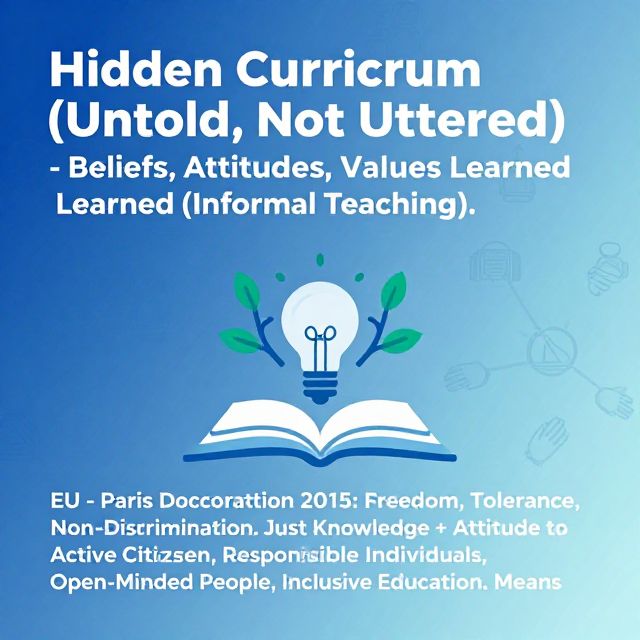
  3. 3. What was the main emphasis of the EU's Paris Declaration of 2015 regarding education?

    The EU's Paris Declaration of 2015 emphasized the importance of values like freedom, tolerance, non-discrimination, and justice, alongside knowledge and attitude, in education. Its primary aim was to foster active, responsible, and open-minded citizens. This declaration sought to promote inclusive education by combating racism and discrimination, and encouraging the acceptance of diverse beliefs and respect for diversity among students.

  4. 4. According to the text, what are values?

    Values are defined as fundamental beliefs, attitudes, and criteria that guide our decisions in both private and public life. While they can be relative to an individual, they often remain relatively permanent, forming the core of one's identity and personality. Values act as broad motivations, guiding principles for life decisions, and criteria for evaluating actions and situations.

  5. 5. How do values typically influence an individual's identity and personality?

    Values influence an individual's identity and personality by forming their core beliefs and attitudes. They serve as fundamental criteria that guide decisions and actions, shaping how a person perceives the world and interacts with it. Although they can be relative, values tend to be relatively permanent, contributing significantly to one's stable sense of self.

  6. 6. What is morality, and what is its role in society?

    Morality represents society's most important code of conduct, influencing actions and decisions. It is shaped by culture, religion, and education, providing a framework for acceptable behavior. Morality is essential for fostering positive cooperation and maintaining social harmony, as it establishes shared expectations and principles for individuals within a community.

  7. 7. Explain the key distinction between "temperament" and "character."

    Temperament is largely biological, instinctive, and genetic, influencing emotional responses and forming part of our personality from birth. In contrast, character is learned; it involves internalizing social values, concepts, and developing a system of perception and action. Character allows for personal adaptation to life and is shaped through education, culture, and social interactions, unlike innate temperament.

  8. 8. What is temperament primarily influenced by, according to the text?

    According to the text, temperament is primarily influenced by biological, instinctive, and genetic factors. It is largely an innate aspect of an individual, affecting their emotional responses and contributing to their personality from an early age. Temperament is considered a given part of one's psychological makeup rather than something acquired through learning.

  9. 9. How is character developed, as opposed to temperament?

    Character is developed through learning and the internalization of social values and concepts. It involves creating a system of perception and action that enables personal adaptation to life's challenges. Unlike temperament, which is largely biological, character is shaped by education, cultural influences, and social interactions, allowing individuals to consciously develop their moral and ethical framework.

  10. 10. What did Rokeach differentiate between regarding values?

    Rokeach differentiated between two types of values: terminal values and instrumental values. Terminal values are desired end-states of existence, representing the ultimate goals an individual strives for in life. Instrumental values, on the other hand, are preferred modes of behavior or means to achieve those terminal values, guiding how individuals act to reach their desired ends.

  11. 11. Define "terminal values" according to Rokeach's framework.

    According to Rokeach's framework, terminal values are desired end-states of existence. They represent the ultimate goals or aspirations that an individual strives to achieve in their life, such as happiness, security, or wisdom. These values are the fundamental objectives that people consider worth pursuing for their own sake.

  12. 12. Define "instrumental values" according to Rokeach's framework.

    Instrumental values, as defined by Rokeach, are preferred modes of behavior or means to achieve desired end-states. They are the characteristics or actions that individuals believe are necessary to attain their terminal values. Examples include honesty, ambition, or courage, which guide daily conduct and decision-making.

  13. 13. In what three main ways can values be integrated into educational programs?

    Values can be integrated into educational programs in three main ways: as stand-alone subjects (e.g., Citizenship, Human Rights), integrated into core subjects (e.g., Social Sciences, Literature), or through a cross-cultural/transversal approach. The transversal approach embeds values like empathy and peace across all subjects, using a learner-centered methodology.

  14. 14. Provide examples of values that are often integrated transversally across educational subjects.

    Values often integrated transversally across educational subjects include empathy, peace, democracy, and unity. This approach means these values are not confined to a single class but are woven into the fabric of various subjects. The goal is to foster a holistic understanding and application of these principles in students' learning and daily lives.

  15. 15. Which educational models are mentioned as adopting a holistic approach to developing consistent and virtuous individuals?

    Finland's education reform and Turkey's Maarif Model are mentioned as educational models that adopt a holistic approach. These models aim to develop consistent and virtuous individuals by integrating values across the curriculum and fostering a learner-centered methodology. Their objective is to shape well-rounded citizens who embody positive values.

  16. 16. How does Sigmund Freud's psychoanalytic theory explain the emergence of morality?

    Sigmund Freud's psychoanalytic theory suggests that morality emerges from the superego. The superego internalizes family values and societal norms through identification with parents and other authority figures. It acts as a moral conscience, balancing the id's primitive desires and the ego's reality principle, thereby guiding an individual's moral behavior.

  17. 17. What is the core principle of Albert Bandura's social learning theory regarding moral development?

    Albert Bandura's social learning theory emphasizes observational learning as the core principle of moral development. Individuals acquire moral behaviors by watching and imitating others, particularly role models. They also learn by observing the consequences of those behaviors, which reinforces or discourages certain actions, shaping their moral conduct.

  18. 18. What did Jean Piaget focus on in his studies of moral development?

    Jean Piaget focused on cognitive moral development, describing a progression from heteronomous morality to autonomous morality. He studied how children's understanding of rules and justice evolves with age. Piaget's work highlighted the shift from viewing rules as fixed and externally imposed to understanding them as flexible and based on fairness and intentions.

  19. 19. Describe "heteronomous morality" as defined by Piaget.

    Heteronomous morality, as defined by Piaget, is the initial stage of moral development where rules are seen as fixed, unchangeable, and absolute. Children in this stage believe that rules come from authority figures and must be strictly obeyed, regardless of the situation or intentions. They often focus on the consequences of actions rather than the underlying motives.

  20. 20. Describe "autonomous morality" as defined by Piaget.

    Autonomous morality, according to Piaget, is a more advanced stage of moral development where individuals understand rules as flexible agreements created by people. Morality in this stage is based on principles of fairness, cooperation, and mutual respect. Intentions behind actions become more important than just the outcomes, allowing for more nuanced moral judgments.

  21. 21. How did Lawrence Kohlberg expand on Piaget's work on moral development?

    Lawrence Kohlberg expanded on Piaget's work by proposing fixed, universal stages of moral reasoning. He suggested that individuals progress through these stages towards higher, principle-based judgments. Kohlberg often used moral dilemmas in classroom discussions to assess and stimulate this development, emphasizing the reasoning behind moral choices rather than just the choices themselves.

  22. 22. What role do classroom discussions of moral dilemmas play in Kohlberg's theory?

    In Kohlberg's theory, classroom discussions of moral dilemmas play a crucial role in stimulating moral reasoning and development. By engaging with complex ethical problems, individuals are encouraged to consider different perspectives and justify their moral judgments. This process helps them move towards higher, more principle-based stages of moral reasoning.

  23. 23. What are the broad motivations that values act as, according to the text?

    According to the text, values act as broad motivations, guiding principles for life decisions, and criteria for evaluating actions and situations. They provide a fundamental framework that influences an individual's choices and behaviors. These motivations help individuals navigate their private and public lives, ensuring consistency with their core beliefs.

  24. 24. How do values serve as criteria in an individual's life?

    Values serve as criteria by providing a standard against which individuals evaluate actions, situations, and decisions. They help determine what is considered right or wrong, good or bad, and desirable or undesirable. This evaluative function ensures that choices align with one's fundamental beliefs and principles, guiding behavior in a consistent manner.

  25. 25. What is the primary goal of fostering active, responsible, and open-minded citizens in education?

    The primary goal of fostering active, responsible, and open-minded citizens in education is to promote inclusive societies and combat issues like racism and discrimination. By instilling values such as freedom, tolerance, and justice, education aims to encourage the acceptance of diverse beliefs and respect for diversity. This prepares individuals to contribute positively to their communities.

02

Bilgini Test Et

15 soru

Çoktan seçmeli sorularla öğrendiklerini ölç. Cevap + açıklama.

Soru 1 / 15Skor: 0

What does the 'hidden curriculum' primarily encompass in education?

03

Detaylı Özet

6 dk okuma

Tüm konuyu derinlemesine, başlık başlık.

Understanding Values and Moral Development in Education

Source Information: This study material has been compiled from a lecture audio transcript and personal notes provided by the user.


📚 Introduction: The Hidden Curriculum and the Importance of Values

Education is a multifaceted process that extends beyond formal instruction. It includes a "hidden curriculum" where beliefs, attitudes, and values are often learned implicitly and unintentionally. The integration of values into educational systems is crucial for fostering well-rounded individuals and cohesive societies.

The European Union's Paris Declaration of 2015 underscored the necessity of values such as freedom, tolerance, non-discrimination, and justice in education. The goal is to cultivate active, responsible, and open-minded citizens who respect diversity and combat racism and discrimination.

💡 Defining Values and Morality

What are Values?

Values are fundamental beliefs and attitudes that serve as guiding principles for decisions in both private and public life. They act as criteria for evaluating actions, people, and situations. ✅ Key Characteristics of Values:

  • Guiding Principles: They direct behavior and choices.
  • Relative yet Permanent: While they can be individual, core values tend to be stable over time.
  • Core to Identity: They are central to an individual's personality and sense of self.
  • No Coercion: True values are internalized, not forced.
  • Socio-cultural Context: Values are often shaped by the environment.

What is Morality?

Morality represents society's most important code of conduct. It influences actions, decisions, and interactions, and is essential for positive cooperation and social harmony. ✅ Influences on Morality: Culture, religion, and education significantly shape an individual's moral compass. 📚 Durkheim's Elements of Morality:

  1. Spirit of Discipline: Adherence to rules and norms.
  2. Autonomy or Self-Determination: The ability to make independent moral judgments.

Temperament vs. Character

It's important to distinguish between these two concepts:

  • Temperament: 🧬 Largely biological, instinctive, and genetic. It influences emotional responses and is a foundational part of one's personality.
  • Character: 🧠 Learned and developed. It involves internalizing social values, concepts, and developing a system of perception and action that allows for personal adaptation to life.

Philosophical Perspectives on Values

Philosophers and psychologists have categorized values in various ways:

  • Munsterberg (1909): Proposed a psychological model where values exist within the self, categorizing them into Biological, Logical, Aesthetic, Ethical, and Metaphysical values.
  • Eduard Spranger (1922): Identified six dominant value types that characterize individuals:
    1. Theoretical: Seeking truth and knowledge.
    2. Economic: Focused on utility and practicality.
    3. Aesthetic: Appreciating beauty, form, and harmony.
    4. Social: Valuing love, kindness, and helping others.
    5. Political: Driven by power, influence, and control.
    6. Religious: Seeking unity, meaning, and spiritual understanding.
  • Milton Rokeach (1973): Distinguished between two forms of values:
    • Terminal Values: Desired end-states of existence (e.g., happiness, success, world peace).
    • Instrumental Values: Preferred modes of behavior for achieving terminal values (e.g., honesty, politeness, responsibility).
  • Shalom Schwartz (1992): Defined values as broad motivations that guide life decisions and serve as criteria for evaluating actions and situations, often linked to universal human needs for survival.

🏫 Integrating Values in Education

Values are incorporated into educational programs through several approaches:

  1. Stand-Alone Subjects: 📖 Dedicated courses like Citizenship Education, Human Rights Education, or Values Education (can be compulsory or optional).
  2. Integrated into Core Subjects: Values are woven into existing subjects such as Social Sciences, Literature, and Life Skills.
  3. Cross-Cultural/Transversal Approach: 🌍 Values like empathy, peace, democracy, and unity are embedded across all subjects, utilizing a learner-centered methodology.

Educational Models Emphasizing Values

  • Finland's Education Reform: Adopts a holistic approach, focusing on values, well-being, and standardized learning.
  • Turkey's Maarif Model: A recent holistic model aiming to develop consistent and virtuous individuals.
  • Turkey's Basic Law of Public Education: Emphasizes national and moral values, Atatürk's principles, love, family, respect for authority, rule of law, human rights, and personal development (physical, mental, spiritual, creative). It prepares individuals for life, professional careers, and contribution to society.

🧠 Theories of Moral Development

Understanding how individuals develop morality is key to effective values education.

1️⃣ Psychoanalytic Theory (Sigmund Freud)

Freud proposed that morality emerges from the superego, one of the three components of personality (alongside the id and ego).

  • Id: Driven by pleasure and instinctual desires.
  • Ego: Operates on the reality principle, balancing the id's demands with the superego's constraints.
  • Superego: The moral component, acting as a conscience. It internalizes parental and societal values through a process called identification, leading to a sense of right and wrong. A strict superego can lead to guilt and self-criticism.

2️⃣ Social Learning Theory (Albert Bandura)

Bandura emphasized that moral behavior is largely acquired through observational learning.

  • Modeling: Individuals learn by observing the behaviors of others (models) and the consequences of those behaviors.
  • Imitation: Children often imitate prosocial behaviors (e.g., kindness) they witness.
  • Reciprocal Determinism: Behavior is influenced by the interaction of personal factors (beliefs), behavior itself, and environmental factors.

3️⃣ Cognitive Developmental Theories (Jean Piaget & Lawrence Kohlberg)

These theories focus on how individuals' moral reasoning changes over time.

Jean Piaget's Stages of Moral Development:

Piaget identified two main stages:

  • Heteronomous Morality (Younger Children): 🧒
    • Rules are seen as fixed, unchangeable, and handed down by authority figures.
    • Focus is on the consequences of actions, not intentions.
    • Punishment is seen as automatic and deserved.
  • Autonomous Morality (Older Children/Adolescents): 🧑‍
    • Rules are understood as flexible agreements that can be changed.
    • Intentions behind actions are considered more important than consequences.
    • Fairness and cooperation become central.
    • Moral development occurs through interaction and thinking, not fixed stages.

Lawrence Kohlberg's Stages of Moral Reasoning:

Kohlberg expanded on Piaget's work, proposing six universal stages of moral development, often explored through moral dilemmas.

  • Progression: Individuals move from external, punishment-avoidance reasoning to internal, principle-based judgments.
  • Internalization: Morality becomes more internalized and mature, based on universal moral principles rather than external rewards or punishments.
  • Higher Reasoning: Classroom discussions of moral dilemmas can facilitate movement to higher stages of moral reasoning.

🌐 Cultural Context and Values

Culture plays a profound role in shaping values and norms.

  • Geert Hofstede's Cultural Dimensions: Provides a framework for comparing cultures and understanding how values differ across countries.
  • Culture as "Collective Programming of the Mind": Hofstede described culture as the collective programming that differentiates groups of people, fostering specific norms, rules, and expectations.
  • Culture-Value-Norm-Behavior Link: Culture shapes values, which in turn influence norms, ultimately affecting individual behavior. Norms reinforce what society deems important.
  • Dynamic Identity: Identity is not fixed; it changes and evolves. People often belong to multiple cultural groups, and cultures themselves are processual.

🤝 Role of Stakeholders in Values Education

Effective values education requires a collaborative effort from various partners:

  • Child: The primary recipient and active participant in value formation.
  • Family: 👨‍👩‍👧‍👦 The first and most influential environment for value transmission, providing core emotional and moral foundations.
  • School: 🏫 Provides a consistent and balanced environment, transmitting traditional values through curriculum (cognitive and affective domains), fostering positive and negative interactions, and adapting to technological changes and peer group influences. Schools also play a role in promoting awareness against stereotypes and prejudice, and fostering shared values in multicultural settings.
  • Media: 📺 Influences values, lifestyles, customs, and social norms. It's crucial to teach media literacy to help individuals critically evaluate media messages and their potential effects.
  • Community/Society: Provides the broader context for values, reinforcing norms and expectations.

Ultimately, values education is essential for maintaining social cohesion, ensuring communication and development, transferring value judgments to future generations, and organizing social relations for the continuity of society.

Kendi çalışma materyalini oluştur

PDF, YouTube videosu veya herhangi bir konuyu dakikalar içinde podcast, özet, flash kart ve quiz'e dönüştür. 1.000.000+ kullanıcı tercih ediyor.

Sıradaki Konular

Tümünü keşfet
Understanding Culture and Its Dynamics

Understanding Culture and Its Dynamics

Explore the definition of culture, its key components, and dynamic processes like assimilation, acculturation, culture shock, and cultural lag.

Özet 15
Comprehensive Program Development Process

Comprehensive Program Development Process

This podcast details the systematic five-step process of educational program development, from initial planning and needs analysis to design, piloting, evaluation, and dissemination.

Özet 15
Self-Motivation: Understanding What Drives Us

Self-Motivation: Understanding What Drives Us

Explore the fundamental concepts of motivation, its types, and influential theories, including Maslow's Hierarchy, Expectancy, and Goal Setting, to understand what propels goal-directed behavior.

5 dk Özet
Exploring Human Psychology: Development, Emotion, Motivation, Personality, and Health

Exploring Human Psychology: Development, Emotion, Motivation, Personality, and Health

This podcast offers an in-depth look into human development, the intricacies of emotion and motivation, various personality theories, social behavior, and the psychological aspects of health and stress management.

23 dk 25 15
Unlocking Your Mind: Theories of Psychotherapy

Unlocking Your Mind: Theories of Psychotherapy

Ever wondered how talking can heal? Explore the major theories of psychotherapy, from uncovering your past with psychodynamic therapy to growing your potential with humanistic and reshaping thoughts with CBT.

7 dk Özet 25 15
Understanding Consciousness, Sleep, Dreams, and Disorders

Understanding Consciousness, Sleep, Dreams, and Disorders

Explore consciousness, its various forms, the science of sleep and dreams, common sleep disorders, and the impact of alcohol on these vital processes.

25 dk Özet 25 15
Understanding Human Development, Learning, Memory, and Intelligence

Understanding Human Development, Learning, Memory, and Intelligence

This podcast provides a comprehensive educational overview of key psychological concepts: human development, learning processes, memory functions, and the multifaceted nature of intelligence, based on detailed scientific principles.

13 dk 25 10
Earth Systems and Resources Overview

Earth Systems and Resources Overview

An academic summary of Earth's physical systems, including plate tectonics, soil dynamics, atmospheric composition, global climate drivers, and oceanic phenomena like ENSO.

8 dk 15 Görsel