 Podit
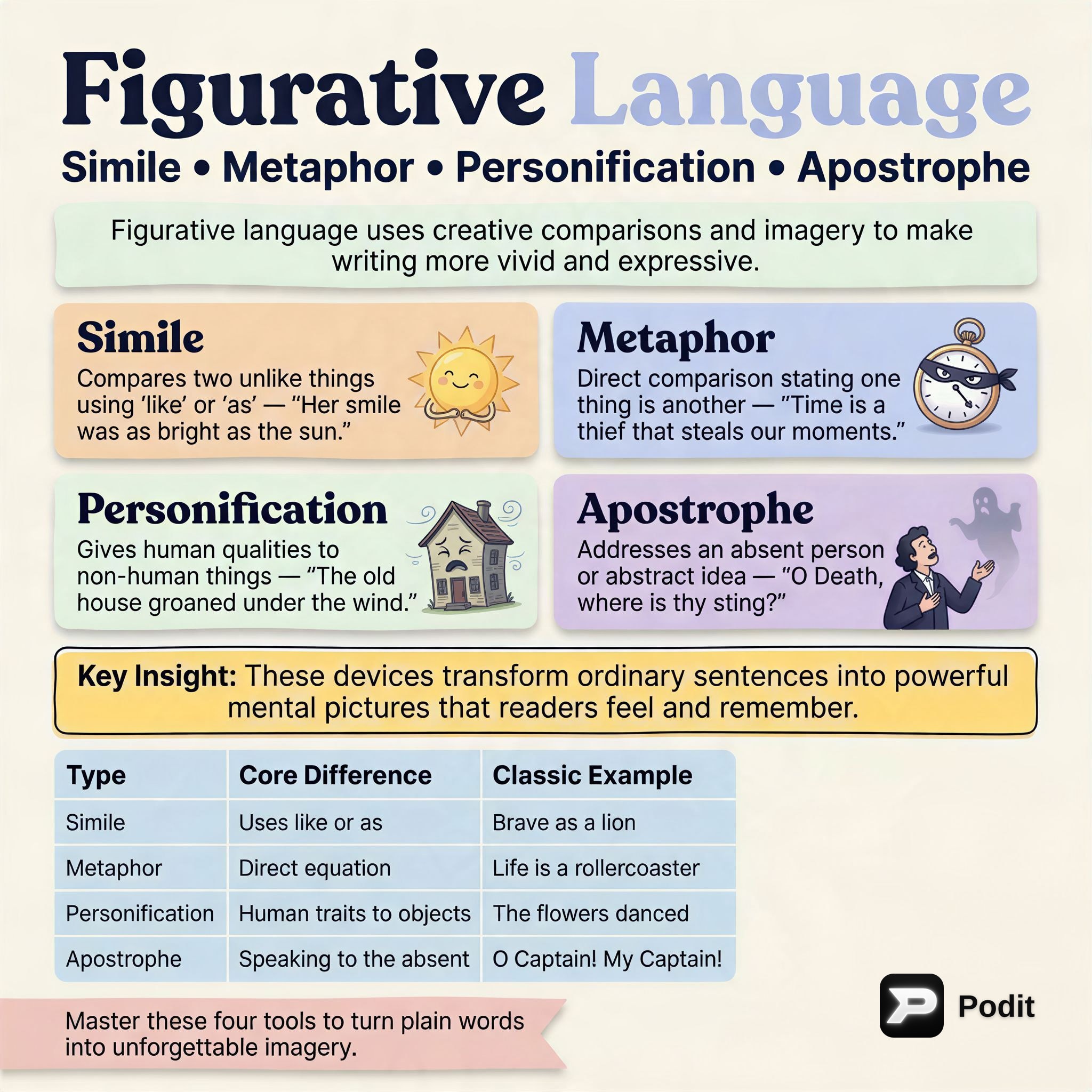
Study Material: Figurative Language – Simile, Metaphor, Personification, and Apostrophe
Source Information: This study material is compiled from a comprehensive understanding of literary devices and incorporates key concepts and examples discussed in a lecture audio transcript on figurative language.
Introduction: Unlocking the Power of Figurative Language 📚
Figurative language is a powerful literary tool that allows writers and speakers to go beyond the literal meaning of words, creating special effects, adding color, depth, and clarity to their communication. Instead of stating facts plainly, it uses imaginative comparisons and expressions to evoke emotions, paint vivid pictures, and make messages more impactful and memorable. It's about implying meaning rather than stating it directly, inviting the audience to engage with the text on a deeper, more imaginative level.
In this comprehensive guide, we will delve into four fundamental types of figurative language: Simile, Metaphor, Personification, and Apostrophe. Understanding these devices will not only enhance your ability to analyze literature and everyday communication but also empower you to use them effectively in your own expression.
1. Simile: The Direct Comparison 💡
A simile is a figure of speech that makes a direct comparison between two distinctly different things, using the words "like" or "as." The purpose of a simile is to make a description more vivid, relatable, or understandable by drawing a parallel to something familiar. It helps to clarify an abstract idea by linking it to a concrete experience.
1.1. Definition 📚
A simile explicitly states that one thing is similar to another, highlighting a shared quality between two otherwise unlike entities. The presence of "like" or "as" is the key indicator.
1.2. Purpose and Effect ✅
- Vividness: Similes create strong mental images, making descriptions more lively and engaging.
- Relatability: They connect unfamiliar concepts to common experiences, making them easier to grasp.
- Emotional Impact: By drawing parallels, similes can evoke specific feelings or moods.
- Clarity: They simplify complex ideas by comparing them to something simpler or more concrete.
1.3. Examples 📝
- "Her smile was as bright as the sun." ☀️
- Here, the smile is directly compared to the sun's brightness using "as." This immediately conveys an image of a radiant, warm, and perhaps even dazzling smile.
- "He fought like a lion." 🦁
- The man's fighting style is compared to that of a lion using "like," suggesting bravery, ferocity, and strength without explicitly listing these qualities.
- "The clouds looked like fluffy cotton balls." ☁️
- This simile helps visualize the soft, white, and rounded appearance of the clouds.
- "The news hit him like a ton of bricks." 🧱
- This conveys the sudden, heavy, and overwhelming impact of the news.
- "She sings like an angel." 🎶
- Compares her singing voice to the beautiful, ethereal quality often associated with angels.
- "The city at night sparkled like a scattered handful of diamonds." ✨
- This creates a glamorous and glittering image of the city lights.
1.4. Key Characteristics 📊
- Uses "like" or "as."
- Makes a direct, explicit comparison.
- Connects two dissimilar things based on a shared characteristic.
- Often used to add descriptive detail and enhance understanding.
2. Metaphor: The Implied Identity 💡
While a simile states that one thing is like another, a metaphor takes it a step further: it asserts that one thing is another. It's an implied comparison, declaring a direct equivalence without using "like" or "as." Metaphors are often considered more powerful than similes because they create a stronger, more immersive image and invite the audience to see the world in a new way.
2.1. Definition 📚
A metaphor directly equates two unlike things, suggesting that one is the other, thereby transferring the qualities of one to the other. It creates an identity between the two compared elements.
2.2. Purpose and Effect ✅
- Stronger Impact: By declaring identity, metaphors create a more profound and assertive statement than similes.
- Deeper Understanding: They encourage a deeper conceptual understanding by forcing the audience to consider the inherent qualities of the comparison.
- Immersive Imagery: Metaphors can transform perception, making the audience experience the world through a new lens.
- Conciseness: They convey complex ideas or emotions in a very compact and powerful way.
2.3. Examples 📝
- "All the world's a stage, and all the men and women merely players." 🎭
- Shakespeare doesn't say the world is like a stage; he declares it is a stage. This transforms our understanding of life as a performance with roles, entrances, and exits, highlighting its transient nature.
- "He is a rock." ⛰️
- This doesn't mean he's like a rock; it means he is a rock, implying unwavering strength, steadfastness, and reliability without needing to explicitly list those qualities.
- "The classroom was a zoo." 🐒
- This metaphor vividly describes a chaotic, noisy, and unruly environment, equating it directly to the wildness of a zoo.
- "Her voice was music to his ears." 🎵
- Her voice is music, implying it was beautiful, harmonious, and pleasing.
- "Time is a thief." ⏳
- Time is equated with a thief, suggesting it steals moments, youth, or opportunities.
- "The politician was a snake in the grass." 🐍
- This implies deceit, treachery, and hidden danger.
2.4. Key Characteristics 📊
- Does NOT use "like" or "as."
- Makes an implied, direct identification.
- States that one thing is another.
- Often more assertive and creates a more profound impact.
2.5. Simile vs. Metaphor: A Clear Distinction ⚠️
The fundamental difference lies in the directness of the comparison:
- Simile: "A is like B" or "A is as B." (e.g., "The moon was like a pearl.")
- Metaphor: "A is B." (e.g., "The moon was a pearl.")
Both enrich language, but metaphors tend to be more assertive and can create a more profound impact by blurring the lines between the two compared entities, inviting you to see the world through a new lens.
3. Personification: Giving Life to the Inanimate 💡
Personification is a figure of speech where human qualities, emotions, or actions are attributed to inanimate objects, animals, or abstract ideas. It breathes life into non-human entities, making them behave or feel like humans.
3.1. Definition 📚
Personification involves endowing non-human things with human characteristics, making them relatable and adding a layer of imaginative depth to descriptions.
3.2. Purpose and Effect ✅
- Relatability: It makes abstract concepts or inanimate objects more understandable and engaging by giving them human traits.
- Vivid Imagery: Personification creates dynamic and memorable descriptions, making the text come alive.
- Emotional Connection: By attributing human emotions, it can evoke empathy or a stronger emotional response from the audience.
- Symbolism: It can subtly convey deeper meanings or themes through the actions of non-human elements.
3.3. Examples 📝
- "The wind whispered secrets through the trees." 🌬️🌳
- Wind cannot literally whisper, but this personification creates a sense of mystery and intimacy, allowing us to almost hear soft, hushed sounds.
- "The old house groaned in the storm." 🏚️
- Houses don't groan, but this conveys the sound of creaking timbers and the feeling of age and strain, making the house seem almost alive and suffering.
- "Opportunity knocked at his door." 🚪
- Opportunity, an abstract concept, is given the human action of "knocking," suggesting it is an active agent presenting itself.
- "The sun smiled down on us." 😊☀️
- The sun cannot smile, but this personification conveys a feeling of warmth, happiness, and benevolence.
- "The alarm clock screamed at me to wake up." ⏰
- This vividly describes the loud and insistent sound of the alarm.
- "The waves danced playfully on the shore." 🌊
- This gives the waves a lively, joyful, and human-like movement.
3.4. Key Characteristics 📊
- Attributes human actions, emotions, or characteristics to non-human things.
- Makes inanimate objects, animals, or abstract ideas seem alive.
- Enhances vividness, relatability, and emotional impact.
4. Apostrophe: Addressing the Absent or Inanimate 💡
Apostrophe, in the context of figurative language, is a direct address to an absent person, an inanimate object, or an abstract idea as if it were present and capable of understanding. It's like having a one-sided conversation with something or someone who isn't actually there or cannot respond.
4.1. Definition 📚
Apostrophe is a rhetorical device used to express strong emotion, create dramatic effect, or allow the speaker to voice their thoughts aloud, even if there's no one to hear them. It externalizes an internal monologue.
4.2. Purpose and Effect ✅
- Emotional Intensity: It allows the speaker to express profound feelings directly, amplifying the emotional impact.
- Dramatic Effect: By addressing an absent or inanimate entity, it can heighten the drama or pathos of a situation.
- Internal Monologue Externalized: It provides a way for characters or speakers to articulate their thoughts and feelings, making them accessible to the audience.
- Engagement: It can draw the audience into the speaker's emotional state or thought process.
4.3. Examples 📝
- "Oh, Death, where is thy sting?" 💀
- The speaker directly addresses "Death," an abstract concept, as if it were a person capable of hearing and responding. This intensifies the emotional impact and allows the speaker to confront mortality.
- "Twinkle, twinkle, little star, how I wonder what you are." ⭐
- The speaker talks directly to a star, an inanimate object, expressing curiosity and wonder. While the star can't reply, the apostrophe conveys the speaker's feelings.
- "Oh, love, why must you be so complicated?" ❤️
- Here, the abstract concept of "love" is directly addressed as if it were a sentient being that could answer.
- "Roll on, thou deep and dark blue Ocean, roll!" 🌊
- Lord Byron addresses the ocean directly, imbuing it with a sense of grandeur and power.
- "Come, Sleep, O Sleep! the certain knot of peace." 😴
- Sir Philip Sidney addresses Sleep as if it were a person he could summon.
- "Forgive me, great Caesar, for I have done thee wrong." (from Shakespeare's Julius Caesar) 👑
- Mark Antony addresses the deceased Caesar, expressing remorse and loyalty.
4.4. Key Characteristics 📊
- Direct address to an absent person, inanimate object, or abstract idea.
- The addressed entity is treated as if it is present and capable of understanding.
- Often marked by exclamations or direct questions.
- Primarily used to convey strong emotion or dramatic effect.
4.5. Personification vs. Apostrophe: A Key Distinction ⚠️
While both involve non-human entities, their functions differ:
- Personification: Gives human qualities to non-human things (e.g., "The wind whispered"). The wind is acting human.
- Apostrophe: Addresses non-human things (or absent people) as if they were present and sentient (e.g., "Oh, Wind, tell me your secrets!"). The speaker is talking to the wind.
They can appear together (e.g., "Oh, Sun, thank you for your warmth," where the sun is personified with warmth and then addressed), but they are distinct rhetorical devices.
Interplay and Nuances of Figurative Language 🔄
It's important to recognize that these figures of speech are not always mutually exclusive and can sometimes overlap or be used in conjunction. For instance:
- A metaphor might imply personification (e.g., "The city slept under a blanket of stars" - "slept" is personification, but "blanket of stars" is a metaphor).
- An apostrophe often involves addressing a personified entity (e.g., "Oh, cruel fate, why do you torment me?"). Here, "fate" is personified as cruel and then directly addressed.
Understanding these nuances allows for a richer appreciation of how language is crafted to create complex layers of meaning and emotion.
Embracing the Art of Language: Importance and Application 📈
We have explored the fascinating world of figurative language, covering:
- Simile: Direct comparison using "like" or "as" (e.g., "her eyes sparkled like diamonds"). ✅
- Metaphor: Assertive comparison stating one thing is another (e.g., "the classroom was a zoo"). ✅
- Personification: Giving human qualities to non-human things (e.g., "the clock watched silently"). ✅
- Apostrophe: Directly addressing an absent person, object, or idea (e.g., "Oh, love, why must you be so complicated?"). ✅
Each of these figures of speech serves a unique purpose, but they all share a common goal: to elevate language beyond its literal meaning. They allow writers and speakers to paint richer pictures, evoke stronger emotions, and communicate complex ideas in ways that are both memorable and impactful.
By understanding and appreciating these literary devices, you not only become a more discerning reader and listener but also a more expressive and creative communicator yourself. The next time you encounter literature, poetry, or even everyday conversation, pay attention to how these linguistic tools are being used. More importantly, don't be afraid to experiment with them in your own writing and speaking. You might be surprised at how much more vibrant and engaging your words can become.
Figurative language is not just a stylistic flourish; it is a fundamental aspect of human communication, enabling us to convey the depth of our experiences and imagination. Keep exploring, keep learning, and keep creating!