11th Grade Turkish Literature: First Term Review - kapak
Edebiyat#turkish literature#11th grade#literature exam#literary periods

11th Grade Turkish Literature: First Term Review

A comprehensive academic review of key periods, movements, and concepts in 11th-grade Turkish Literature, essential for first-term examinations.

belinaytyyyNovember 10, 2026 ~21 dk toplam
01

Sesli Özet

7 dakika

Konuyu otobüste, koşarken, yolda dinleyerek öğren.

Sesli Özet

11th Grade Turkish Literature: First Term Review

0:007:13
02

Görsel Özet

İnfografik

Konunun tüm parçalarını tek bakışta gör.

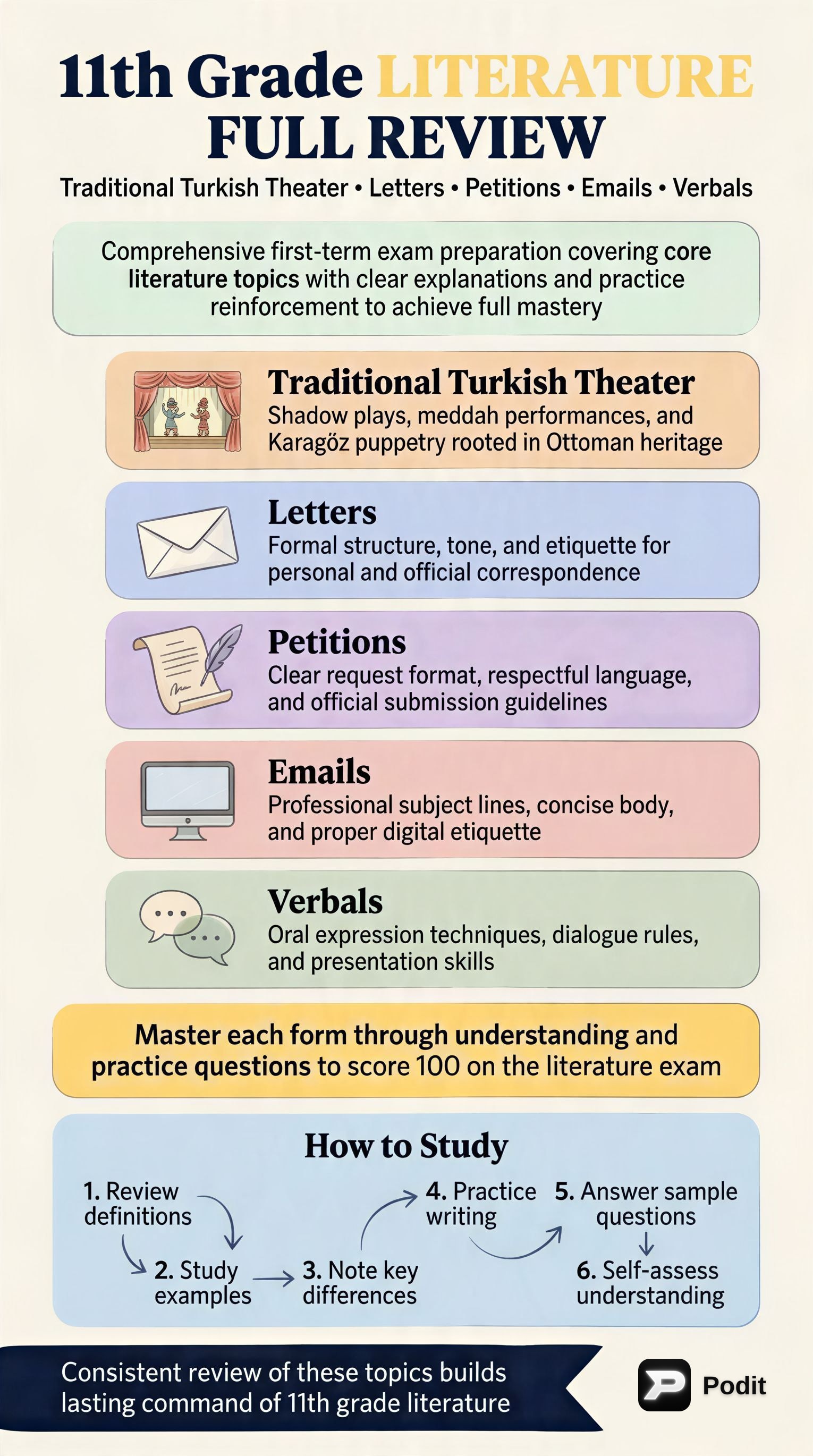
11th Grade Turkish Literature: First Term Review - görsel özet infografik
Tam boyutta görüntüle →
03

Flash Kartlar

25 kart

Karta tıklayarak çevir. ← → ile gez, ⎵ ile çevir.

1 / 25
Tüm kartları metin olarak gör
  1. 1. What is the primary goal of the 11th Grade Turkish Literature review?

    The primary goal is to provide a structured overview of significant literary periods, movements, and foundational concepts for the first term's first examination. It aims to help students comprehend the evolution of Turkish literary thought and expression by exploring defining characteristics, prominent figures, and key works of each era. This comprehensive review ensures thorough preparation for assessment.

  2. 2. What characterized Turkish literature prior to the Tanzimat period?

    Prior to the Tanzimat period, Turkish literature was dominated by Divan literature. It was characterized by classical Ottoman Turkish, intricate poetic forms like gazel and kaside, and a strong reliance on Arabic and Persian literary conventions and aruz meter. This era focused on abstract beauty, religious themes, and courtly life.

  3. 3. Name two prominent poets of the Divan literature period.

    Two prominent poets of the Divan literature period were Fuzûlî and Bâkî. They represented the zenith of this era, known for their mastery of classical Ottoman Turkish, intricate poetic forms, and their contributions to an aesthetic focused on abstract beauty and courtly themes. Their works are prime examples of Divan poetry's sophisticated style.

  4. 4. When did the Tanzimat Reform Era begin and what was its impact on literature?

    The Tanzimat Reform Era began in 1839, initiating a comprehensive modernization process within the Ottoman Empire. This profoundly impacted literature by introducing Western literary genres and concepts. It marked a departure from traditional narrative forms and laid the groundwork for subsequent literary developments, establishing a new trajectory for Turkish literary expression.

  5. 5. Which literary genres were introduced during the Tanzimat literature period?

    During the Tanzimat literature period, Western literary genres such as the novel, plays, and short stories were introduced. This marked a significant departure from traditional narrative forms like mesnevi and hikaye. The introduction of these genres helped modernize Turkish literature and align it with contemporary Western literary trends.

  6. 6. Who were some key figures of Tanzimat literature and what ideas did they champion?

    Key figures of Tanzimat literature included Şinasi, Namık Kemal, and Ziya Pasha. They championed ideas of freedom, justice, patriotism, and national identity. These authors used literature as a tool for social and political commentary, advocating for modernization and societal change within the Ottoman Empire.

  7. 7. How did the language of literature change during the Tanzimat period?

    During the Tanzimat period, the language of literature began a slow process of simplification. While still formal, there was a conscious effort to move away from the overly ornate and Arabic/Persian-heavy vocabulary of Divan literature. This simplification aimed to make literature more accessible to a broader audience and reflect a more modern Turkish identity.

  8. 8. What was the 'Servet-i Fünun' movement and when did it occur?

    The 'Servet-i Fünun,' or 'Literature of Riches,' movement occurred between 1896 and 1901. It emerged as a reaction to the political repression of the Hamidian era, leading writers to retreat into aestheticism and 'art for art's sake.' This movement significantly influenced Turkish literature by introducing new forms and a refined language.

  9. 9. What were the main characteristics of Servet-i Fünun literature?

    Servet-i Fünun literature emphasized individual emotions, melancholy, and a refined, often ornate, language. It was heavily influenced by French symbolism and Parnassianism, focusing on aestheticism and 'art for art's sake.' Writers often explored themes of personal suffering and idealized beauty, moving away from social commentary.

  10. 10. Name two prominent figures of the Servet-i Fünun movement and their contributions.

    Tevfik Fikret and Cenap Şahabettin were prominent figures of the Servet-i Fünun movement, revolutionizing Turkish poetry with new forms like the sonnet and terza rima. Halit Ziya Uşaklıgil perfected the Turkish novel with psychological depth and realistic portrayals. Their works showcased a sophisticated use of language and a focus on individual emotions.

  11. 11. What was the 'Fecr-i Ati' movement and what was its motto?

    The 'Fecr-i Ati,' or 'Dawn of the Future,' movement (1909-1912) was the first organized literary group in Turkish history. Its motto was 'art is personal and sacred,' emphasizing individual expression and aesthetic principles. Although short-lived, it aimed to bring new perspectives to Turkish literature.

  12. 12. How did the Fecr-i Ati movement relate to the Servet-i Fünun movement?

    The Fecr-i Ati movement criticized the Servet-i Fünun for its perceived lack of originality and its isolation from society. However, despite their criticisms, they largely continued the aesthetic principles of Servet-i Fünun, maintaining the 'art is personal and sacred' motto and a focus on individual expression. They shared a similar refined language and artistic sensibility.

  13. 13. Who was the most significant figure of the Fecr-i Ati movement and what was his style?

    Ahmet Haşim was the most significant figure of the Fecr-i Ati movement. His style was characterized by symbolist poetry, focusing on evoking moods and sensations rather than direct meaning. He used rich imagery and musicality in his verses, making him a unique voice within the short-lived movement.

  14. 14. What influenced the rise of the National Literature Period?

    The National Literature Period (1911-1923) was primarily influenced by the Balkan Wars and the rise of Turkish national consciousness. These events fostered a desire for a literature rooted in Turkish identity and Anatolian realities. This led to a decisive turn towards nationalism and a simplification of language in literary works.

  15. 15. What were the defining characteristics of the National Literature Period?

    The National Literature Period was characterized by a decisive turn towards Turkish nationalism and a simplification of language. Writers advocated for literature rooted in Anatolian realities, using the spoken Turkish language and reviving the syllabic meter (hece ölçüsü) in poetry. It emphasized national values, realism, and a focus on the common people.

  16. 16. Name three prominent writers of the National Literature Period.

    Three prominent writers of the National Literature Period were Ömer Seyfettin, Ziya Gökalp, and Mehmet Emin Yurdakul. They were instrumental in advocating for a literature rooted in Turkish national identity, using simplified language and focusing on Anatolian themes. Their works laid the ideological and linguistic foundations for the literature of the Turkish Republic.

  17. 17. What was the legacy of the National Literature Period?

    The National Literature Period laid the ideological and linguistic foundations for the literature of the Turkish Republic. It emphasized national values, realism, and a focus on the common people, promoting a literature that was accessible and reflective of Turkish identity. This period's principles continued to influence subsequent generations of writers.

  18. 18. List three traditional poetic forms dominant in Divan poetry.

    Three traditional poetic forms dominant in Divan poetry were gazel, kaside, and mesnevi. Gazels are typically 5-15 couplets with a consistent rhyme scheme, often on love themes. Kasides are longer odes, usually praising a dignitary. Mesnevis are narrative poems composed of rhyming couplets, used for longer stories.

  19. 19. Which Western poetic forms were introduced into Turkish literature, particularly during Servet-i Fünun?

    During the Westernization movement, particularly in the Servet-i Fünun period, new forms like the sonnet and terza rima were introduced. The sonnet is a 14-line poem with specific rhyme schemes, while terza rima is a three-line stanza form with an interlocking rhyme scheme. These forms enriched Turkish poetry with new structural possibilities.

  20. 20. Explain the 'aruz' meter and its significance in Turkish literature.

    Aruz is a quantitative meter based on syllable length, central to Divan and early Western-influenced Turkish poetry. It relies on the pattern of long and short syllables to create rhythmic structures, borrowed from Arabic and Persian poetic traditions. Its intricate rules made it a hallmark of classical Ottoman poetry, demanding high linguistic skill from poets.

  21. 21. What is 'hece ölçüsü' and which literary movement championed it?

    Hece ölçüsü, or syllabic meter, counts the number of syllables per line, reflecting the natural rhythm of Turkish speech. The National Literature movement championed this meter, moving away from the foreign aruz meter. It connected with the folk poetry tradition and aimed to create a more authentically Turkish poetic expression.

  22. 22. Compare 'aruz' and 'hece ölçüsü' in Turkish poetry.

    Aruz is a quantitative meter based on syllable length, borrowed from Arabic/Persian, and was dominant in Divan poetry. Hece ölçüsü is a syllabic meter, counting syllables per line, reflecting natural Turkish rhythm and championed by the National Literature movement. Aruz is complex and formal, while hece ölçüsü is simpler and closer to folk tradition, representing a shift towards national identity in poetry.

  23. 23. What are the different types of rhyme mentioned in the text?

    The text mentions different types of rhyme including full rhyme, half rhyme, and eye rhyme. Full rhyme involves identical sounds in the stressed syllables and subsequent sounds. Half rhyme (or slant rhyme) involves similar but not identical sounds. Eye rhyme refers to words that look alike but do not sound alike, each contributing to the musicality and structure of a poem.

  24. 24. List three common literary devices used to enrich meaning in Turkish literature.

    Three common literary devices used to enrich meaning in Turkish literature are metaphor, simile, and personification. Metaphor makes a direct comparison between two unlike things. Simile compares two unlike things using 'like' or 'as'. Personification attributes human qualities or actions to inanimate objects or animals, all enhancing imagery and depth.

  25. 25. How is symbolism used in Turkish literature, particularly in certain movements?

    Symbolism uses objects or ideas to represent abstract concepts, enriching meaning and evoking deeper layers of interpretation. It was particularly prominent in movements like Fecr-i Ati, where poets like Ahmet Haşim used symbols to convey moods, emotions, and subjective experiences rather than direct statements. This allowed for a more nuanced and evocative poetic expression.

04

Bilgini Test Et

15 soru

Çoktan seçmeli sorularla öğrendiklerini ölç. Cevap + açıklama.

Soru 1 / 15Skor: 0

Which of the following is NOT a characteristic feature of Divan literature, as described in the text?

05

Detaylı Özet

4 dk okuma

Tüm konuyu derinlemesine, başlık başlık.

This content is based on a YouTube video.


📚 11th Grade Turkish Literature: First Term Exam Review

This study material provides a comprehensive review of key periods, movements, and concepts in 11th Grade Turkish Literature, essential for preparing for the first term's first examination. Understanding these historical and stylistic shifts is crucial for grasping the evolution of Turkish literary thought and expression. We will explore defining characteristics, prominent figures, and key works that shaped each era.


🌍 Foundational Periods and Westernization in Turkish Literature

The development of modern Turkish literature is marked by a significant transition from traditional Eastern influences to Western literary paradigms.

1️⃣ Pre-Tanzimat: Divan Literature (Classical Ottoman Literature)

  • Characteristics:
    • Dominated by classical Ottoman Turkish.
    • Intricate poetic forms.
    • Strong reliance on Arabic and Persian literary conventions and meters (primarily Aruz).
    • Aesthetic focus on abstract beauty, religious themes, and courtly life.
  • Key Forms: Gazel, Kaside.
  • Prominent Poets: Fuzûlî, Bâkî.

2️⃣ The Tanzimat Reform Era (1839 onwards)

  • Impact: Initiated a comprehensive modernization process in the Ottoman Empire, profoundly influencing literature.

3️⃣ Tanzimat Literature (Emerging around 1860)

  • Goal: Introduced Western literary genres and concepts into Turkish literature.
  • Key Themes: Freedom, justice, patriotism, national identity.
  • New Genres: First Turkish novels, plays, and short stories.
  • Language: Began a slow process of simplification.
  • Poetry:
    • Still utilized Aruz meter.
    • Began to prioritize content over form.
    • Addressed social and political issues.
  • Prominent Authors: Şinasi, Namık Kemal, Ziya Pasha.
  • ✅ This period laid the groundwork for subsequent literary developments.

📈 Key Literary Movements

Following the Tanzimat, Turkish literature continued its evolution through distinct movements.

1️⃣ Servet-i Fünun (Literature of Riches) Period (1896-1901)

  • Context: Emerged as a reaction to political repression, leading writers to focus on aestheticism.
  • Motto: "Art for art's sake."
  • Center: The magazine 'Servet-i Fünun'.
  • Characteristics:
    • Emphasis on individual emotions and melancholy.
    • Refined, often ornate language.
    • Heavily influenced by French Symbolism and Parnassianism.
  • Poetic Innovations: Introduced new forms like the sonnet and terza rima.
  • Prominent Figures:
    • Poets: Tevfik Fikret, Cenap Şahabettin.
    • Novelist: Halit Ziya Uşaklıgil (perfected the Turkish novel with psychological depth and realism).

2️⃣ Fecr-i Ati (Dawn of the Future) Movement (1909-1912)

  • Significance: The first organized literary group in Turkish history.
  • Critique: Criticized Servet-i Fünun for perceived lack of originality.
  • Continuity: Largely continued Servet-i Fünun's aesthetic principles.
  • Motto: "Art is personal and sacred."
  • Key Figure: Ahmet Haşim (known for his symbolist poetry).
  • ⚠️ This was a short-lived movement.

3️⃣ National Literature Period (1911-1923)

  • Shift: Marked a decisive turn towards Turkish nationalism and language simplification.
  • Influences: Balkan Wars and the rise of Turkish national consciousness.
  • Goals:
    • Advocated for literature rooted in Anatolian realities.
    • Used the spoken Turkish language.
    • Revived the syllabic meter (hece ölçüsü) in poetry.
  • Themes: National values, realism, focus on common people.
  • Prominent Writers: Ömer Seyfettin, Ziya Gökalp, Mehmet Emin Yurdakul.
  • ✅ Laid the ideological and linguistic foundations for the literature of the Turkish Republic.

📝 Poetic Forms, Meter, and Literary Concepts

Familiarity with these elements is fundamental for analyzing Turkish literature.

1️⃣ Poetic Forms

  • Traditional Divan Poetry Forms:
    • Gazel: 5-15 couplets, consistent rhyme scheme (AA, BA, CA, DA).
    • Kaside: Longer odes.
    • Mesnevi: Narrative poems composed of rhyming couplets.
    • Rubai: Quatrain.
    • Tuyuğ: A specific Turkish quatrain form.
  • Western Forms (Introduced during Westernization, especially Servet-i Fünun):
    • Sonnet: A 14-line poem.
    • Terza Rima: A three-line stanza form.

2️⃣ Meter

  • Aruz Meter:
    • Quantitative meter based on syllable length.
    • Central to Divan and early Western-influenced poetry.
  • Hece Ölçüsü (Syllabic Meter):
    • Counts the number of syllables per line.
    • Reflects the natural rhythm of Turkish speech.
    • Championed by the National Literature movement, connecting with folk poetry.

3️⃣ Rhyme Schemes and Types

  • Rhyme Schemes: Vary (e.g., AA, BA, CA, DA for a gazel).
  • Types of Rhyme:
    • Full Rhyme: Perfect sound match.
    • Half Rhyme (Slant Rhyme): Similar but not identical sounds.
    • Eye Rhyme: Words that look like they should rhyme but don't sound alike.

4️⃣ Literary Devices

  • Metaphor: Direct comparison without "like" or "as."
  • Simile: Comparison using "like" or "as."
  • Personification: Giving human qualities to inanimate objects or animals.
  • Hyperbole: Exaggeration for emphasis.
  • Irony: Contrast between expectation and reality.
  • Symbolism: Using objects or ideas to represent abstract concepts (prominent in Fecr-i Ati).

✅ Conclusion and Examination Preparation

This review has systematically covered pivotal periods and concepts in 11th Grade Turkish Literature.

  • Key Areas Covered:

    • Transformative impact of the Tanzimat era.
    • Aesthetic pursuits of Servet-i Fünun and Fecr-i Ati.
    • Nationalistic resurgence of the National Literature movement.
    • Evolution of poetic forms, metrical systems, and essential literary devices.
  • 💡 Tips for Optimal Examination Preparation:

    1. Context is Key: Understand the socio-political and cultural contexts that shaped each literary movement, not just memorizing facts.
    2. Defining Characteristics: Focus on the unique traits, thematic concerns, and linguistic innovations of each period.
    3. Literary Terms: Thoroughly review poetic structures, meters, and literary devices.
    4. Practice: Engage in analytical questions and comparative studies between different literary eras to solidify understanding.
Kendi çalışma materyalini oluştur

PDF, YouTube videosu veya herhangi bir konuyu dakikalar içinde podcast, özet, flash kart ve quiz'e dönüştür. 1.000.000+ kullanıcı tercih ediyor.

Sıradaki Konular

Tümünü keşfet
Republican Era Turkish Poetry: Part 2

Republican Era Turkish Poetry: Part 2

An academic overview of significant poetic movements and figures in Republican Era Turkish literature, focusing on post-1950s developments including the İkinci Yeni movement and other trends.

7 dk Özet 25 15 Görsel
Imagist Poetry: Characteristics and Key Figures

Imagist Poetry: Characteristics and Key Figures

This audio summary explores Imagist Poetry, detailing its historical context, core principles, and the contributions of prominent figures such as Amy Lowell, H.D., and William Carlos Williams.

6 dk Özet 25 15
Figurative Language: Simile, Metaphor, Personification, Apostrophe

Figurative Language: Simile, Metaphor, Personification, Apostrophe

Unlock the power of language! This podcast explores simile, metaphor, personification, and apostrophe, showing you how these literary devices add depth, emotion, and vivid imagery to communication.

9 dk Özet 15 Görsel
British Literature Since 1945: Evolution and Diversity

British Literature Since 1945: Evolution and Diversity

An academic overview of British literature since 1945, examining societal influences, emerging themes, key authors, and the development of various genres, including feminist, migrant, and popular fiction.

7 dk Özet 25 15 Görsel
Literary & Philosophical Movements: A Comprehensive Overview

Literary & Philosophical Movements: A Comprehensive Overview

An academic summary exploring key literary and philosophical concepts, movements, and periods from ancient times to modernism, highlighting their definitions, characteristics, and influential figures.

10 dk Özet 25 15 Görsel
20th-Century British Poetry: Movements and Themes

20th-Century British Poetry: Movements and Themes

An academic overview of 20th-century British poetry, exploring its historical context, major literary movements, key themes, and influential poets from the Georgian era to the 1970s.

7 dk Özet 25 15 Görsel
Modernism and Postmodernism in English Literature

Modernism and Postmodernism in English Literature

This summary explores the emergence, characteristics, and historical context of Modernism and Postmodernism in English literature, detailing their aesthetic principles, literary forms, and critical reception.

12 dk Özet 25 15 Görsel
The Romantic and Victorian Ages in English Literature

The Romantic and Victorian Ages in English Literature

This summary explores the English Romantic and Victorian Ages, detailing their literary characteristics, key social and political contexts, and influential authors and their works.

9 dk Özet 25 15 Görsel