Podit
Podit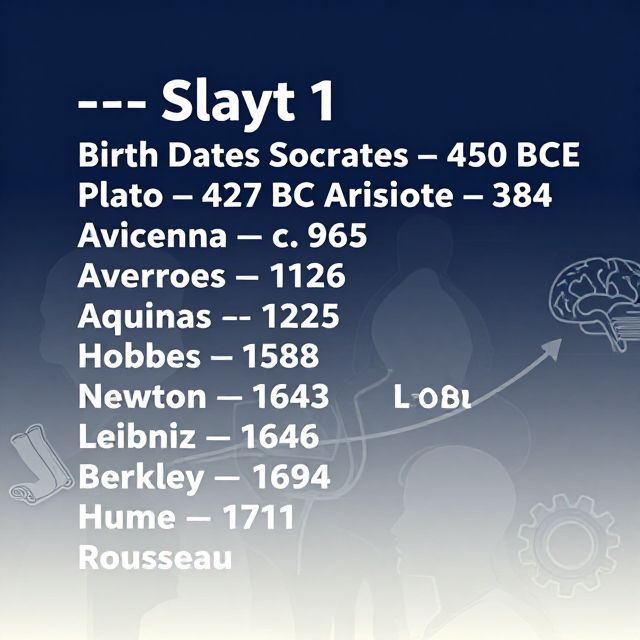
This study material synthesizes information from a lecture audio transcript and accompanying slides to provide a comprehensive overview of the foundational developments that paved the way for scientific psychology.
🧠 The Genesis of Scientific Psychology: Foundational Developments
Introduction
The journey towards establishing psychology as a scientific discipline was a complex evolution, shaped by centuries of philosophical shifts and scientific advancements. This study guide explores the critical developments that transformed the understanding of the human mind from a subject of pure speculation into a legitimate area for empirical investigation. We will examine key philosophical movements, scientific breakthroughs, and the changing perception of human beings that collectively laid the groundwork for modern scientific psychology.
1. Historical Context: Key Thinkers and Their Eras 🗓️
Understanding the timeline of influential thinkers helps contextualize the developments in philosophy and science that contributed to psychology's emergence. Here are some pivotal figures:
- Ancient Philosophers:
- Socrates (c. 470-399 BCE)
- Plato (c. 427-347 BCE)
- Aristotle (c. 384-322 BCE)
- Medieval Scholars:
- Avicenna (c. 965-1037)
- Averroes (c. 1126-1198)
- Aquinas (c. 1225-1274)
- Early Modern & Enlightenment Thinkers:
- Francis Bacon (b. 1561)
- René Descartes (b. 1596)
- Thomas Hobbes (b. 1588)
- John Locke (b. 1632)
- Isaac Newton (b. 1643)
- Gottfried Leibniz (b. 1646)
- George Berkeley (b. 1685)
- Voltaire (b. 1694)
- David Hume (b. 1711)
- Jean-Jacques Rousseau (b. 1712)
- Adam Smith (b. 1723)
- Immanuel Kant (b. 1724)
- Jeremy Bentham (b. 1748)
- Founders of Modern Psychology/Related Fields:
- Charles Darwin (b. 1809)
- Wilhelm Wundt (b. 1832)
- Charles Peirce (b. 1839)
- William James (b. 1842)
- John Dewey (b. 1859)
2. The Empirical Attitude ✅
The first critical development was a fundamental shift in how knowledge was acquired and validated.
- Definition: Moving away from pure speculation or dogma towards observation and experience as the primary sources of knowledge.
- Key Contributors:
- Aristotle: Emphasized observation of the natural world.
- René Descartes: Despite his rationalism, his mechanistic view of the body encouraged empirical investigation.
- The Renaissance: A period of renewed inquiry and exploration.
- Francis Bacon: Championed inductive reasoning and systematic observation as cornerstones of the scientific method.
- Impact: This attitude laid the groundwork for scientific inquiry across all disciplines, including the eventual study of the mind.
3. British Empiricism 🇬🇧
Building upon the empirical attitude, British Empiricism developed into a comprehensive philosophical framework.
- Core Idea: All knowledge originates from sensory experience.
- Three Manifestations:
- Empiricism as Epistemology: The theory that knowledge comes primarily from sensory experience.
- Empiricism as Theory of Mind: The concept that the mind at birth is a 'tabula rasa' (blank slate), with all ideas and concepts formed through experience.
- Empiricism as Theory of Learning: Learning occurs through associations formed between experiences.
- Key Figures: John Locke, George Berkeley, and David Hume.
- Impact: Profoundly influenced subsequent psychological thought by focusing on the origins and nature of ideas within individual experience.
4. Subjectivization of Epistemology 💡
This development marks a profound shift in understanding the nature of knowledge itself, recognizing the active role of the human mind.
- Historical Views:
- Plato: Believed in 'the Forms' – eternal, independent realities existing outside human perception.
- Aristotle: Focused on objective rules of reason and logic.
- Simple Empiricism (Locke to Hume): Began to shift focus towards individual experience.
- Kant's Revolution (Immanuel Kant):
- Introduced 'a priori' knowledge: Innate structures of the mind (e.g., categories of understanding) that organize and shape empirical experiences.
- Argued that our minds are not passive recipients but actively structure reality.
- Discovery of the "Human Factor" in Observation Errors: This realization acknowledged that errors could stem not just from external factors but also from the inherent workings of the human mind.
- Impact: Legitimized the study of internal mental processes, recognizing the mind's active role in shaping perception and knowledge.
5. Availability of Man as a Subject of Empirical Investigation 🔬
For centuries, the human mind was often considered beyond empirical study. This changed due to several factors.
- Historical Barriers: Philosophical or religious reasons often deemed the mind inscrutable.
- Enabling Factors:
- The Greeks: Early inquiries into human nature.
- Descartes: His dualistic view treated the body as a machine, opening the door for its empirical study.
- Charles Darwin: His theories placed humans within the natural world, subject to natural laws and evolution, making them legitimate subjects for scientific inquiry.
- Physiology & Medicine: Advances in these fields allowed for systematic study of the body's functions, providing empirical data.
- Impact: Transformed the human being, including mental processes, into a valid and accessible subject for scientific investigation.
6. The Success of the Physical Sciences and the Metaphor of the Machine ⚙️
The triumphs of the physical sciences provided powerful models and methodologies that influenced the nascent field of psychology.
- Models of Success:
- Astronomy: Copernicus and Kepler revolutionized understanding of the cosmos through meticulous observation and mathematical analysis.
- Physics: Galileo and Isaac Newton established universal laws (e.g., gravity, optics), developed advanced mathematics, and created groundbreaking inventions.
- Physiology: William Harvey's description of blood circulation demonstrated that biological systems could be understood through empirical and mechanistic principles.
- The Metaphor of the Machine:
- Initially applied to the body by Descartes, this metaphor suggested that complex phenomena could be understood by breaking them down into component parts and analyzing their interactions.
- It extended to the universe and even aspects of the mind, promoting a mechanistic worldview.
- Impact: Demonstrated the power of empirical observation, mathematical modeling, and systematic experimentation. This encouraged applying similar scientific rigor to the study of the human mind, paving the way for psychology as a science.
These five interconnected developments collectively created an intellectual environment where the human mind, once considered mysterious and beyond scientific reach, could finally be approached with the same empirical and systematic rigor applied to the physical world. This foundational shift was crucial for the birth of scientific psychology.