Podit
Podit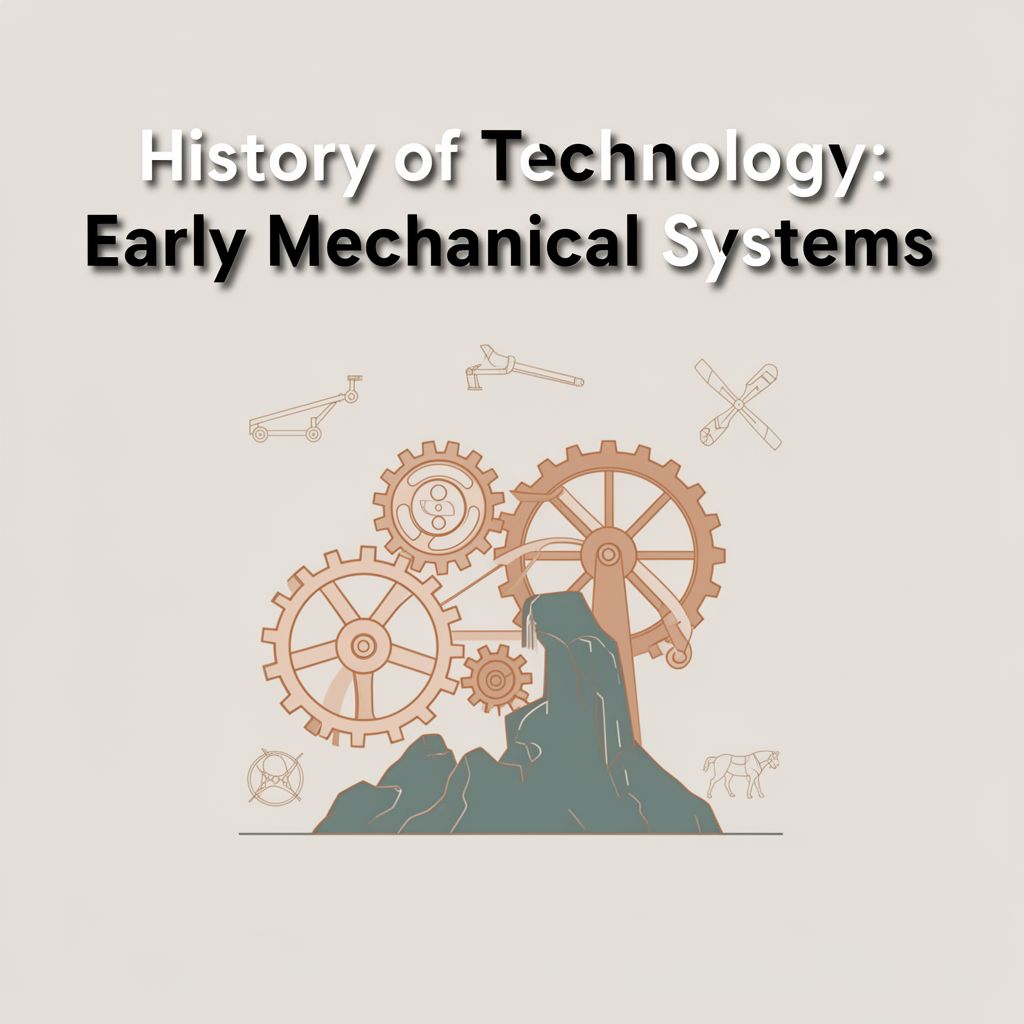
📚 History of Technology: Early Mechanical Systems
📌 Source Information:
This study material has been compiled from a lecture audio transcript and copy-pasted text documents provided by the user.
💡 Introduction: Harnessing Power Through Ingenuity
This guide explores the foundational principles and recurring "levers" that shaped early mechanical systems, long before the Industrial Revolution. It delves into how humanity converted raw energy into useful work, controlled its application, and organized systems for long-term reliability. We will examine the evolution of power generation and mechanical ingenuity through four key aspects: Source, Conversion, Control, and Organization.
1️⃣ The Four Levers of Early Mechanical Systems
Early mechanical systems were built upon four fundamental principles that recurred throughout their development:
- 1️⃣ Source: Choosing the appropriate prime mover based on local conditions.
- ✅ Definition: The primary energy input for a mechanical system.
- 💡 Examples: Human muscle, animal power, flowing water, or wind.
- 2️⃣ Conversion: Transforming raw energy into useful tasks.
- ✅ Definition: Mechanisms used to change the form of energy or motion.
- ⚙️ Examples: Wheels, cranks, gears, and cams to turn rotation into linear force, lifting, grinding, or other work.
- 3️⃣ Control: Making variable energy sources reliable and consistent.
- ✅ Definition: Methods to regulate power output and ensure stable operation.
- 🔧 Examples: Storage mechanisms, escapements, governors, and sluices.
- 4️⃣ Organization: Maintaining systems for long-term sustainability and efficiency.
- ✅ Definition: Establishing infrastructure, rights, and schedules for continuous operation.
- 🗓️ Examples: Maintaining water channels, establishing resource use rights, and scheduling operations.
2️⃣ Human & Animal Power: The Earliest Engines
The most fundamental power sources, human and animal effort, were significantly amplified through simple mechanical principles.
2.1. Human Power
Human strength, though limited, was ingeniously augmented by basic machines:
- 📚 Lever: A rigid bar pivoting on a fulcrum, allowing a greater force to be exerted at one end by applying force at the other. Essential for lifting and moving heavy objects.
- 📚 Treadmill: In historical context, a large wheel or cylinder with steps where human weight and continuous motion (walking/climbing) converted into rotational energy. Used to drive grinding stones or pumps.
- 📚 Capstan: A vertical rotating cylinder or drum around which ropes were wound. Turned by long bars, it generated immense pulling or lifting forces (e.g., raising ship anchors).
2.2. Animal Power
Animals provided a more substantial and steady source of traction, crucial for agriculture and early industry:
- 🚜 Applications: Supplied consistent pulling force for ploughs (cultivation), carts (transportation), and mills (grinding grain, operating water-lifting devices).
- 🌍 Regional Importance: Especially vital in regions where water flow or wind was weak or unreliable.
2.3. Limitations and Optimization
The efficiency of animal power depended on several practical factors:
- Harness Design: A well-designed harness distributed load evenly, preventing injury and maximizing pulling efficiency.
- Shoeing: Protecting hooves was essential for endurance and sustained work, preventing lameness.
- Path Quality: Smooth, well-maintained paths reduced strain, allowing for heavier loads and greater distances.
3️⃣ Water Power: From Wheels to Industrial Scale
Harnessing flowing water marked a significant leap in mechanical capability, enabling tasks on an unprecedented scale.
3.1. Core Idea
- 📚 Principle: A waterwheel converts the energy of falling or flowing water into rotational motion.
- 📊 Power Factors: Determined by 'head' (vertical drop/potential energy) and 'flow' (volume of water per unit time).
3.2. Types of Waterwheels
Different designs optimized energy conversion for specific hydrological conditions:
- Undershot Wheel: Water passes beneath, pushing blades primarily by impulse. Simple but less efficient.
- Breastshot Wheel: Water strikes around the middle, combining impulse and weight. More efficient for moderate heads.
- Overshot Wheel: Water received from the top, filling buckets that drive the wheel primarily by weight. Most efficient, requires significant head.
3.3. Conversion Mechanisms
Rotational energy from waterwheels was converted into useful work via:
- ⚙️ Gears: Changed speed and torque, transmitting power efficiently.
- 🔗 Belts: Transferred power over distances and changed the plane of rotation.
- 🎛️ Cams: Converted rotational motion into reciprocating or oscillating motion (e.g., hammering, pumping).
- 🎯 Applications: Grinding grain, lifting objects, hammering metal, sawing timber.
3.4. Water Lifting Devices
Water power was also crucial for irrigation and supply:
- 📚 Shaduf: A counterweighted lever allowing one person to repeatedly lift a full bucket of water with reduced effort.
- 📚 Saqiyah: Animal-powered device where animals turn a geared wheel that drives a chain of pots or buckets to raise water continuously.
- 📚 Noria: A large waterwheel driven directly by river current, continuously lifting water in attached compartments into an aqueduct or ditch.
3.5. Historical Applications of Hydropower
- 🏛️ Greco-Roman Hydropower:
- Romans built sophisticated mills with wheels and gearing for continuous grain grinding.
- Sites like Barbegal demonstrated industrial-scale output with stacked waterwheels.
- Some mills incorporated crank-and-rod mechanisms to drive saws or hammers.
- 🏰 Medieval Mechanization:
- Thousands of mills powered diverse processes beyond grain grinding: fulling (textiles), forging, bellows, and saws.
- Trip hammers: Water-powered, delivered repeatable, powerful blows.
- Bellows: Water-driven, provided steady air to furnaces.
- Control Mechanisms: Mill ponds stored water, weirs regulated flow, and sluices allowed for precise scheduling to match demand.
4️⃣ Wind Power Across Regions
Wind power offered a renewable energy source, despite its intermittency.
4.1. Regional Variations
- 🌍 Eastern Islamic World:
- 📚 Vertical-axis windmills (Panemones): Featured a vertical main shaft with radial sails, capturing wind from any direction.
- 🎯 Applications: Drove mills and pumps on steady seasonal winds.
- 🇪🇺 Europe:
- 📚 Post Mills: Entire body rotated on a central post for 'yaw control' (facing the wind).
- 📚 Tower Mills: Fixed stone/brick tower with only the cap rotating to orient sails, allowing for larger structures.
- 🎯 Applications: Primarily for grinding grain and draining land (e.g., Netherlands).
4.2. Control Mechanisms for Intermittent Wind
To manage wind's unpredictability, engineers developed:
- Governors: Regulated mill speed, preventing over-speeding in strong winds.
- Shutters: Adjustable slats on sails to control wind capture and power output.
- Brake Gears: Enabled stopping or slowing the mill for protection or maintenance.
5️⃣ Process Heat: The Foundation of Materials Science
Process heat, though not directly turning wheels, was critical for developing stronger materials, foundational for all advanced machinery.
5.1. Fuel and Applications
- 🔥 Charcoal: Primary fuel, produced by burning wood in low-oxygen environments.
- 🏭 Kilns: Fueled by charcoal, used to make:
- Lime (building material)
- Ceramics (pottery, tiles)
- Glass
- 🌡️ Furnaces: Operated at higher temperatures, crucial for metallurgy:
- Extraction and refining of copper, iron, and steel.
5.2. Control of Heat and Airflow
Precise control was paramount for desired material properties:
- 🌬️ Bellows: Provided forced air draft to increase combustion temperatures and control the furnace atmosphere (critical for smelting).
- 💨 Chimneys: Created natural draft, drawing hot gases and smoke, helping regulate internal temperature.
5.3. Significance
- ⚠️ Critical Role: Process heat enabled the production of stronger, more resilient materials.
- 📈 Impact: These materials were prerequisites for constructing more robust and efficient mechanical components, allowing for greater loads, higher speeds, and longer operational lifespans for all machines.