 Podit
Podit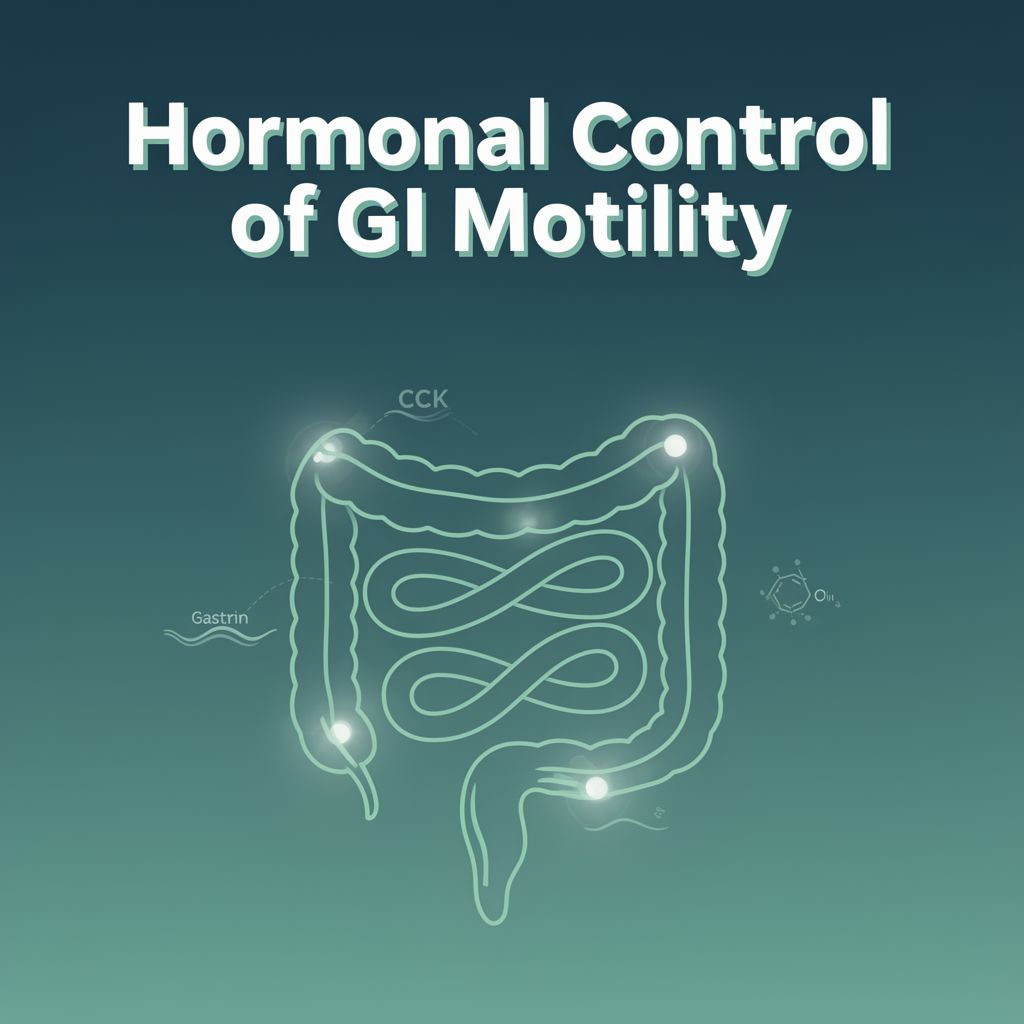
📚 Study Material: Hormonal Control of Gastrointestinal (GI) Motility
Source Information: This study material has been compiled from a lecture audio transcript and accompanying PDF/PowerPoint slides.
🎯 Introduction to Hormonal Control of GI Motility
The gastrointestinal (GI) system is a complex network where functions like motility are meticulously regulated by various hormones. These hormones, secreted from different parts of the GI tract and other organs, act as crucial messengers to coordinate digestion, absorption, and waste elimination. Understanding these hormonal mechanisms is fundamental to comprehending the intricate physiology of the digestive system and its potential dysfunctions. This guide will detail the specific roles of key GI hormones, including their secretion, stimuli for release, diverse effects, and clinical implications.
1️⃣ Key GI Hormones and Their Functions
1.1. Gastrin
📚 Definition: A hormone primarily responsible for stimulating gastric acid secretion.
- Secretion Site: Predominantly by the antrum of the stomach (90%), with the remaining 10% from the duodenum. It is then absorbed into the blood.
- Stimuli for Release:
- Ingestion of a meal, leading to stomach distention.
- Presence of protein digestion products.
- Gastrin-releasing peptide.
- Key Actions:
- Stimulates hydrochloric acid (HCl) secretion in the stomach, crucial for protein digestion.
- Causes contraction of the lower esophageal sphincter (LES), preventing reflux.
- Regulation: High hydrogen ion concentration ([H+]) in the stomach lumen inhibits gastrin release (negative feedback). Specifically, if gastric content pH drops below 2, gastrin secretion ceases.
- ⚠️ Clinical Implication: Zollinger-Ellison Syndrome (Gastrinoma)
- Caused by gastrin-secreting tumors, typically in the pancreas.
- Leads to maximal activity of stomach's acid-secreting cells, resulting in severe gastrointestinal mucosal ulceration.
1.2. Cholecystokinin (CCK)
📚 Definition: A hormone that plays a vital role in fat digestion and satiety.
- Secretion Site: Duodenum and upper jejunum.
- Stimuli for Release: Presence of digestive products in the upper small intestine:
- Fatty acids and monoglycerides (triglycerides do not stimulate release as they cannot cross intestinal cell membranes).
- Proteins, small peptides, and amino acids.
- Key Actions:
- Strongly contracts the gallbladder, expelling bile into the small intestine (bile is essential for fat emulsification).
- Relaxes the sphincter of Oddi, allowing bile and pancreatic secretions to enter the duodenum.
- Inhibits stomach contraction, slowing gastric emptying to allow sufficient time for fat digestion in the upper intestinal tract.
- Increases pancreatic enzyme and bicarbonate (HCO3-) secretion.
- Suppresses hunger.
1.3. Secretin
📚 Definition: The "nature's antacid," crucial for neutralizing gastric acid in the small intestine.
- Secretion Site: S cells in the mucosa of the duodenum and jejunum.
- Stimuli for Release: Entry of acidic chyme from the stomach into the duodenum, specifically when the pH is less than 5.0. Secretin is then absorbed into the blood.
- Key Actions:
- Decreases gastric H+ secretion.
- Significantly increases pancreatic secretion of HCO3- (up to 145 mEq/L, with low chloride concentration) to neutralize acid.
- Increases biliary secretion of HCO3-.
- Mechanism of Action:
- Stimulates adenylate cyclase, which increases cyclic AMP (cAMP).
- HCO3- buffers H+ ions: HCO3- + H+ → H2CO3 → (carbonic anhydrase) → CO2 + H2O.
- CO2 is absorbed and expired through the lungs.
- This process establishes an optimal pH (7.0-8.0) for the activity of pancreatic digestive enzymes.
1.4. Motilin
📚 Definition: A hormone that regulates interdigestive GI motility.
- Secretion Site: M cells in the crypts of the upper duodenum, cyclically during fasting periods.
- Key Actions:
- Stimulates GI motility through Migrating Motor Complexes (MMCs) every 90 minutes in a fasted person (between meals).
- MMCs sweep secretions from the mid-stomach through to the terminal ileum, maintaining low bacterial counts in the upper intestine.
- Regulation: Motilin secretion is inhibited after food ingestion.
- ⚠️ Clinical Implication: Absence of MMCs can lead to decreased duodenal motility and impaired gastric emptying, potentially causing bacterial overgrowth syndrome. MMCs do not affect mass movements or swallowing.
1.5. Gastric Inhibitory Peptide (GIP) / Glucose-dependent Insulinotropic Polypeptide (GLIP)
📚 Definition: A hormone with both GI and metabolic effects, particularly on insulin release.
- Secretion Site: Mucosa of the upper small intestine.
- Stimuli for Release: Unique among GI hormones, GIP is released by all three major foodstuffs:
- Fatty acids
- Amino acids
- Carbohydrates
- Key Actions:
- Decreases gastric H+ secretion.
- Weakly slows gastric emptying.
- 💡 Therapeutic Role:
- After each meal, GLP-1 levels increase 2-3 times, causing insulin release.
- Has a significant therapeutic role in type 2 diabetes and diet-induced obesity.
- Helps reduce feeding by activating POMC neurons and elevates plasma leptin levels.
- GLP-1 receptor agonists are used in the treatment of obesity.
2️⃣ Other Important GI Hormones and Peptides
2.1. Vasoactive Intestinal Peptide (VIP)
- Secretion Site: Released from neurons within the GI tract.
- Key Actions:
- Relaxes smooth muscle of the stomach and gallbladder.
- Stimulates pancreatic HCO3- secretion.
- Inhibits gastric H+ secretion.
- Causes vasodilation, leading to a lowering of arterial blood pressure.
2.2. Somatostatin (Growth Hormone-Inhibiting Hormone)
- Secretion Site: Stomach, intestine, pancreatic delta cells, and hypothalamus.
- Nature: A powerful inhibitory hormone.
- Key Actions:
- Suppresses the release of virtually all other GI hormones (Gastrin, CCK, Secretin, Motilin, VIP, GIP).
- Decreases gastric emptying.
- Decreases intestinal blood flow.
- Decreases gastric H+ secretion.
- Decreases both insulin and glucagon release.
- Regulation: Its secretion is inhibited by vagal stimulation.
2.3. Neuropeptide Y
- Secretion Site: Produced by neurons of the sympathetic nervous system.
- Key Actions:
- Increases food intake and promotes energy storage as fat.
- Acts as a strong vasoconstrictor.
2.4. Peptide YY
- Secretion Site: Released by cells in the ileum and colon in response to feeding.
- Key Actions: Reduces appetite, contributing to feelings of satiety.
2.5. Ghrelin (Hunger-Stimulating Peptide)
- Secretion Site: Produced by P/D1 cells in the fundus of the stomach and epsilon cells of the pancreas.
- Key Actions:
- Levels increase before meals and decrease after meals, signaling hunger to the brain.
- Considered the physiological counterpart to leptin (produced by adipose tissue, induces satiation), highlighting their opposing roles in appetite regulation.
📊 Review Question
Question: Migrating motility complexes (MMCs) occur about every 90 min between meals and are thought to be stimulated by the gastrointestinal hormone, motilin. An absence of MMCs causes an increase in which of the following?
A) Duodenal motility B) Gastric emptying C) Intestinal bacteria D) Mass movements E) Swallowing
Answer: C) Intestinal bacteria