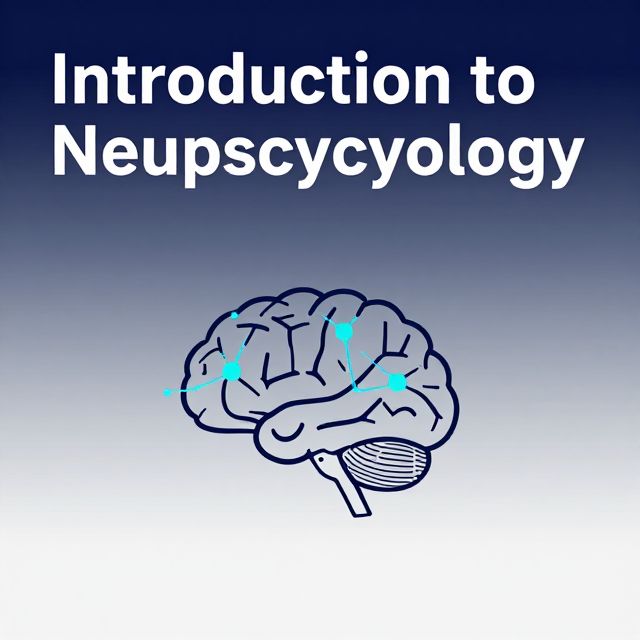
Introduction to Neuropsychology - kapak
Psikoloji#neuropsychology#brain function#cognitive disorders#neurological syndromes

Introduction to Neuropsychology

This audio summary provides an academic overview of neuropsychology, covering its definition, historical development, key concepts, illustrative case studies, and fundamental facts about the brain.

beysagucluMarch 14, 2026 ~25 dk toplam
01

Sesli Özet

8 dakika

Konuyu otobüste, koşarken, yolda dinleyerek öğren.

Sesli Özet

Introduction to Neuropsychology

0:008:04
02

Flash Kartlar

25 kart

Karta tıklayarak çevir. ← → ile gez, ⎵ ile çevir.

1 / 25
Tüm kartları metin olarak gör
  1. 1. What is the fundamental reason for the existence of neuropsychology?

    Neuropsychology fundamentally exists because behavior is intricately mapped onto brain networks. Disruptions within these networks can profoundly alter an individual's reality, leading to changes in cognitive functions and behavior. This field aims to understand these connections and the impact of brain dysfunction on human experience.

  2. 2. Who is Dr. Psk. Deniz Yerlikaya and what are her primary research interests?

    Dr. Psk. Deniz Yerlikaya is a neuroscientist and neuropsychologist with approximately 14 years of experience. Her research primarily focuses on dementia, sleep disorders, and healthy aging. She utilizes various tools such as electrophysiology, magnetic brain imaging, and neuropsychological assessment in her studies.

  3. 3. What cognitive functions are comprehensively explored in the neuropsychology course structure mentioned?

    The course structure explores a comprehensive range of cognitive functions. These include attention, memory, executive functions, visuospatial functions, praxis, and language networks. It also delves into cognitive functions affected by various disorders and assessment techniques for these functions.

  4. 4. What tools does Dr. Yerlikaya utilize in her research to study brain function?

    Dr. Yerlikaya employs a variety of advanced tools in her research. These include electrophysiology, which measures electrical activity in the brain, and magnetic brain imaging, which provides detailed images of brain structures and activity. Additionally, she uses neuropsychological assessment techniques to evaluate cognitive functions.

  5. 5. Describe Capgras Syndrome and its neuropsychological significance.

    Capgras Syndrome is a condition where an individual perceives familiar people, such as their spouse, as identical imposters. Neuropsychologically, it's significant because face perception remains intact, but emotional recognition associated with those faces is impaired. This highlights a dissociation between visual recognition and emotional processing pathways in the brain.

  6. 6. Explain the case of Dr. P and what it illustrates about object recognition.

    Dr. P was a distinguished musician who, due to neurological impairment, mistook his wife for a hat. Despite intact vision, memory, and language, he could not recognize faces or everyday objects. This case profoundly illustrates a specific deficit in object recognition, demonstrating that different cognitive functions can be selectively impaired while others remain intact.

  7. 7. What is Alien Hand Syndrome and what does it demonstrate about conscious control?

    Alien Hand Syndrome presents a patient whose limb acts autonomously, unbuttoning shirts or grabbing objects against their will. This condition demonstrates a dissociation of conscious control over motor actions. It highlights that certain brain regions can initiate movements independently of an individual's conscious intent or will.

  8. 8. How does Phantom Pain contribute to our understanding of the brain's capacity for sensation?

    Phantom Pain, experienced by amputees, demonstrates the brain's remarkable capacity to generate sensations, including intense pain, from a missing limb. This phenomenon shows that the brain's representation of the body can persist even after a limb is gone. It underscores that pain is not solely a peripheral sensation but a complex construct of the brain.

  9. 9. What did the case of Phineas Gage reveal about brain function and personality?

    Phineas Gage was a railway worker who survived a severe brain injury, specifically to his frontal lobe. This injury dramatically illustrated how damage to specific brain regions can fundamentally alter personality. He transformed from a serious and hardworking individual into someone childish, irresponsible, and prone to anger, demonstrating the brain's role in personality and executive functions.

  10. 10. How does neuropsychology serve as a bridge between neuroscience and psychology?

    Neuropsychology serves as a crucial bridge by focusing on the neural basis of behavior. Neuroscience studies cells and circuits, while psychology examines behavior. Neuropsychology integrates these fields by investigating how brain structures and functions influence cognitive processes, emotions, and actions, thereby linking the biological mechanisms to observable psychological phenomena.

  11. 11. What was trepanation and what did it signify in ancient times regarding brain intervention?

    Trepanation was an ancient practice, dating back 7000 years, that involved creating openings in the skull. It was performed to treat head trauma, skull fractures, and mental illnesses. This practice signified an early, albeit primitive, attempt to intervene directly with the brain, reflecting an initial understanding that the brain played a role in health and mental states.

  12. 12. How did Ancient Egypt's view on the brain differ from later understandings, despite some early observations?

    In Ancient Egypt, the heart, not the brain, was considered the center of thought and emotion. This view differed significantly from later understandings that placed cognitive function in the brain. However, the Ebers Papyrus did document observations linking brain injuries to behavioral changes, showing some early, albeit unintegrated, recognition of the brain's importance.

  13. 13. Compare Aristotle's and Pythagoras's views on the seat of cognitive function in Ancient Greece.

    Ancient Greek philosophers held differing views on the seat of cognitive function. Aristotle believed the heart was the center of thought and emotion. In contrast, Pythagoras emphasized the brain's role in mental processes, aligning more with modern understanding. These contrasting views highlight the early philosophical debate about the mind-body connection.

  14. 14. What was the Cell Doctrine and why was it significant despite being disproven?

    The Cell Doctrine, championed by Nemesius and Saint Augustine, proposed that mental functions were localized within the brain's ventricles, or 'cells,' and mediated by humors. Despite being scientifically disproven, this theory was crucial for the development of neuroscience. It represented an early attempt to localize cognitive functions within specific brain structures, paving the way for future research.

  15. 15. What was phrenology and what was its contribution to the concept of brain localization?

    Phrenology, developed by Franz Joseph Gall in the early 19th century, posited that personality and abilities could be determined by skull shape and bumps. Despite its scientific inaccuracies and lack of empirical support, phrenology was significant for being one of the first systematic attempts to localize cognitive abilities to distinct brain areas. It stimulated interest in functional specialization of the brain.

  16. 16. Who was Paul Broca and what was his key discovery regarding language function?

    Paul Broca was a French physician who made a pivotal discovery regarding language function. His study of 'Mr. Tan,' a patient with severe speech production difficulties but intact comprehension, led to the identification of Broca's Area. This region, located in the left frontal lobe, was linked to speech production, establishing a key principle of functional localization.

  17. 17. Who was Carl Wernicke and what was his key discovery regarding language comprehension?

    Carl Wernicke was a German physician who, following Broca's work, identified another crucial language area. He discovered Wernicke's Area in the left temporal lobe, which he associated with language comprehension. His findings, alongside Broca's, solidified the understanding that specific brain regions are responsible for distinct aspects of language processing.

  18. 18. What is the principle of functional localization and its importance in clinical neuropsychology?

    The principle of functional localization states that specific brain regions are responsible for particular cognitive functions. This concept is of core importance in clinical neuropsychology as it aids in identifying affected brain regions when a patient presents with specific cognitive deficits. This understanding guides diagnosis, prognosis, and targeted rehabilitation strategies for neurological disorders.

  19. 19. How has the modern understanding of brain function evolved beyond strict localization?

    Modern research emphasizes that brain functions are not strictly confined to isolated regions but emerge from the interaction of different brain areas within interconnected networks. While localization is still important, the contemporary view highlights the dynamic interplay and distributed processing across multiple brain regions. This network theory provides a more nuanced understanding of complex cognitive processes.

  20. 20. What is the approximate weight and energy consumption of the human brain?

    The human brain weighs approximately 1.3 to 1.4 kilograms, constituting only about 2% of the body's total weight. Despite its relatively small size, it consumes a disproportionately large amount of energy, roughly 20% of the body's total energy. This high energy demand reflects its continuous and complex activity.

  21. 21. How many neurons and synaptic connections are estimated to be in the human brain?

    The human brain is estimated to contain about 86 billion neurons, which are the primary cells for transmitting information. Additionally, it has an equivalent number of glial cells, which support neurons. These cells form an astonishing number of synaptic connections, estimated to be between 100 to 500 trillion, enabling vast communication networks.

  22. 22. What are some key facts about the brain's oxygen dependency and its water/fat composition?

    The brain is highly dependent on oxygen, utilizing about 20% of the body's oxygen supply, with tissue damage occurring after only 4 to 6 minutes without it. It is also the fattest organ, composed of approximately 60% fat by dry weight, and about 73% water. These compositions are crucial for its structure and function.

  23. 23. Until what age does brain development continue, particularly in which area?

    Brain development continues well into the mid-20s, which is a longer period than often assumed. This prolonged development is particularly notable in the prefrontal cortex. This region is responsible for executive functions like planning, decision-making, and impulse control, which mature later than other brain areas.

  24. 24. What is the significance of the cerebral cortex's thickness and its potential surface area?

    The cerebral cortex, though only 2 to 4 millimeters thick, is crucial for higher cognitive functions. If unfolded, its surface area would cover about 2,500 square centimeters, roughly the size of a pillowcase. This extensive surface area, achieved through its folded structure, allows for a vast number of neurons and connections within a confined space.

  25. 25. Debunk the myth that humans only use 10% of their brain.

    The notion that humans only use 10% of their brain is a pervasive myth. Functional imaging studies, such as fMRI, consistently demonstrate that 100% of the brain is utilized, even during simple tasks. Different areas are active at different times, but no part remains entirely dormant, as all regions have vital functions.

03

Bilgini Test Et

15 soru

Çoktan seçmeli sorularla öğrendiklerini ölç. Cevap + açıklama.

Soru 1 / 15Skor: 0

What is the primary focus of Dr. Psk. Deniz Yerlikaya's research mentioned in the introduction?

04

Detaylı Özet

7 dk okuma

Tüm konuyu derinlemesine, başlık başlık.

🧠 Introduction to Neuropsychology: A Comprehensive Study Guide

Source Information: This study material is compiled from lecture slides and an audio transcript presented by Dr. Psk. Deniz Yerlikaya.


1. Course Overview & Introduction to Neuropsychology 📚

This course, led by Dr. Psk. Deniz Yerlikaya, a neuroscientist and neuropsychologist with approximately 14 years of experience, provides a comprehensive introduction to the field of neuropsychology. Dr. Yerlikaya's research focuses on areas such as dementia, sleep disorders, and healthy aging, utilizing advanced tools like electrophysiology (EEG, ERP, ERO), magnetic brain imaging (MRI), and neuropsychological assessment. She also contributes to serious games development for cognitive assessment and rehabilitation.

Neuropsychology serves as a crucial bridge between:

  • Neuroscience (studying cells and circuits) 🔬
  • Psychology (examining behavior) 🧠
  • It specifically focuses on the neural basis of behavior.

The core premise of neuropsychology is that behavior is intricately mapped onto brain networks. When one link in these networks breaks, an individual's reality and functioning can profoundly change. This course aims to equip students with the knowledge to identify failing brain systems, their locations, and underlying causes based on behavioral patterns.

Course Structure Highlights:

  • Weeks 1-6: Explore cognitive functions (attention, memory, executive functions, visuospatial functions, praxis, language) and their associated brain structures.
  • Week 7: Cognitive functions affected in various disorders.
  • Weeks 8-12: Assessment techniques for different cognitive functions.
  • Weeks 13-14: Neuropsychological test profiles and report preparation.

2. Illustrative Case Studies: When Reality Changes 🎭

Neuropsychology is best understood through real-world cases that vividly demonstrate the intricate link between brain damage and altered behavior. These cases highlight how disruptions in brain networks can dramatically impact perception, personality, and control.

  • 1️⃣ Capgras Syndrome:

    • Description: A person believes a close relative (e.g., spouse) has been replaced by an identical imposter.
    • Key Feature: Face perception is intact ✅, but emotional recognition/connection to the face is impaired ❌. The brain recognizes the face but doesn't evoke the usual emotional response, leading to the delusion of an imposter.
  • 2️⃣ Dr. P (The Man Who Mistook His Wife for a Hat):

    • Description: A distinguished musician, Dr. P, could see objects clearly and describe their shapes, colors, and details, but he could not recognize faces, everyday objects, or even his own wife. He once tried to put his wife's head on his own, mistaking it for a hat.
    • Key Feature: Intact vision, memory, and language, yet a profound deficit in object recognition (visual agnosia). He saw parts but couldn't synthesize them into a meaningful whole.
  • 3️⃣ Alien Hand Syndrome:

    • Description: A patient's limb (often a hand) acts autonomously, performing complex actions against the patient's will, such as unbuttoning clothes or grabbing objects. The patient is fully conscious and distressed by this behavior.
    • Key Feature: A dissociation between conscious intent and motor control, making the limb feel as if it has "a mind of its own."
  • 4️⃣ Phantom Pain:

    • Description: Individuals who have lost a limb (e.g., through amputation) continue to experience sensations, often intense pain, in the missing limb.
    • Key Feature: The brain continues to generate sensory experiences as if the limb were still present, demonstrating the brain's complex role in constructing our perception of the body.
  • 5️⃣ Phineas Gage:

    • Description: A railway worker in the mid-1800s survived a severe brain injury when an iron rod passed through his skull, damaging his frontal lobe.
    • Key Feature: While his cognitive abilities (memory, language) remained largely intact, his personality underwent a dramatic transformation. Previously serious and hardworking, he became childish, irresponsible, selfish, and prone to anger outbursts. This case provided early evidence for the frontal lobe's role in personality and executive functions.

3. Historical Perspectives on Brain Function & Localization 📜

The understanding of the brain's role in behavior has evolved over millennia.

  • Ancient Practices (7000 years ago): Trepanation / Craniotomy

    • Description: An ancient surgical procedure involving creating an opening in the skull.
    • Purpose: To treat head trauma, skull fractures, and mental illnesses (e.g., releasing "evil spirits").
    • Significance: An early, albeit primitive, attempt to directly intervene with the brain to influence mental and physical functioning.
  • Ancient Egypt (c. 1550 BCE):

    • Belief: The heart, not the brain, was considered the center of thought, emotion, and memory.
    • Observation: The Ebers Papyrus documented observations linking brain injuries to behavioral changes, laying an early foundation for understanding brain-behavior relationships.
  • Ancient Greek Philosophers:

    • Aristotle (On the Soul): Argued the heart was the center of cognitive function, reasoning it was the most vital organ and site of the "rational soul."
    • Pythagoras: Placed more emphasis on the brain as the seat of mental functions, laying groundwork for later investigations.
  • The Cell Doctrine (Nemesius & Saint Augustine):

    • Theory: Proposed that mental functions were localized in the brain's ventricles (cavities), mediated by "humors."
    • Nemesius: Detailed account of brain functions, linking ventricles to perception, imagination, and memory.
    • Saint Augustine: Integrated these ideas into a theological framework, connecting the mind and brain through divine intervention.
    • Significance: While disproven by modern science, it was a crucial early attempt to localize mental functions within specific brain structures.
  • Phrenology (Early 19th Century - Franz Joseph Gall):

    • Theory: Proposed that the shape and bumps on a person's skull could reveal specific aspects of their personality and intellect, as different brain regions controlled distinct mental faculties.
    • Example: A prominent forehead bump might indicate high intelligence.
    • Significance: Despite its scientific inaccuracies, phrenology was one of the first systematic attempts to localize cognitive abilities to distinct brain areas, paving the way for more rigorous scientific inquiry.
  • Scientific Localization (Mid-19th Century):

    • Paul Broca (1861):
      • Case: Studied "Mr. Tan," a patient who could only utter the syllable "tan" despite normal intelligence and comprehension.
      • Discovery: Post-mortem examination revealed damage in the left frontal lobe.
      • Contribution: Identified Broca's Area, linked to speech production. Damage leads to Broca's Aphasia (impaired speech production).
    • Carl Wernicke (1870s):
      • Discovery: Identified damage in the left temporal lobe in patients with difficulties understanding language, though they could still produce speech.
      • Contribution: Identified Wernicke's Area, linked to language comprehension. Damage leads to Wernicke's Aphasia (impaired language comprehension).
    • Clinical Application: Localization of function is a core principle in clinical neuropsychology, helping identify affected brain regions, explain cognitive deficits, and guide diagnosis and rehabilitation.
  • Modern Perspective: Network Theory 🌐

    • Current research emphasizes that brain functions are not strictly confined to isolated regions.
    • Cognition emerges from the interaction of different brain areas within larger, interconnected systems.
    • Advances in neuroimaging (fMRI, MEG) allow scientists to study these dynamic networks.

4. The Human Brain: Facts & Common Myths 💡

The brain is an extraordinary organ with fascinating characteristics.

Key Facts About the Brain:

  • Size & Weight: Weighs ~1.3-1.4 kg (2% of body weight), but consumes ~20% of the body's total energy.
  • Neurons & Cells: Contains ~86 billion neurons and an equivalent number of glial cells, forming 100-500 trillion synaptic connections.
  • Speed & Signaling: Neural signals can travel up to 120 m/s (~430 km/h). Communication is both electrical (within neurons) and chemical (between neurons).
  • Blood & Oxygen: Uses 15-20% of heart's output and ~20% of body's oxygen. Damage can occur after 4-6 minutes without oxygen.
  • Composition: Approximately 73% water and ~60% fat (by dry weight), making it the fattest organ.
  • Development: At birth, 25% of adult size; 90% by age 5. Development continues into mid-20s, especially in the prefrontal cortex.
  • Cortex: The cerebral cortex is 2-4 mm thick; if unfolded, it would cover ~2,500 cm².
  • Energy Use at Rest: The brain is never "off"; it remains highly active even at rest.
  • Electrical Power: Brain activity generates 12-25 watts of electricity, enough to power a small light bulb when awake.

Common Myths Debunked:

  • Myth 1: "We only use 10% of our brain."
    • Reality: We use 100% of our brain. Functional imaging studies show activity across all brain regions, even during simple tasks. This myth likely stems from a misinterpretation of statements about untapped human potential.
  • Myth 2: "Multitasking is efficient."
    • Reality: What we perceive as multitasking is actually context-switching. We rapidly switch between tasks, which significantly increases error rates (up to 50%) and doubles the time it takes to complete tasks.
  • Myth 3: "Headaches are brain aches."
    • Reality: The brain itself does not feel pain. Headaches originate from chemical activity, nerves, blood vessels surrounding the skull, or muscles of the head and neck. This is evident in awake brain surgeries where patients report no pain from direct brain manipulation.

5. Conclusion: The Importance of Neuropsychology ✅

Neuropsychology is vital for understanding the complex interplay between brain structure, function, and human behavior. By studying historical developments, fascinating case studies, and the intricate workings of the brain, we gain insights into how neurological conditions can alter an individual's reality. This knowledge is crucial for:

  • Diagnosis: Accurately identifying neurological disorders.
  • Assessment: Evaluating cognitive deficits.
  • Rehabilitation: Developing targeted therapies and interventions.

This field continues to evolve, integrating historical insights with cutting-edge research to deepen our comprehension of human cognition and neurological health.

Kendi çalışma materyalini oluştur

PDF, YouTube videosu veya herhangi bir konuyu dakikalar içinde podcast, özet, flash kart ve quiz'e dönüştür. 1.000.000+ kullanıcı tercih ediyor.

Sıradaki Konular

Tümünü keşfet
Functionalism in Psychology: Origins and Impact

Functionalism in Psychology: Origins and Impact

This summary explores the historical development of functionalism in psychology, examining its roots in Darwinian evolution, Galton's individual differences, and William James's contributions, along with its criticisms and lasting impact.

6 dk 25 Görsel
Adolescents and Social Media: Engagement, Theories, and Well-being

Adolescents and Social Media: Engagement, Theories, and Well-being

Explore how adolescents and young adults engage with social media, examining key theories, the screen time debate, and the nuanced impact of online interactions on well-being.

Özet Görsel
Expressing Opinions and Beliefs Using Sync Belief

Expressing Opinions and Beliefs Using Sync Belief

This summary explores the articulation of opinions and beliefs, differentiating between them, examining communication strategies, and detailing the 'sync belief' approach for effective, aligned discourse.

6 dk Özet 25 15 Görsel
Self and Personality: Psychological Perspectives

Self and Personality: Psychological Perspectives

This audio summary explores the psychological concepts of self and personality, examining how individuals understand themselves, various theoretical approaches to personality, biological influences, and assessment methods.

8 dk Özet 25 15 Görsel
Social Psychology: Perception, Attitudes, and Influence

Social Psychology: Perception, Attitudes, and Influence

This summary explores fundamental concepts in social psychology, including social perception, attribution biases, stereotypes, attitude formation, persuasion, group dynamics, and the complexities of interpersonal relationships.

9 dk 15
Understanding Pubertal Development: Status, Timing, and Tempo

Understanding Pubertal Development: Status, Timing, and Tempo

Explore the nuances of pubertal development, differentiating between pubertal status, timing, and tempo. Learn about measurement tools, sex differences, and the social context that shapes adolescent experiences.

Özet 15
From Learning Theory to Contemporary Models in Psychology

From Learning Theory to Contemporary Models in Psychology

Explore the evolution of psychological thought from early behaviorism to the cognitive revolution and sociobehaviorism, focusing on key figures like Bandura and Rotter.

Özet 15
Foundations of Scientific Psychology

Foundations of Scientific Psychology

Explore the five pivotal historical and philosophical developments that enabled the emergence of scientific psychology, from the empirical attitude to the machine metaphor.

Özet 15