 Podit
Podit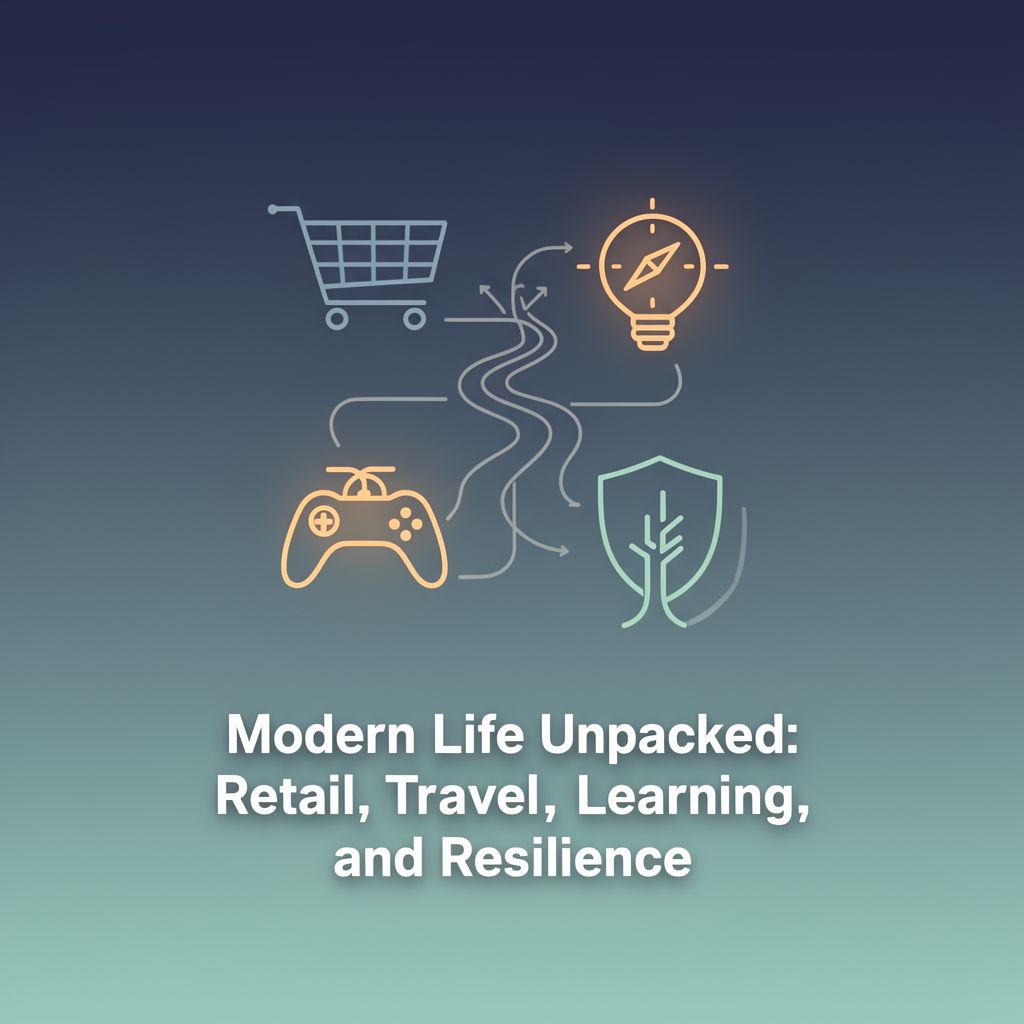
Subject: Comprehensive Study Material
Source Information: This study material has been compiled from a lecture audio transcript and various copy-pasted text sources, including German and Arabic content, which have been fully translated into English for consistency.
📚 Introduction: Exploring Modern Life's Facets
This study guide delves into several key aspects of modern life, offering insights into societal, economic, and personal developments. We will explore the evolution of the supermarket, the multifaceted nature of travel, the innovative field of gamification in education, and the crucial concepts of resilience and financial literacy.
1️⃣ The Supermarket Revolution: From Counter Service to Self-Service
The supermarket, a ubiquitous part of modern life, has a fascinating history marked by significant shifts in shopping habits.
🛒 Early Grocery Shopping: A Social Affair
- Pre-Self-Service Era: Before the 1960s in Germany, grocery shopping was a cumbersome process.
- Customers visited multiple specialized shops.
- Products were individually retrieved, weighed by hand, packaged, and paid for.
- This was time-consuming but also a social event.
- The "Tante-Emma-Laden": Small corner grocery stores, affectionately known as 'Tante-Emma-Laden' (Aunt Emma's Shop), served as community hubs for exchange and friendly conversation.
💡 The Birth of Self-Service
- American Origins: The pioneering idea of self-service originated in the USA.
- Large retail chains with numerous branches existed in the USA since the mid-19th century.
- The King Kullen chain established the modern supermarket concept: a complete range of groceries under one roof, allowing customers to select items themselves.
- German Pioneers:
- 1938: Herbert Eklöh, a trained pharmacist, opened Germany's first self-service store in Osnabrück, a precursor to the modern supermarket. He adopted the concept after observing US models.
- Initial Skepticism: Both customers and competitors in Germany were initially skeptical.
- Retailers feared losing close customer contact.
- Customers had to learn to use shopping carts, often filling them hesitantly.
- Eklöh's Second Attempt (1957): After initial lack of success, Eklöh tried again in 1957, opening the first large supermarket in Cologne.
- Modeled after American style.
- Featured an enormous sales area of 1,700 square meters for its time.
- Immediate Success: This store was an instant hit, leading to a rapid increase in customer numbers and the overall count of supermarkets in Germany.
📈 Growth Factors and Evolution
- Economic Prosperity: The "economic miracle" period brought prosperity, enabling people to afford more, which fueled supermarket growth.
- Decline of Traditional Retail: The traditional food retail sector lost importance, with only larger specialty stores surviving. Shops where the owner stands behind the counter are now largely nostalgic.
- Pricing Challenges: Initially, supermarket prices were relatively high due to price fixing, which allowed manufacturers to set selling prices.
- The Rise of Discounters:
- 1962: Brothers Karl and Theo Albrecht opened their first discounter.
- Their business model was "simple and affordable."
- Online Grocery Shopping: The next major revolution was online grocery shopping, with orders placed online and delivered to the doorstep. This trend also first gained traction in the USA.
2️⃣ The Profound Impact of Travel: Happiness, History, and Dilemmas
Travel is more than just a leisure activity; it's a fundamental human drive with deep historical roots and significant personal and societal implications.
🧠 Travel as a Source of Knowledge and Happiness
- "Erfahrung" (Experience): In German, this word signifies that knowledge, worldly sophistication, and a broader perspective are primarily acquired through travel and being on the move.
- Deeply Ingrained Desire: The desire to travel is considered deeply ingrained in human nature.
- Memory & Learning: Impressions gathered during travel embed themselves deeper into memory than routine daily experiences.
- Scientific Confirmation: Studies, such as one by the University of Tampere in Finland, confirm that travel makes people happier and allows for better recovery than a free day at home, due to freedom from daily obligations and new impressions.
🌍 Historical Perspectives on Travel
- Ancient Times: Travel was not a luxury but a necessity.
- Humans were on the move long before settling down, initially out of necessity, then curiosity, and finally, for discovery.
- Wealthy Romans traveled to places like the Bay of Naples or the Adriatic.
- Middle Ages: Despite arduous living conditions, people continued to travel.
- Hundreds of thousands embarked on pilgrimages across Europe, even during wars or plagues.
- Modern Era: Wealthy nobles mandated educational journeys for their sons to cultural sites (e.g., Paris, Venice, Rome) for social standing and to gather anecdotes.
🤔 Modern Dilemmas and Criticisms of Travel
- Environmental Impact: Increasing voices condemn travel due to its ecological footprint, especially air travel. This creates a dilemma for frequent travelers: how to explore the world without causing harm?
- Moralizing & Guilt: Some critics meticulously calculate the environmental impact of even short trips, instilling guilt in those who fly. The author questions if such "moralizers" are driven by envy.
- "Escape from Daily Life": Some argue travel is merely an escape, and relaxation can be found at home. The author suggests this view might stem from a fear of new experiences and encourages trying travel to leave worries behind.
- Economic Dependence: Many people, especially in poorer regions, depend on tourism for their livelihoods. Reducing travel activities could negatively impact these economies.
- Sustainable Travel: These dilemmas highlight the importance of discussing and practicing sustainable travel.
✅ Author's Stance
- The author acknowledges counterarguments but emphasizes the privilege of our time to immerse in other cultures and learn through travel.
- The author suggests that a world without exploration would be "bleak" and that travel truly brings happiness.
3️⃣ Gamification: Transforming Learning Through Play
Gamification is an innovative approach that applies game design elements and game principles in non-game contexts, particularly in education, to engage and motivate individuals.
🎮 The Essence of Play
- Ubiquitous & Creative: Play is found everywhere and is a fundamental source of human creativity, not a meaningless pastime.
- Cultural Foundation: According to Dutch cultural historian Johan Huizinga, humans develop not only through reason and creation but also through play, suggesting that no culture emerges without it.
- Adaptability: Games have always adapted to the characteristics of their respective eras.
- Virtual Worlds: Modern virtual worlds allow players globally to collaborate (build cities), compete (fight monsters), strategize, and assume different roles.
🚀 What is Gamification?
- Definition: Coined by programmer Nick Pelling, "gamification" refers to the transfer of game mechanisms (e.g., collecting points, high scores, levels) to non-gaming contexts, such as educational settings.
- Objective: To activate the innate human play drive to boost motivation, especially for unpopular tasks and topics.
- Real-World Spread: The popularity of computer games has led to game mechanisms spreading into everyday life beyond digital games.
🎓 Gamification in Education
- Integration: Gamification has long been integrated into the education sector, moving beyond simple learning games to complex, multifaceted game arrangements.
- University Examples:
- Mathematics Students: Can earn points by solving problems on learning platforms.
- First-Year Students: May embark on virtual research expeditions (e.g., to Antarctica) to practice skills like researching, citing, and academic writing.
- Criticisms: Critics argue that fun and excitement cannot replace disciplined learning and the processing of difficult subject matter.
- Benefits: Despite criticisms, playful elements used for knowledge transfer can build a valuable bridge. Games present participants with complex challenges, fostering the urge to master them through knowledge acquisition and cooperation.
4️⃣ Cultivating Resilience and Financial Awareness
These two topics are crucial for personal well-being and navigating modern life's challenges.
💪 Resilience: The Ability to Cope
- 📚 Definition: Resilience describes the ability to cope with stress and crises effectively.
- Learned Skill: Resilience is not innate but a learned skill that can be developed.
- Resilient Individuals:
- Are exceptionally adaptable.
- Find new ways to achieve goals, even in difficult circumstances.
- Situations Where Resilience is Key:
- Job loss
- Exams (school and university)
- Workplace stress
- ✅ Characteristics of Resilient People:
- Optimism
- Acceptance
- Adaptability
- Self-reflection
- Willingness to learn
- 💡 Practical Tips for Cultivating Resilience:
- Maintain social contacts.
- Take responsibility for your well-being.
- Practice self-care through hobbies.
- Utilize relaxation techniques like meditation and breathing exercises.
💰 Financial Awareness and Education
- Early Education: It is crucial to teach financial literacy to the younger generation early on.
- Perspectives on University Funding: There are diverse viewpoints on how higher education should be financed:
- State Funding: Access to university education should be ensured for all through government support.
- Student Independence: Students covering living expenses through part-time jobs fosters independence.
- Corporate Support: Companies should offer more funding opportunities for their future workforce.
- Job Market Demand: Only study programs in high demand in the job market should receive funding.
- Self-Funding by Academics: Since academics often earn more, they should bear their study costs themselves.
- Non-University Options: School leavers should be aware that good earning opportunities can exist even without a university degree.
- Parental Role: Not all parents are willing or able to finance their children's university studies.
5️⃣ Insights from Dr. Julia Henzel on Cycling
Dr. Julia Henzel offers valuable perspectives on cycling, its societal role, and ways to promote it.
- Commuting Habits: Dr. Henzel does not frequently use a bicycle for her commute to work.
- Research Focus: When she began her doctorate, she had a different research focus than her current work on cycling.
- Societal Importance of Bicycles: She emphasizes that bicycles are noteworthy for their social purposes, not just as a mode of transport.
- Improving Urban Cycling Conditions: To encourage more car drivers to switch to cycling, conditions for bicycle traffic in cities must be significantly improved.
- Traffic Improvement: Lowering the maximum speed limit in cities is recommended to improve overall traffic situations.
- Motivating Children: Parents serve as crucial role models in motivating children to cycle.
- Expanding Cycling Education: Cycling education should be expanded to include diverse content, going beyond basic skills.
- Rural Public Transport: Dr. Henzel finds the poor development of public transport in rural areas annoying.
- Parental Carpooling: She recommends that parents form carpools for transportation needs.
- Future Plans: Dr. Henzel plans to continue working in research.
6️⃣ Biographical Notes: Erika Fuchs, Translator Legend
Erika Fuchs was a pioneering German comic translator, known for her distinctive style.
- Childhood: Her childhood was marked by her family's constant financial worries.
- Father's Parenting: Retrospectively, she viewed her father's parenting methods negatively.
- Education:
- Her father had no reservations about her desire to attend a boys' high school.
- She had to acquire private language skills before being allowed to attend high school.
- She did not spend much time researching in archives during her doctorate.
- Career & Contributions:
- She did not found a small publishing house for children's magazines.
- She was not a passionate comic reader before becoming a comic translator.
- Her husband, Günter Fuchs, supported her work with his extensive literary knowledge.
- She was not often accused of excessively altering the original American comics during translation.
- She was not the first to use a specific verb form (the "Erikativ").
- She had not worked with her successor as editor-in-chief for many years prior.
- Legacy: Erika Fuchs is remembered as a "Translator Legend" who dedicated her life to comics.