Ottoman Empire's 18th Century Decline: A Deep Dive - kapak
Tarih#ottoman empire#18th century#decline period#ottoman history

Ottoman Empire's 18th Century Decline: A Deep Dive

Explore the 18th-century decline of the Ottoman Empire, examining internal weaknesses, external pressures, key conflicts, and the empire's struggle to adapt to a changing world.

eslemcknMay 5, 2026 ~14 dk toplam
01

Görsel Özet

İnfografik

Konunun tüm parçalarını tek bakışta gör.

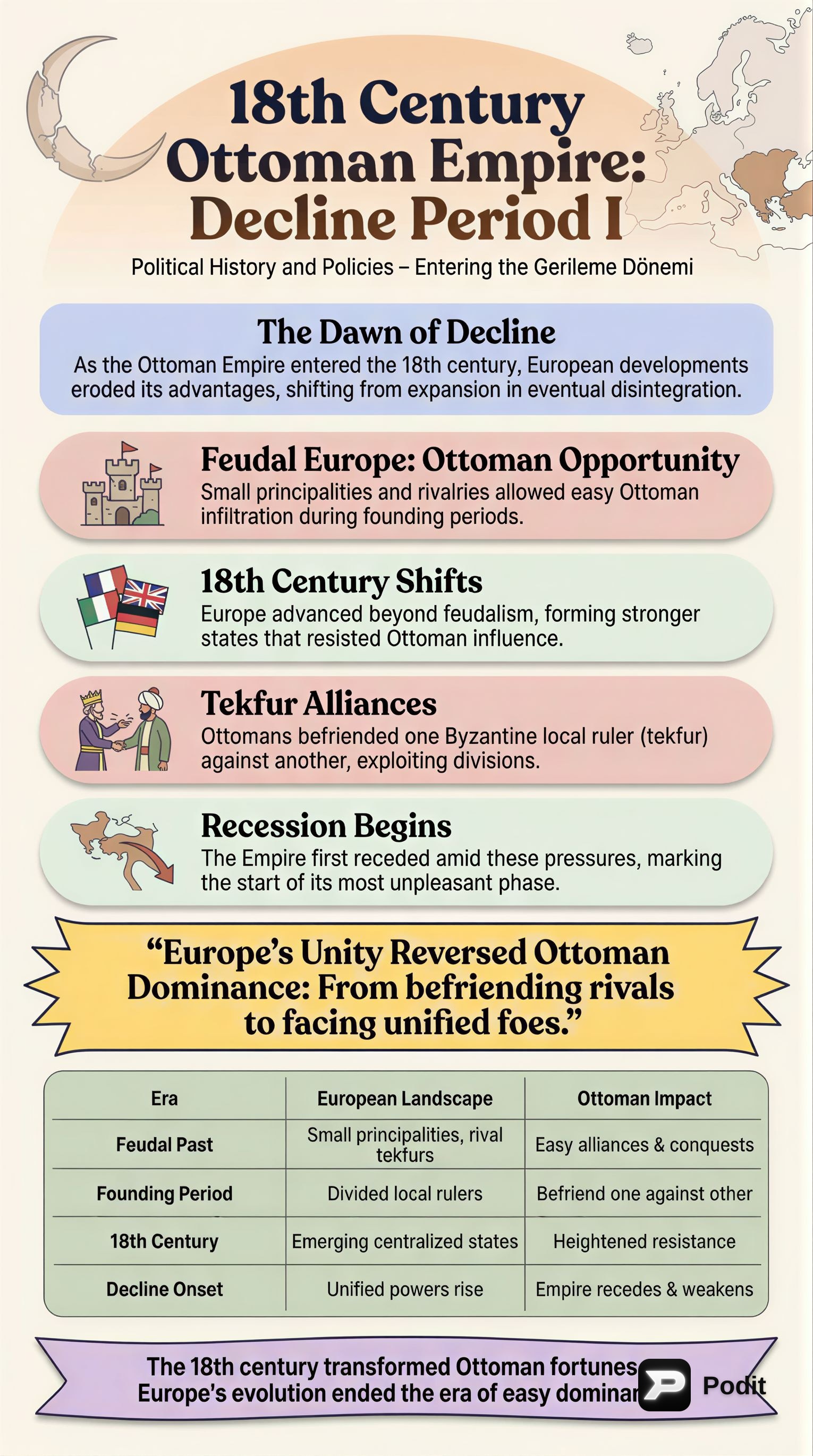
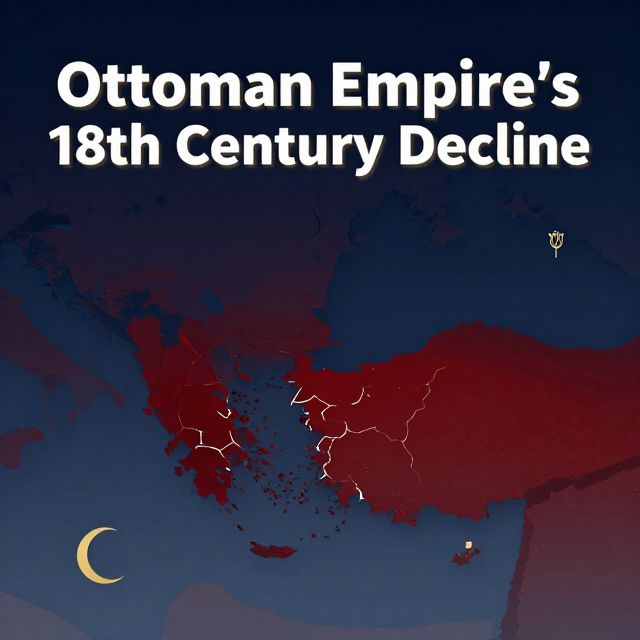
Ottoman Empire's 18th Century Decline: A Deep Dive - görsel özet infografik
Tam boyutta görüntüle →
02

Flash Kartlar

25 kart

Karta tıklayarak çevir. ← → ile gez, ⎵ ile çevir.

1 / 25
Tüm kartları metin olarak gör
  1. 1. What is the main topic of this content?

    The main topic of this content is the Ottoman Empire's Decline Period in the 18th Century. It explores how a once mighty empire began its long period of decline during this crucial phase. The lesson aims to provide a clear understanding of the challenges faced and how they shaped future developments.

  2. 2. What period is referred to as the 'Decline Period' for the Ottoman Empire in this context?

    The 18th century is referred to as the 'Decline Period' for the Ottoman Empire in this context. This era marks a crucial phase where the empire faced significant internal weaknesses and external pressures. It was a challenging time that set the stage for future developments and its eventual dissolution.

  3. 3. What key aspects will be explored regarding the Ottoman Empire in this lesson?

    This lesson will explore the internal weaknesses, external pressures, and significant events that shaped the Ottoman Empire during the 18th century. It aims to provide a clear understanding of why this period was so challenging. The content will cover administrative corruption, military stagnation, economic struggles, and major conflicts.

  4. 4. Describe the internal weakness related to Ottoman administration during the 18th century.

    During the 18th century, the Ottoman administration suffered from significant internal weaknesses, primarily due to a vast bureaucracy that had grown corrupt and inefficient. Nepotism and bribery became common practices within the system. This widespread corruption severely eroded the central authority of the empire, making effective governance increasingly difficult.

  5. 5. How did the Janissary corps change during the 18th century?

    The Janissary corps, originally an elite fighting force, underwent a significant transformation during the 18th century. They evolved into a privileged and undisciplined group. Their primary interests shifted from military prowess to political power and personal gain, severely diminishing their effectiveness as a military unit and contributing to the empire's internal weaknesses.

  6. 6. What economic challenges did the Ottoman Empire face due to global trade routes in the 18th century?

    The Ottoman Empire faced significant economic challenges due to the shift in global trade routes during the 18th century. The discovery of new sea routes bypassed Ottoman-controlled lands, leading to a substantial decrease in customs revenues. This redirection of trade diminished the empire's economic vitality and its role in international commerce.

  7. 7. Why did the Ottoman Empire experience a constant outflow of silver and gold during this period?

    The Ottoman Empire experienced a constant outflow of silver and gold primarily due to its inability to industrialize and compete with European manufacturing. As European nations produced goods more efficiently, the Ottomans had to import more, leading to a trade imbalance. This economic disparity resulted in a steady drain of precious metals from the empire.

  8. 8. Which powerful European states primarily pressured the Ottoman Empire externally in the 18th century?

    In the 18th century, the Ottoman Empire faced increasing external pressure primarily from powerful European states, notably Russia and Austria. These nations were rapidly modernizing their armies and actively seeking to expand their territories. Their aggressive expansionist policies came at the expense of the weakening Ottoman Empire, leading to numerous conflicts.

  9. 9. How did the balance of power in Europe shift during this time concerning the Ottomans?

    The balance of power in Europe shifted dramatically during the 18th century, leaving the Ottomans increasingly vulnerable. European states like Russia and Austria were rapidly modernizing and growing stronger, while the Ottoman Empire was experiencing internal decay. This shift meant that the Ottomans were no longer the dominant force and struggled to compete militarily and politically with their European rivals.

  10. 10. Which significant war marked the 18th-century decline of the Ottoman Empire, as mentioned in the text?

    The Russo-Turkish War of 1768-1774 is highlighted as perhaps the most significant war marking the 18th-century decline of the Ottoman Empire. This devastating conflict concluded with the Treaty of Küçük Kaynarca, which was a monumental blow to the Ottomans. It resulted in significant territorial losses and granted Russia unprecedented influence within the empire.

  11. 11. When did the Russo-Turkish War mentioned in the text take place?

    The Russo-Turkish War mentioned in the text took place from 1768 to 1774. This six-year conflict was a critical event in the 18th-century decline of the Ottoman Empire. It culminated in the signing of the Treaty of Küçük Kaynarca, which had profound and lasting negative consequences for the Ottomans.

  12. 12. What was the name of the treaty that concluded the Russo-Turkish War of 1768-1774?

    The treaty that concluded the Russo-Turkish War of 1768-1774 was the Treaty of Küçük Kaynarca. This treaty represented a monumental blow to the Ottoman Empire. It granted Russia significant territorial gains and, crucially, the right to protect Orthodox Christians within Ottoman borders, setting a precedent for future interference.

  13. 13. What were the significant territorial gains for Russia as a result of the Treaty of Küçük Kaynarca?

    As a result of the Treaty of Küçük Kaynarca, Russia gained significant territorial advantages, including direct access to the Black Sea. This acquisition was strategically vital for Russia, enhancing its naval power and trade routes. The territorial losses further weakened the Ottoman Empire's control over its northern borders and its influence in the region.

  14. 14. What crucial right did the Treaty of Küçük Kaynarca grant Russia regarding Orthodox Christians?

    The Treaty of Küçük Kaynarca granted Russia the crucial right to protect Orthodox Christians within the Ottoman Empire. This clause was highly significant because it provided Russia with a legal basis to interfere in Ottoman internal affairs. It became a frequent pretext for future Russian interventions and further eroded Ottoman sovereignty.

  15. 15. What was the implication of Russia gaining the right to protect Orthodox Christians within the Ottoman Empire?

    The implication of Russia gaining the right to protect Orthodox Christians within the Ottoman Empire was profound. It meant that a foreign power now had a legal basis to meddle in the Ottoman Empire's domestic policy. This 'protection' clause became a recurring pretext for Russian interference, undermining Ottoman sovereignty and contributing to its decline.

  16. 16. Which other major conflict further demonstrated Ottoman military inferiority in the late 18th century?

    Another major conflict that further demonstrated Ottoman military inferiority in the late 18th century was the Austro-Turkish War of 1787-1791. Despite some Ottoman resistance, this war highlighted their military disadvantages against modernizing European armies. It contributed to further territorial losses and drained the empire's already strained resources and morale.

  17. 17. What were the general consequences of these wars for the Ottoman Empire besides territorial losses?

    Besides territorial losses, the general consequences of these wars for the Ottoman Empire included a severe drain on its already strained resources and morale. The constant conflicts weakened the empire financially and militarily. They also exposed the empire's military inferiority, forcing them to constantly play catch-up with European powers and attempt often ineffective reforms.

  18. 18. How did the Ottomans attempt to address their military inferiority in the 18th century?

    To address their military inferiority in the 18th century, the Ottomans attempted to implement military reforms inspired by European models. They recognized the need to modernize their armed forces to compete with their powerful neighbors. However, these reforms were often implemented too little, too late, and faced significant internal resistance, limiting their overall effectiveness.

  19. 19. Summarize the internal factors contributing to the Ottoman Empire's 18th-century decline.

    Internal factors contributing to the Ottoman Empire's 18th-century decline included administrative corruption and inefficiency, characterized by nepotism and bribery. The Janissary corps transformed from an elite fighting force into a self-serving, undisciplined group. Economically, the empire suffered from a shift in global trade routes and an inability to industrialize, leading to a constant outflow of wealth.

  20. 20. Summarize the external factors contributing to the Ottoman Empire's 18th-century decline.

    External factors contributing to the Ottoman Empire's 18th-century decline primarily involved increasing pressure from powerful European states, particularly Russia and Austria. These powers were rapidly modernizing their armies and aggressively seeking territorial expansion at the Ottomans' expense. The dramatic shift in the European balance of power left the Ottoman Empire increasingly vulnerable to foreign aggression and intervention.

  21. 21. What does the Treaty of Küçük Kaynarca symbolize in the context of Ottoman decline?

    The Treaty of Küçük Kaynarca symbolizes a major turning point and a significant blow in the context of Ottoman decline. It marked substantial territorial losses for the Ottomans and, more importantly, granted Russia the right to protect Orthodox Christians within the empire. This clause became a symbol of foreign intervention and the erosion of Ottoman sovereignty, setting a precedent for future meddling.

  22. 22. Beyond territorial losses, what else did the Ottoman Empire lose during this period?

    Beyond territorial losses, the Ottoman Empire lost significant prestige, economic vitality, and the ability to effectively govern during the 18th century. The widespread corruption and inefficiency undermined central authority, while economic shifts and lack of industrialization diminished its wealth. These losses collectively weakened the empire's standing and its capacity to maintain control.

  23. 23. How did the challenges of the 18th century set the stage for the 19th century's perception of the Ottoman Empire?

    The challenges faced in the 18th century laid the groundwork for the 'Sick Man of Europe' narrative that would dominate the 19th century. The internal decay, military stagnation, and significant territorial losses during this period created an image of a weakening, declining empire. This perception influenced European powers' policies and further contributed to the empire's struggles in the subsequent century.

  24. 24. What was the 'Sick Man of Europe' narrative, and when did it dominate?

    The 'Sick Man of Europe' narrative was a derogatory term used to describe the Ottoman Empire in the 19th century, reflecting its perceived decline and weakness. It dominated the 19th century, portraying the empire as unstable and on the verge of collapse. This narrative was a direct consequence of the significant internal and external challenges the empire faced in the 18th century.

  25. 25. What specific administrative issues contributed to the erosion of central authority in the Ottoman Empire?

    Specific administrative issues that contributed to the erosion of central authority in the Ottoman Empire included widespread nepotism and bribery. These practices became common within the vast bureaucracy, leading to inefficiency and corruption. The integrity and effectiveness of the central government were severely compromised, making it difficult to enforce laws and maintain control across the empire.

03

Bilgini Test Et

15 soru

Çoktan seçmeli sorularla öğrendiklerini ölç. Cevap + açıklama.

Soru 1 / 15Skor: 0

Which century is often referred to as the Ottoman Empire's 'Decline Period' in the provided text?

04

Detaylı Özet

4 dk okuma

Tüm konuyu derinlemesine, başlık başlık.

This content is based on a YouTube video.

The Ottoman Empire in the 18th Century: The Period of Decline

Introduction 📚

The 18th century marks a pivotal and challenging era for the Ottoman Empire, often referred to as its 'Decline Period.' During this time, an empire that once spanned three continents began to face significant internal weaknesses and relentless external pressures. Understanding this period is crucial for grasping the broader trajectory of the Ottoman Empire and its eventual dissolution, setting the stage for the "Sick Man of Europe" narrative of the 19th century. This study material will explore the key factors, conflicts, and legacies that defined the Ottoman Empire's 18th-century decline.

I. Understanding the Concept of Decline 📉

The term 'decline' in this context refers to a period characterized by:

  • Erosion of Central Authority: Weakening of the Sultan's power and effective governance.
  • Military Stagnation: Inability to keep pace with European military advancements.
  • Economic Deterioration: Loss of revenue and inability to adapt to global economic shifts.
  • Territorial Losses: Significant ceding of lands to rival powers.
  • Loss of Prestige: Diminished standing on the international stage.

II. Factors Contributing to Decline: Internal Weaknesses and External Pressures

The 18th century saw a confluence of internal decay and increasing external threats that severely impacted the Ottoman Empire.

A. Internal Weaknesses 📉

The empire's vast internal structure, once a source of strength, became a major vulnerability.

  1. Administrative Corruption and Inefficiency:

    • Bureaucracy: The once efficient Ottoman administration became plagued by corruption and inefficiency.
    • Nepotism and Bribery: These practices became widespread, eroding the central authority and undermining effective governance.
    • Impact: This led to a breakdown in law and order, reduced state revenues, and a general weakening of the state's ability to implement reforms or respond to crises.
  2. Military Stagnation: The Janissary Corps

    • Transformation: The Janissaries, originally an elite fighting force, transformed into a privileged and undisciplined group.
    • Focus Shift: Their interests shifted from military prowess to political power and personal gain.
    • Consequences: This led to a decline in military effectiveness, resistance to modernization, and frequent interference in state affairs, often through revolts.
  3. Economic Struggles:

    • Shift in Global Trade Routes: The discovery of new sea routes (e.g., around Africa) bypassed Ottoman-controlled lands, leading to a significant decrease in customs revenues.
    • Lack of Industrialization: The empire's inability to industrialize and compete with rapidly industrializing European manufacturing nations meant a constant outflow of silver and gold to purchase European goods.
    • Impact: This resulted in economic stagnation, inflation, and a weakening of the empire's financial base.

B. External Pressures ⚔️

Simultaneously, the Ottoman Empire faced formidable challenges from rapidly modernizing European powers.

  1. Rising European Powers:

    • Primary Adversaries: Russia and Austria emerged as the most significant threats, actively seeking to expand their territories at the Ottomans' expense.
    • Modernization: These powers were rapidly modernizing their armies and administrative structures, creating a significant military disparity.
  2. Shift in the Balance of Power:

    • European Dominance: The balance of power in Europe had shifted dramatically, leaving the Ottomans increasingly vulnerable and on the defensive.
    • Territorial Ambitions: European states viewed the weakening Ottoman Empire as an opportunity for territorial gains and strategic advantages.

III. Key Conflicts and Territorial Losses 🌍

The 18th century was punctuated by a series of devastating wars that underscored the empire's declining military and political strength.

A. The Russo-Turkish War (1768-1774)

This conflict was perhaps the most significant and damaging war for the Ottomans in the 18th century.

  1. Outcome: The war concluded with the signing of the Treaty of Küçük Kaynarca in 1774. ✅
  2. Significance of the Treaty:
    • Territorial Gains for Russia: Russia gained significant territories, including access to the Black Sea, which was a major strategic victory.
    • Protection of Orthodox Christians: Crucially, the treaty granted Russia the right to protect Orthodox Christians within the Ottoman Empire. ⚠️ This clause became a persistent pretext for future Russian interference in Ottoman internal affairs, effectively allowing a foreign power to meddle in domestic policy.
    • Symbol of Decline: The treaty was a monumental blow to the Ottomans, symbolizing their diminished power and the growing influence of European states.

B. The Austro-Turkish War (1787-1791)

  • Further Weakness: This conflict, despite some Ottoman resistance, further demonstrated their military inferiority compared to European forces.
  • Resource Drain: These wars not only resulted in territorial losses but also severely drained the empire's already strained resources and morale.
  • Reform Attempts: The Ottomans were constantly attempting to implement military reforms inspired by European models, but these efforts were often "too little, too late" to reverse the tide.

IV. Legacy of the 18th Century Decline 📚

The challenges and events of the 18th century had profound and lasting consequences for the Ottoman Empire.

  • Combined Impact: The period showcased how a combination of internal decay (administrative corruption, military stagnation) coupled with relentless external pressure from modernizing European powers led to significant territorial losses and a weakening of central authority.
  • Symbolic Turning Point: The Treaty of Küçük Kaynarca stands out as a critical turning point, marking a new era in Ottoman-Russian relations and European interventionism.
  • Loss of Vitality: The decline was not merely about losing land; it encompassed a loss of prestige, economic vitality, and the fundamental ability to govern effectively.
  • Foundation for Future Narratives: This era laid the groundwork for the infamous "Sick Man of Europe" narrative that would come to define the Ottoman Empire in the 19th century, highlighting its perceived weakness and vulnerability to European powers.

💡 Insight: Understanding the specific internal and external factors of the 18th century is key to comprehending why the Ottoman Empire, despite its vast history, entered a prolonged period of decline that ultimately led to its dissolution.
Kendi çalışma materyalini oluştur

PDF, YouTube videosu veya herhangi bir konuyu dakikalar içinde podcast, özet, flash kart ve quiz'e dönüştür. 1.000.000+ kullanıcı tercih ediyor.

Sıradaki Konular

Tümünü keşfet
Ottoman Decline: 18th Century Challenges

Ottoman Decline: 18th Century Challenges

Explore the 18th-century decline of the Ottoman Empire, examining its internal weaknesses, external pressures, and the pivotal events that marked this transformative period in its history.

Özet 15 Görsel
Ottoman Empire's 18th Century Decline

Ottoman Empire's 18th Century Decline

An academic summary of the Ottoman Empire's period of decline in the 18th century, examining internal weaknesses, external pressures, and reform attempts.

7 dk 25 15
The Ottoman Empire's 18th-Century Decline

The Ottoman Empire's 18th-Century Decline

An academic overview of the Ottoman Empire's period of decline during the 18th century, examining its political, military, and economic challenges and the factors contributing to its weakening.

6 dk Özet 25 15
Ottoman Empire: Culture and Civilization (Part 3)

Ottoman Empire: Culture and Civilization (Part 3)

An academic overview of the Ottoman Empire's cultural and civilizational aspects, including social structure, education, arts, and legal systems, highlighting its unique identity and enduring legacy.

7 dk Özet 25 15 Görsel
The 1876 Ottoman Constitution: Articles and Key Figures

The 1876 Ottoman Constitution: Articles and Key Figures

Explore the 1876 Ottoman Constitution's pivotal articles and the influential figures who shaped or reacted to its complex framework, revealing its blend of reform and absolutism.

25 15
Ottoman Empire: Early 20th Century Challenges

Ottoman Empire: Early 20th Century Challenges

Explore the critical internal and external challenges faced by the Ottoman Empire in the early 20th century, leading to its eventual decline and dissolution.

Özet 15 Görsel
Life in the Colonies: Daily Routines, Rights, and Justice

Life in the Colonies: Daily Routines, Rights, and Justice

An academic overview of colonial life, covering daily routines, economic activities, urban challenges, the evolution of colonists' rights, and the system of crime and punishment.

5 dk 15
The Lausanne Peace Treaty: Negotiations and Outcomes

The Lausanne Peace Treaty: Negotiations and Outcomes

An academic summary of the Lausanne Peace Treaty, covering its negotiation phases, key provisions, unresolved issues, and its profound historical significance for the Turkish Republic.

8 dk Özet 25 15