 Podit
Podit
Post-World War II Turkey: Economic, Political, and Geopolitical Transformations
Source Information: This study material has been compiled from a lecture audio transcript and a list of user-provided topics/questions. All content has been synthesized and organized for clarity and educational value.
📚 Introduction: A Nation in Transition
The period following World War II marked a pivotal era for Turkey, characterized by profound shifts across its economic, social, and political landscapes. This study guide explores Turkey's journey from a single-party system towards a multi-party democracy, its strategic alignment with the Western Bloc amidst the emerging Cold War, and the significant economic and geopolitical challenges it encountered. Key aspects include economic restructuring, the impact of international aid, and the complexities of its foreign relations, particularly with Greece and regarding the Cyprus issue.
📈 Economic and Social Transformations
Post-World War II, Turkey's economy underwent substantial changes, necessitating new policies to stimulate growth and address wartime strains.
1. Economic Restructuring and Devaluation
- Post-War Economic Life: Turkey's economic life after WWII involved a shift towards more market-oriented approaches to foster recovery and growth.
- 📚 What is Devaluation?
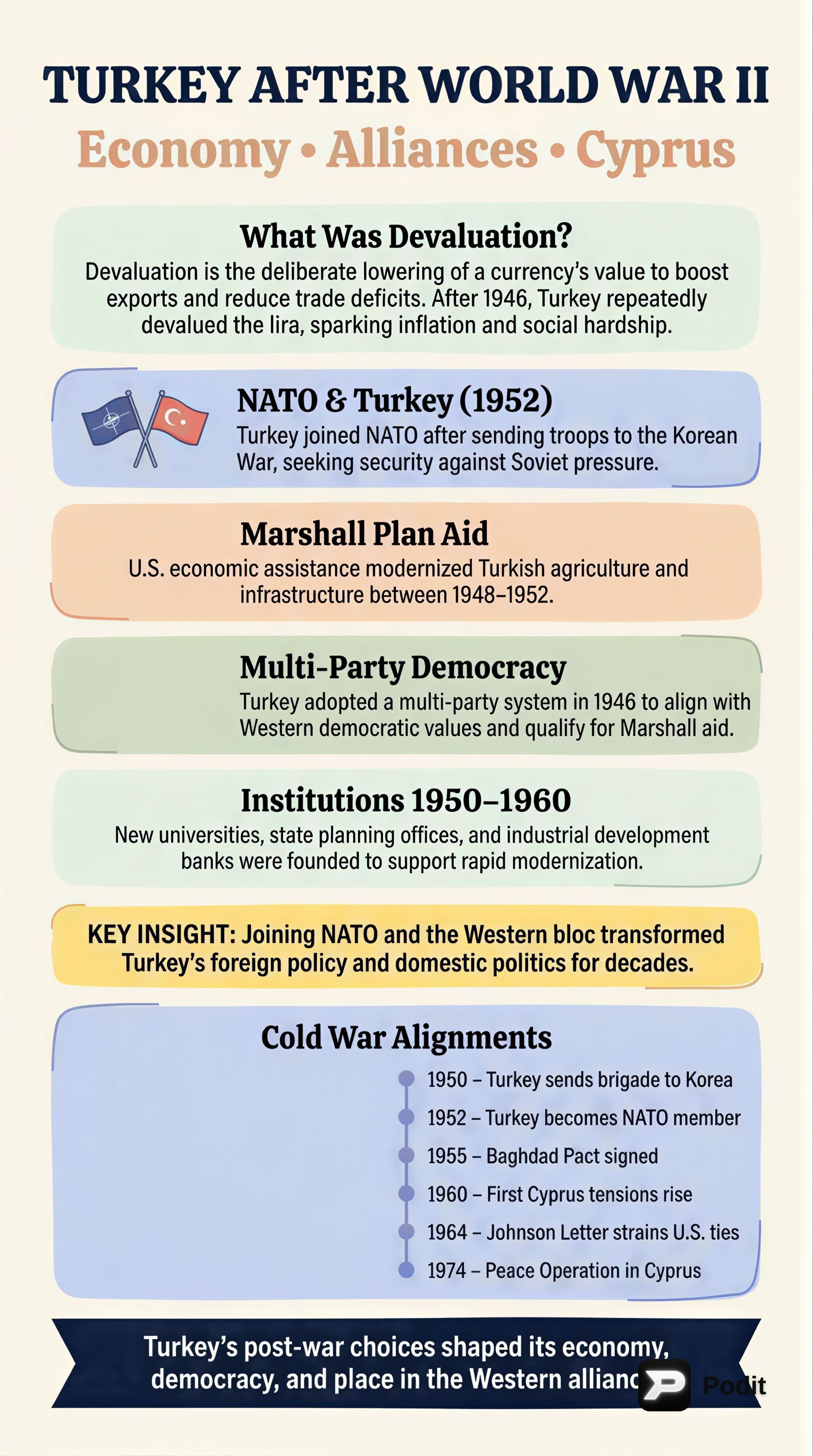
- Devaluation refers to the deliberate downward adjustment of a country's currency value relative to other currencies.
- Purpose: Typically implemented to address balance of payments deficits, enhance export competitiveness, or manage inflation.
- Social Impact of Devaluation:
- Devaluation significantly impacted social life in Turkey.
- It often led to shifts in purchasing power, changes in the cost of living, and subsequent adjustments in societal economic behaviors and expectations.
2. The Marshall Plan and Economic Aid
- 📚 What is the Marshall Plan?
- An American initiative designed to aid the economic recovery of Western European nations after World War II.
- Turkey's Role: Turkey's participation in the Marshall Plan provided vital economic assistance, contributing to its development efforts and further solidifying its alignment with the Western world.
3. Institutional Growth (1950-1960)
- Between 1950 and 1960, numerous institutions and organizations were established.
- Goal: These establishments generally aimed at fostering industrial growth, agricultural development, and financial stability, reflecting a concerted effort to modernize the economy and infrastructure.
🏛️ Political Evolution and International Alignment
Turkey's post-war era also witnessed a significant political evolution, notably its transition to a multi-party system and its firm alignment with the Western Bloc.
1. Transition to Multi-Party Democracy
- Reasons for Transition:
- ✅ Internal Pressures: Growing demands for greater political freedom and representation within the country.
- ✅ External Influence: The post-war global order increasingly championed democratic governance, influencing Turkey's political trajectory.
2. Alignment with the Western Bloc
- Reasons for Western Alignment:
- ⚠️ Soviet Threat: The perceived threat from the Soviet Union compelled Turkey to seek security guarantees and alliances with Western powers.
- Strategic Imperative: This alignment was a strategic necessity driven by the geopolitical realities of the Cold War.
3. The Korean War and NATO Accession
- Korean War (1950-1953):
- Turkey's participation in the Korean War demonstrated its dedication to collective security and its emerging role within the Western alliance.
- Its military contributions underscored its commitment to the Western cause.
- NATO and Turkey's Accession:
- This commitment culminated in Turkey's accession to NATO in 1952.
- Significance: A pivotal moment that firmly integrated the nation into the Western defense architecture.
4. Internal Political Developments During the Democratic Party (DP) Years
During the rule of the Democratic Party (1950-1960), Turkey experienced several key internal political developments:
- 1️⃣ Economic Liberalization Policies: Implementation of policies aimed at opening up the economy and reducing state intervention.
- 2️⃣ Increased Political Participation: A rise in public debate and broader political engagement.
- 3️⃣ Evolving Tensions: Growing tensions between secularist principles and religious expression.
- 4️⃣ Political Polarization: A gradual rise in authoritarian tendencies leading to increased political division.
5. The 1950 Elections and Electoral Reforms
The 1950 elections were a landmark event, introducing several key regulations that transformed the political landscape:
- ✅ Secret Ballot: Voters could cast their ballots in secret, ensuring privacy and reducing intimidation.
- ✅ Public Counting: Ballots were counted publicly, enhancing transparency and electoral integrity.
- ✅ Broader Participation: Reforms aimed at ensuring wider political participation.
- ✅ Peaceful Transfer of Power: Set a crucial democratic precedent for the peaceful transition of government.
🌍 Cold War Alliances
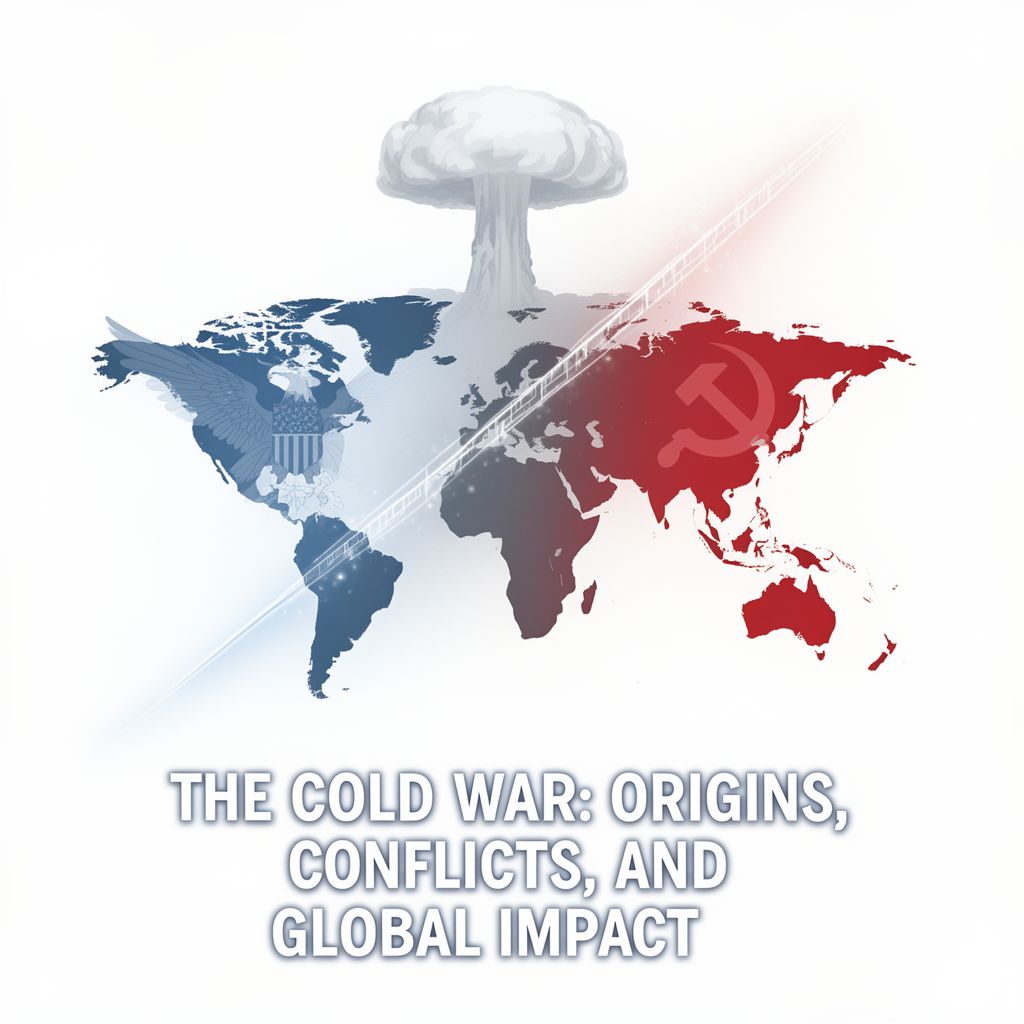
The Cold War era saw the formation of two major opposing blocs, NATO and the Warsaw Pact.
1. NATO Member States (Cold War Era)
- The North Atlantic Treaty Organization (NATO) was formed in 1949.
- Examples:
- United States 🇺🇸
- United Kingdom 🇬🇧
- France 🇫🇷
- West Germany 🇩🇪 (joined 1955)
- Other key members included Canada, Italy, Belgium, Netherlands, Luxembourg, Denmark, Norway, Iceland, Portugal, Greece (joined 1952), and Turkey (joined 1952).
2. Warsaw Pact States (Cold War Era)
- The Warsaw Pact was formed in 1955 in response to NATO.
- Examples:
- Soviet Union 🇷🇺
- Poland 🇵🇱
- East Germany 🇩🇪
- Czechoslovakia 🇨🇿
- Other members included Hungary, Romania, Bulgaria, and Albania (withdrew 1968).
🗺️ Geopolitical Challenges: Cyprus and Greco-Turkish Relations
The post-1960 period was marked by significant geopolitical challenges, particularly concerning the Cyprus issue and its impact on relations between Turkey and Greece.
1. The Cyprus Issue
- Origins: The Cyprus problem originated from the desire of Greek Cypriots for Enosis (union with Greece) and the security concerns of the Turkish Cypriot community.
- Examples of the Cyprus Issue:
- 1974 Cyprus Peace Operation: Turkey's intervention aimed at protecting Turkish Cypriots following a Greek-backed coup on the island.
- Division of the Island: The subsequent de facto division of Cyprus into a Greek Cypriot-controlled south and a Turkish Cypriot-controlled north.
- Turkish Republic of Northern Cyprus (TRNC): The establishment of the TRNC in 1983, recognized only by Turkey.
- Ongoing Diplomatic Efforts: Persistent international efforts to achieve a lasting resolution and reunification.
2. Reasons for Problems Between Turkey and Greece After 1960
The reasons for persistent problems between Turkey and Greece after 1960 are multifaceted:
- ✅ Cyprus Issue: This stands as a primary driver of tension, with differing historical narratives and political objectives.
- ✅ Aegean Sea Disputes: Various disagreements over territorial waters, airspace, and continental shelf rights in the Aegean Sea.
- ✅ Minority Rights: Issues concerning the treatment of Turkish minority in Greece and Greek minority in Turkey.
- ✅ Historical Grievances: Lingering historical tensions and mistrust.
3. Key Concepts in Greco-Turkish Disputes
- 📚 Enosis:
- Refers to the political movement for the union of Cyprus with Greece.
- A central cause of conflict and instability in Cyprus.
- 📚 Mavi Vatan (Blue Homeland):
- A Turkish geopolitical concept asserting Turkey's maritime jurisdiction and strategic interests.
- Encompasses areas across the Aegean, Mediterranean, and Black Seas, often leading to disputes over maritime boundaries.
- 📚 Continental Shelf:
- The extended perimeter of each continent, submerged under relatively shallow seas.
- Importance: Critically important for determining sovereign rights over natural resources (e.g., hydrocarbons) and for establishing maritime boundaries between neighboring states. Disputes over its delimitation are a major source of tension between Turkey and Greece.
✅ Conclusion
Turkey's post-World War II journey was defined by profound internal transformations towards democracy and economic liberalization. Its foreign policy was firmly anchored in Western alliances during the Cold War, a commitment demonstrated through its participation in the Korean War and its accession to NATO. Simultaneously, Turkey navigated persistent geopolitical challenges, most notably the complex Cyprus issue and the enduring tensions with Greece over Aegean disputes. These developments collectively shaped modern Turkey's national identity, its strategic orientation, and its ongoing role in regional and international affairs.