Science: Diet, Chemical Reactions, and Magnetism - kapak
Bilim#science#diet#growth#nutrition

Science: Diet, Chemical Reactions, and Magnetism

This summary explores fundamental concepts across science, including the principles of diet and growth, the mechanisms of chemical reactions, and the properties and applications of magnetism.

dortem07June 4, 2026 ~21 dk toplam
01

Sesli Özet

6 dakika

Konuyu otobüste, koşarken, yolda dinleyerek öğren.

Sesli Özet

Science: Diet, Chemical Reactions, and Magnetism

0:006:11
02

Görsel Özet

İnfografik

Konunun tüm parçalarını tek bakışta gör.

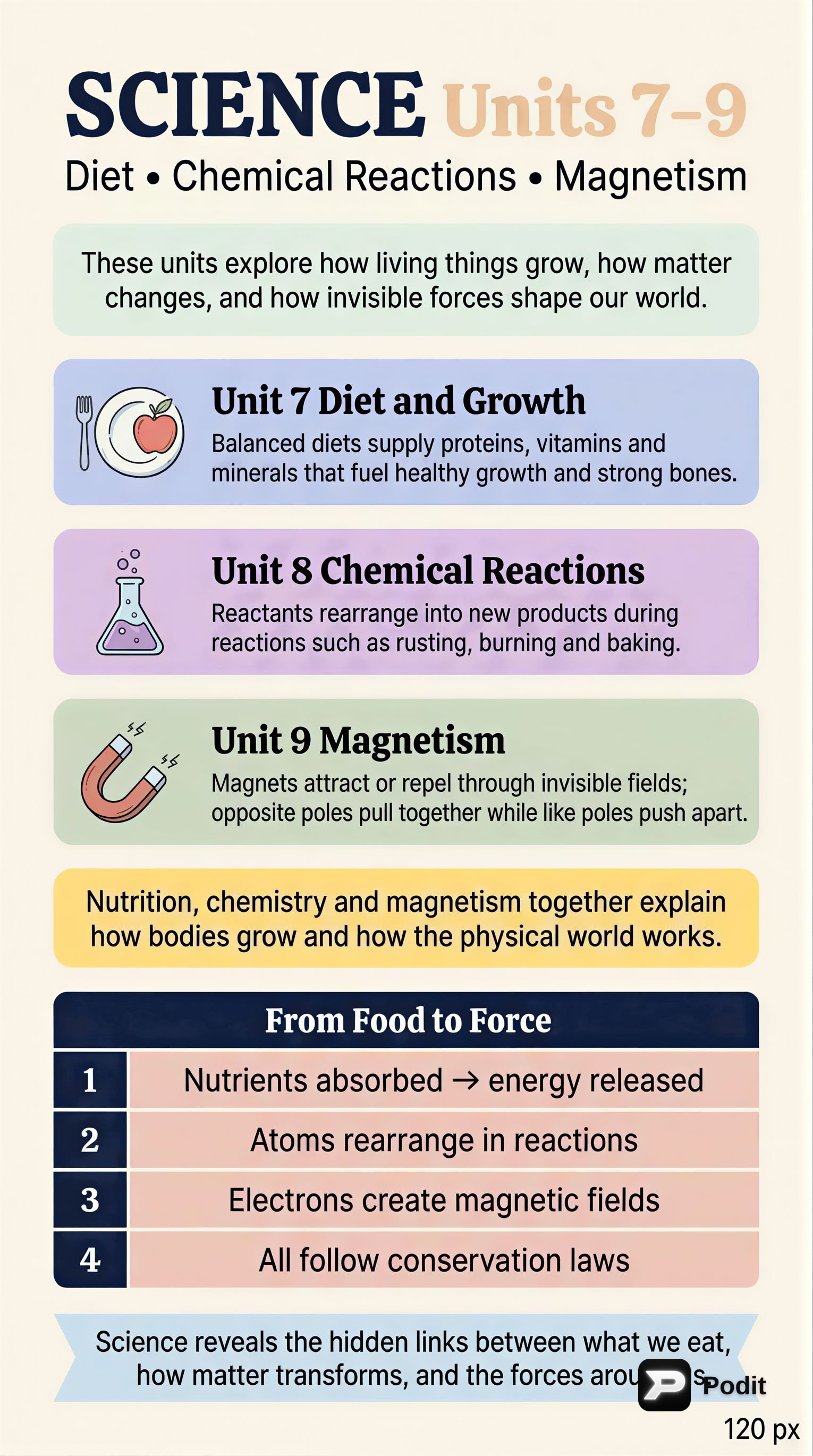
Science: Diet, Chemical Reactions, and Magnetism - görsel özet infografik
Tam boyutta görüntüle →
03

Flash Kartlar

25 kart

Karta tıklayarak çevir. ← → ile gez, ⎵ ile çevir.

1 / 25
Tüm kartları metin olarak gör
  1. 1. What is the definition of "diet" in a biological context?

    In a biological context, "diet" refers to the total amount of food and drink consumed by an organism. It provides the essential nutrients required for energy production, tissue maintenance and repair, and overall physiological functions. A balanced diet is crucial for sustaining life and promoting healthy development.

  2. 2. Explain the primary role of carbohydrates in an organism's diet.

    Carbohydrates are the primary energy source for living organisms. They are broken down into glucose, which cells use for cellular respiration to produce ATP, the main energy currency. Adequate carbohydrate intake ensures that the body has sufficient fuel for daily activities and metabolic processes.

  3. 3. Why are proteins considered vital nutrients for growth and development?

    Proteins are essential for building and repairing tissues, including muscles, organs, and skin. They also form enzymes, which catalyze biochemical reactions, and hormones, which regulate various bodily functions. Proteins are crucial for cell growth, differentiation, and overall structural integrity of an organism.

  4. 4. Describe the functions of fats in the human body.

    Fats provide a concentrated source of energy, storing more energy per gram than carbohydrates or proteins. They are also vital for insulating organs, protecting them from shock, and maintaining body temperature. Additionally, fats aid in the absorption of fat-soluble vitamins (A, D, E, K) and are components of cell membranes.

  5. 5. What is the significance of vitamins and minerals in the diet, despite being micronutrients?

    Vitamins and minerals are micronutrients that, although needed in smaller quantities, are crucial for various metabolic functions. They act as coenzymes or cofactors, facilitating biochemical reactions, supporting immune function, and maintaining bone health, among other roles. Deficiencies can lead to significant health problems.

  6. 6. Define "growth" in the context of living organisms.

    Growth in living organisms is defined as the irreversible increase in the size and mass of an organism. This process results from a combination of cell division (increasing cell number), cell enlargement (increasing individual cell size), and cell differentiation (cells specializing in function). It leads to an overall increase in body mass and complexity.

  7. 7. What are the main cellular mechanisms contributing to growth in multicellular organisms?

    In multicellular organisms, growth primarily involves three cellular mechanisms: cell division, which increases the number of cells; cell enlargement, where individual cells increase in size; and cell differentiation, where cells develop specialized structures and functions. These processes collectively lead to an increase in body mass and complexity.

  8. 8. How does diet specifically influence the growth of an organism?

    Diet is a paramount external factor directly correlated with healthy growth and development. Adequate intake of balanced nutrients provides the necessary building blocks and energy for cell division, enlargement, and differentiation. Malnutrition, whether undernutrition or overnutrition, can significantly impair growth and lead to various health complications.

  9. 9. Explain the potential consequences of malnutrition on growth.

    Malnutrition, encompassing both undernutrition (insufficient nutrient intake) and overnutrition (excessive nutrient intake), can severely impair growth. Undernutrition can lead to stunted growth, weakened immune systems, and developmental delays, especially in critical stages like childhood. Overnutrition can lead to obesity and related health issues, also impacting healthy growth patterns.

  10. 10. What defines a chemical reaction?

    A chemical reaction is a process that involves the rearrangement of atoms and molecules, resulting in the formation of new substances with distinct properties. During a chemical reaction, existing chemical bonds are broken, and new chemical bonds are formed, leading to a transformation of matter.

  11. 11. Differentiate between reactants and products in a chemical reaction.

    Reactants are the starting materials or substances that undergo a chemical change during a reaction. Products are the new substances that are formed as a result of the chemical reaction. In a chemical equation, reactants are typically shown on the left side, and products on the right side.

  12. 12. State the Law of Conservation of Mass in the context of chemical reactions.

    The Law of Conservation of Mass states that matter is neither created nor destroyed in a chemical reaction. This means that the total mass of the reactants before the reaction must be equal to the total mass of the products after the reaction. Atoms are merely rearranged, not lost or gained.

  13. 13. Describe a synthesis reaction and provide a general example.

    A synthesis reaction is a type of chemical reaction where two or more simple substances combine to form a more complex substance. The general form is A + B → AB. For example, hydrogen gas reacting with oxygen gas to form water (2H₂ + O₂ → 2H₂O) is a synthesis reaction.

  14. 14. What is a decomposition reaction?

    A decomposition reaction is the opposite of a synthesis reaction, where a complex substance breaks down into two or more simpler substances. The general form is AB → A + B. An example is the decomposition of hydrogen peroxide into water and oxygen (2H₂O₂ → 2H₂O + O₂).

  15. 15. Explain the concept of a single displacement reaction.

    A single displacement reaction occurs when one element replaces another element in a compound. The general form is A + BC → AC + B. For instance, if a more reactive metal reacts with a salt of a less reactive metal, the more reactive metal will displace the less reactive one.

  16. 16. What characterizes a double displacement reaction?

    A double displacement reaction involves the exchange of ions between two compounds, typically in an aqueous solution, to form two new compounds. The general form is AB + CD → AD + CB. These reactions often result in the formation of a precipitate, a gas, or water.

  17. 17. List and briefly explain three factors that can influence the rate of a chemical reaction.

    Three factors influencing reaction rate are temperature, concentration, and surface area. Increasing temperature generally increases reaction rate because particles move faster, leading to more frequent and energetic collisions. Higher concentration of reactants means more particles per unit volume, increasing collision frequency. Greater surface area allows more reactant particles to be exposed, facilitating more interactions.

  18. 18. What is the role of a catalyst in a chemical reaction?

    A catalyst is a substance that increases the rate of a chemical reaction without being consumed in the process. Catalysts achieve this by providing an alternative reaction pathway with a lower activation energy. They are crucial in many industrial processes and biological systems (enzymes).

  19. 19. Differentiate between exothermic and endothermic reactions.

    Exothermic reactions are chemical reactions that release energy, typically in the form of heat, to their surroundings. This results in a temperature increase in the surroundings. Endothermic reactions, conversely, absorb energy from their surroundings, usually as heat, causing the surroundings' temperature to decrease.

  20. 20. Define magnetism as a fundamental force.

    Magnetism is a fundamental force of nature that arises from the motion of electric charges. It describes the phenomena of attraction and repulsion between objects due to their magnetic properties. This force is mediated by magnetic fields.

  21. 21. Describe a magnetic field and its characteristics.

    A magnetic field is an invisible area of force that surrounds a magnet or a moving electric charge. It is characterized by magnetic field lines, which are imaginary lines that indicate the direction and strength of the magnetic force. These lines originate from the north pole and terminate at the south pole of a magnet.

  22. 22. How do magnetic poles interact with each other?

    Magnets possess two poles: a north pole and a south pole. The interaction between these poles follows a simple rule: like poles repel each other (north repels north, south repels south), while opposite poles attract each other (north attracts south). This attraction or repulsion is the basis of magnetic force.

  23. 23. What are ferromagnetic materials, and how do they behave in a magnetic field?

    Ferromagnetic materials, such as iron, nickel, and cobalt, are strongly attracted to magnets and can be easily magnetized. This is due to the alignment of their atomic magnetic domains. They can retain their magnetism even after the external magnetic field is removed, forming permanent magnets.

  24. 24. Explain the concept of electromagnetism.

    Electromagnetism is the intrinsic link between electricity and magnetism. It states that an electric current flowing through a wire creates a magnetic field around it. Conversely, a changing magnetic field can induce an electric current in a conductor. This principle is fundamental to many electrical devices.

  25. 25. How is an electromagnet created, and how can its strength be controlled?

    An electromagnet is a temporary magnet created by passing an electric current through a coil of wire. The current generates a magnetic field. Its strength can be controlled by varying the magnitude of the electric current flowing through the coil or by changing the number of turns in the coil. More current or more turns lead to a stronger magnetic field.

04

Bilgini Test Et

15 soru

Çoktan seçmeli sorularla öğrendiklerini ölç. Cevap + açıklama.

Soru 1 / 15Skor: 0

What is the primary role of carbohydrates in the human body according to the text?

05

Detaylı Özet

5 dk okuma

Tüm konuyu derinlemesine, başlık başlık.

🔬 Science Study Guide: Diet & Growth, Chemical Reactions, and Magnetism

This study material has been compiled and organized from a lecture audio transcript, providing a comprehensive overview of foundational scientific principles.


Introduction to Core Scientific Principles

This guide explores three distinct yet interconnected areas of science: Diet and Growth, Chemical Reactions, and Magnetism. These topics are fundamental to understanding biological processes, chemical transformations, and physical forces that govern our natural world and technological advancements.


Unit 7: Diet and Growth 🌱

Diet and growth are essential biological processes for the survival and development of living organisms.

📚 Key Concepts

  • Diet: The total food consumed by an organism, providing necessary nutrients.
  • Growth: The irreversible increase in an organism's size and mass, resulting from cell division, enlargement, and differentiation.

✅ Essential Nutrients for Diet

Nutrients are categorized based on their primary functions:

  1. Macronutrients: Needed in large quantities.
    • Carbohydrates: ⚡ Primary energy source.
    • Proteins: 🏗️ Vital for building and repairing tissues, enzymes, and hormones.
    • Fats: 🔋 Concentrated energy, organ insulation, and aid in vitamin absorption.
  2. Micronutrients: Needed in smaller quantities.
    • Vitamins: Crucial for various metabolic functions.
    • Minerals: Essential for bodily processes (e.g., bone health, nerve function).
  3. Water: 💧 Indispensable solvent, regulates temperature, and facilitates all bodily processes.

📈 Factors Influencing Growth

Growth is a complex process influenced by several factors:

  • Genetic Predisposition: Inherited traits determine potential growth.
  • Hormonal Regulation: Hormones (e.g., growth hormone) control growth rates.
  • Environmental Conditions: External factors like hygiene and exposure to toxins.
  • Diet: 🍎 A paramount external factor. Adequate intake of balanced nutrients is directly linked to healthy growth, especially during childhood and adolescence.

⚠️ Impact of Malnutrition

Malnutrition, whether undernutrition (insufficient intake) or overnutrition (excessive intake), can significantly impair growth and lead to various health complications.


Unit 8: Chemical Reactions 🧪

Chemical reactions are processes that involve the rearrangement of atoms and molecules, leading to the formation of new substances with different properties.

📚 Core Principles

  • Reactants: The starting materials in a chemical reaction.
  • Products: The new substances formed during the reaction.
  • Chemical Bonds: Reactions involve the breaking and forming of these bonds.
  • Law of Conservation of Mass: ⚖️ Matter is neither created nor destroyed in a chemical reaction. The total mass of reactants equals the total mass of products.

🔬 Types of Chemical Reactions

Chemical reactions are classified based on how reactants transform into products:

  1. Synthesis Reaction: Two or more simple substances combine to form a more complex substance.
    • Example: A + B → AB (e.g., H₂ + O₂ → H₂O)
  2. Decomposition Reaction: A complex substance breaks down into simpler ones.
    • Example: AB → A + B (e.g., H₂O₂ → H₂O + O₂)
  3. Single Displacement Reaction: One element replaces another in a compound.
    • Example: A + BC → AC + B (e.g., Zn + HCl → ZnCl₂ + H₂)
  4. Double Displacement Reaction: The ions of two compounds exchange places.
    • Example: AB + CD → AD + CB (e.g., AgNO₃ + NaCl → AgCl + NaNO₃)
  5. Combustion Reaction: Rapid reaction with oxygen, often producing heat and light.
    • Example: CH₄ + O₂ → CO₂ + H₂O (burning methane)
  6. Acid-Base Reaction: Involves the transfer of protons (H⁺ ions).
    • Example: HCl + NaOH → NaCl + H₂O

⏱️ Factors Affecting Reaction Rate

The speed at which a chemical reaction occurs can be influenced by:

  • Temperature: Higher temperature generally increases reaction rate.
  • Concentration of Reactants: Higher concentration usually leads to faster reactions.
  • Surface Area: Increased surface area (e.g., powdered solids) allows more contact between reactants.
  • Catalysts: 💡 Substances that increase the reaction rate without being consumed.

🔥 Energy Changes in Reactions

Chemical reactions involve energy changes:

  • Exothermic Reactions: Release energy, typically as heat, to the surroundings.
    • Example: Burning wood, neutralization reactions.
  • Endothermic Reactions: Absorb energy from the surroundings, often causing a cooling effect.
    • Example: Photosynthesis, dissolving ammonium nitrate in water.

Unit 9: Magnetism 🧲

Magnetism is a fundamental force of nature arising from the motion of electric charges, describing attraction and repulsion between objects.

📚 Basic Principles

  • Magnetic Field: An invisible area of force around a magnet or moving electric charge.
    • Represented by magnetic field lines that originate from the north pole and terminate at the south pole.
  • Magnetic Poles: Magnets have two poles: North (N) and South (S).
    • Like poles repel: N-N or S-S push each other away.
    • Opposite poles attract: N-S pull towards each other.

⚛️ Magnetic Properties of Materials

Materials respond differently to magnetic fields:

  • Ferromagnetic Materials: 🔗 Strongly attracted to magnets and can be magnetized (e.g., iron, nickel, cobalt). These retain magnetism due to aligned atomic magnetic domains.
  • Paramagnetic Materials: Weakly attracted to magnets.
  • Diamagnetic Materials: Weakly repelled by magnets.

⚡ Electromagnetism

This concept highlights the intrinsic link between electricity and magnetism:

  • Electric Current & Magnetic Field: An electric current flowing through a wire creates a magnetic field around it.
  • Changing Magnetic Field & Electric Current: Conversely, a changing magnetic field can induce an electric current (electromagnetic induction).
  • Electromagnets: 💡 Temporary magnets created by passing an electric current through a coil of wire.
    • Their strength can be controlled by varying the current or the number of turns in the coil.

🌐 Applications of Magnetism

Magnetism has widespread applications in technology and natural phenomena:

  • Electric Motors: Convert electrical energy into mechanical energy.
  • Generators: Convert mechanical energy into electrical energy.
  • Magnetic Resonance Imaging (MRI): Medical diagnostic tool.
  • Data Storage Devices: Hard drives, magnetic tapes.
  • Compasses: Used for navigation, aligning with Earth's magnetic field.
  • Earth's Magnetic Field: Protects the planet from solar radiation.

Conclusion

This study guide has explored three crucial scientific domains: the biological necessity of Diet and Growth, the transformative processes of Chemical Reactions, and the fundamental force of Magnetism. Understanding these units provides a comprehensive foundation for appreciating the intricate and interdependent mechanisms that govern the biological, chemical, and physical aspects of our world, paving the way for further scientific inquiry.
Kendi çalışma materyalini oluştur

PDF, YouTube videosu veya herhangi bir konuyu dakikalar içinde podcast, özet, flash kart ve quiz'e dönüştür. 1.000.000+ kullanıcı tercih ediyor.

Sıradaki Konular

Tümünü keşfet
Understanding Atoms and Molecules: The Building Blocks of Matter

Understanding Atoms and Molecules: The Building Blocks of Matter

Explore the fundamental concepts of atoms and molecules, their structure, interactions, and their crucial role as the basic constituents of all matter in the universe.

19 dk Özet
Gauss's Law: Electric Flux and Conductors in Electrostatics

Gauss's Law: Electric Flux and Conductors in Electrostatics

This summary defines electric flux, explains Gauss's Law for calculating electric fields in symmetric situations, and details the electrostatic behavior of conductors.

5 dk Özet 25 15
Effusion and Diffusion: Principles and Applications

Effusion and Diffusion: Principles and Applications

This audio summary explores the fundamental concepts of effusion and diffusion, detailing their mechanisms, influencing factors, and practical applications in various scientific and industrial contexts.

5 dk Özet 25 15
Fundamental Principles of Biological Organization and Nutrition

Fundamental Principles of Biological Organization and Nutrition

This summary explores the foundational concepts of biological organization, from cells to organ systems, and delves into essential nutritional components and their biochemical identification methods.

5 dk Özet 25 15
Fundamental Biological Principles and Nutrition

Fundamental Biological Principles and Nutrition

An academic summary covering biological organization from cells to organ systems, key cellular processes, major organ system functions, and essential nutritional components with their identification tests.

5 dk Özet 25 15
Unlocking Life's Chemistry: An Intro to Biochemistry

Unlocking Life's Chemistry: An Intro to Biochemistry

Explore the fascinating world of biochemistry, understanding the chemical processes and molecules that make life possible, from DNA to energy production.

Özet 25 15
Understanding Motion: Speed, Distance, and Time

Understanding Motion: Speed, Distance, and Time

Explore the fundamental concepts of motion, including definitions of speed, distance, and time, and their interconnected relationships in physics.

7 dk Özet
Understanding Motion: Speed and Distance-Time Relationship

Understanding Motion: Speed and Distance-Time Relationship

Explore the fundamental concepts of motion, including speed and the critical relationship between distance and time, in this educational podcast.

5 dk Özet