 Podit
Podit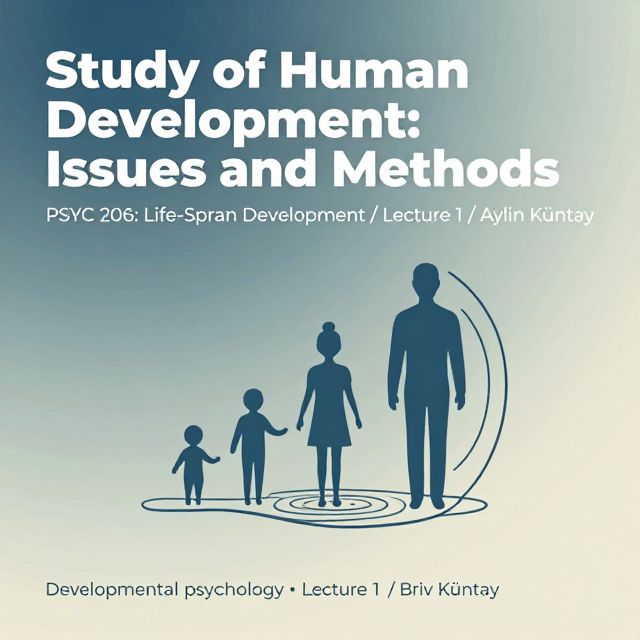
This study material has been compiled from a lecture audio transcript and accompanying PDF/PowerPoint texts for PSYC 206: Life-Span Development, Lecture 1, presented by Aylin Küntay.
📚 Understanding Human Development: Issues and Methods
🎯 Introduction to Developmental Psychology
Developmental psychology is a scientific field dedicated to understanding how and why humans change throughout their lifespan. It examines the intricate interplay between an individual and their environment, often summarized by the formula: B = f (S x O), where behavior (B) is a function (f) of a Subject's (S) interaction with outer Objects (O), representing the environment.
✅ Key Aspects of Development:
- Regular and Relatively Permanent Changes: Development involves consistent and lasting transformations in the interaction between the subject and their environment.
- Multidimensional Changes: These changes occur across three primary domains:
- Biological: Physical growth, motor skills, brain development.
- Cognitive: Thinking, memory, problem-solving, language.
- Psychosocial (Socioemotional): Emotions, personality, social relationships.
💡 Purpose of Developmental Psychology: This field not only describes the sequence of biological, cognitive, and socioemotional changes but also investigates the underlying processes that lead to age-related changes and transitions. The knowledge gained is highly practical, applied in areas such as:
- Designing educational toys and digital media for children.
- Developing effective school curricula.
- Creating therapeutic methods for developmental psychopathology.
- Promoting healthy parenting practices.
🌳 Bronfenbrenner's Ecological Theory of Development
One of the most influential "big theories" in developmental psychology is Urie Bronfenbrenner's Ecological Theory. This framework emphasizes that human development is profoundly influenced by a series of interconnected environmental systems.
✅ Bronfenbrenner's Four Environmental Systems:
- Microsystem: 🏡
- The immediate settings where the individual lives and directly interacts.
- Includes family, school, peer groups, and neighborhood.
- Example: A child's direct interactions with parents, teachers, and friends.
- Mesosystem: 🤝
- The relations or connections between different microsystems.
- Highlights how experiences in one setting influence experiences in another.
- Example: The relationship between a child's home life and their school performance (e.g., parental involvement in school activities).
- Exosystem: 🏢
- Experiences in a setting where the individual does not have an active role but is still indirectly affected.
- Example: A parent's workplace policies or community resources that impact the family's well-being and, consequently, the child.
- Macrosystem: 🌍
- The broadest cultural context, encompassing the values, beliefs, customs, laws, and ideologies of the society in which the individual lives.
- These overarching cultural patterns influence all other systems.
- Example: Cultural norms about gender roles or socioeconomic status affecting educational opportunities.
🤔 Three Important Issues in Developmental Psychology
Developmental psychology grapples with several fundamental debates that shape how we understand human change.
1️⃣ Continuity vs. Discontinuity
This issue questions whether development is a smooth, gradual process or occurs in distinct, abrupt stages.
- Continuity of Development: 📈
- Views development as a gradual, cumulative change from conception to death.
- Often involves quantitative changes (changes in amount or degree).
- Example: Gradual growth in skull size, steady increase in vocabulary over time.
- Discontinuity of Development: 🪜
- Views development as involving distinct stages in the lifespan.
- Often involves qualitative changes (changes in kind or type).
- Example: The transition from crawling to walking, the emergence of social smiling, or the shift from single words to combining words into grammatical sentences.
2️⃣ Maturation and Experience (Nature vs. Nurture)
This classic debate explores the relative contributions of genetic inheritance and environmental influences on development.
- Nature: 🧬
- Refers to the biologically inherited and genetically determined capacities and constraints that affect development.
- Includes innate predispositions and biological maturation.
- Nurture: upbringing
- Encompasses all environmental influences on development.
- Includes family, peers, culture, education, and life experiences.
💡 The Challenge: The goal is not to take one side but to understand the complex relative contributions and intricate interaction between nature and nurture in shaping an individual's development.
3️⃣ Individual Differences
This issue focuses on what makes each person unique and how stable these unique characteristics are over time.
- Questions Explored:
- What factors contribute to individuals being physically and psychologically different from one another?
- To what extent are individual traits and characteristics stable across the lifespan?
- Example: Research by Kagan suggests that certain temperamental traits can show remarkable stability; for instance, shy babies may remain timid into adulthood, while outgoing babies tend to become more unconstrained adults.
🔬 Research Methods and Designs in Developmental Psychology
To investigate these complex issues, developmental psychologists employ various research methodologies.
📊 Data Collection Methods
- Self-Report: 📝
- Involves asking participants to report on their own behaviors, thoughts, and internal states through interviews or questionnaires.
- Limitations for Young Children: Only parental reports are typically feasible for very young children (e.g., for vocabulary development), but parents can be influenced by cultural expectations.
- Suitability: More appropriate for older children and adolescents who can accurately self-report.
- Naturalistic Observation: 🌳
- Studying behavior in real-world, natural settings without intervention.
- Historical Use: "Baby biographies" (diaries recording observations of children) were historically used, though now rare outside of language development studies where they remain crucial.
- Ethology: Very important in the study of ethology, which examines the biological foundations of behavior in natural environments.
- Experiments: 🧪
- The researcher systematically manipulates one variable (independent variable) and observes its effect on other variables (dependent variables).
- Example: The fear of heights experiment by Campos & Barrett disproved the idea that fear of heights is an innate predisposition, instead isolating locomotion as a causal factor in its development.
- ⚠️ Ethics: Special care and ethical considerations are paramount when conducting experiments, especially with children, to ensure their safety and well-being.
📈 Research Designs
Developmental psychologists use specific designs to track changes over time:
- Cross-sectional Design: Compares different age groups at a single point in time.
- Longitudinal Design: Studies the same group of individuals over an extended period.
- Cross-sequential Design: Combines elements of both cross-sectional and longitudinal designs, studying multiple age groups over time.