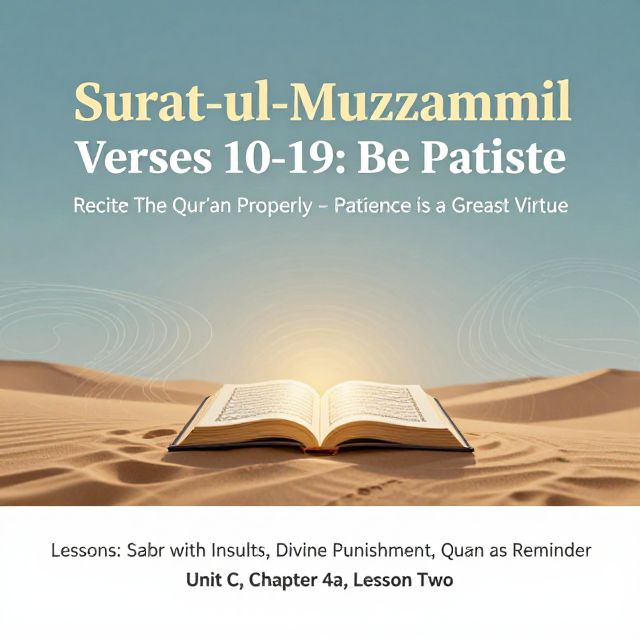
Surat-ul-Muzzammil: Patience, Punishment, and Reminder - kapak
Eğitim#quran#islam#surat al-muzzammil#patience

Surat-ul-Muzzammil: Patience, Punishment, and Reminder

Explore Surat-ul-Muzzammil verses 10-19, focusing on the virtues of patience, divine justice for disbelievers, the terrifying Day of Judgment, and the Qur'an's role as a profound reminder.

mysterieuxApril 10, 2026 ~15 dk toplam
01

Flash Kartlar

25 kart

Karta tıklayarak çevir. ← → ile gez, ⎵ ile çevir.

1 / 25
Tüm kartları metin olarak gör
  1. 1. What is the meaning of "Surat-ul-Muzzammil"?

    Surat-ul-Muzzammil translates to "Wrapped in Clothing." This name refers to the Prophet Muhammad, peace be upon him, who was initially found wrapped in his clothing when the first verses of the Surah were revealed. The Surah provides guidance and solace to him during a challenging period.

  2. 2. What was the historical context for the revelation of Surat-ul-Muzzammil, verses 10-19?

    These verses were revealed during a challenging time for Prophet Muhammad, peace be upon him, when he faced significant opposition and insults from disbelievers in Makkah. They offered him guidance, solace, and reassurance amidst the adversity he encountered, emphasizing steadfastness in faith.

  3. 3. What are the main themes conveyed in Surat-ul-Muzzammil, verses 10-19?

    The main themes conveyed are patience, divine justice, and the ultimate accountability on the Day of Judgment. These verses emphasize the importance of steadfastness in faith and warn about the severe consequences awaiting those who reject divine guidance, serving as a crucial reminder for believers.

  4. 4. What is the primary directive given to the Prophet Muhammad in Ayah 10 of Surat-ul-Muzzammil?

    In Ayah 10, the Prophet is instructed to "be patient when the disbelievers say hurtful things about you and wisely stay away from them." This command highlights the importance of maintaining composure and avoiding confrontation when it serves no constructive purpose, focusing instead on one's mission.

  5. 5. What fundamental principle does Ayah 10 of Surat-ul-Muzzammil teach about dealing with adversity?

    Ayah 10 teaches the fundamental principle of maintaining composure and avoiding confrontation when faced with adversity and insults, especially when such confrontation would not lead to a constructive outcome. It emphasizes patience (sabr) and wisdom in disengaging from harmful interactions, rather than succumbing to anger or despair.

  6. 6. What promise does Allah make regarding the wealthy disbelievers in Ayah 11?

    In Ayah 11, Allah promises to personally deal with the wealthy disbelievers. He grants them a temporary reprieve, but assures that their inevitable reckoning will come. This serves as a reassurance to believers that justice will ultimately prevail, and they should not despair over the apparent prosperity of wrongdoers.

  7. 7. How do Ayahs 12 and 13 describe the punishment awaiting disbelievers in the afterlife?

    Ayahs 12 and 13 vividly describe a grim reality for disbelievers, speaking of "chains to tie them and a raging Hell to punish them in." Additionally, they will face "food that sticks in the throat and lots of other painful punishment," designed to instill deep fear and caution against rejecting the truth.

  8. 8. What is the purpose of the vivid descriptions of punishment in Ayahs 12 and 13?

    The purpose of these vivid descriptions is to instill a deep sense of fear and caution against rejecting the truth. They serve as a stark warning about the severe consequences of disbelief and disobedience to divine guidance, encouraging adherence to the righteous path and emphasizing the gravity of one's choices.

  9. 9. How does Ayah 14 describe the events of the Day of Judgment?

    Ayah 14 paints a picture of cosmic upheaval, stating that "the Earth and the mountains will shake and the mountains will be like a pile of fine sand." This imagery underscores the immense power of Allah and the utter destruction that will precede the final judgment, highlighting its transformative nature.

  10. 10. What does the imagery of the Earth and mountains shaking in Ayah 14 signify?

    This imagery signifies the immense power of Allah and the utter destruction that will precede the final judgment. It emphasizes the overwhelming and transformative nature of the Day of Judgment, highlighting that nothing will remain as it was before and all creation will be humbled before divine might.

  11. 11. Which historical figure is mentioned in Ayahs 15 and 16 as a parallel to the disbelievers of Makkah?

    Ayahs 15 and 16 draw a parallel between the disbelievers of Makkah and Pharaoh. Just as Pharaoh disobeyed the messenger sent to him and was severely destroyed by drowning, these verses warn the Makkah disbelievers of a similar, if not greater, fate due to their disobedience and rejection of Prophet Muhammad.

  12. 12. What lesson is conveyed by the example of Pharaoh in Ayahs 15 and 16?

    The example of Pharaoh serves as a stark reminder of divine retribution. It conveys that disobedience to divine messengers leads to severe consequences, warning the disbelievers of Makkah that their rejection of Prophet Muhammad will result in a similar, if not greater, punishment. This historical example underscores the certainty of divine justice.

  13. 13. How do Ayahs 17 and 18 emphasize the horror of the Day of Judgment?

    Ayahs 17 and 18 emphasize the horror by asking, "how will you save yourselves from a scary day that would turn the hair of children white from terror?" It further states that "the sky will be torn during that day," portraying an event of unimaginable magnitude and fear that transcends human comprehension.

  14. 14. What is the ultimate promise of Allah mentioned in Ayah 18 regarding the Day of Judgment?

    Ayah 18 states that "Allah's promise to bring you back from the dead for judgment will happen." This emphasizes the certainty of resurrection and the final accountability, underscoring that the Day of Judgment is an inevitable event where everyone will face their deeds and be judged accordingly.

  15. 15. What is the concluding message and primary function of the Qur'an as stated in Ayah 19?

    Ayah 19 concludes by declaring, "This is just a reminder and warning. So whoever wants should take the path to his Lord by obeying Allah's Messengers." This highlights the Qur'an's primary function as a guide and a warning, offering humanity a clear choice between righteousness and dire consequences.

  16. 16. What choice does Ayah 19 offer to humanity?

    Ayah 19 offers humanity the choice to either heed the divine message and follow the righteous path by obeying Allah's Messengers, or to face the dire consequences of rejection. It emphasizes personal responsibility in choosing one's spiritual direction and underscores the importance of conscious decision-making in faith.

  17. 17. What is the first crucial lesson derived from these verses regarding personal conduct?

    The first crucial lesson is that "Patience is a Great Virtue" (Sabr). The Prophet Muhammad endured immense suffering and insults, yet Allah commanded him to show patience and wisely avoid contact with those who sought to harm him. This teaches us to maintain composure and focus on good work in the face of adversity.

  18. 18. How did Prophet Muhammad exemplify "sabr" according to the text?

    Prophet Muhammad exemplified "sabr" by enduring immense suffering and insults from the disbelievers of Makkah, who called him names like a liar or a magician. Despite feeling hurt, he was commanded by Allah to show patience and wisely avoid confrontation, focusing on his mission and not succumbing to anger.

  19. 19. What practical advice is given regarding "sabr" when faced with hurtful words?

    When faced with hurtful words or actions, the practical advice is not to succumb to depression or lose one's temper. Instead, one should maintain focus on their good work, prevent distractions, and wisely and honorably avoid retaliating with similar evil actions. This demonstrates strength of character and adherence to divine guidance.

  20. 20. What is the second crucial lesson learned from these verses about divine justice?

    The second crucial lesson is that "Allah Punishes the Evil People." While Allah desires guidance for all, those who reject Islam and actively fight against His messengers will face divine retribution. This demonstrates Allah's justice and the certainty of His promises, reassuring believers that wrongdoing will not go unpunished.

  21. 21. How was Allah's promise to punish evil individuals fulfilled historically, according to the text?

    Allah's promise to punish evil individuals was historically fulfilled during the Battle of Badr. A few years after these verses were revealed, many of the evil leaders of the Quraysh who had rejected Islam and fought the Prophet were killed, confirming the divine warning and demonstrating Allah's swift justice.

  22. 22. What did A'ishah, may Allah be pleased with her, recount regarding the timing of Allah's promise?

    A'ishah, may Allah be pleased with her, recounted that "After Allah revealed this verse 'leave to me those disbelievers...' it was only a short time until the Battle of Badr." This highlights the swiftness and certainty of Allah's divine promise and justice, showing how quickly divine warnings can manifest.

  23. 23. What is the third crucial lesson emphasized by these verses regarding the Qur'an?

    The third crucial lesson is that "Al-Qur'an is a Great Reminder." Ayah 19 explicitly describes it as such. It consistently reminds believers to cultivate strong faith, perform good deeds, and embody a pious character, guiding them towards spiritual growth and noble personalities.

  24. 24. How does the Qur'an function as a "Great Reminder" in a believer's life?

    The Qur'an functions as a "Great Reminder" by consistently prompting believers to cultivate strong faith, perform good deeds, and embody a pious character. Regular recitation and acting upon its teachings help individuals evolve into better people and develop noble personalities, providing invaluable guidance and spiritual nourishment.

  25. 25. What is the consequence of abandoning the Qur'an and neglecting its regular recitation?

    Abandoning the Qur'an and neglecting its regular recitation will inevitably deprive individuals of its invaluable reminders and guidance. This can lead to a weakening of faith, a decline in good deeds, and a loss of the spiritual direction it provides, hindering personal and moral development.

02

Bilgini Test Et

15 soru

Çoktan seçmeli sorularla öğrendiklerini ölç. Cevap + açıklama.

Soru 1 / 15Skor: 0

What is the meaning of 'Surat-ul-Muzzammil'?

03

Detaylı Özet

5 dk okuma

Tüm konuyu derinlemesine, başlık başlık.

This study material has been compiled from a copy-pasted text and a lecture audio transcript.


Surat-ul-Muzzammil (Chapter 73), Verses 10-19: Patience, Justice, and Divine Guidance

Introduction

Surat-ul-Muzzammil, meaning "Wrapped in Clothing," is the 73rd chapter of the Qur'an. Verses 10-19 of this Surah deliver profound messages concerning patience, divine justice, and the ultimate accountability on the Day of Judgment. These verses were revealed during a challenging period for Prophet Muhammad (peace be upon him), offering guidance and solace amidst the intense opposition he faced from the disbelievers in Makkah. This segment of the Qur'an serves as a crucial reminder for believers, emphasizing the importance of steadfastness in faith and the severe consequences awaiting those who reject divine guidance.

I. Understood Meaning of Verses (73:10-19) 📚

These verses provide direct instructions and warnings:

  • 73:10 ✅ And be patient when the disbelievers say hurtful things about you and wisely stay away from them (when they do this).
  • 73:11 ✅ And leave to Me those wealthy disbelievers; let them have a little more time.
  • 73:12 ✅ We have chains to tie them and a raging Hell to punish them in,
  • 73:13 ✅ And food that sticks in the throat and lots of other painful punishment.
  • 73:14 ✅ [This punishment comes] on the day when the Earth and the mountains will shake and the mountains will be like a pile of fine sand.
  • 73:15 ✅ [You disbelievers] I have sent you a messenger to be a witness against you (on that day). He is sent to you like I sent to Pharaoh another messenger.
  • 73:16 ✅ Pharaoh disobeyed his messenger, [like you are disobeying your messenger], so I destroyed him in a severe way [by drowning him and his supporters].
  • 73:17 ✅ So how will you save yourselves from a scary day that would turn the hair of children white from terror?
  • 73:18 ✅ The sky will be torn during that day and Allah's promise to bring you back from the dead for judgment will happen.
  • 73:19 ✅ This is just a reminder and warning. So whoever wants should take the path to his Lord [by obeying Allah's Messengers].

II. Key Lessons from Surat-ul-Muzzammil (73:10-19)

These verses impart timeless lessons crucial for a believer's life:

A. Patience (Sabr) is a Great Virtue 🧘

The Prophet Muhammad (peace be upon him) endured immense suffering and insults from the disbelievers of Makkah. They called him a liar, a fortune teller, and a magician, causing him great hurt and insult. Immediately, Allah commanded him to show sabr, or patience, and to wisely avoid contact with those who sought to harm him.

  • Dealing with Adversity: This teaches us that when faced with hurtful words or actions from evil people, we must not succumb to depression or lose our temper.
  • Focus on Good: Instead, our focus should remain on the good work we are doing, preventing distractions from negative influences.
  • Prophetic Trait: Sabr is a noble characteristic shared by all Prophets, and Allah taught them to employ it during times of distress. It is a fundamental principle for maintaining composure and avoiding unproductive confrontations.

B. Divine Justice: Allah Punishes the Evil ⚖️

While Allah desires all disbelievers to be guided to the straight path, and Prophet Muhammad exerted his utmost effort to convey the message of the Qur'an to the Quraysh, they rejected Islam and actively fought against him and his followers. They even attempted to assassinate him.

  • Promise of Retribution: Consequently, Allah informed Prophet Muhammad that He would punish these evil individuals in Hellfire. This serves as a reassurance that justice will ultimately prevail, and believers should not despair over the apparent prosperity of wrongdoers.
  • Historical Fulfillment: This warning was not merely theoretical. A few years later, during the Battle of Badr, many of the evil leaders of the Quraysh were indeed killed, fulfilling this divine promise. A'ishah (may Allah be pleased with her) recounted, "After Allah revealed this verse 'leave to me those disbelievers...' it was only a short time until the Battle of Badr." This demonstrates Allah's justice and the certainty of His promises.
  • Day of Judgment: The verses vividly describe the grim reality awaiting disbelievers in the afterlife, with "chains to tie them and a raging Hell to punish them in," along with "food that sticks in the throat and lots of other painful punishment." The Day of Judgment will be a terrifying event where "the Earth and the mountains will shake and the mountains will be like a pile of fine sand," and "the sky will be torn."

C. The Qur'an as a Great Reminder 💡

Ayah 19 explicitly describes the Qur'an as "a reminder." Its primary function is to guide and warn humanity.

  • Guidance for Life: It consistently reminds us to cultivate strong faith, perform good deeds, and embody a pious character.
  • Personal Development: The more we recite the Qur'an and diligently act upon its teachings, the more we evolve into better individuals and develop noble personalities.
  • Consequences of Neglect: Conversely, abandoning the Qur'an and neglecting its regular recitation will inevitably deprive us of its invaluable reminders and guidance, leading us away from the path to Allah.

III. Putting the Qur'an into Action 🚀

To integrate these profound lessons into daily life:

  • 1️⃣ Practice Sabr: Always practice patience (sabr) with others, especially when faced with negativity.
  • 2️⃣ Wise Avoidance: Whenever others insult you or hurt your feelings, avoid retaliating with the same evil actions. Instead, defend yourself by wisely and honorably avoiding such individuals or situations.
  • 3️⃣ Fear Allah: Always fear Allah and His punishment.
  • 4️⃣ Avoid Sins: Consciously avoid any actions that could lead you to Hellfire.

IV. Lesson Review Questions ❓

  1. What did Allah order Prophet Muhammad (peace be upon him) to do with those who insulted him?
  2. What did Allah prepare for the evil people in the next life? Describe the punishment they will suffer then.
  3. Describe what will happen on the Day of Judgment according to these verses.
  4. What special value did Allah mention about the Qur'an in Ayah 19, and how does this help us in our daily lives?
Kendi çalışma materyalini oluştur

PDF, YouTube videosu veya herhangi bir konuyu dakikalar içinde podcast, özet, flash kart ve quiz'e dönüştür. 1.000.000+ kullanıcı tercih ediyor.

Sıradaki Konular

Tümünü keşfet
Early Events of Seerah: The Life of Prophet Muhammad

Early Events of Seerah: The Life of Prophet Muhammad

This podcast explores the initial stages of Prophet Muhammad's life, the state of Arabia before Islam, his prophethood, migration to Madinah, and the pivotal early battles.

Özet 25 15
Mission Possible: Becoming a Hafith

Mission Possible: Becoming a Hafith

This podcast explores the profound importance of memorizing the entire Qur'an and outlines seven essential principles to guide you on this blessed journey.

25 15
The Peaceful March to Makkah: A Historical Overview

The Peaceful March to Makkah: A Historical Overview

Explore the significant journey of Prophet Muhammad and his companions to Makkah for Umrah, the challenges faced, and the pivotal Pledge of Ar-Ridwan.

Özet 25 15
Earth Systems and Resources Overview

Earth Systems and Resources Overview

An academic summary of Earth's physical systems, including plate tectonics, soil dynamics, atmospheric composition, global climate drivers, and oceanic phenomena like ENSO.

8 dk 15 Görsel
Introduction to Geography for KPSS Examination

Introduction to Geography for KPSS Examination

This summary provides a formal academic overview of introductory geography, covering its fundamental concepts, branches, and key principles relevant for the KPSS examination.

5 dk Özet 25 15 Görsel
Introduction to Geography for KPSS-MEB AGS 2026

Introduction to Geography for KPSS-MEB AGS 2026

This audio summary provides an academic overview of foundational geographical concepts relevant to the KPSS-MEB Field Knowledge Examination, specifically focusing on introductory geography principles.

5 dk Özet 25 15 Görsel
Introduction to Geography for KPSS-AGS Examination

Introduction to Geography for KPSS-AGS Examination

This summary provides an academic overview of foundational geographical concepts relevant to the KPSS-AGS examination for prospective geography teachers in Turkey, emphasizing key principles and their educational significance.

6 dk Özet 25 15
IELTS Academic Writing Task 1: A Beginner's Guide for 2026

IELTS Academic Writing Task 1: A Beginner's Guide for 2026

This summary provides a comprehensive guide for beginners approaching IELTS Academic Writing Task 1 in 2026, covering requirements, assessment criteria, and strategic preparation methods.

5 dk Özet 25 15 Görsel